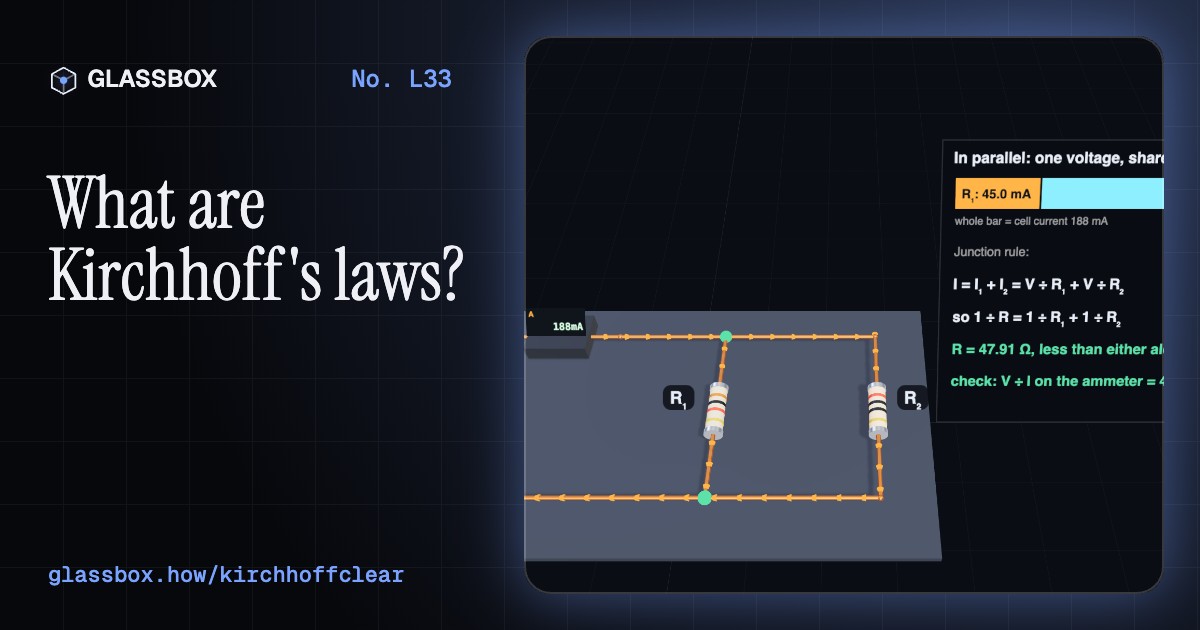
What are Kirchhoff's laws?
Two short rules written by a 21-year-old student in 1845 solve every circuit ever built: what flows into a junction flows out, and round any loop the voltages add to zero. Change any cell or resistor in a live 3D circuit and watch both sums stay at zero.
▶ Play with it · Read the 60-second explainer · Watch the 40-second video
- Two rules, two things that are conserved. Junction rule: at any joint, current in equals current out, because charge cannot pile up or vanish. Loop rule: round any closed loop, the voltage rises from cells equal the drops across resistors, because energy is conserved. Lift a circuit by its voltage and every loop ends at the height it began.
- Series and parallel are not new laws. In one loop the loop rule gives V − I R₁ − I R₂ = 0, so series resistors add and share the voltage: a voltage divider, the trick in a volume knob. At a junction I = V ÷ R₁ + V ÷ R₂, so parallel resistors share the current and always resist less than either alone.
- Your house is a ladder of parallel branches. Every appliance bridges live and neutral and gets nearly the full 230 V. Their currents add in the feed wire, which is why an MCB watches the total. A short circuit is just one more branch with almost no resistance: hundreds of amps.
- A balanced bridge and a hidden resistor. Two dividers side by side with a meter between their taps make a Wheatstone bridge. When the ratios match, the meter reads zero, which is how weighing scales sense tiny changes. And every cell hides an internal resistance, so its voltage sags as you draw current.
- A myth, and where the rules run out. Current does not take only the easiest path: it takes every path, in proportion to 1 ÷ R. The rules themselves assume a small, slow circuit. A changing magnetic field through a loop, or a wire that is a fair fraction of a wavelength long, breaks them.
| Term | Meaning |
|---|---|
| Junction rule | Kirchhoff's current law: the currents into any junction add up to the currents out of it, because charge is conserved. |
| Loop rule | Kirchhoff's voltage law: round any closed loop the voltage rises and drops add up to zero, because energy is conserved. |
| Voltage divider | Two resistors in series; the point between them sits at a fixed fraction of the supply voltage. |
| Parallel | Connected across the same two points: the same voltage on each branch, and the branch currents add. |
| Short circuit | An accidental branch with almost no resistance, so a very large current flows. |
| Wheatstone bridge | Two dividers with a meter between their taps; it reads zero when the two resistance ratios match. |
| Internal resistance | The resistance inside a cell, which makes its terminal voltage fall as more current is drawn. |
| Lumped circuit | A circuit much smaller than the wavelength of its signals, the condition under which Kirchhoff's rules hold. |
From Volta's pile to the simulators that check every chip: how two rules written by a student came to solve every circuit.
- 1800 · Volta's pile gives a steady current (Alessandro Volta, Como)
- 1827 · Ohm ties voltage, current and resistance together (Georg Simon Ohm, Cologne)
- 1833 · Christie's 'diamond' of four wires (Samuel Hunter Christie, London)
- 1843 · Wheatstone makes the bridge famous (Charles Wheatstone, London)
- 1845 · A student writes down two rules (Gustav Kirchhoff, Königsberg, Prussia (now Kaliningrad))
- 1853 · 3,500 miles of telegraph across India (William Brooke O'Shaughnessy, Calcutta)
- 1865 · Maxwell's fields explain why the rules work (James Clerk Maxwell, London)
- 1883 · Thévenin's equivalent circuit (Léon Charles Thévenin, Paris)
The full story, with 22 moments, charts, people and 23 sources: glassbox.how/e/kirchhoffclear/history. The data lives in history.json.
Made with the Glassbox studio from this box's storyboard (window.glassbox.director). Free to reuse under CC BY 4.0.
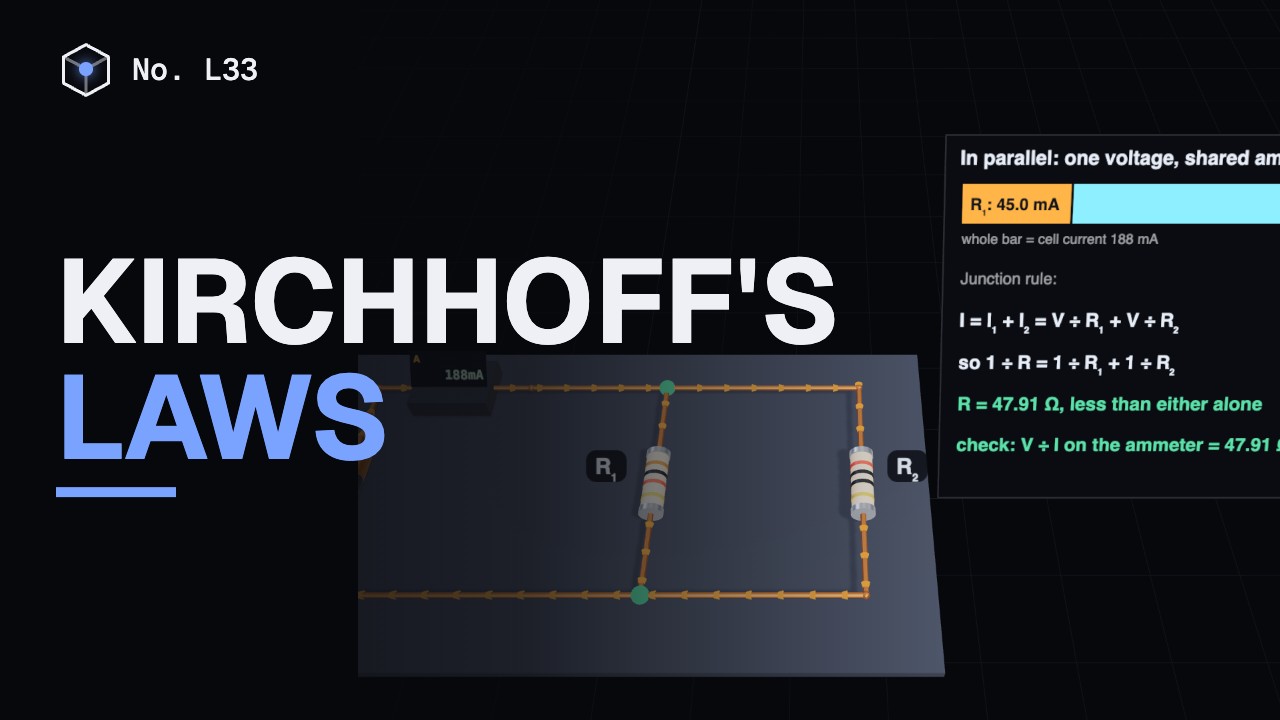


| File | What | Size |
|---|---|---|
glassbox/reel.mp4 |
Reel / Short, with captions and soundtrack | 1080×1920 |
glassbox/video.mp4 |
YouTube video, with captions and soundtrack | 1920×1080 |
glassbox/slide-1…10.jpg |
Instagram carousel | 1080×1350 |
glassbox/thumb.jpg |
YouTube thumbnail | 1280×720 |
glassbox/cover.jpg |
Share card and repo social preview | 1200×630 |
glassbox/history-reel.mp4 |
“History in 10 moments” Reel / Short | 1080×1920 |
glassbox/history-slide-*.jpg |
History carousel | 1080×1350 |
glassbox/post.json |
Post copy and schedule used by the publish kit |
This box has no accounts and no ads, and it ships its own fonts and libraries. When you run it yourself it sends nothing anywhere. On glassbox.how, the site's /bar.js also loads Glassbox's analytics: Google Analytics to count visits (it asks first in the EU, UK and Switzerland, and stays off when your browser sends Global Privacy Control or Do Not Track) and ClickTrust to detect bots.
It remembers a few things in your own browser only, and never sends them anywhere:
| Browser storage key | What it holds |
|---|---|
kirchhoffclear.v1 |
Which chapters you have opened, your best quiz scores, and sound on or off. |
Exactly what each one sees is at glassbox.how/privacy.
- Code: MIT. Use it, change it, ship it.
- Explanations, text, images and videos (
glassbox.json,glassbox/): CC BY 4.0. Credit “Glassbox, glassbox.how/e/kirchhoffclear”. - Third-party parts keep their own licences: three.js (MIT), Geist, Instrument Serif (SIL OFL 1.1).
- The Glassbox name and logo aren't covered by either licence. See the terms.
Found a mistake? Open an issue. Corrections happen in public.
It's plain HTML, CSS and JavaScript. No build step and no dependencies. Run locally, it contacts no other website.
python3 -m http.server 8000
Three.js and the fonts ship in vendor/ and fonts/, so it also works offline.
Then open http://localhost:8000.
| File | What |
|---|---|
index.html, css/app.css |
The page and its styles |
js/app.js, js/stage.js, js/ui.js, js/kit.js |
The shared Glassbox 3D engine: chapters, 3D stage, controls, quiz, video director |
js/chapters/*.js |
One file per chapter: the 3D model, controls, text, key terms, quiz and video scenes |
js/kirchhoff.js |
The circuit solver (modified nodal analysis), the rig that draws and animates any circuit from its netlist, meters, tags and chart boards |
glassbox.json |
Title, question, explainer beats, key terms, browser storage and credits shown on glassbox.how |
reel in each chapter |
The storyboard the Glassbox studio records into short videos |
glassbox/ |
The published video, slides, thumbnail and post copy |
fonts/, vendor/three/ |
Self-hosted Geist and Instrument Serif (SIL OFL 1.1) and three.js (MIT) |