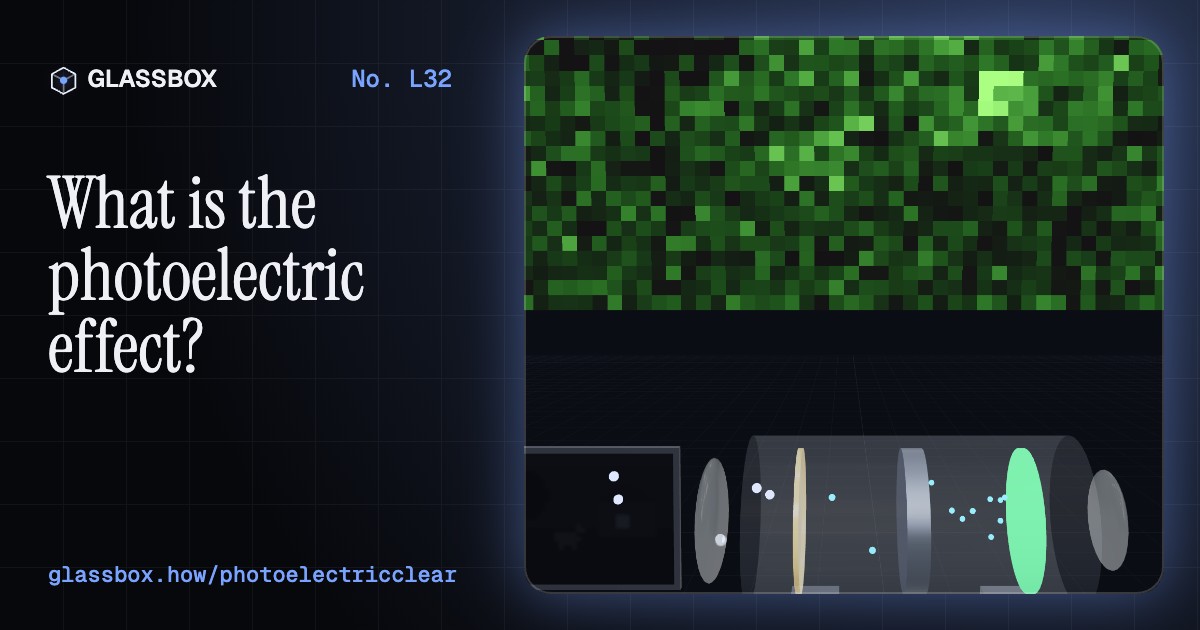
What is the photoelectric effect?
Shine red light on zinc and nothing happens, however bright. Shine a little ultraviolet and electrons fly out at once. Run the experiment that won Einstein his Nobel Prize, find Planck's constant from a straight line, then see the same idea inside night-vision goggles, lift doors, camera sensors and solar panels.
▶ Play with it · Read the 60-second explainer · Watch the 40-second video
- The experiment. Light on a clean metal plate in a vacuum knocks out electrons. Each photon carries E = hf; an electron spends the work function φ getting out and keeps at most hf − φ. Below the threshold frequency nothing comes out, however bright the light. Above it, brightness sets how many electrons and colour sets how fast. The stopping voltage rises in a straight line with frequency, with slope h ÷ e.
- Counting photons. A photomultiplier frees one electron per photon caught, then multiplies it 4 or 5 times at each of ten or so dynodes: a gain of millions. Dim light shows up as separate clicks. Night-vision goggles do the same across a whole picture with a microchannel plate, and the grain you see is single photons.
- Light as a switch. Inside a semiconductor a photon frees an electron without throwing it out: the internal photoelectric effect. The threshold is the band gap, 1.12 eV for silicon, so it sees infrared up to 1,107 nm. That runs lift-door beams and TV remotes. A street light's sensor is a strip whose resistance climbs as daylight fades.
- Solar cells and camera pixels. A solar cell uses the related photovoltaic effect: light frees electrons and holes inside silicon and a p–n junction steers them round a circuit. Photons below the gap pass through and spare energy becomes heat, leaving 44 % at best; real panels manage about 21 %. A camera pixel stores one electron per photon, with a random wobble of √N.
- Limits and a myth. A wave would need seconds or hours to free an electron in dim light; in fact it takes under 3 billionths of a second. Power counts photons, frequency decides what each can do: a 1,000 W microwave oven's photons cannot break one bond. Intense lasers bend the rule by delivering several photons at once.
| Term | Meaning |
|---|---|
| Photon | One packet of light, with energy E = h × f. Bluer light means more energetic photons. |
| Work function (φ) | The least energy needed to pull an electron out of a metal surface: 1.95 eV for caesium, about 4.3 eV for zinc. |
| Threshold frequency | The lowest frequency that can free electrons from a metal, f₀ = φ ÷ h. Below it, no brightness is enough. |
| Stopping voltage | The reverse voltage that just stops the fastest electrons. Plotted against frequency it is a straight line of slope h ÷ e. |
| Planck constant (h) | 6.626 × 10⁻³⁴ joule seconds: the number linking a photon's energy to its frequency. |
| Electronvolt (eV) | The energy an electron gains crossing one volt, 1.602 × 10⁻¹⁹ J. A photon's energy in eV is 1,240 divided by its wavelength in nm. |
| Band gap | The energy needed to free an electron inside a semiconductor: 1.12 eV for silicon. It is the threshold for photodiodes and solar cells. |
| Photovoltaic effect | Light producing a voltage inside a semiconductor junction, as in a solar cell. Related to the photoelectric effect, but no electron leaves the material. |
From a stray spark in Hertz's laboratory to Einstein's photons, and on to solar panels and camera chips.
- 1887 · A spark that liked ultraviolet (Heinrich Hertz, Karlsruhe)
- 1888 · A zinc plate loses its charge (Wilhelm Hallwachs, Leipzig)
- 1902 · Brightness does not make electrons faster (Philipp Lenard, Kiel)
- 1905 · Einstein's light quanta (Albert Einstein, Bern)
- 1916 · Millikan proves the line is straight (Robert Millikan, Chicago)
- 1922 · A Nobel Prize, but not for relativity (Albert Einstein, Stockholm)
- 1924 · Bose counts photons (Satyendra Nath Bose, Dacca (now Dhaka))
- 1928 · The Raman effect (C. V. Raman and K. S. Krishnan, Calcutta (Kolkata))
The full story, with 21 moments, charts, people and 32 sources: glassbox.how/e/photoelectricclear/history. The data lives in history.json.
Made with the Glassbox studio from this box's storyboard (window.glassbox.director). Free to reuse under CC BY 4.0.


| File | What | Size |
|---|---|---|
glassbox/reel.mp4 |
Reel / Short, with captions and soundtrack | 1080×1920 |
glassbox/video.mp4 |
YouTube video, with captions and soundtrack | 1920×1080 |
glassbox/slide-1…10.jpg |
Instagram carousel | 1080×1350 |
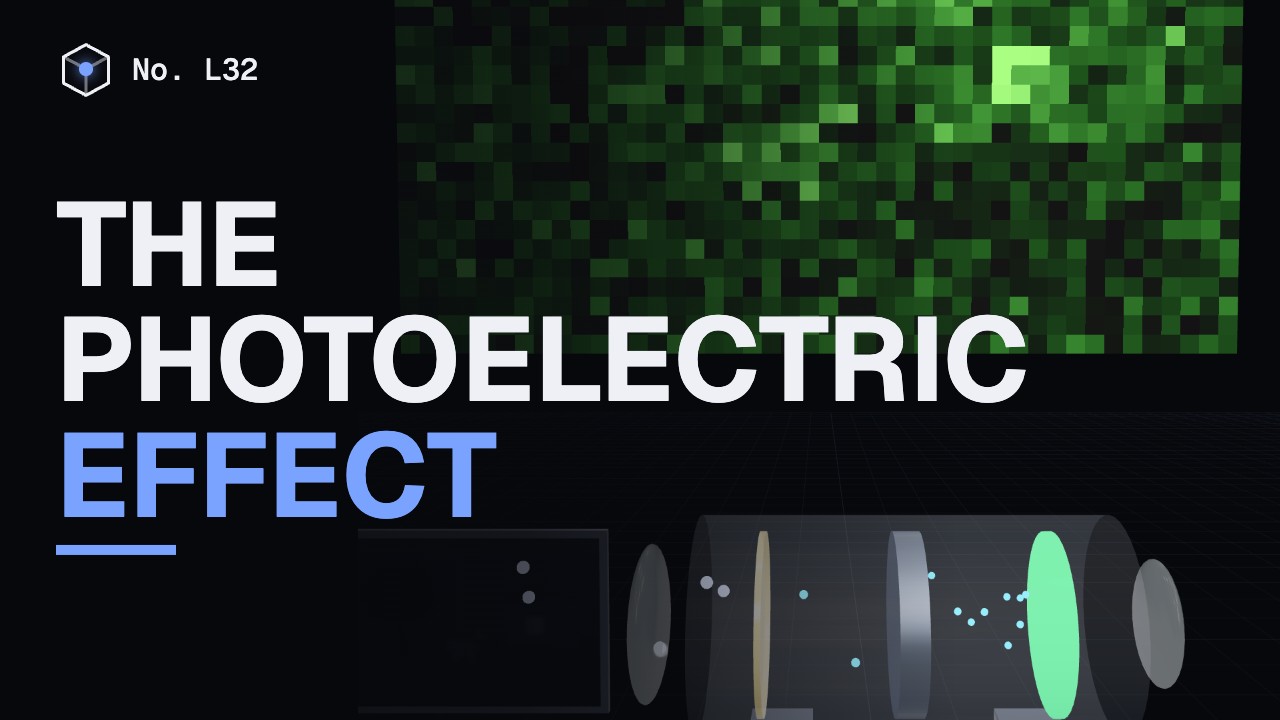
glassbox/thumb.jpg |
YouTube thumbnail | 1280×720 |
glassbox/cover.jpg |
Share card and repo social preview | 1200×630 |
glassbox/history-reel.mp4 |
“History in 10 moments” Reel / Short | 1080×1920 |
glassbox/history-slide-*.jpg |
History carousel | 1080×1350 |
glassbox/post.json |
Post copy and schedule used by the publish kit |
This box has no accounts and no ads, and it ships its own fonts and libraries. When you run it yourself it sends nothing anywhere. On glassbox.how, the site's /bar.js also loads Glassbox's analytics: Google Analytics to count visits (it asks first in the EU, UK and Switzerland, and stays off when your browser sends Global Privacy Control or Do Not Track) and ClickTrust to detect bots.
It remembers a few things in your own browser only, and never sends them anywhere:
| Browser storage key | What it holds |
|---|---|
photoelectricclear.v1 |
Which chapters you have opened, your best quiz scores, and sound on or off. |
Exactly what each one sees is at glassbox.how/privacy.
- Code: MIT. Use it, change it, ship it.
- Explanations, text, images and videos (
glassbox.json,glassbox/): CC BY 4.0. Credit “Glassbox, glassbox.how/e/photoelectricclear”. - Third-party parts keep their own licences: three.js (MIT), Geist, Instrument Serif (SIL OFL 1.1).
- The Glassbox name and logo aren't covered by either licence. See the terms.
Found a mistake? Open an issue. Corrections happen in public.
It's plain HTML, CSS and JavaScript. No build step and no dependencies. Run locally, it contacts no other website.
python3 -m http.server 8000
Three.js and the fonts ship in vendor/ and fonts/, so it also works offline.
Then open http://localhost:8000.
| File | What |
|---|---|
index.html, css/app.css |
The page and its styles |
js/photo.js |
Shared physics for this box: the photoelectric equation, work functions and band gaps, photon colours, chart boards and layout helpers |
js/app.js, js/stage.js, js/ui.js, js/kit.js |
The shared Glassbox 3D engine: chapters, 3D stage, controls, quiz, video director |
js/chapters/*.js |
One file per chapter: the 3D model, controls, text, key terms, quiz and video scenes |
glassbox.json |
Title, question, explainer beats, key terms, browser storage and credits shown on glassbox.how |
reel in each chapter |
The storyboard the Glassbox studio records into short videos |
glassbox/ |
The published video, slides, thumbnail and post copy |
fonts/, vendor/three/ |
Self-hosted Geist and Instrument Serif (SIL OFL 1.1) and three.js (MIT) |