Building Scalable Multi-Tenancy Authentication and Authorization using Open Standards and Open-Source Software: Keycloak, OpenFGA and Apache APISIX
A hands-on workshop for multi-tenant SaaS authorization with open standards and open-source software. Keycloak Organizations model the tenants. The keycloak-openfga-event-publisher extension publishes roles and organization membership to OpenFGA. Apache APISIX allows a request to a tenant's API only if the user has the role and belongs to that tenant.
The workshop is based on the article Building Scalable Multi-Tenancy Authentication and Authorization using Open Standards and Open-Source Software, which explains the architecture in detail.
Tip
Fine-grained authorization doesn't stop at users. AI agents need it too.
When an agent calls MCP tools on behalf of a user, the questions of this workshop come back, with more at stake: who is calling (the user, the agent, or both), what can they do (which tool, on which resource), and where is it enforced.
Agentic Security Labs: hands-on Docker labs that secure MCP tools with open standards, no custom protocols:
- MCP tool authorization: Agent Gateway is the Policy Enforcement Point (PEP) in front of the MCP server: it asks Keycloak to allow or deny each
tools/call, per tool and per user. - OpenID AuthZEN: the standard API between the PEP and the PDP, with Keycloak as the AuthZEN Policy Decision Point. Change the PDP without changing the gateway.
- Cedar policies in Keycloak: the Keycloak Cedar provider brings Cedar to Keycloak authorization: readable policy as code, RBAC and ABAC in one language, policies validated against a schema, and a formally verified engine.
Read more
- Implementing OpenID AuthZEN in Agent Gateway: MCP Tool Authorization
- Cedar Policy Engine in Keycloak: Fine-Grained Authorization for Users and AI Agents via AuthZEN
- AI Agents Require Runtime Authorization: Just In Time Passkey Approval for Sensitive Actions
- More on the blog: embesozzi.github.io · all links in More workshops, labs and articles

- Keycloak authenticates users with OpenID Connect. Its Organizations feature models the tenants (
org-a,org-b), and theorganizationscope adds the user's organizations to the tokens. - keycloak-openfga-event-publisher (3.2.0) listens to Keycloak admin events and publishes them to OpenFGA:
- role assignments and composite roles:
user:<id> assignee role:<name>,role:<parent> parent role:<child>, - organization membership:
user:<id> member organization:<alias>.
- role assignments and composite roles:
- OpenFGA answers the checks against the authorization model.
- Apache APISIX with the authz-openfga plugin protects each tenant route with several checks combined with
AND(orOR), see apisix/routes.yaml. - PayPlus portal: a Vue app that signs users in with Keycloak and shows the transactions of their organization.
Authorization model
model
  schema 1.1
type client
type group
  relations
    define assignee: [user, client]
type organization
  relations
    define member: [user]
type role
  relations
    define assignee: [user, client] or assignee from parent or assignee from parent_group
    define parent: [role]
    define parent_group: [group]
type user
Tenant route: role AND organization
- uris: ["/api/org-a/transactions"]
  plugins:
    authz-openfga:
      check:
        condition: AND
        tuples:
        - user_id: claim::sub
          relation: assignee
          object_type: role
          object_id: view_transaction_any
        - user_id: claim::sub
          relation: member
          object_type: organization
          object_id: org-a
Requires Git, Docker with Docker Compose, and make. The workshop uses the host ports 4000, 8080, 8081 and 9080, the same as keycloak-openfga-workshop: run one workshop at a time.
| Component | Version |
|---|---|
| Keycloak | 26.8.2 |
| keycloak-openfga-event-publisher | 3.2.0 |
| OpenFGA | v1.23.0 |
Versions are set in .env.
1. Clone the repository
git clone https://github.com/embesozzi/keycloak-openfga-multitenancy-workshop
cd keycloak-openfga-multitenancy-workshop
2. Add the workshop hosts to your hosts file (/etc/hosts)
127.0.0.1 payplus.lab keycloak openfga
3. Start the workshop
make up # or: docker compose up -d --buildRun make to list all targets (up, down, restart, logs, test, clean). This builds Keycloak with the extension (keycloak/Dockerfile downloads release 3.2.0 and checks its checksum), creates the keycloak store and the model in OpenFGA, and creates the PayPlus realm with its organizations, roles and users (keycloak/init.sh). The extension publishes them to OpenFGA.
4. Open the workshop
| Component | URL | Credentials |
|---|---|---|
| PayPlus portal | http://payplus.lab:4000 | paula.smith / demo1234! |
| Keycloak Admin Console | http://keycloak:8081/admin | admin / password |
| OpenFGA API | http://localhost:8080 | |
| Apache APISIX | http://localhost:9080 |
5. Stop the workshop
make down # or: docker compose down -v- Organizations enabled, with
org-a(domainorga.com) andorg-b(domainorgb.com). - Roles:
account-manager, a composite ofview_transaction_any. - User
paula.smith(passworddemo1234!): hasaccount-managerand is a member oforg-a. - The
openfga-events-publisherevent listener is enabled.
After the import, the keycloak store has these tuples:
| User | Relation | Object |
|---|---|---|
role:account-manager |
parent |
role:view_transaction_any |
user:<paula's id> |
assignee |
role:account-manager |
user:<paula's id> |
member |
organization:org-a |
Users are identified by their Keycloak id (the sub claim) and organizations by their alias (a key of the organization claim).
Read the tuples
STORE_ID=$(curl -s http://localhost:8080/stores | jq -r '.stores[] | select(.name == "keycloak") | .id')
curl -s -X POST http://localhost:8080/stores/$STORE_ID/read -H 'content-type: application/json' -d '{}' \
  | jq -r '.tuples[].key | "\(.user) \(.relation) \(.object)"'
| User | Role | Organization | GET /api/org-a/transactions |
GET /api/org-b/transactions |
|---|---|---|---|---|
| Paula | account-manager |
org-a |
✅ | ❌ |
Use case 1: Paula views the transactions of her organization
-
Open the PayPlus portal and sign in with Keycloak as
paula.smith/demo1234!. -
The token's
organizationclaim holdsorg-a, so the portal callsGET /api/org-a/transactions. -
APISIX asks OpenFGA both questions: is Paula
assigneeofrole:view_transaction_any(throughaccount-manager), andmemberoforganization:org-a? Both are allowed, so APISIX returns the transactions.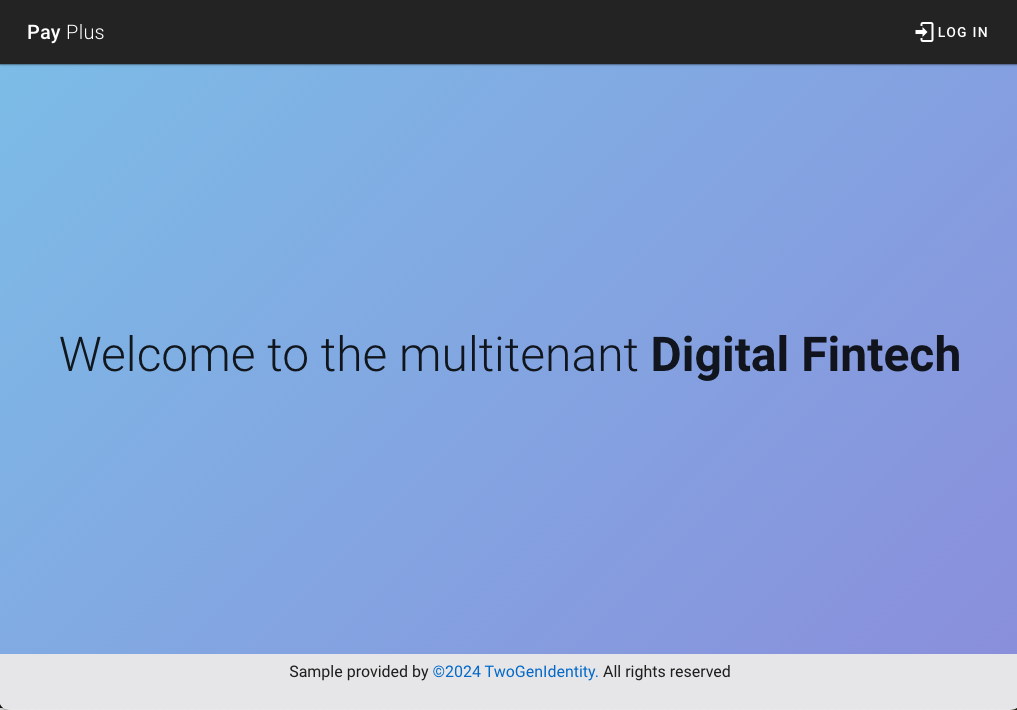

Use case 2: Paula cannot view the transactions of another organization
-
Call the API of
org-bwith Paula's token. -
Paula has the role, but she is not a member of
org-b, so theANDcheck fails and APISIX returns403.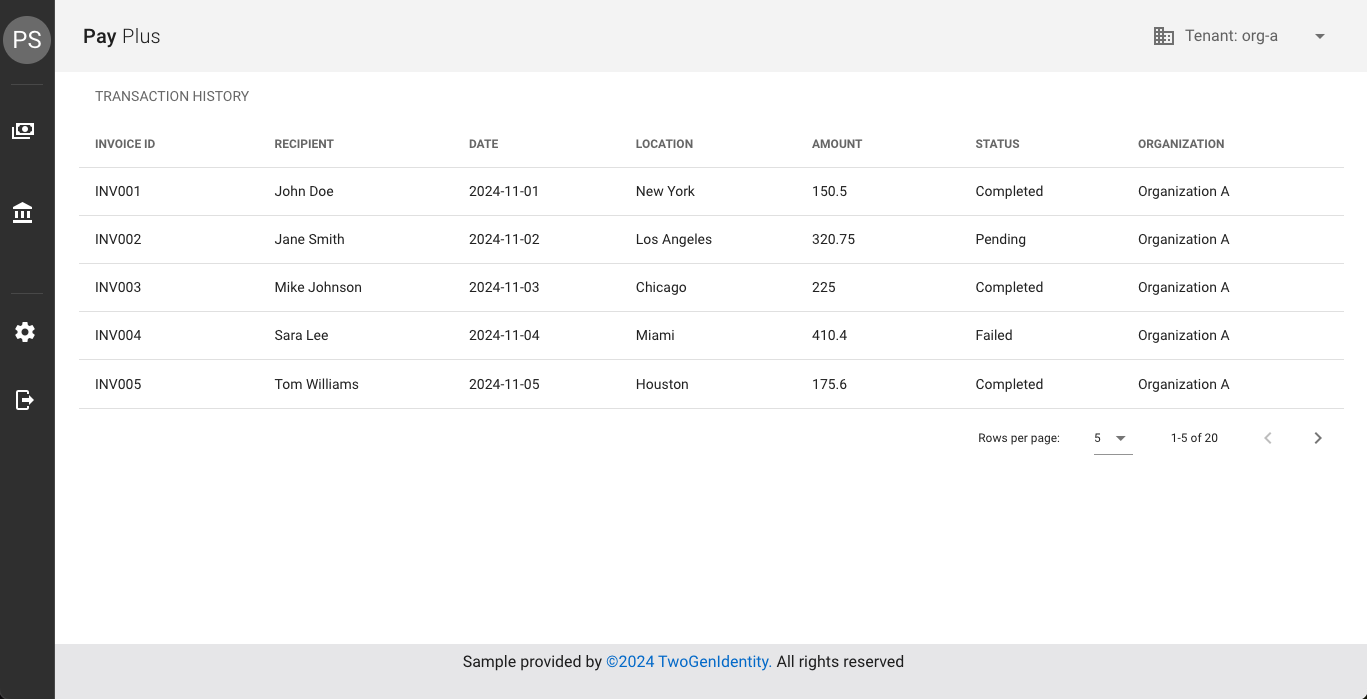

Try it: add Paula to org-b and watch OpenFGA follow
In the Admin Console, open org-b > Members > Add member > paula.smith. The extension publishes user:<paula's id> member organization:org-b, and GET /api/org-b/transactions is now allowed. Remove her and the extension deletes the tuple.
tests/test_workshop.py (pytest) checks the running workshop end to end: the tuples in OpenFGA, the organization claim in the token, and the tenant routes of APISIX. It runs in a container on the workshop network. CI runs it on every push and pull request.
make up
make test    # docker run --rm --network keycloak-openfga-multitenancy-workshop_default <tests image>
Warning
The import creates a smoke-test client with the password grant for the tests. Testing only, not recommended (RFC 9700).
Agentic AI security
- Agentic Security Labs: hands-on labs for securing AI agents and the MCP tools they call with open identity and authorization standards (Keycloak, OpenID AuthZEN, Cedar, Agent Gateway).
- Implementing OpenID AuthZEN in Agent Gateway: MCP Tool Authorization
- Cedar Policy Engine in Keycloak: Fine-Grained Authorization for Users and AI Agents via AuthZEN, with the Keycloak Cedar authorization provider
- Agentic AI Security: Protecting Interactive Keycloak MCP App with OpenID AuthZEN Gateway for FGA
- AI Agents Require Runtime Authorization: Just In Time Passkey Approval for Sensitive Actions
- Mastering Secure APIs and AI Agents with Zero Trust and Fine-Grained Authorization Based on OpenID AuthZEN
Keycloak and OpenFGA
- keycloak-openfga-workshop: the first workshop, ReBAC for a product catalog with protection at the API and at the gateway
- Building Scalable Multi-Tenancy Authentication and Authorization using Open Standards and Open-Source Software
- keycloak-openfga-event-publisher: the Keycloak extension used in this workshop (organization support since 3.2.0)
- apisix-authz-openfga: the APISIX plugin behind the tenant routes
- Keycloak integration with OpenFGA (based on Zanzibar) for Fine-Grained Authorization at Scale (ReBAC)
- Mastering Access Control: Implementing Low-Code Authorization Based on ReBAC and Decoupling Pattern
More
- Blog: embesozzi.github.io: posts on IAM, passkeys and AI agent security
- Book: Keycloak: Identity and Access Management for Modern Applications, 2nd Edition