Thousands of exoplanets have been discovered, most of them not so far from the Sun considering the galactic scale. This distribution is mostly because the methods used for detection can more easily detect exoplanets close to us or exoplanets with certain characteristics, not because all exoplanets are really distributed close to us. Curious about what area of our Galaxy we were able to map for exoplanets, I made this interactive visualization. You may see that, until now, we just mapped a very small region of our Galaxy.
There have been 6451 exoplanets discovered around 4847 stars. But only 4819 of those stars have had their distances to us determined, totaling 6423 exoplanets in the visualization.
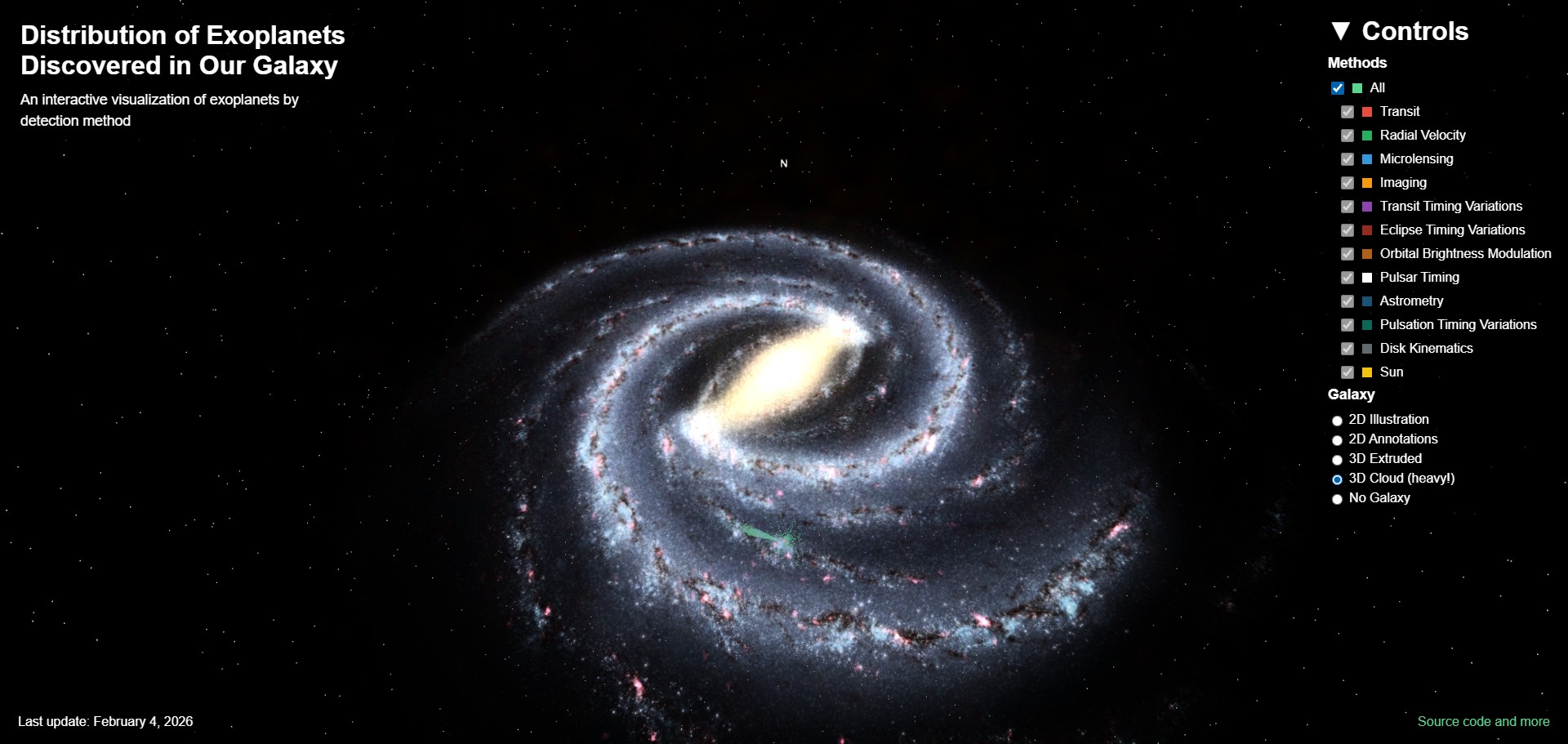
Access the interactive visualization in your browser going here or clicking on the image below.
Also, the files are being update monthly with the newly discovered exoplanets in the exoplanet archive.
Date of the last (automatic) update: 2026-11-01

├──.github/
│  └──workflows/
│         update.yml               # Github actions to automatize deployments
├──data/                           # Where all the data donwloaded, reduced and transformed is stored
├──images/                         # Where the image assets used or created are stored
├──data_transformer.py             # Transforms the data to the format and coordinates to be used
├──exoplanets_in_the_galaxy_3d.nb  # The original notebook. Creates transparent asset image
├──exoplanet_data.py               # Connects to the API to donwload exoplanet data
├──favicon.ico
├──flat_maps.py                    # Makes simples face-on and edge-on maps of the exoplanets in the galaxy
├──index.html                      # The static page
├──LICENSE
├──README.md
└──requirements.txt
Run exoplanet_data.py to retrieve data from https://exoplanetarchive.ipac.caltech.edu and build (or update) Exoplanets_coordinates.txt and exoplanets_coordinates_methods.txt with distance, position, and method of detection of every exoplanet (with estimated distance to us) discovered till now.
Run flat_maps.py to retrieve data from exoplanets_coordinates.txt and Artist's_impression_of_the_Milky_Way_gna_small.jpg to make MW_fo_dots.jpg, 2D map of the distribution of exaplanets discovered in our Galaxy.

It also retrieves data from exoplanets_coordinates_l_b.txt and Milky_Way_edge_on.jpg to make MW_eo_dots.jpg, another 2D map of the distribution of exaplanets discovered in our Galaxy.

Run data_transformer.py to retrieve data from exoplanets_coordinates.txt and exoplanets_coordinates_methods.txt and transform the data to JSON format in exoplanets_coordinates.json and exoplanets_coordinates_methods.json. This is used in the interactive visualization.
The images MW_transparent.png and MW_transparent_small.png may already be present. If not, you need to run exoplanets_in_the_galaxy_3d.nb (Mathematica notebook) to create them and have a 3D visualization of the exoplanets.
Now, to access the interactive visualization locally in your browser, you need to run index.html locally.
In your computer, open a terminal window and go to the project folder:
cd C:\Git\exoplanets-in-the-galaxy-3dCreate a server:
python -m http.server 8000In your browser, go to:
http://127.0.0.1:8000/Later, close the server in the terminal pressing "Ctrl+C" in it.
The Illustration of our Galaxy comes from here. The annotated version can be found here. The edge on picture of our Galaxy comes from here. The extruded galaxy is built from a low-resolution black-and-white (also in the folder images) version of the illustration, where the height of the mesh is set in function of how bright a pixel is in the image.
https://exoplanetarchive.ipac.caltech.edu/docs/TAP/usingTAP.html
https://exoplanetarchive.ipac.caltech.edu/docs/API_PS_columns.html