This project evaluates four architectures for short-term steering prediction: a baseline CNN inspired by NVIDIA’s PilotNet, an enhanced CNN with more temporal steering history, a MobileNetV2-based CNN, and an RNN with ConvLSTM. All models performed similarly, with RNN demonstrating the highest accuracy (MAE 0.57°).
Caution
The report is written based on the result of the previous version of the project. After the report is written, we did more training with larger dataset, more epochs, and more improved training process out of our curiosity. Some of the latest results does not match exactly with the results in the report. However, the overall conclusions remain the same.
SteerNet/
├── ECE1508_Project_Report.pdf # report for this project
├── data/ # original dataset
├── data_synced/ # dataset after syncing the sensor data with video frames
├── model_checkpoints/ # all model trained in this project will be saved here as .pth files
├── deprecated/ # deprecated files
├── aria2c.exe # aria2c executable used for downloading the dataset on windows
├── download_dataset.py # dataset download script
├── data_prep_v2.py # data preparation script
├── requirements.txt # all dependencies for this project
├── README.md # this file
├── v4_CNN_framerate_test.ipynb # framerate test for v4_CNN
├── v4_CNN_MobileNetV2.ipynb
├── v4_CNN.ipynb
├── v4_CNN2.ipynb
├── v4_RNN.ipynb
├── v4_RNN_GRU.ipynb
├── results/ # all results diagrams for this project will be saved here
-
For Windows:
-
Open a terminal/command prompt in the root folder of this project
-
Run this command to download the full dataset (94.62GB):
.\aria2c.exe --dir="data/" --seed-time=0 --continue=true "https://academictorrents.com/download/65a2fbc964078aff62076ff4e103f18b951c5ddb.torrent"
- To download selected chunks (about 9GB each), add
--select-file=1(for first chunk),--select-file=2(for second chunk), etc.:
.\aria2c.exe --dir="data/" --select-file=1 --seed-time=0 --continue=true "https://academictorrents.com/download/65a2fbc964078aff62076ff4e103f18b951c5ddb.torrent"
- None important part (this is just what nerds do)
.\aria2c.exe --dir="E:\SteerNet\data" --select-file=2 --seed-time=0 --file-allocation=falloc --max-connection-per-server=16 --split=16 --min-split-size=1M --max-concurrent-downloads=64 --max-overall-download-limit=0 --max-download-limit=0 --disable-ipv6=true --bt-max-peers=500 --bt-request-peer-speed-limit=0 --max-overall-upload-limit=1K --async-dns=true --summary-interval=1 --disk-cache=128M --enable-mmap=true --optimize-concurrent-downloads=true --bt-tracker="http://academictorrents.com:6969/announce,udp://tracker.opentrackr.org:1337/announce,udp://9.rarbg.com:2810/announce,udp://tracker.openbittorrent.com:6969/announce,udp://tracker.torrent.eu.org:451/announce,udp://exodus.desync.com:6969/announce,udp://tracker.torrent.eu.org:451/announce,udp://tracker.moeking.me:6969/announce,udp://tracker.opentrackr.org:1337/announce,udp://open.stealth.si:80/announce,udp://movies.zsw.ca:6969/announce" --bt-enable-lpd=true --enable-peer-exchange=true --follow-torrent=mem --continue=true --console-log-level=notice "https://academictorrents.com/download/65a2fbc964078aff62076ff4e103f18b951c5ddb.torrent"
-
-
For Mac: directly run the download_dataset.py to download the dataset
python download_dataset.py
Warning
Download speed will vary based on your internet connection and available seeders. Thus, it is best to download the few chunks than the full dataset.
pip install -r requirements.txt
The origianl dataset is video segments and CAN bus sensor data. However, the sensor log data is not at the same rate as the video frames, ie, we have much more sensor data than video frames. Since the input of the models is the video frames and the log data, we need to sync the sensor data with the video frames.
python data_prep_v2.py
Note
If you want to explore the frame rate vs model accuracy experiment as we did in the report, you can change the diresred frame rate in the data_prep_v2.py script.
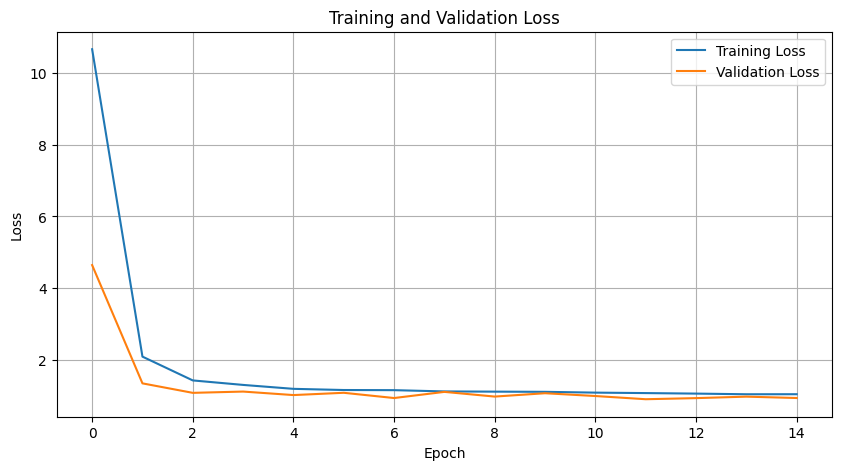
Model building/training/evaluation is done in Jupyter Notebook files named as models' names. In the training section, we plot the training status and loss diagrams.
- example of v4_CNN training results

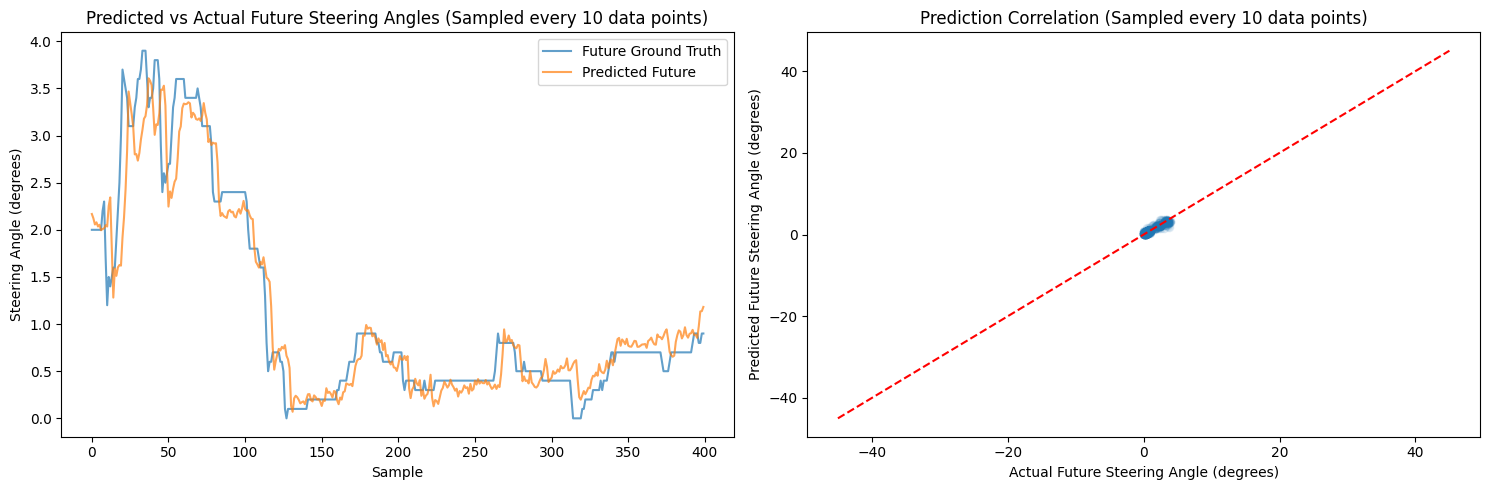
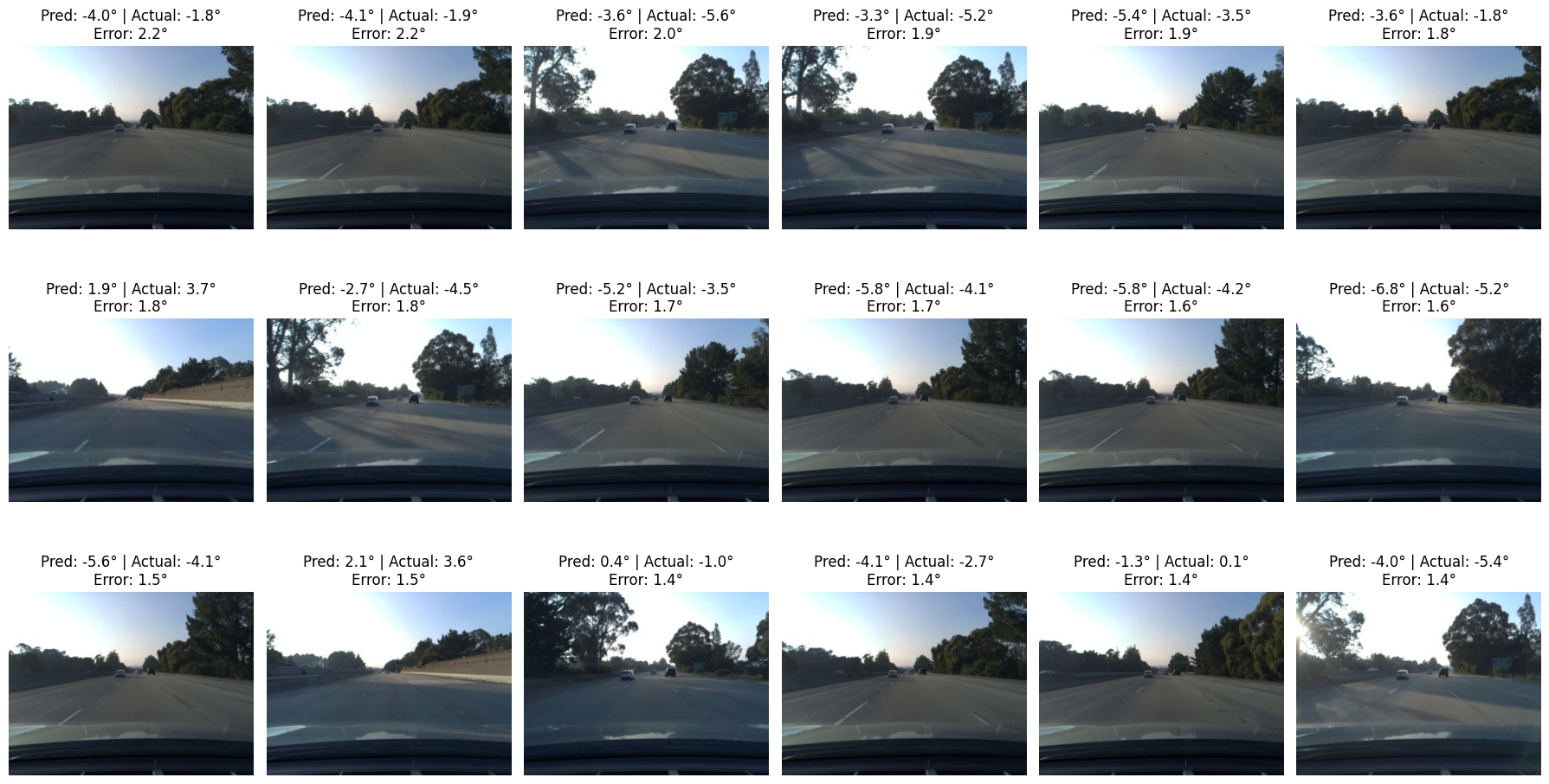
In the testing section, we plot the prediction vs ground truth diagram, correlation diagram, and some most wrong predictions with thier video frames so we can investigate what is the potential cause of the wrong predictions.
- example of v4_CNN testing results
- example of wrong predictions


The framerate experiment result is updated compared to the report. The new result is generate with more well designed experiment setup. The result shows that the framerate is not ralated to the model's performance. ie, using 1 fps frame rate as input and 10 fps frame rate as input will get the similar performance from the model. Even though the result changes, but this experiment is still significant due to the same reason as we inlcude in the presentation and report.
As trainings involving images are perticularly time consuming and computing power intensive, knowing that using fewer frames will get similar performance from model is effectivly reducing the training time and increasing the efficiency of the training process

The RNN performance is the best but all model performan at the same level. All models are able to predict the steering angle with decent accuracy. ie, the model knows how, when, and even how much to steer. However, the model's driving style is not matching the ground truth (the human driver's style) exactly, which is not really a problem based on the accuracy shown in the result.
- CNN
- CNN version 2
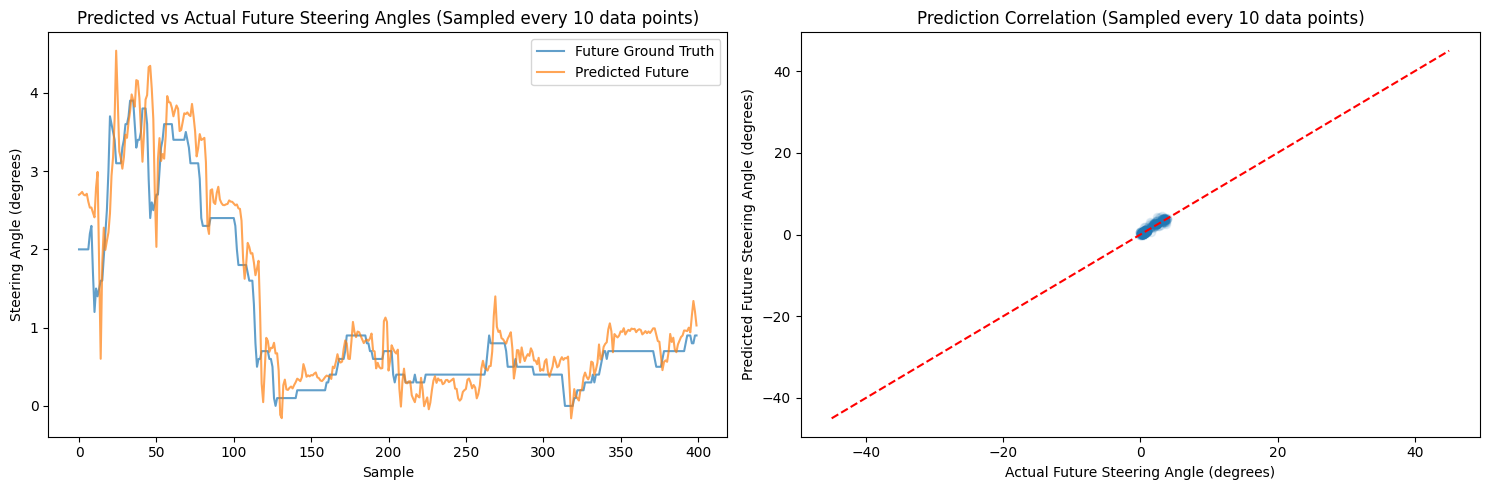
- CNN MobileNetV2
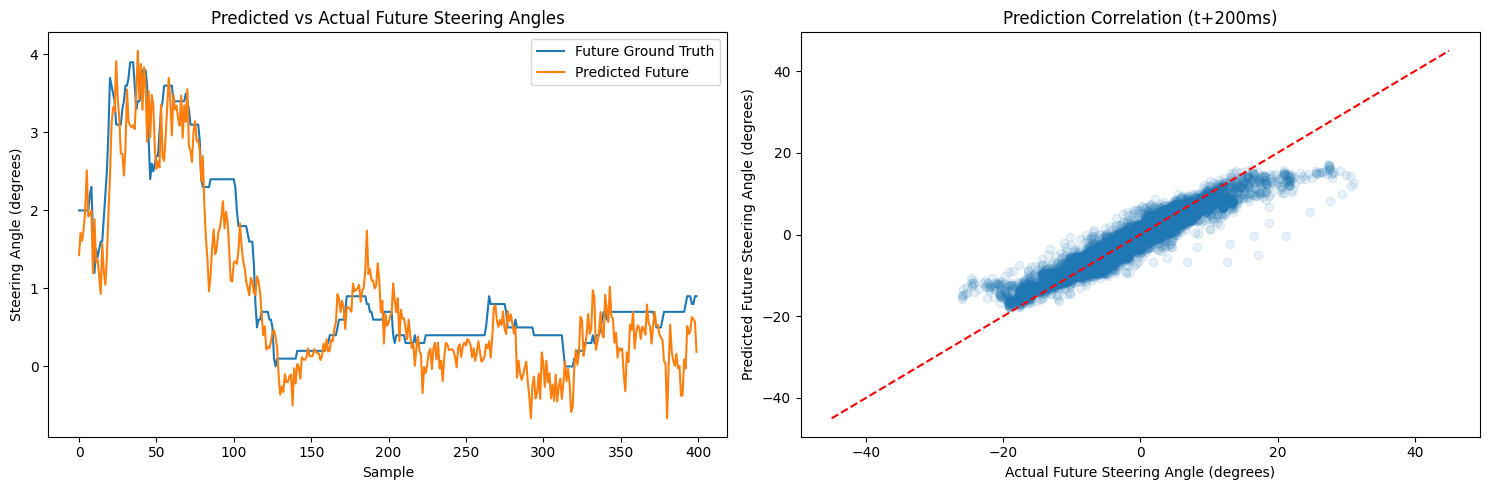


Note
Since the increased size of the dataset for the new training and the RNN's nature of using sequential dataset format, it is particularly time consuming to train the RNN models. Thus, so far the training is not completed for the RNN models. The results are based on the old training on smaller dataset.
- RNN old
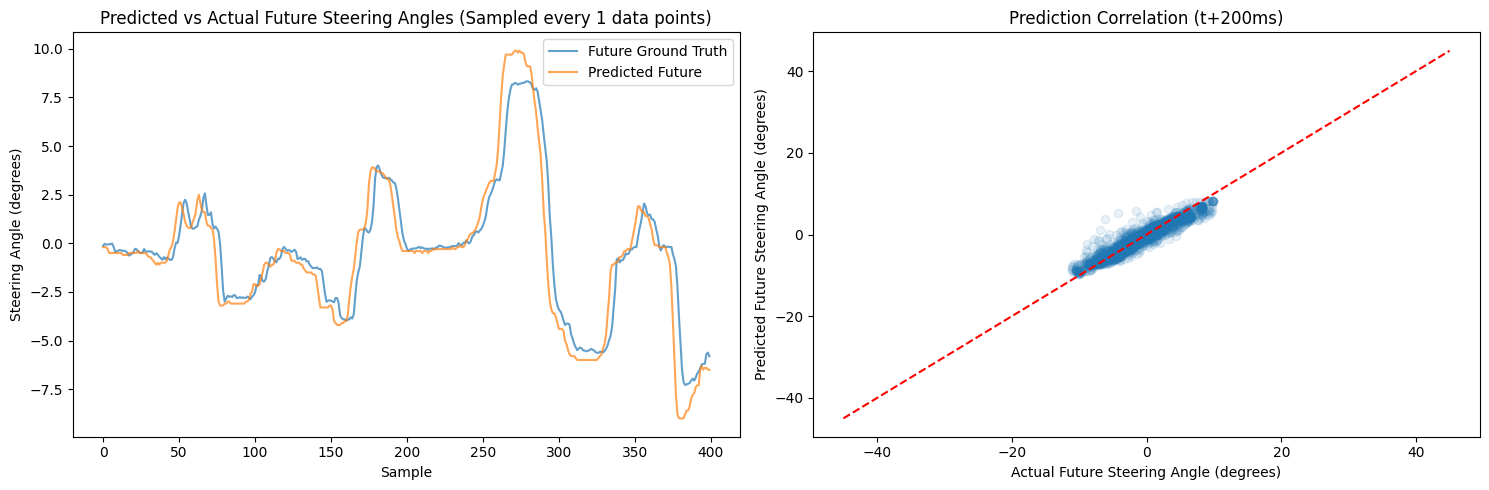
- RNN GRU old


Overall, the conclusion is the same as the report.
-
autonomous driving is a complex engineering problem, which involves many components, such as perception, decision making, and control. Using one model to predict all these components is challenging.
-
Using camera video frames and sensor data as input, CNN can predict the steering angle with decent accuracy. However, due to the stateless nature of the CNN, it can only predict a steering angle for a short period of time, not predict more steps into the future (planing the path), which leads many problems, such as failing to detect obstacles in lane and turning too late. Such problems are solved by the RNN models' stateful nature. When the model is making decent predictions, RNN and CNN models can get similar performance. But when CNN is making wrong predictions due to the problem mentioned above, RNN is more likely to avoid the problem and make better predictions. Thus, to better solve the autonomous driving problem, we need more sophisticated models that can plan the path and make decision based on the path and the environment.