The banner is an illustration, not a screenshot. The placeholder bars stand for requirement text.
The BSI ships its Grundschutz++ security catalog as a 92,000-line OSCAL JSON file — built for SSP-generation tooling, unreadable by a human who just wants to know what a control requires. This project turns that same JSON into a site you'd actually want to read: full-text search, one permalink per control, security level / effort / base threats / target object categories shown inline, a side-by-side mapping to the old IT-Grundschutz-Kompendium control it replaces, entry pages per role, a summary of the BSI methodology, an Excel/CSV export, a changelog of the catalog, dark mode, and a print-to-PDF per topic area.
This is an unofficial, independent project — not affiliated with, endorsed by, or produced by the Bundesamt für Sicherheit in der Informationstechnik (BSI).
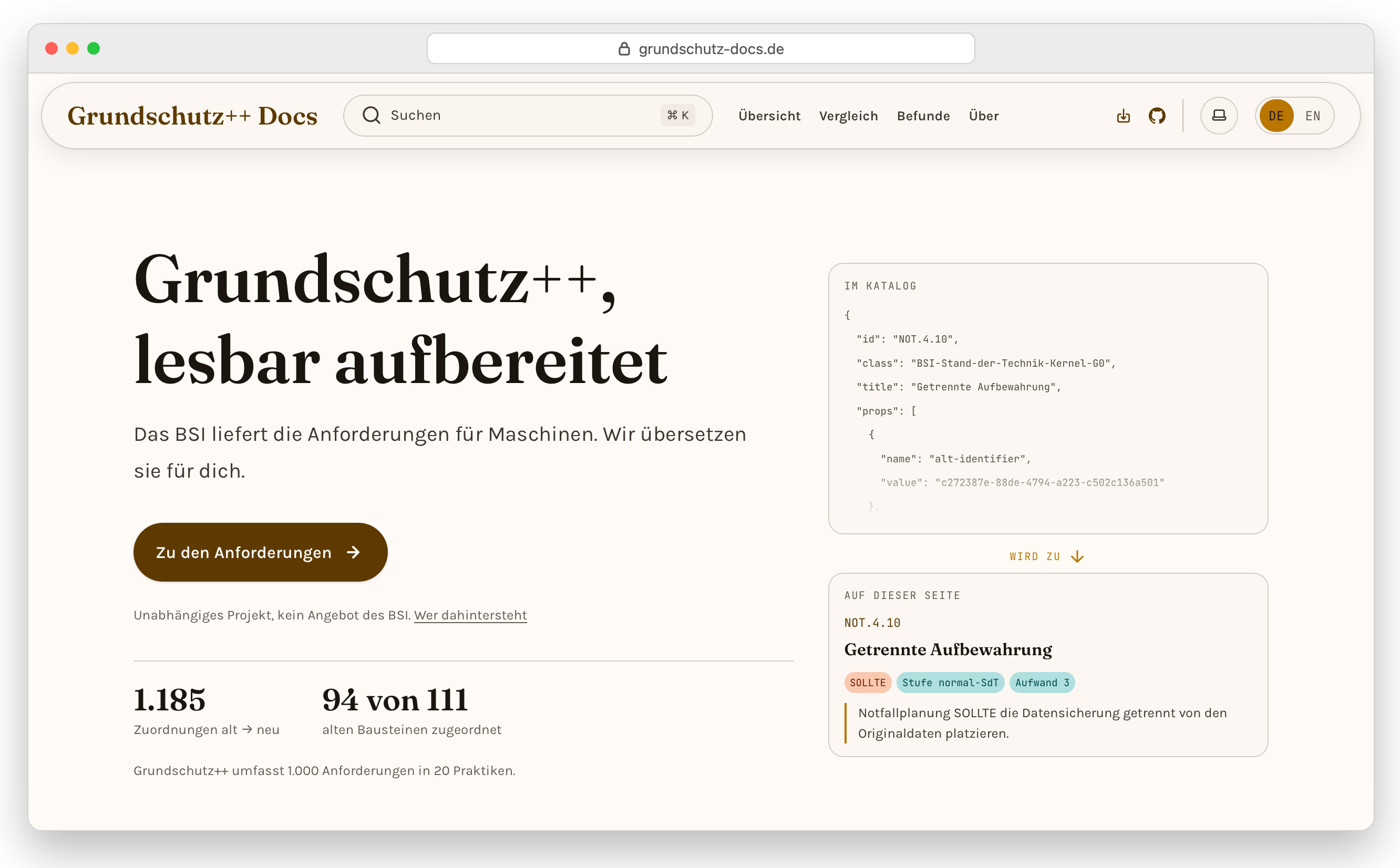
The start page: the BSI's raw OSCAL entry above, the readable page it becomes below. German UI, English landing page at /en/.
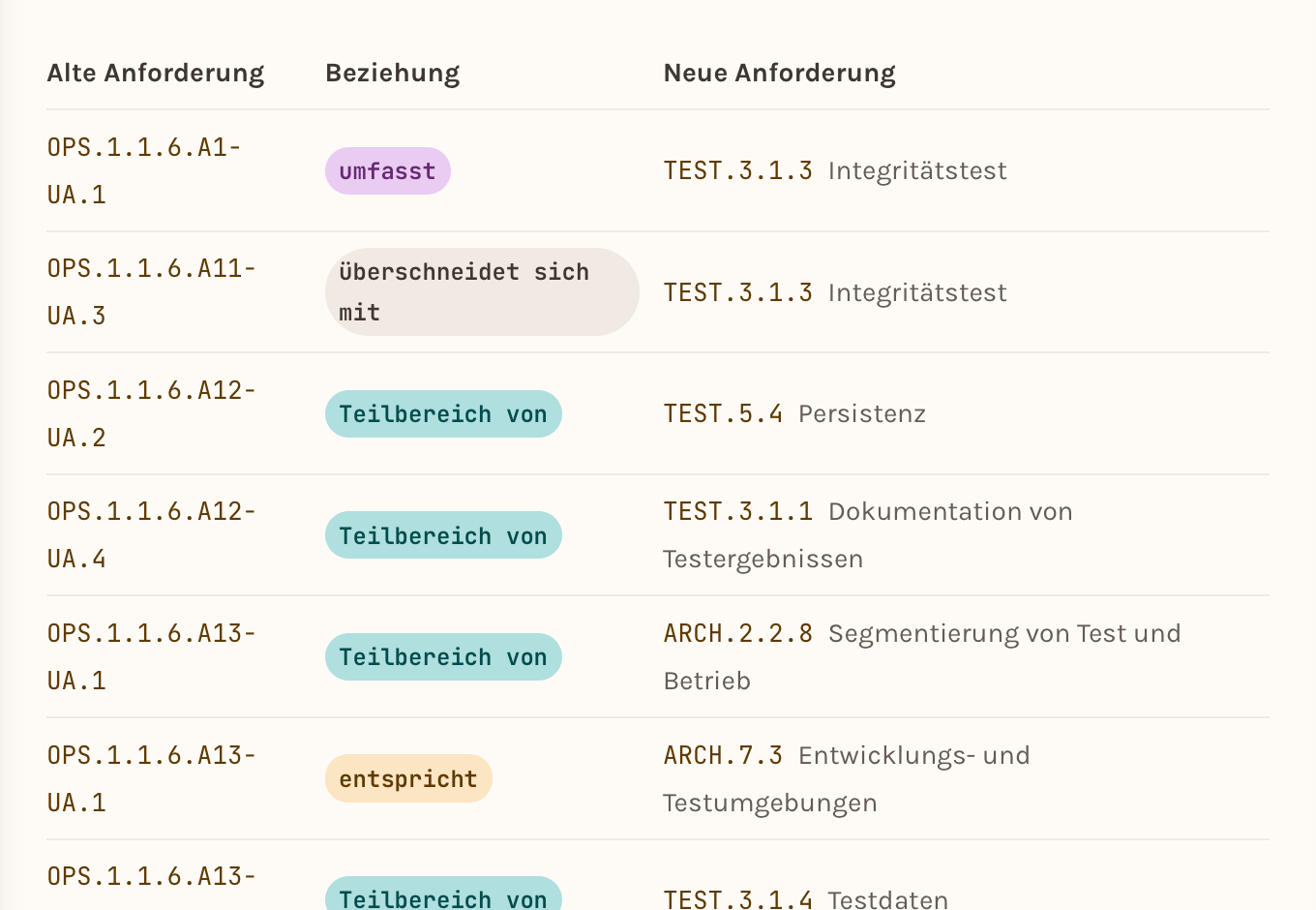
The comparison: each old requirement next to its Grundschutz++ counterpart, with the relationship type from the BSI's mapping file (which the BSI marks as a draft; the site says so).
The UI is German; the catalog text is the BSI's German original and is not translated.
- Catalog (
/grundschutzpp/) — every requirement, one page per practice, with obligation level, security level, effort, base threats and target object categories inline, and the BSI's topic tags (/grundschutzpp/themen/) - Roles (
/rollen/geschaeftsfuehrung/,/rollen/isb/,/rollen/devs/) — entry pages for management, ISB and developers - Comparison (
/vergleich/) — old Kompendium requirement ↔ new requirement, from the BSI's mapping file - Methodology (
/methodik/) — the BSI Standard 300-1 in five steps, as an own summary - Status & timeline (
/grundschutzpp/zeitplan/) — the BSI's milestones - Target object categories (
/zielobjekte/) — one page per category of the BSI hierarchy (39): the requirements that apply directly, and those inherited from the categories above (STM.2.1.4.1), with the BSI's synonyms and examples to find a category by the word you use for your system - Links between requirements — under the labels of each requirement: the prerequisite(s) the catalog names
(
required), what it is a prerequisite for, and related requirements (related, both directions), each with a link (see adr/0015). The catalog gives no order of implementation; the pages don't suggest one. - Threats (
/gefaehrdungen/) — one page per elementary threat (G 0.x) with the BSI definition verbatim (with source), the requirements the catalog assigns to it, and a split by practice and modal verb; the "Gefährdungen" pill on each requirement links there. The pages say that the assignment is not a risk assessment (see adr/0014). - Documents (
/dokumente/) — the 62 document types the catalog names indocumentation, grouped by the BSI category, with the BSI description verbatim (with source) and the requirements that name each type; the requirement pages carry a "Dokumentiert in" pill, and each target-object page lists the documents its requirements name. The pages say that this is not evidence:resultis the subject of the requirement - Export (
/export/) — the requirements as an Excel file or CSV, as a checklist (Markdown or formatted, for tickets and wikis), and every selection has an address (?ziel=Webserver,Cloud-Dienste), where a value that no longer exists is reported instead of silently widening the selection, filterable by practice, obligation level, security level, effort and target object category (the categories above a chosen one are included, as the catalog requires in STM.2.1.4.1), with columns for tracking the implementation status (status, "Bewertet am" = the date of your own assessment, owner, deadline, note), the prerequisites the catalog names ("Voraussetzungen", IDs only), a sheet "Festlegungen" (one row per parameter the catalog leaves to the organisation, e.g. "regelmäßig": 224 parameters in 211 requirements, with empty columns for your value, approval and date; the sheet proposes no values) and an overview of the documents the catalog names. The Excel file is built in the browser; nothing is sent to a server - ID check (
/id-check/) — paste or load a list of requirement IDs (or the export CSV with its "Bewertet am" column) and see which of them the BSI changed since a date, or since your own assessment date per row. It runs in the browser: the only request fetches the change data (/aenderungen/ids.json), nothing you enter is sent. It reports what changed, not whether it matters to you - Last changed — a line under the labels of each requirement the BSI changed since the changelog starts ("Zuletzt geändert: date (fields)"), added in the browser from the same data
- Short links —
/GC.5.1.1redirects to the requirement (nginx,docker/nginx.conf; they don't work inastro dev/astro preview), and a "Kurzlink" button next to each requirement's labels copies ID, title, catalog version and the link - What this site is — and is not (
/grenzen/) — scope and limits in one page, with the links for ideas, needs and errors (issue templatesidea_need,catalog_finding,site_bug) - Changelog (
/aenderungen/) — what changed in the catalog between two published versions, as a diff (old and new wording, changed words highlighted). Built from the git history of the BSI repository; it describes, it doesn't rate. Subscribe via RSS:/aenderungen/feed.xml(one item per published version that changed something; IDs, titles and counts, never the changed wording) - Findings (
/befunde/) — a public register of inconsistencies found in the catalog, and of this site's own mistakes. RSS:/befunde/feed.xml(new findings, and when one was reported or fixed; the fix date is a required field) - Data for language models (
/rag/) — the catalog as JSONL, see Related
There's already a community-built viewer for the catalog with more visual firepower than this site aims for — graphs, diagrams. This one is going for something different: a clean, modern reading experience — searchable, permalinked, comfortable to sit down with. The BSI's catalog content stays CC BY-SA, exactly as licensed; the code here is MIT.
Past that, the pilot catalog is JSON-first by design — built for tooling and SSP generation, not for reading. Keeping it current here means running the generator against the upstream source automatically, not hand-transcribing it once and letting it rot.
Reading the catalog this closely also surfaces places where it doesn't add
up — overlapping requirements, mappings that don't quite hold, missing
cross-references. Those findings get published too, in a public register
(/befunde/) — fact, interpretation, or observation, each labeled as
such, with a status from open to fixed. The site's own bugs go in the same
register, in the same format: a register that only points outward is an
instrument, not a register.
Two tools go with the reading. The export puts the requirements into a table with columns for status, responsible person and deadline. The changelog shows what changed between two published versions of the catalog: the commit messages for those versions mostly read "publish rolling artifacts" and don't say what changed, so the changelog compares the versions themselves.
A hosted instance is live at grundschutz-docs.de — free to use, no setup required. It runs this code: there is no separate tier, no feature held back, nothing you can't run yourself. The convenience is the hosting, not a different version of the site.
An earlier plan split the project into this repo plus a closed-source
"hosted" layer with richer components. That split was dissolved after a
day — the components live here now, under MIT like everything else. The
reasoning, including what it cost and why it was wrong, is in
adr/0008.
The upstream catalog is being phased in alongside the existing IT-Grundschutz-Kompendium, on a multi-year timeline (pilot, public presentation, optional certification, eventual full replacement). The site tracks whatever the catalog looks like at build time — see the in-site "Status & Zeitplan" page for the current phase and dates, and the changelog for what has changed in the catalog itself.
pnpm install
pnpm run dev      # http://localhost:4321
pnpm run build    # production build to ./dist/
pnpm run preview  # preview the production build locally
Requires the pnpm version pinned in package.json (packageManager).
Site name and operator data (imprint, privacy policy) come from .env, see
.env.example. Analytics (Plausible) is only included if
PLAUSIBLE_SCRIPT_URL is set.
docker compose up -d # http://localhost:8080The Dockerfile builds the site with Node and serves the result with nginx
(docker/nginx.conf). .env is read at build time, so changing it means
rebuilding the image. The generated pages are committed, so the build needs
neither Python nor access to the BSI catalog.
The image is based on nginx-unprivileged: nginx runs as user 101 instead of
root and listens on port 8080 (an unprivileged user may not bind ports
below 1024). If you put a reverse proxy in front, point it at port 8080; with
the old image this was port 80, so a port mapping like "8080:80" or a Traefik
label loadbalancer.server.port=80 has to become 8080. nginx adds security
headers to every response (docker/security-headers.conf) but does not set
HSTS, since the proxy that terminates TLS should do that.
The short links (/GC.5.1.1) are a map plus one location in docker/nginx.conf, one rule per
practice. scripts/tests/test_nginx.py starts a real nginx and checks every practice of the catalog,
so a practice the BSI adds turns the test red until the map has it.
The pages under src/content/docs/grundschutzpp/ are generated, not
hand-written. scripts/generate_docs.py reads the BSI's
Grundschutz++-resolved_catalog.json (OSCAL) and renders Starlight MDX
from it — MDX rather than plain markdown so the generated pages can use
real components (ControlMeta for the obligation/level/effort pills,
PdcaCycle, the filter inputs) instead of bold-text metadata. It needs
python3 and nothing from PyPI (standard library only), plus git for the
changelog.
Locally, it expects a Grundschutz-PlusPlus checkout of
BSI-Bund/Stand-der-Technik-Bibliothek
as a sibling directory. Make it a full clone, not a shallow one: the
changelog compares the published versions, so it needs the history.
cd Grundschutz-PlusPlus && git pull
python3 ../Grundschutz-Docs/scripts/generate_docs.py
cd ../Grundschutz-Docs && pnpm run build
What a run writes:
- the pages under
src/content/docs/grundschutzpp/,rollen/,vergleich/,zielobjekte/,dokumente/andgefaehrdungen/. Edit those inscripts/generate_docs.py, never in the.mdx— the next run overwrites them.DESCRIPTION_OVERRIDESthere keeps a few shortened meta descriptions for search results src/data/*.json— the figures for the homepage and timeline, the baustein lookup, andchangelog.jsonpublic/downloads/— the CSV files (all requirements and one per practice), the JSON the export page filters from, andLIZENZ.txt
The changelog is incremental. changelog.json has one entry per BSI
commit that changed the catalog. A run only computes commits that are not in
the file yet. Without git history (shallow clone, no git repository) it says
so and leaves the file alone. The oldest version covered is 27 July 2026;
before that the catalog lived at a different path in the BSI repository.
The generator refuses to write something wrong. After a run it checks the
numbers on the pages (check_invariants()), the export files
(check_export()), the target object pages (check_zielobjekte()), the document
pages (check_dokumente()), the threat pages (check_gefaehrdungen()), the links between requirements (check_zusammenhang()) and the changelog (check_changelog()) against the source,
each recomputed by a second path that does not reuse the code that produced the
value (for the changelog it reads the same git history, but flattens the whole
tree instead of picking fields). The rule and the incident behind it are in CONTRIBUTING.md
("Numbers on the site"). One more check is not about numbers: check_sync_paths() fails the
run if the generator writes into a folder that the daily sync PR would not pick up.
Instead of the sibling checkout, the generator can read its inputs from files you name
(the sync workflow does this): GRUNDSCHUTZPP_CATALOG, GRUNDSCHUTZPP_BASETHREATS,
GRUNDSCHUTZPP_MAPPING, GRUNDSCHUTZPP_TAGS, GRUNDSCHUTZPP_TARGETS and
GRUNDSCHUTZPP_DOCUMENTATION. The variables are listed in .github/workflows/sync-catalog.yml.
Each run also writes src/data/upstream.json: the newest BSI commit that changed one of those six
input files (not the head of the BSI repository, which moves for unrelated reasons). The workflow
.github/workflows/generated.yml checks out exactly that commit on every push and pull request, runs
the generator and fails if anything differs from what is committed, including files that are missing
from the commit. That catches a hand edit of a generated page, a generator change nobody re-ran and an
overwritten upstream.json before the next daily sync would silently undo them. If it fails, run the
generator against the commit it names and commit the result.
In CI, .github/workflows/sync-catalog.yml runs on a daily schedule,
checks the upstream catalog out directly (with its full history, without file
contents, they are loaded on demand), regenerates everything above, and opens a
pull request if anything changed — review the diff before merging (see
CONTRIBUTING.md). .github/workflows/ci.yml runs a production build on
every push and pull request.
The export page builds the Excel file in the browser with a small writer of
its own (src/lib/xlsx/, on top of fflate) instead of a general-purpose
library: the export needs a handful of features (several sheets, frozen rows,
autofilter, dropdowns, hyperlinks), and a general-purpose library would have
brought about 175 transitive packages. The writer is only loaded when
the button is clicked.
Excel is strict about the order of XML elements and answers a mistake with
"repair this file" and no hint what is wrong. scripts/xlsx/verify.py
checks a file four independent ways (the ECMA-376 schema, package
consistency, a read-back with exceljs, and LibreOffice), and
scripts/xlsx/compare.py compares every cell with the CSV the generator
wrote. Both need things that are not in this repository (the schema,
exceljs); the header of verify.py says where to get them. They run by
hand, not in CI.
pnpm build                                                          # some tests read the built site (dist/)
python3 -m unittest discover -s scripts/tests -p "test_*.py"
node --experimental-strip-types --test scripts/tests/id-check.test.mjs   # the ID check's rules
Tests that read dist/ skip when it is missing. Others need the BSI catalog and its documentation files
(GRUNDSCHUTZPP_CATALOG and the other variables of the generator), nginx in the PATH, or exceljs
(XLSX_ORACLE_DIR); without them they fail with a message saying what is missing, so they never pass silently.
.
├── adr/                       # architecture decisions, with the reasoning
├── docker/nginx.conf          # web server config for the image
├── Dockerfile                 # build with Node, serve with nginx
├── docker-compose.yml         # generic self-hosting template
├── public/downloads/          # generated — CSV, JSON and license text of the export
├── scripts/
│   ├── generate_docs.py       # OSCAL catalog → MDX, data files, export, changelog
│   └── xlsx/                  # checks for the Excel files (run by hand)
├── src/
│   ├── components/            # ControlMeta, PdcaCycle, ExportTabelle, IdCheck, Kurzlink, ZuletztGeaendert, Aenderungsprotokoll, Befund*, filters, header/hero overrides
│   ├── data/                  # generated — landing, status, bausteine, changelog (JSON)
│   ├── lib/                   # id-check.ts (the ID check's rules), anforderung-dom.ts, feed.ts, export helpers
│   ├── lib/xlsx/              # the Excel writer used by the export page
│   ├── content/docs/
│   │   ├── grundschutzpp/     # generated — the catalog, one page per practice
│   │   ├── rollen/            # generated — entry pages per role
│   │   ├── vergleich/         # generated — one page per old↔new mapping
│   │   ├── zielobjekte/       # generated — one page per target object category (see adr/0011)
│   │   ├── dokumente/         # generated — one page per document type (see adr/0012)
│   │   ├── gefaehrdungen/     # generated — one page per elementary threat (see adr/0014)
│   │   ├── befunde/           # the findings register (see adr/0009)
│   │   ├── en/                # hand-written English pages (not a catalog translation)
│   │   ├── index.mdx          # homepage
│   │   ├── methodik.mdx       # summary of BSI Standard 300-1
│   │   ├── export.mdx         # the export page
│   │   ├── aenderungen.mdx    # the changelog page
│   │   ├── rag.mdx            # the catalog as data for language models
│   │   ├── ueber.mdx          # about
│   │   ├── impressum.mdx      # legal notice template (see adr/0003)
│   │   └── datenschutz.mdx    # privacy policy template
│   └── styles/custom.css      # OKLCH palette, light + dark
├── .github/workflows/         # ci.yml (build), sync-catalog.yml (daily catalog PR)
├── astro.config.mjs           # site title, sidebar, i18n, Starlight plugins
└── .env                       # SITE_NAME, operator data (see .env.example)
Non-code input counts too — a different reading of a requirement, a gap,
an open question; see CONTRIBUTING.md for the low-friction way in. The
same file covers what's expected in a PR (build must pass, generator
changes need an actual run and diff review, check both color schemes and
both mobile/desktop layouts); CODE_OF_CONDUCT.md has the community
expectations.
grundschutz-docs/rag is the
data pipeline behind this site for people who want to build their own
search or chatbot on the catalog: the same controls as JSONL plus a small
Qdrant indexing script.
Not promises, just what's on the list — open an issue if you want to pick
one of these up (see CONTRIBUTING.md):
- Better theme browsing: the BSI tags are on every control as pills, in
search as a "Thema" filter, and collected on
/grundschutzpp/themen/. They cover only 470 of the 1,000 controls, so a richer view (per-theme pages, filters on the catalog pages) would mostly expose that gap - The requirement package for a target object category as a file (CSV, JSON,
Markdown) under a stable address, and as a shareable link with the selection
(the export page already reads
?ziel=and?praktik=), so tickets, wikis and other tools can fetch "the package for web servers" directly - An OSCAL explainer page — what it is, and why a German agency adopted a NIST-originated format instead of building its own
- A sheet in the Excel export that maps the old Kompendium requirements to the new ones, once the BSI's mapping file is no longer marked as a draft
- The Excel checks (
scripts/xlsx/) in CI. They need the ECMA schema andexceljs, which is why they are not there yet - The English side is hand-written pages for foreign companies operating in Germany (home, about, legal pages, "operating in Germany"). The catalog itself, the comparison, the export, the changelog and the findings register are German-only; a real English translation of the catalog is not started
- Code: MIT — see
LICENSE. - Catalog content (the Grundschutz++ text rendered under
src/content/docs/grundschutzpp/): CC BY-SA 4.0, © BSI-Bund, per the upstream catalog's own license. This site's generated pages inherit that license from their source. - Files and pages derived from the catalog (the export under
public/downloads/, the Excel file the export page builds, and the changelog): they contain catalog text, so they are CC BY-SA 4.0 too. The attribution, the license and the note that they are modified are in the files themselves (LIZENZ.txt, the info sheet of the Excel file, the source column) and not only on the web page. - Every page carries one line in the footer with the catalog's author, license, source and the
note that it is modified (on
/methodik/the line names the BSI's terms of use instead).scripts/tests/test_lizenzzeile.pychecks the built site. - The page on the BSI Standard 300-1 (
/methodik/): an own summary. The source is © BSI and is not under CC BY-SA; the BSI's terms of use apply to it. The old IT-Grundschutz-Kompendium is not reproduced: the comparison pages and the export only name its requirement IDs and link to the BSI's PDFs. - Original text (the findings register under
src/content/docs/befunde/, and the ADRs underadr/): CC BY 4.0 — a content license fits prose better than a software license does, seeadr/0010.
The BSI-OSCAL catalog itself follows OSCAL, a standard originating from NIST that the BSI adopted rather than building a proprietary format.