
| Documentation | ▸ | Homepage · User Guide · API Reference · Examples |
| On this page | ▸ | Features · Examples · Concepts · Citation |
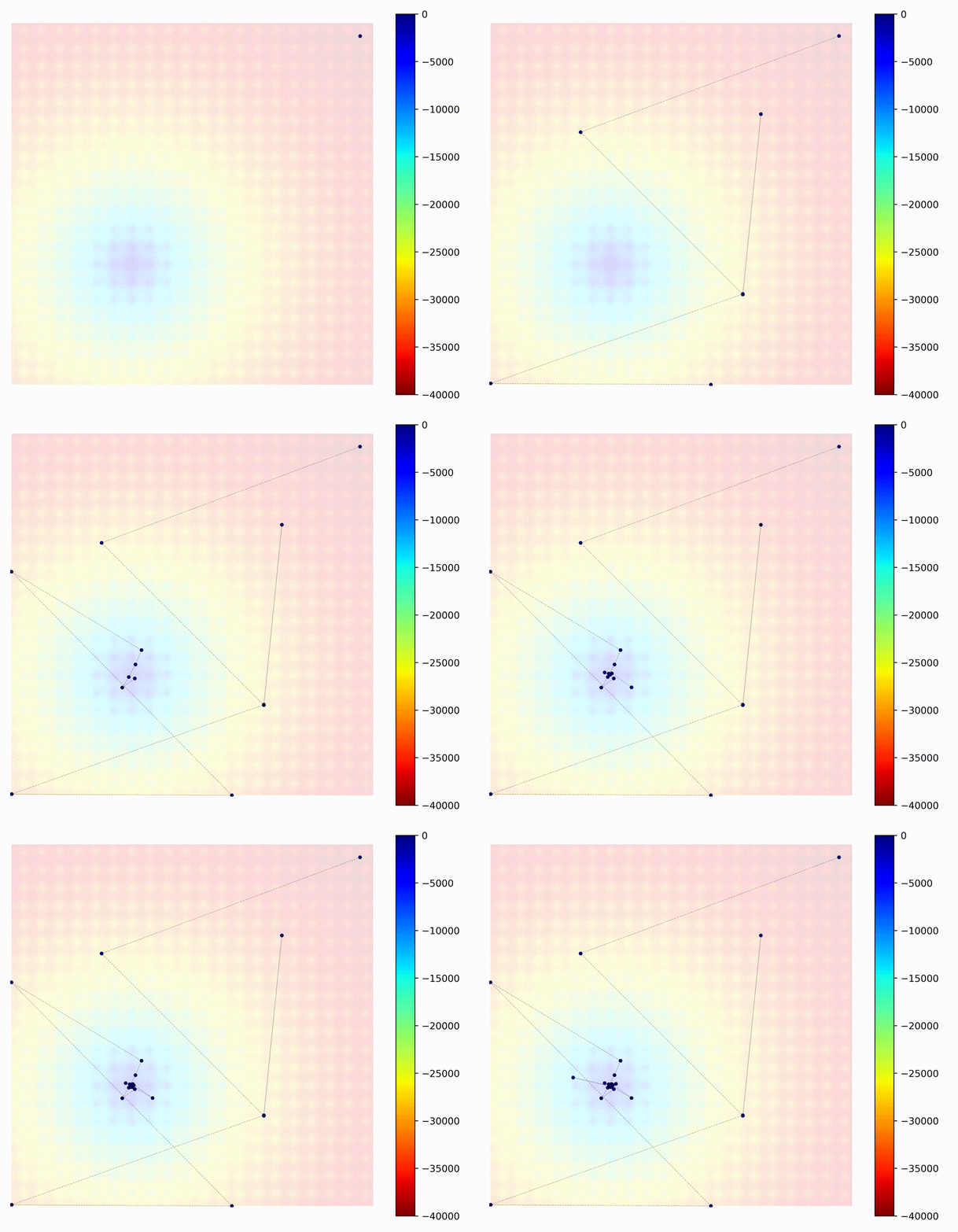
Hyperactive provides 31 optimization algorithms across 3 backends (GFO, Optuna, scikit-learn), accessible through a unified experiment-based interface. The library separates optimization problems from algorithms, enabling you to swap optimizers without changing your experiment code.
Designed for hyperparameter tuning, model selection, and black-box optimization. Native integrations with scikit-learn, sktime, skpro, and PyTorch allow tuning ML models with minimal setup. Define your objective, specify a search space, and run.
pip install hyperactive
Optional dependencies
pip install hyperactive[sklearn-integration]  # scikit-learn integration
pip install hyperactive[sktime-integration]   # sktime/skpro integration
pip install hyperactive[all_extras]           # Everything including Optuna
|
31 Optimization Algorithms Local, global, population-based, and model-based methods across 3 backends (GFO, Optuna, sklearn). |
Experiment Abstraction Clean separation between what to optimize (experiments) and how to optimize (algorithms). |
Flexible Search Spaces Discrete, continuous, and mixed parameter types. Define spaces with NumPy arrays or lists. |
|
ML Framework Integrations Native support for scikit-learn, sktime, skpro, and PyTorch with minimal code changes. |
Multiple Backends GFO algorithms, Optuna samplers, and sklearn search methods through one unified API. |
Stable & Tested 5+ years of development, comprehensive test coverage, and active maintenance since 2019. |
import numpy as np
from hyperactive.opt.gfo import HillClimbing

# Define objective function (maximize)
def objective(params):
    x, y = params["x"], params["y"]
    return -(x**2 + y**2)  # Negative paraboloid, optimum at (0, 0)

# Define search space
search_space = {
    "x": np.arange(-5, 5, 0.1),
    "y": np.arange(-5, 5, 0.1),
}

# Run optimization
optimizer = HillClimbing(
    search_space=search_space,
    n_iter=100,
    experiment=objective,
)
best_params = optimizer.solve()

print(f"Best params: {best_params}")
Output:
Best params: {'x': 0.0, 'y': 0.0}
Hyperactive separates what you optimize from how you optimize. Define your experiment (objective function) and search space once, then swap optimizers freely without changing your code. The unified interface abstracts away backend differences, letting you focus on your optimization problem.
flowchart TB
    subgraph USER["Your Code"]
        direction LR
        F["def objective(params):<br/>    return score"]
        SP["search_space = {<br/>    'x': np.arange(...),<br/>    'y': [1, 2, 3]<br/>}"]
    end

    subgraph HYPER["Hyperactive"]
        direction TB
        OPT["Optimizer"]

        subgraph BACKENDS["Backends"]
            GFO["GFO<br/>21 algorithms"]
            OPTUNA["Optuna<br/>8 algorithms"]
            SKL["sklearn<br/>2 algorithms"]
            MORE["...<br/>more to come"]
        end

        OPT --> GFO
        OPT --> OPTUNA
        OPT --> SKL
        OPT --> MORE
    end

    subgraph OUT["Output"]
        BEST["best_params"]
    end

    F --> OPT
    SP --> OPT
    HYPER --> OUT
Optimizer: Implements the search strategy (Hill Climbing, Bayesian, Particle Swarm, etc.).
Search Space: Defines valid parameter combinations as NumPy arrays or lists.
Experiment: Your objective function or a built-in experiment (SklearnCvExperiment, etc.).
Best Parameters: The optimizer returns the parameters that maximize the objective.
Scikit-learn Hyperparameter Tuning
from sklearn.svm import SVC
from sklearn.datasets import load_iris
from sklearn.model_selection import train_test_split

from hyperactive.integrations.sklearn import OptCV
from hyperactive.opt.gfo import HillClimbing

# Load data
X, y = load_iris(return_X_y=True)
X_train, X_test, y_train, y_test = train_test_split(X, y, test_size=0.2)

# Define search space and optimizer
search_space = {"kernel": ["linear", "rbf"], "C": [1, 10, 100]}
optimizer = HillClimbing(search_space=search_space, n_iter=20)

# Create tuned estimator
tuned_svc = OptCV(SVC(), optimizer)
tuned_svc.fit(X_train, y_train)

print(f"Best params: {tuned_svc.best_params_}")
print(f"Test accuracy: {tuned_svc.score(X_test, y_test):.3f}")
Bayesian Optimization
import numpy as np
from hyperactive.opt.gfo import BayesianOptimizer

def ackley(params):
    x, y = params["x"], params["y"]
    return -(
        -20 * np.exp(-0.2 * np.sqrt(0.5 * (x**2 + y**2)))
        - np.exp(0.5 * (np.cos(2 * np.pi * x) + np.cos(2 * np.pi * y)))
        + np.e + 20
    )

search_space = {
    "x": np.arange(-5, 5, 0.01),
    "y": np.arange(-5, 5, 0.01),
}

optimizer = BayesianOptimizer(
    search_space=search_space,
    n_iter=50,
    experiment=ackley,
)
best_params = optimizer.solve()
Particle Swarm Optimization
import numpy as np
from hyperactive.opt.gfo import ParticleSwarmOptimizer

def rastrigin(params):
    A = 10
    values = [params[f"x{i}"] for i in range(5)]
    return -sum(v**2 - A * np.cos(2 * np.pi * v) + A for v in values)

search_space = {f"x{i}": np.arange(-5.12, 5.12, 0.1) for i in range(5)}

optimizer = ParticleSwarmOptimizer(
    search_space=search_space,
    n_iter=500,
    experiment=rastrigin,
    population_size=20,
)
best_params = optimizer.solve()
Experiment Abstraction with SklearnCvExperiment
import numpy as np
from sklearn.svm import SVC
from sklearn.datasets import load_iris
from sklearn.metrics import accuracy_score
from sklearn.model_selection import KFold

from hyperactive.experiment.integrations import SklearnCvExperiment
from hyperactive.opt.gfo import HillClimbing

X, y = load_iris(return_X_y=True)

# Create reusable experiment
sklearn_exp = SklearnCvExperiment(
    estimator=SVC(),
    scoring=accuracy_score,
    cv=KFold(n_splits=3, shuffle=True),
    X=X,
    y=y,
)

search_space = {
    "C": np.logspace(-2, 2, num=10),
    "kernel": ["linear", "rbf"],
}

optimizer = HillClimbing(
    search_space=search_space,
    n_iter=100,
    experiment=sklearn_exp,
)
best_params = optimizer.solve()
Optuna Backend (TPE)
import numpy as np
from hyperactive.opt.optuna import TPEOptimizer

def objective(params):
    x, y = params["x"], params["y"]
    return -(x**2 + y**2)

search_space = {
    "x": np.arange(-5, 5, 0.1),
    "y": np.arange(-5, 5, 0.1),
}

optimizer = TPEOptimizer(
    search_space=search_space,
    n_iter=100,
    experiment=objective,
)
best_params = optimizer.solve()
Time Series Forecasting with sktime
from sktime.forecasting.naive import NaiveForecaster
from sktime.datasets import load_airline

from hyperactive.integrations.sktime import ForecastingOptCV
from hyperactive.opt.gfo import RandomSearch

y = load_airline()

search_space = {
    "strategy": ["last", "mean", "drift"],
    "sp": [1, 12],
}

optimizer = RandomSearch(search_space=search_space, n_iter=10)
tuned_forecaster = ForecastingOptCV(NaiveForecaster(), optimizer)
tuned_forecaster.fit(y)

print(f"Best params: {tuned_forecaster.best_params_}")
PyTorch Neural Network Tuning
import numpy as np
import torch
import torch.nn as nn
from torch.utils.data import DataLoader, TensorDataset
from hyperactive.opt.gfo import BayesianOptimizer

# Example data
X_train = torch.randn(1000, 10)
y_train = torch.randint(0, 2, (1000,))

def train_model(params):
    learning_rate = params["learning_rate"]
    batch_size = params["batch_size"]
    hidden_size = params["hidden_size"]

    model = nn.Sequential(
        nn.Linear(10, hidden_size),
        nn.ReLU(),
        nn.Linear(hidden_size, 2),
    )

    optimizer = torch.optim.Adam(model.parameters(), lr=learning_rate)
    criterion = nn.CrossEntropyLoss()
    loader = DataLoader(TensorDataset(X_train, y_train), batch_size=batch_size)

    model.train()
    for epoch in range(10):
        for X_batch, y_batch in loader:
            optimizer.zero_grad()
            loss = criterion(model(X_batch), y_batch)
            loss.backward()
            optimizer.step()

    # Return validation accuracy
    model.eval()
    with torch.no_grad():
        predictions = model(X_train).argmax(dim=1)
        accuracy = (predictions == y_train).float().mean().item()

    return accuracy

search_space = {
    "learning_rate": np.logspace(-5, -1, 20),
    "batch_size": [16, 32, 64, 128],
    "hidden_size": [64, 128, 256, 512],
}

optimizer = BayesianOptimizer(
    search_space=search_space,
    n_iter=30,
    experiment=train_model,
)
best_params = optimizer.solve()
This library is part of a suite of optimization and machine learning tools. For updates on these packages, follow on GitHub.
| Package | Description |
|---|---|
| Hyperactive | Hyperparameter optimization framework with experiment abstraction and ML integrations |
| Gradient-Free-Optimizers | Core optimization algorithms for black-box function optimization |
| Surfaces | Test functions and benchmark surfaces for optimization algorithm evaluation |
| Resource | Description |
|---|---|
| User Guide | Comprehensive tutorials and explanations |
| API Reference | Complete API documentation |
| Examples | Jupyter notebooks with use cases |
| FAQ | Common questions and troubleshooting |
Contributions welcome! See CONTRIBUTING.md for guidelines.
- Bug reports: GitHub Issues
- Feature requests: GitHub Discussions
- Questions: Discord
If you use this software in your research, please cite:
@software{hyperactive2019,
  author = {Simon Blanke},
  title = {Hyperactive: A hyperparameter optimization and meta-learning toolbox},
  year = {2019},
  url = {https://github.com/SimonBlanke/Hyperactive},
}
MIT License - Free for commercial and academic use.