

Live demo: remit-reconciliation-engine.streamlit.app — no login, no install. A GitHub Action appends a new synthetic remit cycle every 30 minutes, reruns the full dbt build + tests, and the app redeploys — it is a live pipeline, not a static snapshot.
Payments come in. The books say something else. This engine finds every mismatch — automatically.
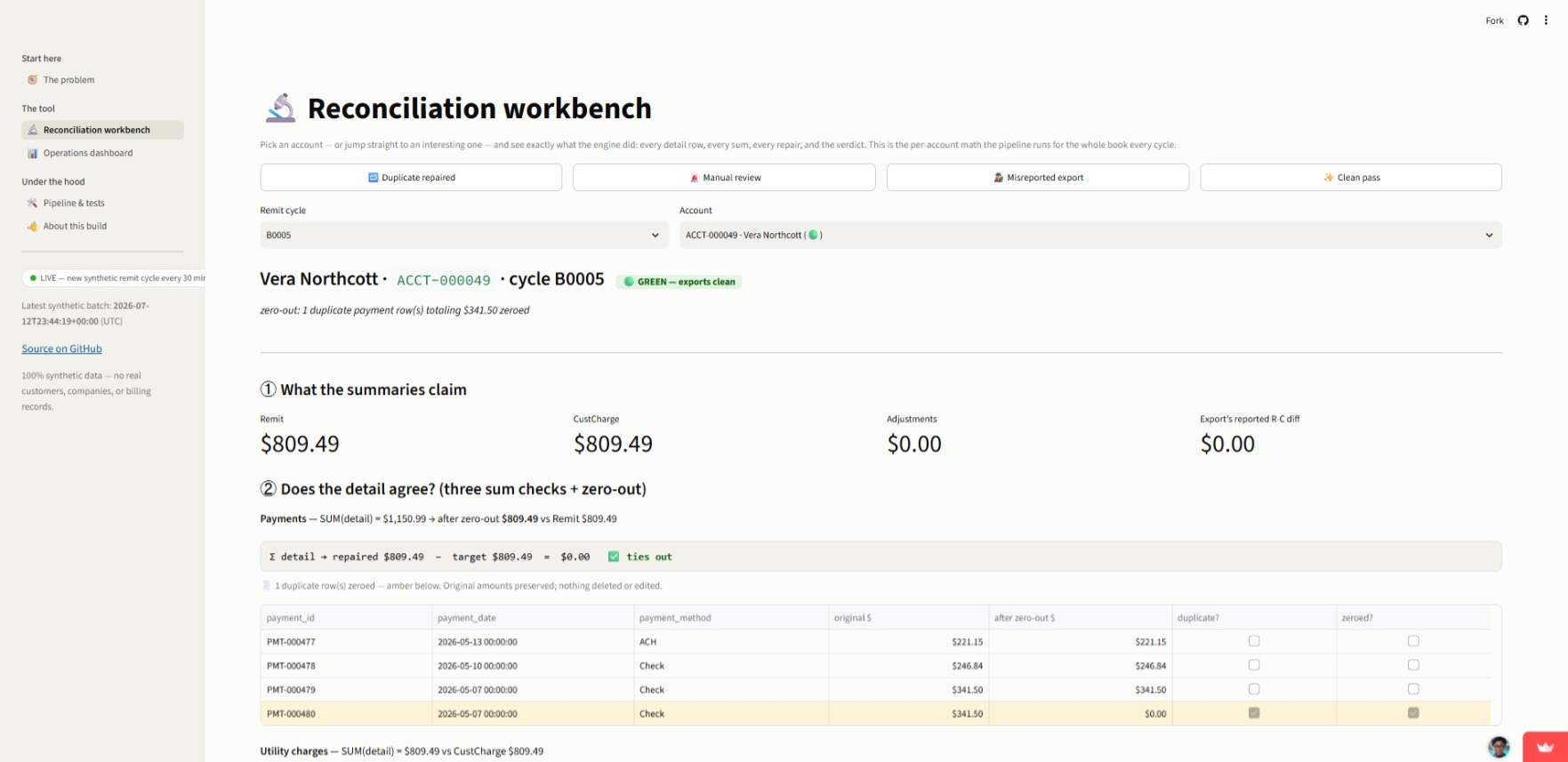 The reconciliation workbench: a duplicate $341.50 payment inflates the column to $1,150.99; the engine zeroes the duplicate (amber row — original preserved, nothing edited) and ties out to the $809.49 remit. Try it live.
A production-style rebuild of a real reconciliation workflow: a utility-billing remittance feed that changes every cycle (payments post, services get cancelled, adjustments land — originally SQL Server extracts reconciled in Excel), rebuilt as a tested SQL pipeline that repairs what it can, proves what it did, and routes what it can't fix to a human.
All data is 100% synthetic and self-generated. No real company names, account numbers, customer data, or proprietary business rules — the project generalizes a common remittance-reconciliation pattern in generic terms.
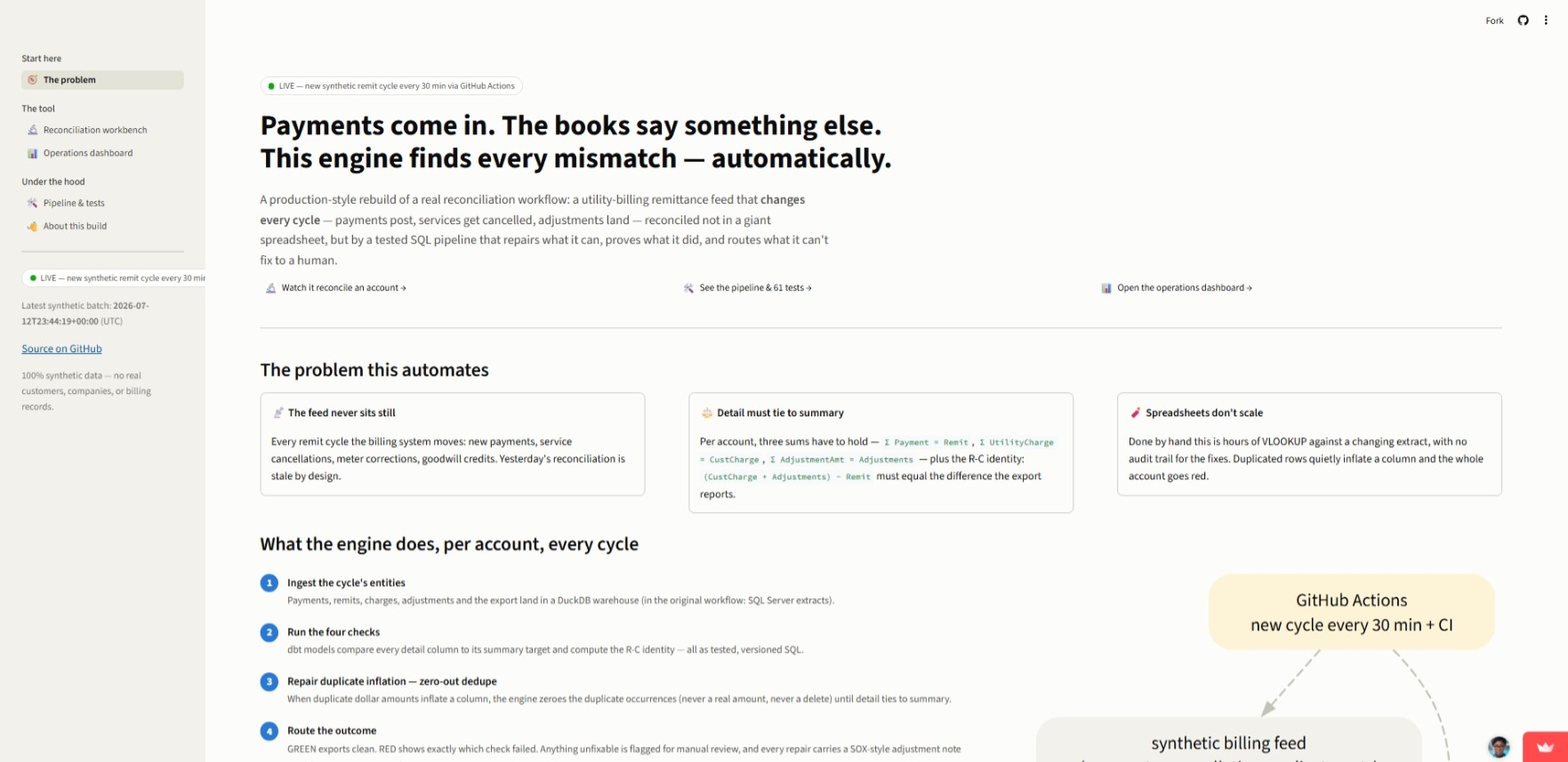
| Page | What you'll see |
|---|---|
| 🧭 The problem | The 60-second story: why this exists, how the engine works, live stats, one-click guided demos |
| 🔬 Reconciliation workbench | Pick any account — or jump to "duplicate repaired" / "manual review" / "misreported export" — and watch all four checks run with the actual math, before/after zero-out |
| 📊 Operations dashboard | Cycle KPIs with deltas, match-rate trend, failed-checks breakdown, exception queues, CSV export |
| 🛠️ Pipeline & tests | The dbt lineage DAG and all 43 test results rendered from dbt's own artifacts, plus the live refresh commit feed |
| 👋 About this build | What each part demonstrates, honest limits, next steps |
Per account and remit cycle, four checks:
| # | Check | Rule |
|---|---|---|
| 1 | Payment | SUM(Payment) = Remit |
| 2 | Charge | SUM(UtilityCharge) = CustCharge |
| 3 | Adjustment | SUM(AdjustmentAmt) = Adjustments |
| 4 | R-C | (CustCharge + Adjustments) − Remit = reported "R-C" difference |
Zero-out dedupe: when duplicate dollar amounts inflate a detail column, the
engine zeroes the duplicate occurrences (it never alters or deletes a real
amount) until the column ties to its summary target — including duplicated
credits, which deflate a column instead of inflating it. Anything still
unmatched goes to manual review, and every repair carries a SOX-style
adjustment note requiring manager approval. The rule is implemented once, as a
parameterized dbt macro (zero_out_dedupe),
instantiated three times, and enforced by tests — not by a promise.
flowchart LR
    subgraph gen[Synthetic billing feed]
        G["data_gen/generate.py<br/>payments · cancellations ·<br/>adjustments · seeded failures"]
    end
    subgraph wh[warehouse/raw.duckdb]
        R[(raw schema)]
        S[staging views]
        I["intermediate<br/>zero-out dedupe +<br/>per-check rollup"]
        M["marts<br/>star schema +<br/>fct_reconciliation +<br/>recon_export"]
    end
    D["Streamlit app<br/>5 pages incl. workbench +<br/>pipeline evidence"]
    G -->|CSV / Parquet| R
    R --> S --> I --> M --> D

    subgraph gha[GitHub Actions]
        CI["dbt-ci.yml<br/>dbt build on push"]
        REF["refresh-data.yml<br/>every 30 min: append cycle,<br/>dbt build + 43 tests, commit"]
    end
    REF -->|new commit| D
The original workflow's source was SQL Server; here a deterministic generator emulates the moving billing system so every recon path is demonstrable — clean passes, duplicate-inflated columns (fixable), real shortfalls (unfixable), summary drift, misreported exports, disclosed known differences.
- 18 dbt models across staging → intermediate → marts (star schema)
- 43 dbt tests on every build:
unique/not_nullon every key,relationshipstodim_account,accepted_valueson status, and two singular tests that encode the business rule itself:assert_zero_out_reconciles_or_flags— passed checks must tie out within $0.01; unmatched accounts must be flaggedassert_only_duplicates_zeroed— only duplicates may be zeroed; amounts are0or untouched, never edited
- CI runs the full build on every push; the scheduled refresh re-tests every 30 minutes on fresh data before committing
- The app's Pipeline page renders the lineage DAG and test results from
dbt's own
manifest.json/run_results.json— republished each run
data_gen/         synthetic generator (11 seeded scenario types) + CSV/Parquet output
warehouse/        DuckDB loader + the bundled warehouse the app reads
dbt_project/      models (staging/intermediate/marts), macros, tests, artifacts
orchestration/    one-shot refresh entrypoint used locally and by Actions
dashboard/        Streamlit app: app.py + ui.py + views/ (5 pages)
.github/workflows dbt CI + 30-minute scheduled refresh
python -m venv .venv && . .venv/bin/activate   # Windows: .venv\Scripts\activate
pip install -r requirements.txt
python orchestration/refresh.py --base         # generate → load → dbt build (61 items)
streamlit run dashboard/app.py
Simulate the live feed: python orchestration/refresh.py appends one cycle
and rebuilds; run it again for another.
Live (everything in this repo actually runs and is deployed): generator, DuckDB warehouse, dbt models + tests, zero-out macro, the 5-page app, CI, the 30-minute scheduled refresh, the public deployment.
Documented next steps (deliberately not built):
- Swap the dbt target to Snowflake/BigQuery (models are warehouse-agnostic —
see
profiles.yml) - Object storage instead of committing the
.duckdb(git history growth) - Incremental models once volume warrants it
- Match-rate threshold alerting (e.g. Slack webhook)
- Persisted approvals (the workbench approval button is a UI demo)