
Brazilian jiu-jitsu positions and transitions in 3D. Two jointed mannequins play each transition; in a submission, the attacked joint lights up as the lock tightens and a note says when it can cause injury.
It covers the whole GrappleMap database: 601 positions and 1,485 transitions, no-gi, linked into a graph you can walk ("from here you can…").
Open the app · Watch the 60-second demo · UI catalog (Storybook)

-
Mannequins: a wooden figure, as an artist's mannequin (an egg head, a chest with shoulders, abdomen and pelvis, tapered limbs, shoe-like feet, a belt), its pieces shaped from five views of a reference (
docs/character.html). A ball fills every joint, so a bent one closes instead of opening a gap; the hand has a thumb and four fingers that fold together. Nothing deforms: every piece is placed straight from the 23 joints per player, so the figure is exactly the data. Amber and blue stay the same people while you chain transitions. -
Contact: GrappleMap's figures are thin; given thickness they would sink into each other. An offline solver (
packages/core/src/contact.ts) gives each player capsules close to the mannequin's pieces (the wooden figure is a little fuller in the chest and thighs), separates what overlaps (touching is allowed), keeps bone lengths, keeps everything above the mat and stays close to the original pose. It also adds an in-between frame per keyframe gap so limbs do not pass through each other on the way. Over the database, the deepest overlap per transition goes from 5.2 cm to 1.5 cm (median; 1 cm is allowed). -
Looks: solid (the fighter's colour, easiest to read), wood (an artist's mannequin with joints in the fighter's colour) and x-ray (translucent, to see limbs hidden behind the other body).
solid wood x-ray 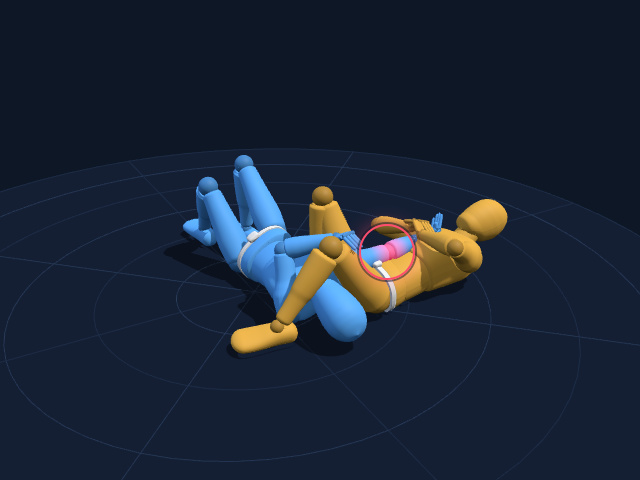
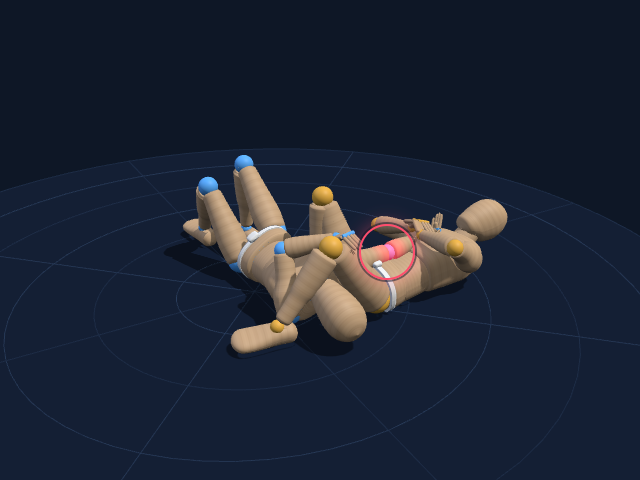
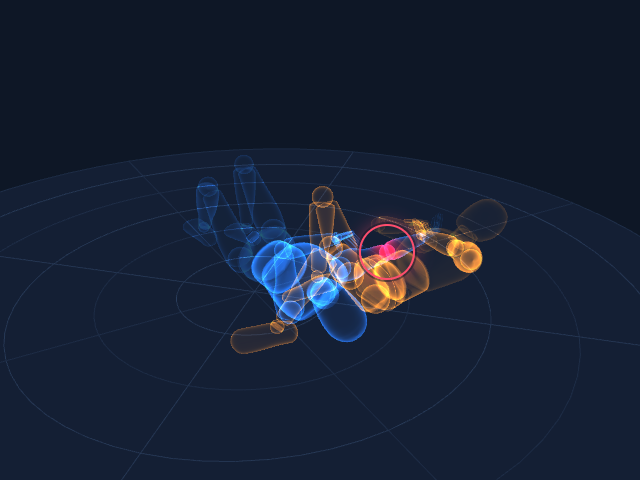
-
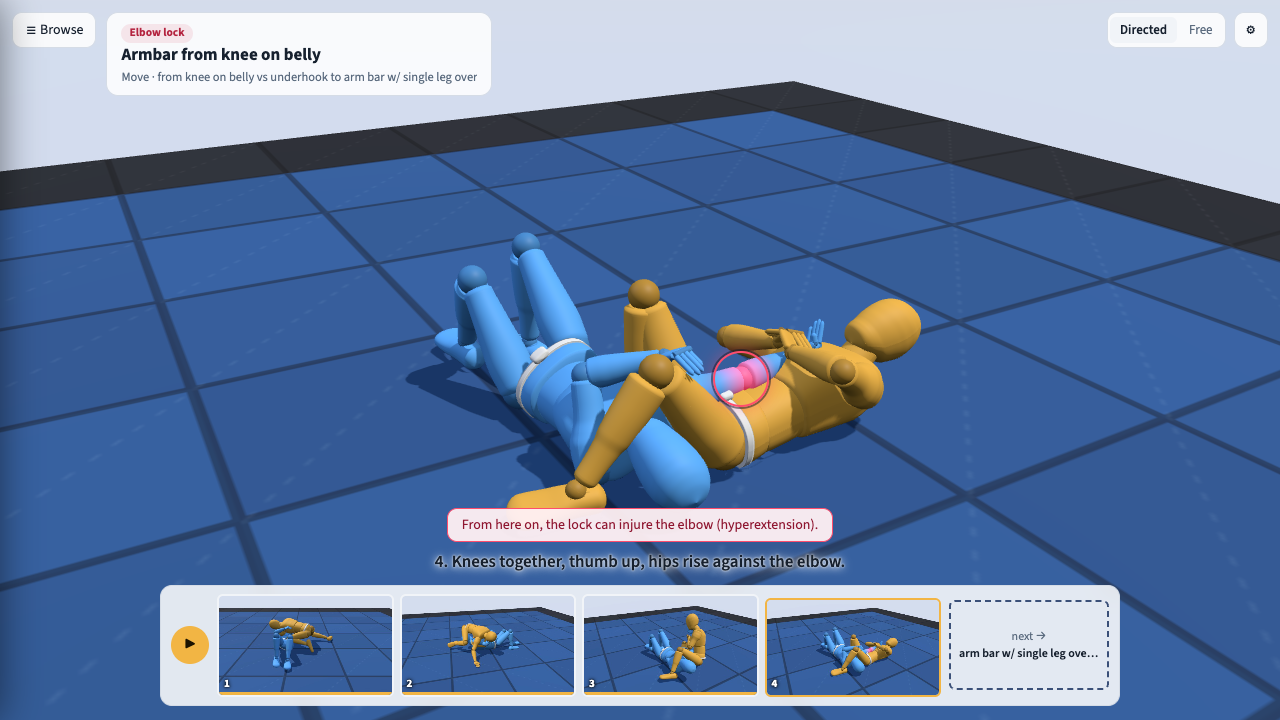
Joint load: one reading per submission kind, lit on the attacked joint only.
kind reading danger from elbow lock elbow flexion, with the opponent's hips on the elbow under 14° knee bar knee flexion, with the opponent's hips on the knee under 25° shoulder lock (kimura, omoplata) internal rotation of the upper arm over 110° knee twist (heel hook, toe hold) rotation of the shin under the bent knee over 60° choke gap between the throat and the axis of the opponent's second-closest limb under 12.2 cm neck crank neck flexion over 75° These are angles and distances, not forces: GrappleMap has neither forces nor timing. docs/validation.md checks them against every finish in the database (15 of 20 reach the danger range; the other five never get there in the animation).
-
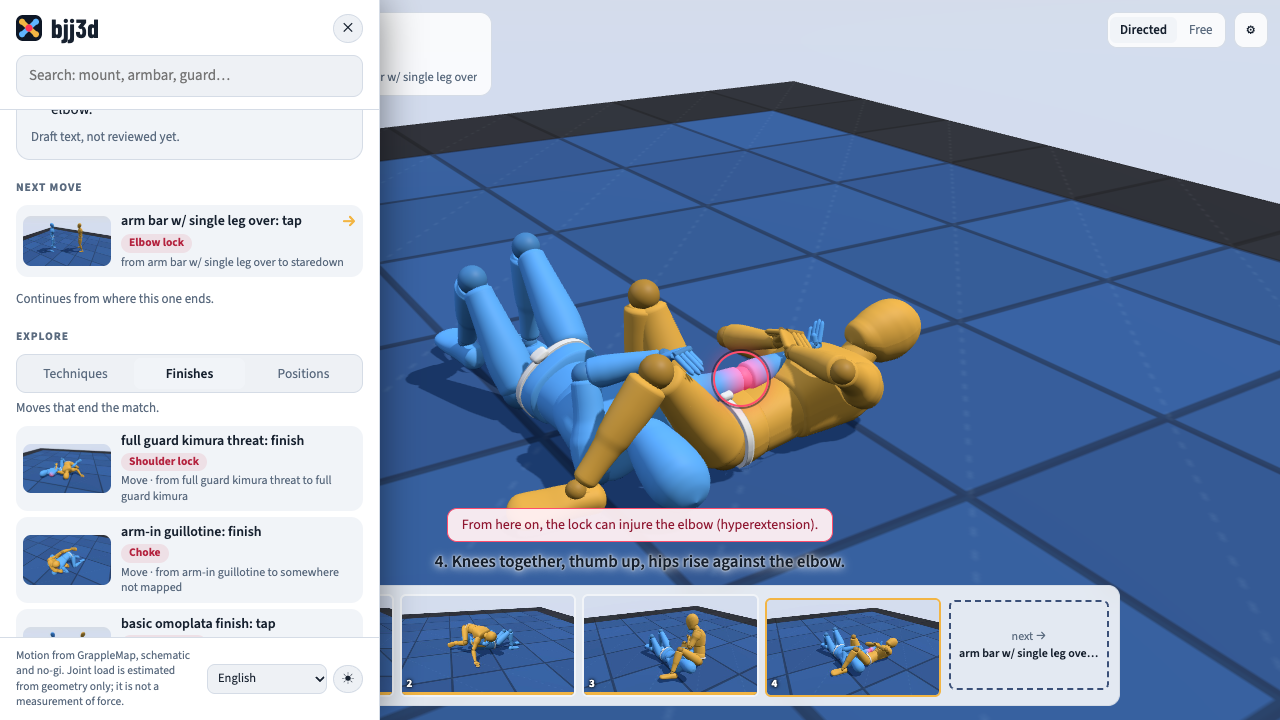
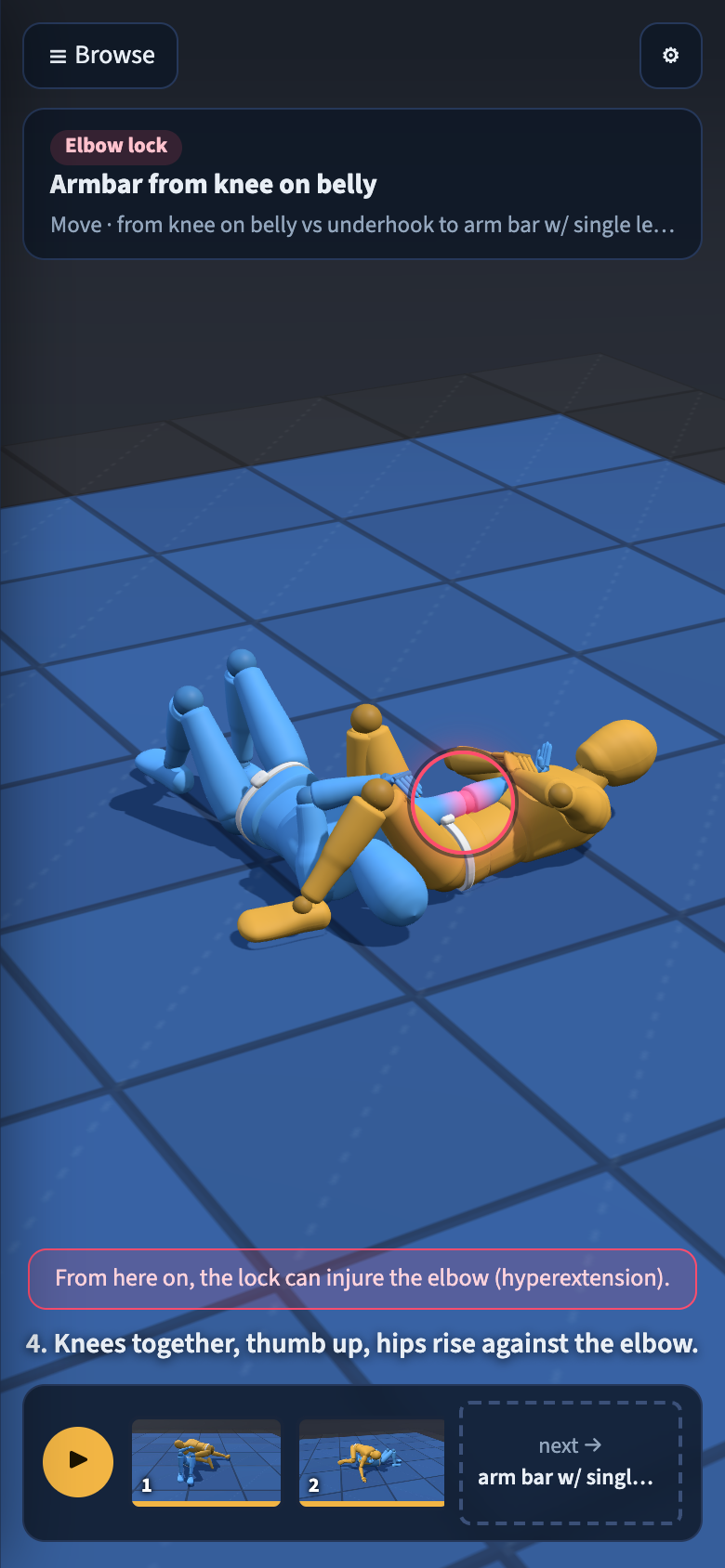
Interface: the move fills the screen. The camera is directed: for each keyframe it picks the angle that keeps the attacked joint in sight, shows the two bodies side by side rather than one behind the other, and stays near the previous angle; it glides there and orbits slowly while playing. Grabbing the view hands the camera over ("Free"); a chip gives it back. Under the move, a filmstrip holds a real frame of every step (or keyframe): click one to jump, drag across to scrub; the last cell offers the next move, which continues from where this one ends. A ring marks the attacked joint while the lock is on. A new fight opens with a big "Oss!" and a pulse, held for a second (not when chaining the next move). At the finishing moment (the first frame in the danger range while playing) time slows to an eighth, the camera pushes in on the joint, the edges darken and a pulse leaves the ring; it can be turned off in the options. The panel (what is on screen with its current frame, next moves, techniques, finishes and positions, each with a picture of where it ends) slides over the view from "Browse"; look, place, other cameras, speed and options sit behind ⚙. A short "how to use" shows on the first visit.
-
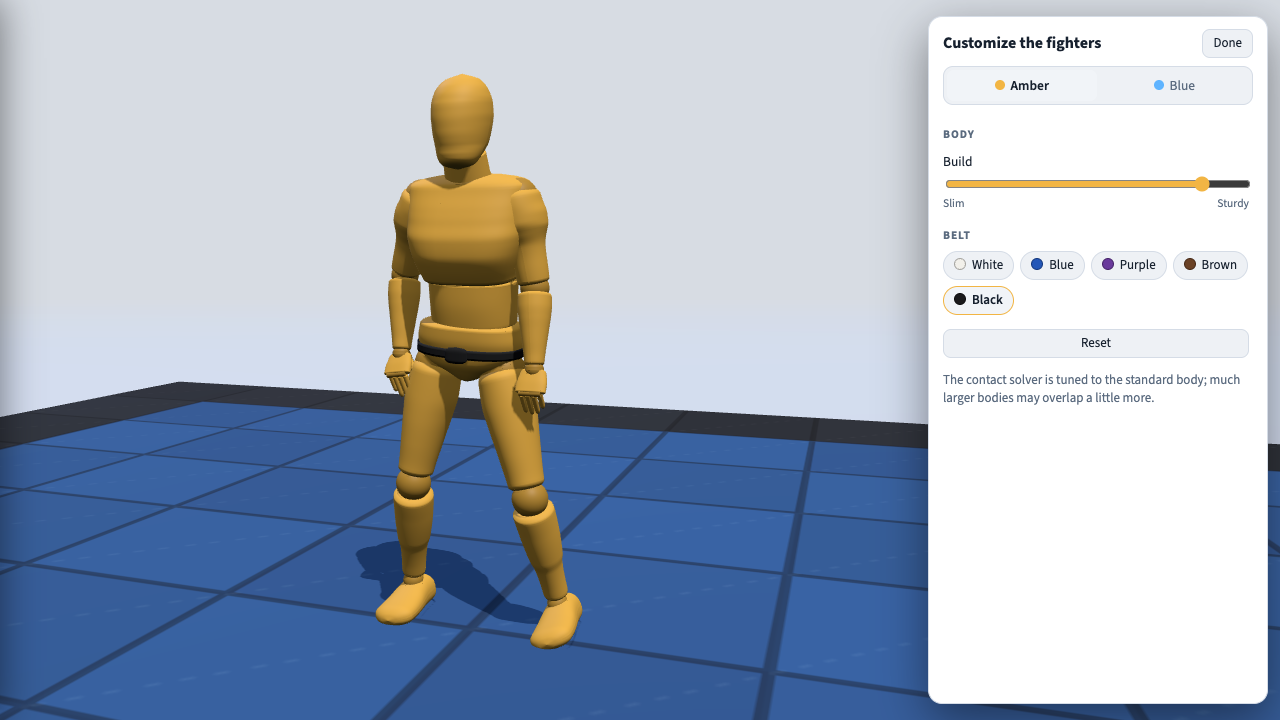
Fighters: each one can be customized on a screen of its own, standing alone: build (slim to sturdy) and belt (white, blue, purple, brown, black). The contact solver is tuned to the standard build, so a much sturdier one may overlap a little more.
-
Places: a competition mat (1 m tiles, 8 × 8 m area with a safety border), a gym (the mat in a room with padded walls), a plain studio (an endless backdrop where only shadows show depth) and the dark grid. All are drawn in code; nothing is downloaded.
mat gym studio dark grid 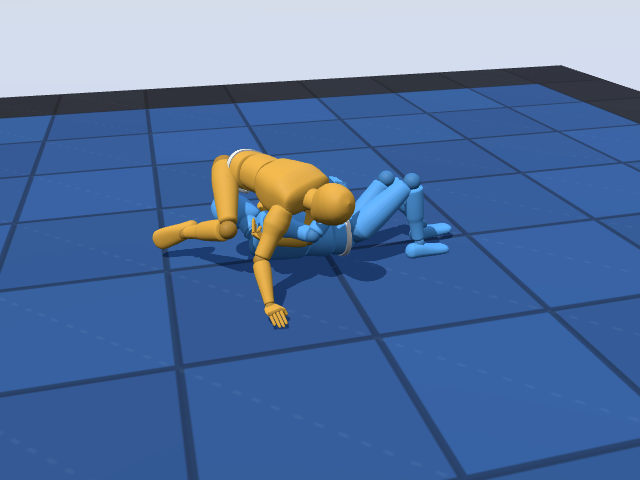
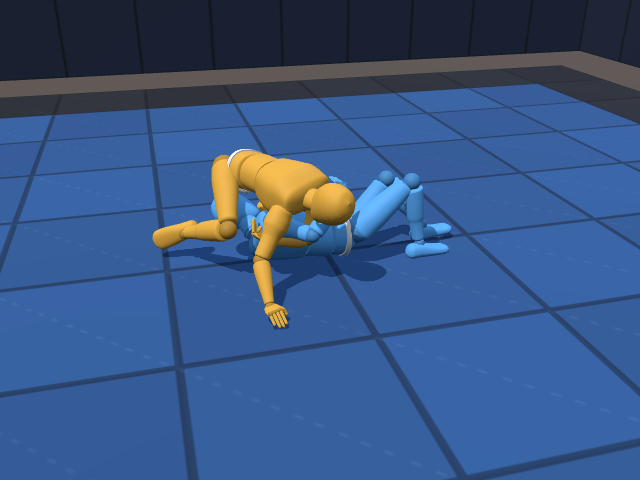
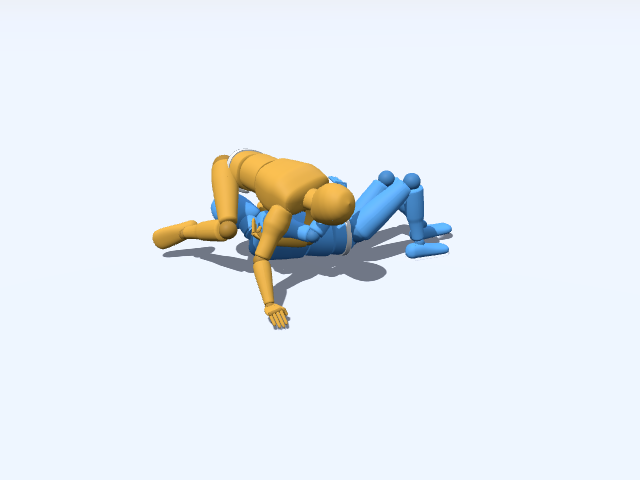
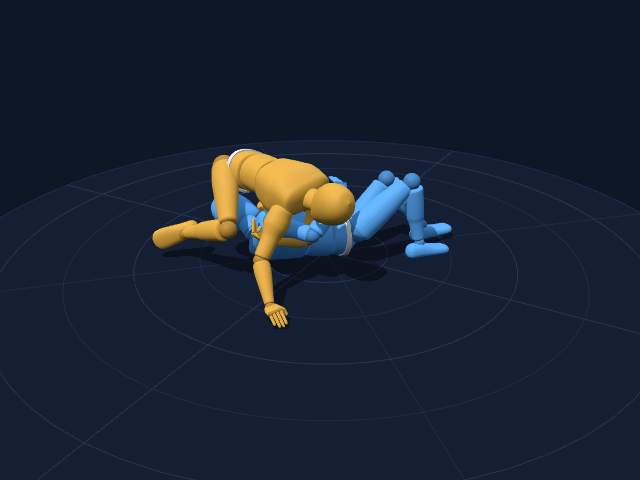
-
Theme: light or dark, following the system on the first visit.
-
Reviewed techniques: a transition can carry hand-written names (English and Portuguese), steps and notes from
data/techniques/. Their text stays marked as a draft until reviewed.


16 languages: pt-BR (default),
en, es, fr, de, it, ru, zh, ja, ko, hi, ar (right to left), id, tr,
nl and pl, chosen at the top of the panel. Each one is a JSON file in apps/web/src/locales/
with the keys of en.json. Portuguese and English are reviewed; the other languages still
need a native speaker's review. Position and transition names stay in English, as in
GrappleMap, and technique texts exist in English and Portuguese only.
pnpm install
pnpm dev
pnpm build writes a static site to apps/web/dist. Links: #p/<n> opens position n,
#t/<n> transition n (#t/<n>r backwards), and ?frame=<k> opens paused at keyframe k.
Keys: space plays and pauses, the arrows step.
For checking: ?debug=1 draws the solved stick figures over the mannequins, and
?graph=<file> loads another build of the data.
The viewer is split into packages that can be used and extended on their own; the site is one more consumer of them. docs/library-plan.md has the plan and what is left.
| package | what it holds | depends on |
|---|---|---|
@bjj3d/core |
the skeleton (23 joints, two players), pose operations, the contact solver (/contact), test poses (/testing) |
nothing |
@bjj3d/grapplemap |
reader and writer of GrappleMap's text format, the position graph | core |
@bjj3d/metrics |
joint-load readings, one per submission kind, as a registry (createMetrics) |
core, three |
@bjj3d/data |
graph.json as the viewer loads it, JSON Schemas of the data formats, the scripts that build and check it |
core, grapplemap, metrics |
@bjj3d/three |
the viewer: mannequins, looks, places, belts, the directed camera | core, metrics, three |
@bjj3d/editor |
the local pose editor and its Vite plugin (/server) |
core, grapplemap, three |
@bjj3d/ui |
the site's interface by atomic design: plain DOM components, tokens and styles | nothing |
Submissions, places, looks and belts are registries: the viewer takes new ones as options,
next to the built-ins (new Viewer(canvas, { metrics, places, looks, belts })), and
viewer.dispose() releases everything it holds. The packages are not on npm yet.
pnpm storybook opens the catalog (apps/storybook): foundations, atoms, molecules,
organisms, templates and pages of the viewer, the engine (skeleton, metrics, every finish)
and guides to extending it. Its Pages level shows the site's production build,
made on first start (pnpm build refreshes it).
data/grapplemap/       GrappleMap database, unchanged (public domain), and bjj3d.txt,
                       our additions in the same format (written by the local editor)
data/techniques/       reviewed techniques: one JSON file per transition
data/body/capsules.json  thickness of each body part (metres), shared by the mannequin and
                       the contact solver
tools/                 icon.svg, banner.html and brand.mjs, which renders docs/banner.png
                       and the PNG icons from the running viewer; screens.mjs, which takes
                       the screenshots in docs/screens/
packages/core/src/
  pose.ts              the skeleton; matches poses up to rotation, mirror and player swap
  contact.ts           offline contact solver and in-between frames
packages/grapplemap/src/
  grapplemap.ts        reader and writer of the text format, the position graph
packages/metrics/src/
  landmarks.ts         a player's joints as vectors
  metrics.ts           joint readings per submission kind, and their registry
packages/three/src/
  mannequin.ts         the jointed mannequin, placed from the joints every frame
  materials.ts         the looks (solid, wood, x-ray), with the load glow
  environment.ts       the places: mat, gym, studio, night
  viewer.ts            scene, playback, chaining, cameras
packages/editor/src/
  editor.ts            the local editor (dev only)
  editor-server.ts     its two endpoints, as a Vite plugin
packages/data/
  src/data.ts          graph.json as the viewer reads it, and search
  schemas/             JSON Schemas of graph.json, techniques and body capsules
  scripts/build-data.ts  GrappleMap + data/techniques -> solved poses -> apps/web/public/graph.json
  scripts/validate.ts  writes docs/validation.md
  scripts/calibrate.ts raw distributions used to pick thresholds
  scripts/find.ts      search transitions from the command line
packages/ui/src/
  atoms/, molecules/, organisms/, templates/  the interface components (plain DOM)
  tokens.css, ui.css   design tokens and component styles
apps/web/src/
  main.ts              the page: the cinema template, filled and wired to the viewer
  i18n.ts, locales/    interface text, one JSON file per language
apps/storybook/        the catalog
{
  "id": "armlock-from-knee-on-belly",
  "reviewed": false,
  "names": { "en": "Armbar from knee on belly", "pt-BR": "Chave de braço do joelho na barriga" },
  "source": { "grapplemap_line": 14237, "from": "knee on belly vs underhook", "to": "arm bar w/ single leg over" },
  "steps": [{ "frame": 0, "text": { "en": "…", "pt-BR": "…" } }]
}
grapplemap_line is where the transition starts in GrappleMap.txt; pnpm find "<name>"
lists candidates. The build checks that the line goes from from to to. Optional fields:
note and risk (both {en, pt-BR}).
The editor exists only in the dev server (pnpm dev), never in a build: ⚙ → ✎ Editor.
It poses the two mannequins by dragging their joints (the big ball moves a whole body; bone
lengths are kept), keeps a list of frames (duplicate, delete, mirror, swap, turn), and saves
the block in GrappleMap's own format to data/grapplemap/bjj3d.txt, which the data build
merges with the original database. Saving rebuilds graph.json (a few seconds: solved poses
are cached in packages/data/.cache) and reloads the page on the new block.
It starts from a neutral position (the best-connected position of each family: standing,
closed guard, half guard, butterfly, combat base, side control, knee on belly, mount,
north-south, turtle, back), from any position found by name, from a copy of any transition
(its keyframes, tags and references), or from the frame on screen. The drawer says which
existing position each end matches, so a new transition connects into the graph; "Append
an existing position as the last frame" ends it on one. Tags use
GrappleMap's vocabulary (closed_guard, armbar, top_kneeling…); a submission tag is
what lights the attacked joint.
pnpm test           # unit tests with coverage (must stay at 100%)
pnpm e2e        # end-to-end: the app driven like a person would
pnpm validate   # regenerates docs/validation.md
- Unit (Vitest): plain modules run in Node; anything that needs WebGL or the DOM
(
*.browser.test.ts) runs in headless Chromium. Coverage is measured over both, over every package andapps/web/src, and the run fails below 100% of statements, branches, functions and lines. - End-to-end (Playwright,
apps/web/e2e/): a dedicated dev server on port 5181, Chromium in new headless mode (WebGL on the GPU when there is one). It covers the first visit and Oss!, the filmstrip and keyboard, the finishing moment, chaining, the panel, settings kept across reloads, the camera chip, theme and language, the fighters screen, a phone-sized screen, the local editor from a neutral position to a saved, rebuilt and playable move, and a production build that must carry no editor. The editor saves into a scratch copy (BJJ3D_ADDITIONS,BJJ3D_GRAPH); the suite fails ifdata/grapplemap/bjj3d.txtorapps/web/public/graph.jsonchanged.
On GitHub, every pull request and push to main runs typecheck and the unit tests. The
end-to-end suite, the validation report and the catalog build run only when started by hand
(Actions → ci → Run workflow, or gh workflow run ci): the runners have no GPU, so the app
draws in software WebGL and that suite takes many minutes.
Motion: GrappleMap by Eelis van der Weegen and contributors, public domain. The thickness of the body parts was measured once on a body generated with MPFB2 (CC0 assets).
Code under MIT or Apache-2.0, at your option.