A PSP emulator written in TypeScript that runs in the browser. It uses HLE (High-Level Emulation) like PPSSPP, so there's no BIOS ROM. PSP syscalls are reimplemented in TypeScript instead.
Try the emulator · Documentation · Compatibility list
It boots real games: decrypts KIRK-encrypted EBOOTs, loads ISO/PBP, runs the MIPS Allegrex CPU and VFPU, renders the GE over WebGL, decodes ATRAC3+ audio and MPEG/PSMF video, and saves game data in the browser.
Work in progress. Several commercial games boot to their menus and render, and the pspautotests CPU/kernel suite passes. Per-game status is on the compatibility list.
Click a thumbnail to play (video only, no audio).
 |
 |
 |
| Ridge Racer (60s replay) | Metal Slug (software renderer) | Cladun (overworld) |
The full documentation covers the user guide, architecture, and a per-subsystem and per-HLE-module reference. Run it locally with npm run docs:dev, or npm run dev:all to serve the app and docs side by side.
git submodule update --init --recursive   # pulls ppsspp-reference (and its nested pspautotests)
npm install
npm run dev
If you cloned without --recurse-submodules, run the submodule line first. The PPSSPP reference and the pspautotests it carries are needed for the test suite, not for running the emulator.
Open the printed localhost URL, pick a game, and load an ISO or PBP. Keyboard controls are in the in-app input settings.
The dev server sends COOP/COEP headers so SharedArrayBuffer works. The GE worker needs it, so a plain static file server won't do.
npm run dev          # dev server (browser frontend)
npm run build:web    # production build to dist-web/
npm run typecheck    # tsc --noEmit
npx vitest run       # all tests
npx vitest run src/  # unit tests only (skip the ones that need ISOs)
Headless tools, run with npx tsx:
npx tsx tools/boot-iso.ts test/fixtures/puzzle-bobble.iso 100   # boot an ISO for N frames in node
npx tsx tools/game-diag.ts test/fixtures/gta.iso                # game diagnostics
npx tsx tools/find-dup-nids.ts                                  # check for duplicate NIDs
The node path has no GE worker, so it's for CPU/kernel/boot diagnostics, not rendering.
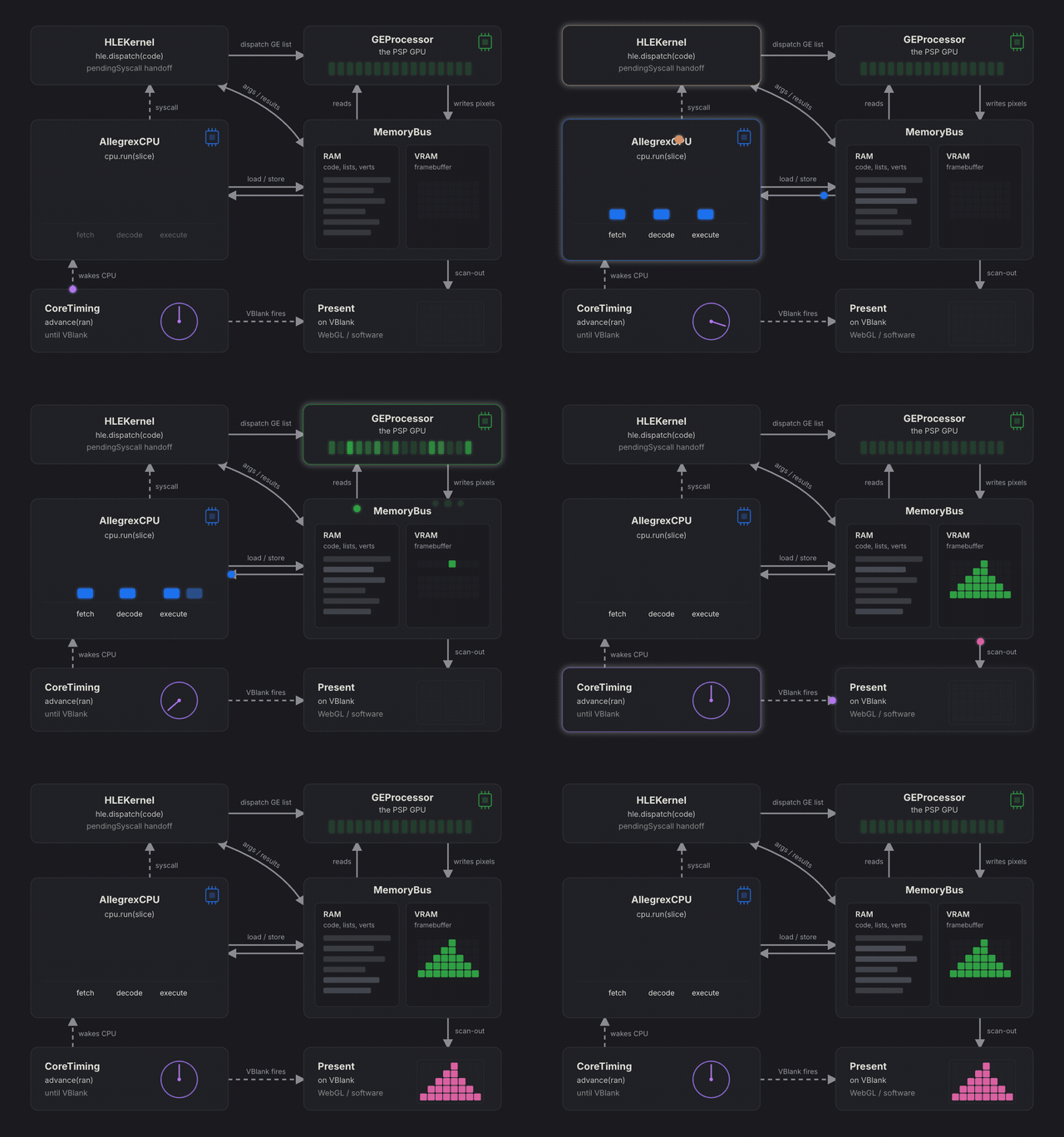
How one frame runs (the CPU runs in slices, the GE draws inline, and CoreTiming fires the VBlank that presents). Animated version of the architecture page:
PSPEmulator (src/emulator.ts)
├── AllegrexCPU   MIPS CPU + VFPU, branch delay slots   (src/cpu/)
├── MemoryBus     64MB RAM, 2MB VRAM, BlockAllocator     (src/memory/)
├── HLEKernel     syscall dispatch, thread scheduler     (src/kernel/)
├── CoreTiming    cycle-accurate event scheduler         (src/timing/)
└── GEProcessor   GE command processing, runs inline     (src/gpu/)
| Path | What's there |
|---|---|
src/cpu/ |
Allegrex CPU and VFPU (decoder, executor, registers). |
src/memory/ |
MemoryBus routing plus a port of PPSSPP's BlockAllocator. |
src/kernel/ |
HLEKernel and per-module hle-*.ts handlers. NID values live in nids.ts. |
src/gpu/ |
The GE: command processor, vertex/lighting/texture pipeline, WebGL and software renderers. Runs inline on the main thread (the off-thread worker exists but is dead code). |
src/loader/ |
ELF loader, PBP parser, and the PRX decrypter for encrypted EBOOTs. |
src/crypto/ |
AES, SHA1, KIRK, AMCTRL. |
src/iso/ |
ISO9660 reader, param.sfo parser, ISO metadata. |
src/audio/ |
AudioWorklet engine and ATRAC3+ decode (via ffmpeg/libav). |
src/media/ |
MPEG/PSMF video demux and decode (WebCodecs). |
src/storage/ |
Browser-persisted savedata and file stores. |
src/frontend/ |
The browser UI. Entry point is main.ts, loaded by index.html. |
Tests run under vitest. npx vitest run src/ covers the units (CPU, crypto, timing, parsers). test/ boots real ISOs from test/fixtures/ and runs the pspautotests harness in test/pspautotests/, which uses compiled .prx programs from the ppsspp-reference/ submodule.
ppsspp-reference/ is a submodule with the PPSSPP source. It's the ground truth for PSP behavior. When fixing a syscall, read the matching Core/HLE/sce*.cpp and match it instead of guessing. ppsspp_niddb.xml is generated from the project's NID constants with npm run nids:generate. Check hardware behavior against the reference source when needed.
See CLAUDE.md for the deeper architecture notes and conventions.