Open the live wind tunnel in your browser →
A butterfly flight simulator in plain JavaScript. It models the air with a 3-D unsteady vortex lattice, couples it to the dynamics of the body, and drives both with the measured wingbeat of a monarch. It runs in Node and live in the browser. It has no dependencies; the viewer loads three.js.
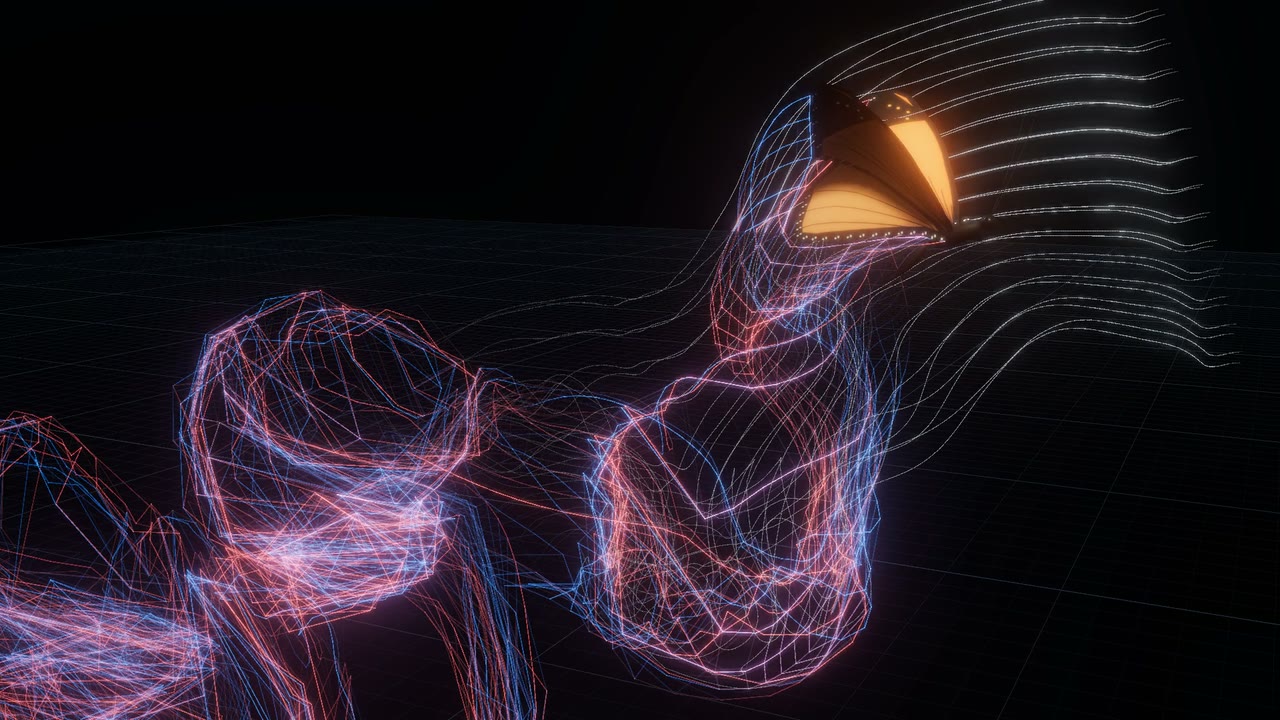
A monarch's measured wingbeat at 20× slow motion: smoke-wire streaklines, then the red and blue vortices each stroke leaves behind (30 s video).
- Unsteady aerodynamics.
- Lattice: each side's fore- and hindwing, which fly overlapped, are one vortex-lattice wing.
- Wake: a free wake rolls up behind every stroke.
- Wing–wing interaction: the two wings induce flow on each other, so the clap and fling come out of the solution.
- Included effects: added mass, wake capture and the effect of body motion on the air. Leading-edge-vortex lift is added with the Polhamus suction analogy.
- Comparison model: a quasi-steady blade-element model runs on the same geometry.
- Measured wingbeats.
- Monarch: the preset plays the measured flap, feathering, deviation, body pitch and abdomen motion of a monarch in climbing flight (Fourier fits to motion capture).
- Deformation: wings can also twist, camber and bend.
- More species: five others come with measured morphology and partly assumed wingbeats.
- Flight, not only forces.
- Body: a thorax, a hinged abdomen and the wing masses.
- Modes:
- wind tunnel: motion prescribed;
- free flight: the body moves under its own forces while its pitch follows the measured history;
- fully free: six degrees of freedom with a flight controller (experimental).
- Outputs: it trims itself to steady flight, takes gusts, and reports lift, thrust, pitching moment and power.
- Seeing the air.
- Live viewer: wake filaments, smoke tracers, wing loads, force charts, and sliders for every wingbeat parameter.
- Film: a renderer turns runs into film.
-
Against theory, within a few percent. Each of these runs in
node --test tests/:- steady lift slope within 1.5 % of lifting-surface theory;
- an impulsively started wing within 3 % of Wagner's function;
- a plunging wing within 5 % in amplitude and 1° in phase of Theodorsen's theory;
- momentum conserved to 1 part in 10⁴.
-
Against butterflies, close where the inputs are measured.
- Lift balance: take the measured monarch wingbeat at its measured speed and climb, untrimmed. Once the wings carry a modest camber, the solver gives 0.96 of the body weight in lift, a net thrust of −0.05 weight and a pitching moment near zero. The camber is assumed (12 % in the downstroke, 6 % in the upstroke), within the range measured on painted-lady wings.
- Flat wings fall short: flat rigid wings carry only half the weight, as published rigid-wing models also find.
- Trim and free flight: balancing the forces exactly moves the measured wingbeat by under 5°. In free flight the monarch settles at 1.6 m/s in a 26° climb; the real one flew at 1.42 m/s and 23°.
-
Where it is weaker.
- Painted lady: its wingbeat is reconstructed by eye from published figures. Peak and RMS lift fall inside the range measured on the animal, but mean lift comes out 55 % high.
- The clap: it adds thrust as the wings close, but the upstroke as a whole gives net drag, where real butterflies get thrust. The real clap is flexible, and that is the likely difference.
- Fully free flight: pitch is unstable within one wingbeat, as in published butterfly models. The controller holds it for a few beats only.
-
What it does not resolve.
- flow separation and the leading-edge vortex itself;
- wing elasticity, since deformation is prescribed;
- viscous decay of the wake beyond a core-growth law.
Use it for trends, force magnitudes, power and wake topology, not for the near-wing flow detail that needs CFD.
More detail:
- Validation: every comparison with published data is in reports/validation.md.
- Ingredients: what each piece of the physics is worth is in reports/monarch/study.md.
- Model: the full description is in docs/model.md.
git clone https://github.com/mishaevoma/butterfly-sim && cd butterfly-sim
python3 -m http.server 8642            # the viewer locally, at http://localhost:8642/ (or use the live link above)
node --test tests/                     # benchmarks, about 25 s (Node 18+)
node tools/validate_butterflies.mjs    # regenerates reports/validation.md, about 3 min
import { FlightSim } from './src/sim.js';
const sim = new FlightSim({ species: 'monarch', aero: 'uvlm', mode: 'tethered' });
sim.run(4);                    // four wingbeats
console.log(sim.averages(1));  // lift/weight, thrust/weight, moment, power …
To make the film, run node tools/film_record.mjs, then node tools/render_film.mjs. This needs Google Chrome, puppeteer-core and ffmpeg.
| Path | What |
|---|---|
src/ |
the solver: vortex lattice, quasi-steady model, wing geometry, kinematics, body dynamics, trim, control and species presets |
index.html, viewer/ |
the wind-tunnel viewer (three.js, a web worker, force charts) |
tests/ |
analytic and multibody benchmarks |
tools/ |
validation, the study, trims, controller tuning, film recording and rendering |
reports/ |
validation and study reports with figures |
research/ |
sourced notes on morphology, kinematics, validation targets and existing codes |
docs/ |
the model in detail |
film/, media/ |
the film page, and the poster and compact video |
-
Monarch data: kinematics, segment masses and the combined wing outline come from the FWUAV repository (fdcl-gwu, George Washington University), fitted to motion capture of a monarch in climbing flight. That monarch's wing size is from Pohly et al. (2022).
-
Sources:
research/kinematics_morphology.mdlists the source of every number and how it was obtained. -
Validation targets:
- Bode-Oke & Dong (2020);
- Zheng, Hedrick & Mittal (2013);
- Johansson & Henningsson (2021);
- Yokoyama, Senda, Iima & Hirai (2013).
See
research/validation_and_code.md. -
three.js: r160 (MIT licence), loaded from jsDelivr.