This is a project about using Spark with Scala and IntelliJ IDE. I participated in the Kaggle Knowledge Competition called House Prices: Advanced Regression Techniques and used their datasets (put them inside a data/ folder). The goal of the competition is to predict the sales price for each house. The models are evaluated using Root-Mean-Squared-Error (RMSE), which means that the lower the value, the better -- the predictions are close to the actual house prices.
- IntelliJ IDEA 2020.1.3
- scala = 2.11.12
- spark = 2.4.5
This assumes that you are using IntelliJ IDE. This part is similar to using sbt assembly command if you are using the sbt plugin.
-
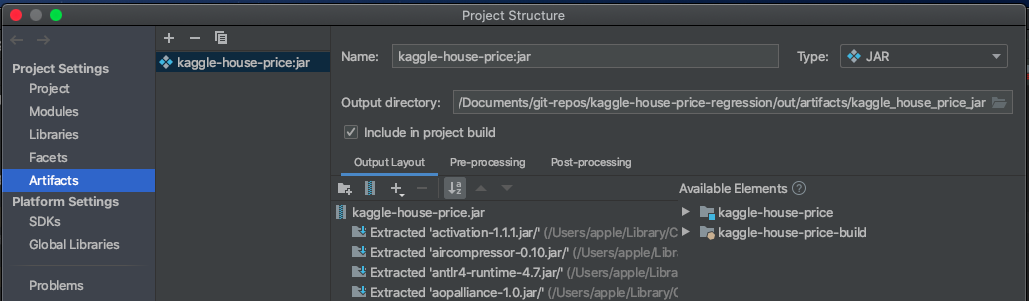
File -> Project Structure -> Artifacts -> + -> JAR -> "From modules with dependencies...".
-
Fill in the information and make sure to tick the box: "Include in project build". Same as shown in the picture below:
-
Click OK. Then "Build Project". It will generate the jar file inside the
out/artifacts/.

Again, this assumes that you are using IntelliJ IDE. This part is similar to using spark-submit command if you have spark in your machine.
-
Run -> Edit Configurations... -> + -> Application
-
Name it "spark-submit", just for ease of understanding.
- Main class:
org.apache.spark.deploy.SparkSubmit - VM options:
-Dspark.master=local[2] - Program arguments:
--class <name_of_class> <location_of_jar_file> args, example:
--class kaggle.houseprice.HPRegression /<location_path>/out/artifacts/kaggle_house_price_jar/kaggle_house_price.jar data/train.csv data/test.csv data/sample_submission.csv tmp/submissionIt looks like this:

- Main class:
-
Click OK. Run "spark-submit". It will generate the CSV file inside the
tmp/submission/, which you can submit to Kaggle.

- Check the RMSE of the
sample_submission.csv
- Trial submission using Linear Regression with one feature.

- Linear Regression with more features: combination of numerics and categories.

- Linear Regression with more features: combination of numerics and categories + hyperparameter tuning via cross-validation.


