GeezerVison is showing github.com — Build software better, together
Here are
24 public repositories
matching this topic...
Language:
All
Filter by language
Sort:
Most stars
Sort options
Free quant interview prep for quant trader, researcher, developer, and risk roles at HFT firms, prop shops, and hedge funds: 292 topics, 6,264 question cards, 18 firm guides, CI-checked C++20 and Python code, and a self-tracking study platform.
-
Updated
Nov 22, 2026
-
Jupyter Notebook
Manuel Touyaa's porfotlio of Python projects/assignments for Finance Market Risk.
-
Updated
Mar 5, 2022
-
Jupyter Notebook
Free, open-source FRTB capital calculators
-
Updated
Feb 1, 2026
-
Python
This is about calculating Market Risk capital charge under Standardised Approach(SBM) in FRTB
-
Updated
Dec 19, 2023
-
Jupyter Notebook

-
Updated
May 27, 2024
-
Rust
Shreejit Verma - Senior Quantitative Developer (FRTB market risk, low-latency C++). Profile README and source of www.shreejitverma.com
Advanced Approach under FRTB(IMA) requires institutions to meet quantitative tests namely Backtesting and PnL attribution..
-
Updated
Nov 2, 2023
-
Jupyter Notebook
FRTB IMA-compliant daily VaR/Expected Shortfall risk monitor: stress calibration, liquidity-horizon scaling, NMRF checks, Acerbi-Szekely/Kupiec/Christoffersen backtesting, a Plotly Dash dashboard, and Claude-generated narratives.
-
Updated
Nov 28, 2026
-
Python
End-to-end sell-side market-risk engine: VaR/ES across four methods, FRTB Expected Shortfall with liquidity horizons, Basel III vs FRTB capital, Kupiec/Christoffersen backtesting, stress testing and component-VaR attribution.
-
Updated
Jun 8, 2026
-
Python
EU banking regulatory risk frameworks implemented in Python: IRRBB, FRTB, CSRBB, credit risk IRB, and liquidity risk (LCR, NSFR, stress testing, ILAAP).
-
Updated
Jul 17, 2026
-
Python
Open-source financial risk platform with 385+ JIT-accelerated functions for fast VaR and Monte Carlo simulations.
-
Updated
Nov 28, 2026
-
Python
VaR backtesting engine + FRTB SA capital calculator in Python
-
Updated
Oct 13, 2026
-
Python

FRTB standardized approach (SA) market risk capital: Excel/VBA prototype of SBM, DRC and RRAO, reconciled with an independent Python reference in LibreOffice. Builds, regression, acceptance and sync checks passed in desktop Excel on one host; not regulatory-certified.
-
Updated
Nov 27, 2026
-
Python
FRTB-aligned VaR & Expected Shortfall risk engine with GARCH volatility modeling, regulatory backtesting, and Streamlit dashboard — built for Swedish equities.
-
Updated
Sep 12, 2026
-
Jupyter Notebook
VaR y Expected Shortfall por simulación histórica filtrada con GARCH y DCC-GARCH, colas por teoría de valores extremos, y suite completa de backtesting: Kupiec, Christoffersen y Acerbi-Szekely.
-
Updated
Nov 10, 2026
-
Python
Expected Shortfall 97.5 and Stressed VaR under Basel III and FRTB, three estimators compared, with a Kupiec backtest of a calm window calibration.
-
Updated
Aug 26, 2026
-
Jupyter Notebook
Stochastic simulation for risk modeling and model validation: VaR and ES, backtesting, model risk (SR 26-2), credit portfolio risk and PD validation, counterparty exposure and CVA, Monte Carlo methods, operational risk and stress testing. Ten slide decks, verified Python code, 3D figures and animations.
-
Updated
Nov 20, 2026
-
Python
Basel FRTB market-risk capital in Python: Standardised and Internal Models approaches, desk eligibility, SA fallback and Market RWA on a synthetic trading book.
-
Updated
Sep 10, 2026
-
Jupyter Notebook
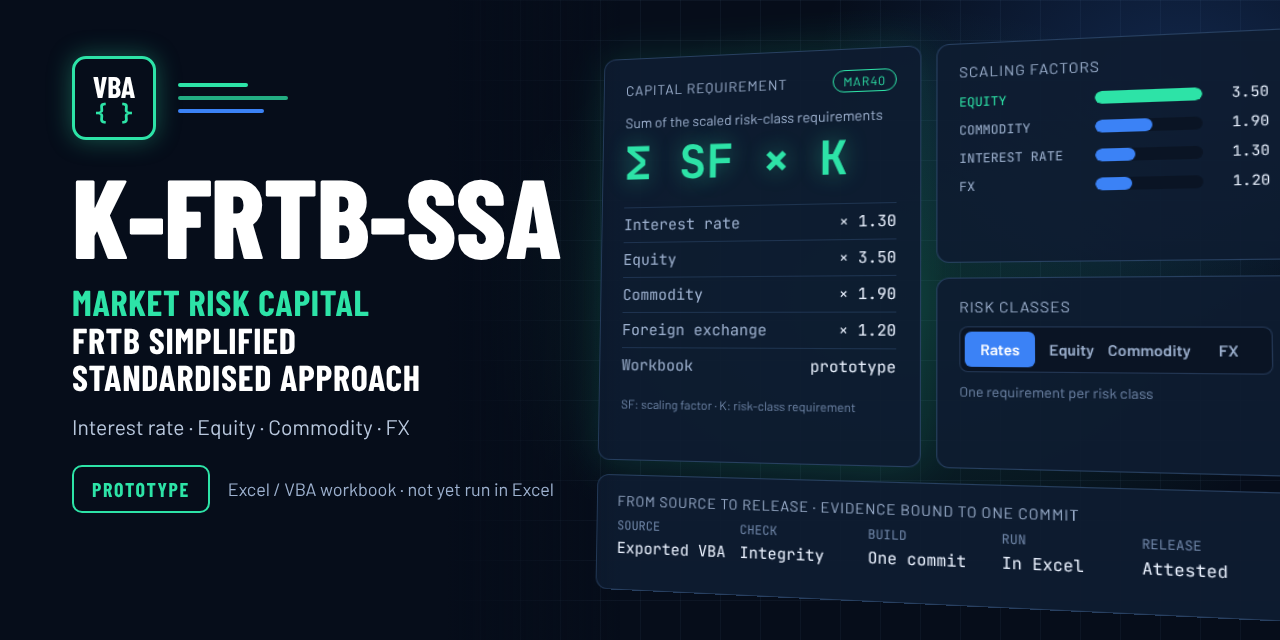
FRTB simplified standardised approach (Basel MAR40 and EU CRR) market risk capital in Excel/VBA: interest rate, equity, commodity and FX. Prototype: run in LibreOffice only, not yet compiled or run in Excel; the CRR regime and every rule are not validated; synthetic data only.
-
Updated
Nov 28, 2026
-
Python
Basel IV FRTB Sensitivity-Based Method (SBM) Equity Risk Capital Charge Calculator in Python (BCBS MAR21 compliant).
-
Updated
Aug 4, 2026
-
Python
Add this topic to your repo
To associate your repository with the
frtb
topic, visit your repo's landing page and select "manage topics."
Learn more
|