

Author: Yang Su · ENS-PSL · [email protected]
Click the link above or either illustration below. Runs in your browser with no installation or sign-in.
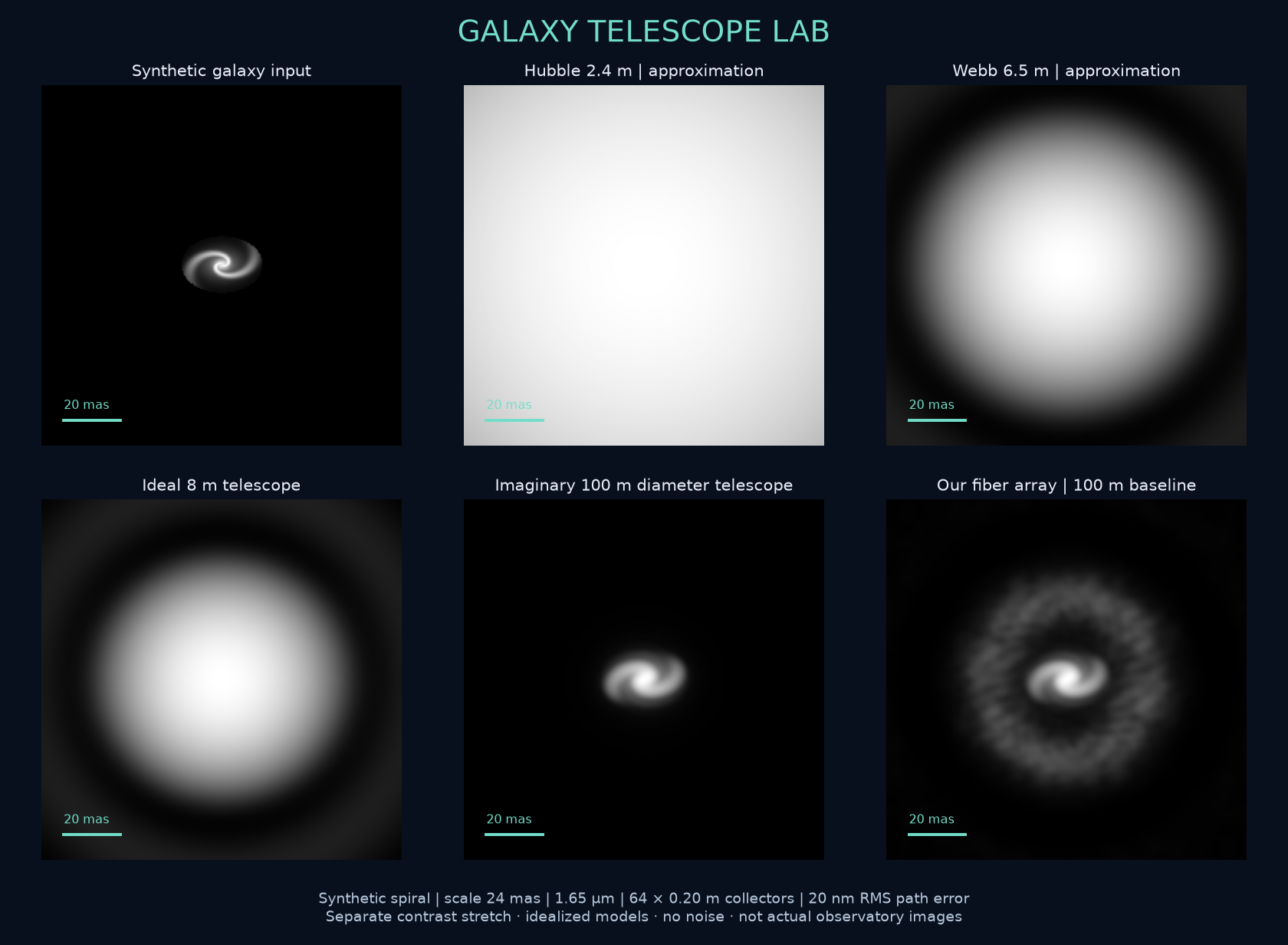
An interactive scalar-optics simulator comparing five telescope models viewing the same synthetic galaxy. Select spiral, barred spiral, elliptical, edge-on disk, interacting pair, or ring morphology. Change wavelength, exposure, source flux, collector count/diameter, residual optical-path error, output-pupil packing, detector noise, and display scaling. Export a six-panel PNG and JSON settings/results.
The app provides English (original) | 中文 | Bilingual, defaults to English, and works offline by opening index.html.
| Model | Diameter / baseline | Interpretation |
|---|---|---|
| Hubble approximation | 2.4 m diameter | Ideal circular aperture, not the actual Hubble PSF |
| James Webb approximation | 6.5 m diameter | Ideal circular PSF and 25.37 m² collecting area; no segmented pupil |
| Ideal 8 m telescope | 8 m diameter | Filled circular diffraction-limited reference |
| Imaginary 100 m telescope | 100 m diameter | A theoretical filled-aperture reference, not an existing observatory |
| Our proposed fiber hypertelescope | 100 m longest baseline | Sparse collectors with adjustable coherent combination; not a validated instrument |
All models use the same selected wavelength, synthetic source and angular scale. Webb is marked unavailable at 0.55 µm. The Hubble/Webb panels are simulations, not downloaded observatory images. Instrument filters, obscurations, mirror segmentation, detector sampling and measured throughput are not modeled. A common assumed 20% throughput and simplified noise model make this a controlled comparison, not a sensitivity ranking of real observatories.
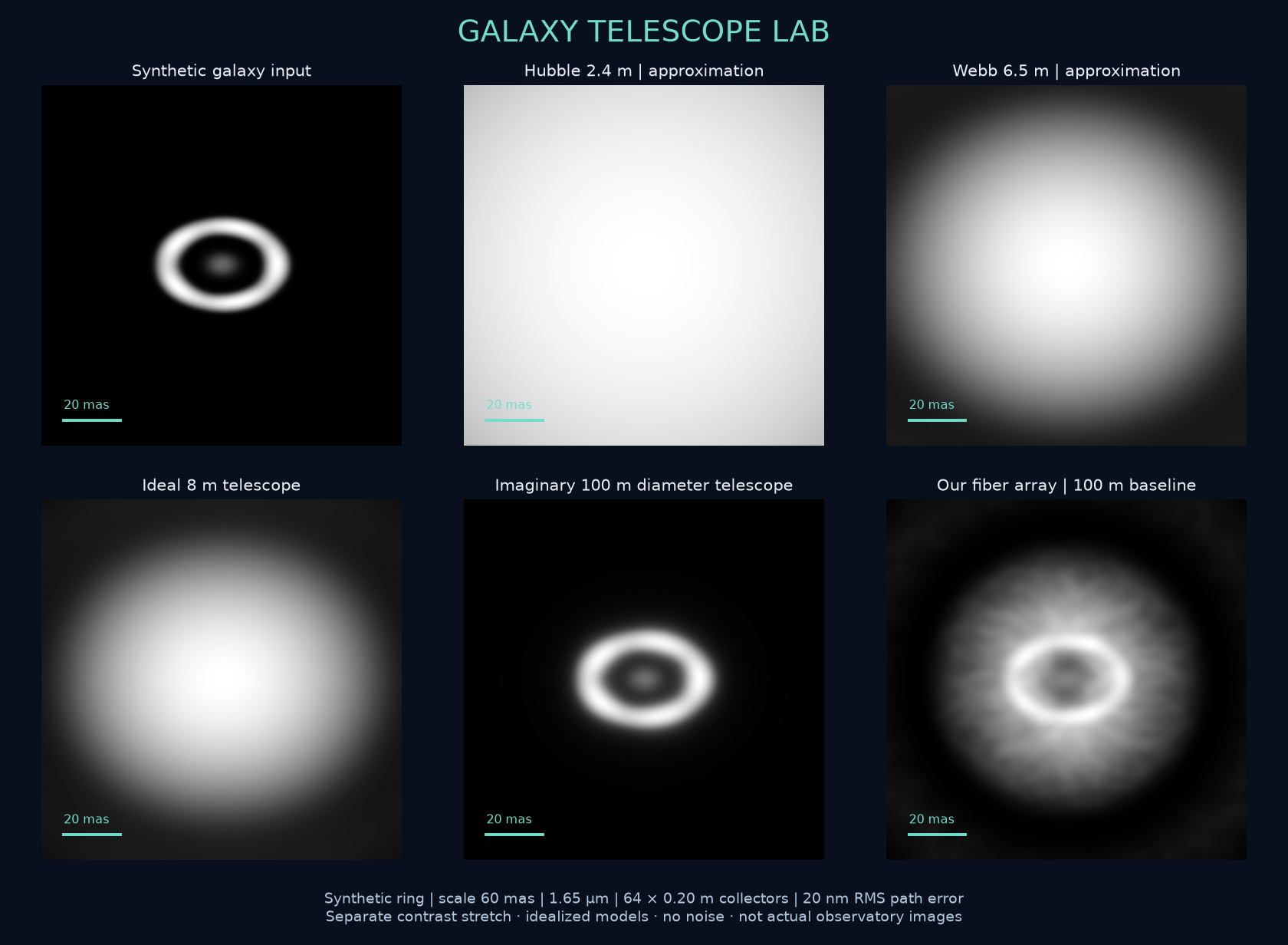
The illustrated ring has a 60 mas characteristic size, beyond the default array's approximate 34 mas characteristic field. Sparse-array artifacts and field limitations remain even when optical paths are well aligned. Each panel is independently stretched; use Same scale in the app to compare photon counts.
- Filled circular apertures use Airy intensity PSFs and FFT convolution. PSFs are analytically normalized over the whole plane; light outside the displayed field is not restored.
- Coherent mode sums fields across collectors for each source point, then adds the intensities of mutually incoherent source points. A fixed output-pupil envelope limits the field.
- Independent-camera mode adds small-aperture images: a 100 m spacing does not produce 100 m resolution.
- Default 64 × 0.20 m collectors collect 2.01 m², versus 7,854 m² for the imaginary filled 100 m aperture.
- Wavelength switching changes diffraction, not galaxy spectral morphology. One universal fiber is not assumed to transmit every band.
- No atmosphere, feedback-control dynamics, actual fiber losses, image reconstruction or AI enhancement is modeled. This educational simulation does not establish engineering feasibility.
The original 8 m and 100 m calculations were checked against independent SciPy Airy convolutions (maximum absolute discrepancy divided by peak intensity below 10⁻⁶). Browser checks cover all six galaxy models, phase response, independent-camera invariance, noise, language modes, mobile layout and exports.
- Patru et al. — Fiber hypertelescope laboratory imaging
- Lardière et al. — Sparse-aperture field-of-view limitations
- Bouyeron et al. — Experimental co-phasing
- NASA — Hubble vs. Webb
- NASA — Webb telescope overview and collecting area
Illustrations are generated by this simulator from synthetic sources; they are not NASA imagery.