Custom scripts get the job done once, yet as soon as you maintain several Java or Kotlin agents, you want those evaluations living in src/test and running with mvn test on every pull request.
Back in June, I wrote about vibe-coding a Philosophy Bac prep app to help my daughter revise her handwritten flashcards before her high school exams.
She passed, and she is now in her first year of medical school.
Med school comes with a new set of study habits.
In several of her courses (cell biology, biochemistry, histology), professors project dense slides packed with Western blots, fluorescence microscopy, and molecular structures, but do not share the slide decks with students.
Seated in a large amphitheater, she does what every student does: she snaps quick photos of the projector screen with her phone, hoping to print them out later as clean study handouts.
Recently, I read Alex Abashev’s article on Foojay.io, My love-hate relationship with Java formatters.
Unlike Go with gofmt or Rust with rustfmt, Java has never shipped a built-in source code formatter in the JDK, leaving teams to argue in pull requests over Checkstyle rules, IntelliJ XML exports, or where the dot goes in a stream pipeline.
In his post, Alex made two points that immediately resonated with me:
Once you experience an opinionated, zero-configuration formatter as a CI gate, you never want to go back to bikeshedding over indentation in code reviews.
AI coding agents make deterministic formatters matter more than ever. Every model and every session has its own idea of code style, regardless of what you write in your AGENTS.md or GEMINI.md files. One agent puts every method parameter on its own line, another crams a whole stream pipeline into a 200-character line, and a third reformats untouched methods, turning a two-line bug fix into a 400-line whitespace diff.
In his article, Alex also introduced open-java-format (GitHub), an open-source fork of palantir-java-format that he created to fix long-standing bugs, modernize the build and IDE tooling, and keep pace with recent JDK releases.
Both upstream targets move fast.
The Gemini Interactions API updates its public OpenAPI specification (interactions.openapi.json) whenever new agent capabilities, voice synthesis options, or webhook parameters land.
Meanwhile, the official Antigravity Python SDK publishes new wheels to PyPI containing updated native Go localharness binaries, compiled Protobuf descriptors, and new Python classes.
With Devoxx Belgium 2026 just around the corner (October 5–9 at Kinepolis Antwerp), I started looking through the schedule to decide which sessions to attend.
With more than 200 talks spread across 5 days, multiple session formats (Deep Dives, Hands-on Labs, Conference sessions, Tools-in-Action, and BOFs), and up to 8 parallel tracks running at any given time, putting together a cohesive, conflict-free agenda by hand takes quite a bit of clicking back and forth.
Most of our conversations around Large Language Models focus on generative chat: you give the model a prompt, and it outputs a sequence of tokens autoregressively.
Recently, Typesafe AI introduced a different paradigm called System 1 models, embodied by Jev. Rather than generating free-form prose token by token, a Jev-style model acts as a high-speed, deterministic decision maker. Given an input state and a series of discrete questions, it runs in a single forward pass and outputs calibrated probability distributions for each question:
In this post, I will explain what these models offer, what was added to the SDK, and show you a complete, practical example of how to design a custom voice and synthesize speech with it.
A few months ago, I introduced the unofficial Antigravity SDK for Java.
My goal was simple: enable enterprise Java developers to build and run autonomous AI agents in Java, backed by the same engine that powers Google Antigravity.
The ability to run models locally on-device without cloud API dependencies, and without paying token costs for high-frequency tasks, sounded very appealing, right? 😃
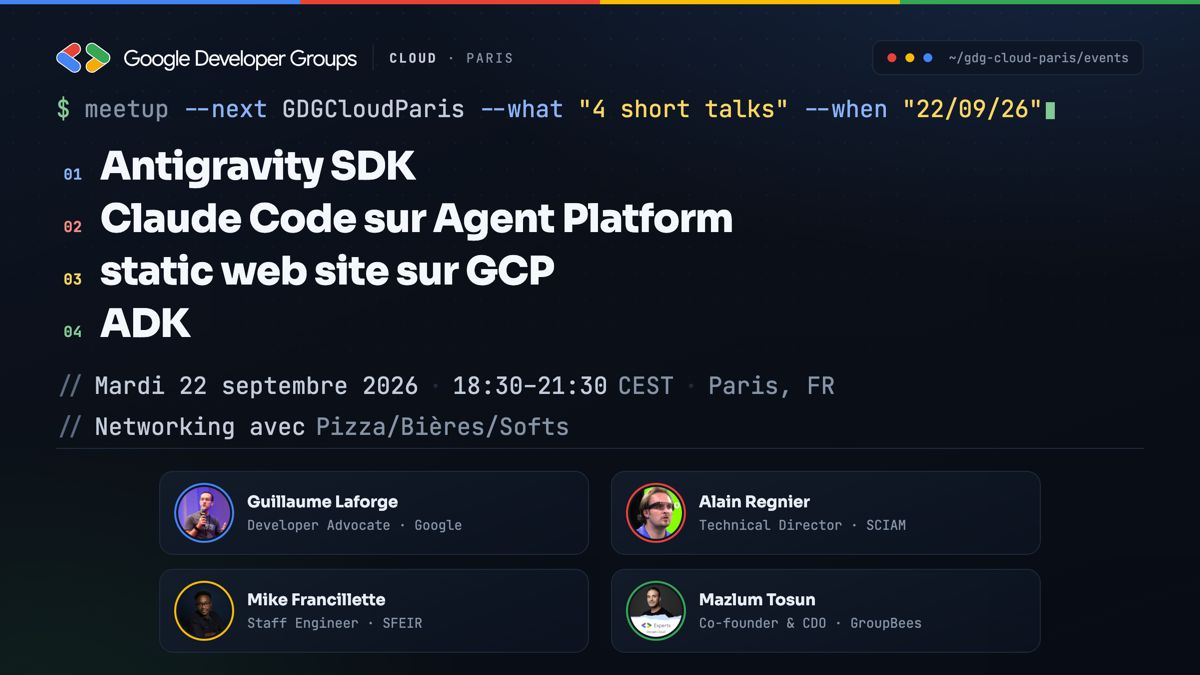
I spoke at GDG Cloud Paris, hosted at Sfeir.
The meetup featured four short presentations on cloud and AI technologies, and my talk focused on the Antigravity SDK for the Java Developer.
Most developers who have used Antigravity are familiar with its user-facing surfaces:
Antigravity 2.0: the desktop agent manager
Antigravity CLI: the terminal tool for command-line agent runs
Antigravity IDE: the agent-centric code editor
Underneath these applications lies the Antigravity harness (actually, a Go binary!), which lets you programmatically define, host, and orchestrate AI agents with Gemini models.
Google offers a Python SDK that wraps the Go binary.
While the official SDK is currently available for Python, I built an unofficial Antigravity SDK for Java (with the help of Antigravity 2.0 itself)
so JVM developers can build the same agent automations in Java.
You are visitor 01402503 — GeezerVison does not store the pages you look up. Best viewed with Netscape Navigator 4.7 or Internet Explorer 6 at 800×600. No cookies required.