GV

GeezerVison

The World Wide Web, restored to 800 pixels of glory.

Home|About|Gaming cabinet|Archives|How it works|Starter sites

On this site

  • Rui's Blog
  • Posts
  • Notes
  • 简体中文

This view

  • Original page
  • New address

GeezerVison is showing low-hands.github.io — Rui's Blog

Author Image

Hi, I am lowhands

  • I am a master student at UBC
  • I am interested in AI software development

Rui

Master Student at UBC

I am a Master of Engineering student in the Department of Electronical and Computer Engineering at UBC, Vancouver. I am interested in Vision Language Models and Diffusion LLMs.

Hard Working
Team Work
Innovation

Skills

Java
Java

Proficient in Java programming. Used for website construction.

Python
Python

Using as the main language for professional AI development. Capable of writing scalable, testable, and maintainable program.

Scikit-learn
Scikit-learn

Experienced with the basic usage of scikit-learn library.

Git
Git

Experienced with git-based development. Mostly, use Github. Also, have experience in working with GitLab.

Experiences

1
Huawei Technologies Co., Ltd.

July 2025 - Dec 2025

Nanjing, Jiangsu, China

Huawei is a leading global provider of information and communications technology (ICT) infrastructure and smart devices.

AI Software Engineer Internship

July 2025 - Dec 2025

Responsibilities:
  • Contributed to the development of a large-scale Java language model for IDE code completion scenarios
  • Led the construction of data flows for the model’s SFT phase and optimized preference alignment in the DPO phase using real-world bad cases from production, thereby achieving dual improvements in both offline accuracy and online adoption rates.

Education

M.Eng. in Elctronical and Computer Engineering
The University of British Columbia
2024 - 2026
M.Eng. in Elctronical and Computer Engineering
GPA: 92.9 out of 100
B.Sc. in Computing Science
University of Alberta
2022 - 2024
B.Sc. in Computing Science
GPA: 3.86 out of 4
B.Eng. in Software Engineering
Beihang University
2019-2022
B.Eng. in Software Engineering
GPA: 86.7 out of 100

Featured Posts

Hero Image
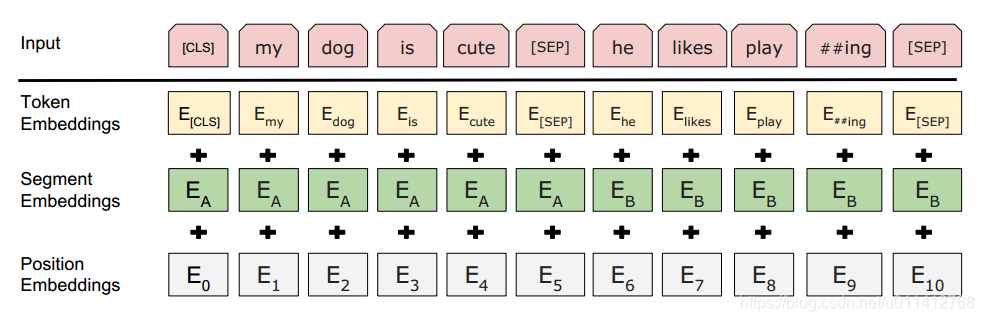
Encoder-only

What is Pre-training? Initializing neural network model parameters through self-supervised learning (unlabeled data). The goal is to learn a universal language understanding capability. BERT BERT Pre-training Tasks Masked Language Modeling (MLM) A certain percentage (15%) of tokens in the input sequence are replaced, and the model is tasked with predicting what those original words were. The 8-1-1 Rule 80% of the selected tokens are replaced with [MASK]: Acts like a cloze test, enabling the model to learn bidirectional semantic context. 10% are replaced with a random token from the vocabulary: Since the model doesn’t know which tokens are random, this improves error-correction capabilities and forces the model to rely on the global context to generate the correct vector representation. 10% remain as the original token: This anchors the model’s representations toward the actual “true” embeddings. Optimization Objective $$\mathcal{L}{MLM} = - \sum{i \in m} \log P(x_i | \tilde{X}; \theta)$$ Where $\tilde{X}$ is the corrupted input sequence, $m$ is the set of chosen masked positions, and $\theta$ represents the model parameters.

    Monday, March 2, 2026 | 3 minutes Read
    Hero Image
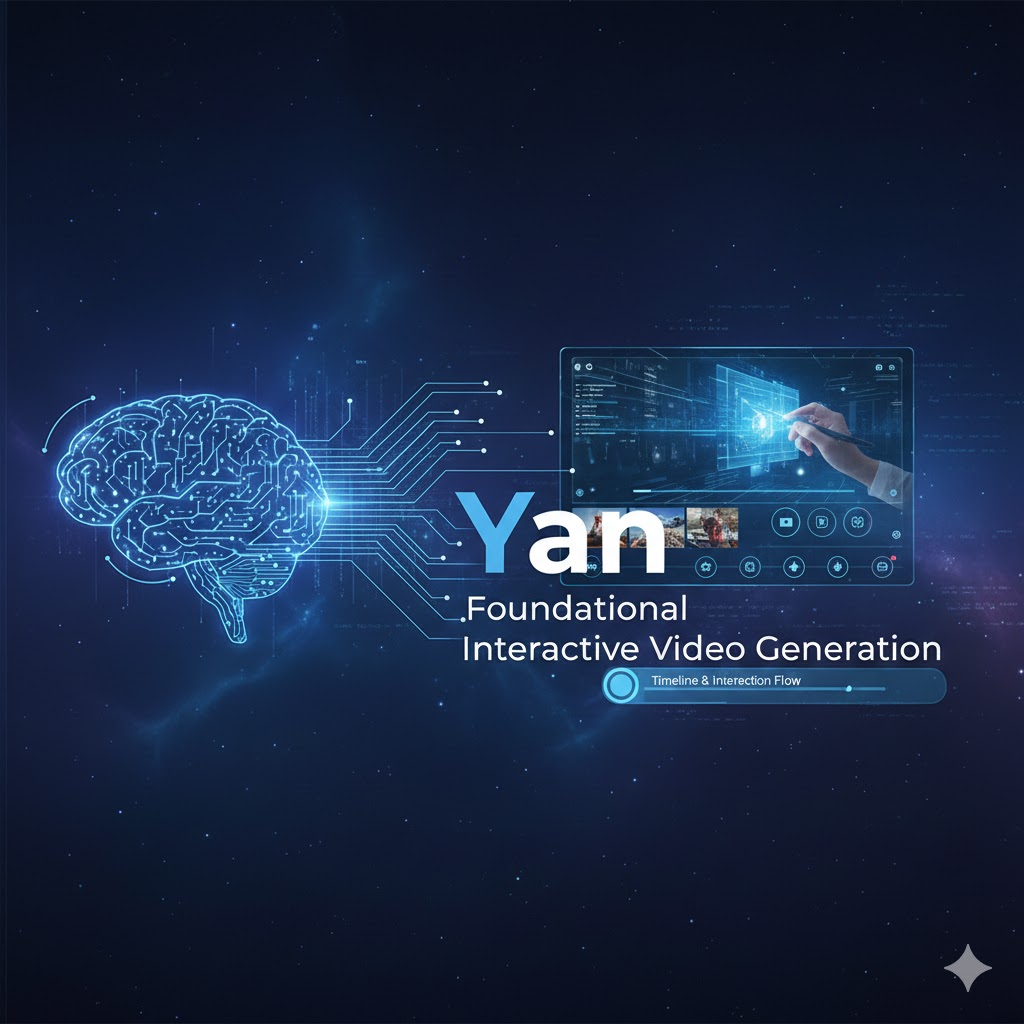
    Yan:Foundational Interactive Video Generation

    Abstract Introduction The first paragraph primarily discusses the applications and deficiencies of Interactive Generative Video (IGV). AIGC is evolving from generating text and images to video synthesis, and has now progressed to IGV. IGV requires dynamic reactions to user input, with applications ranging from virtual simulation to embodied intelligence. However, the deficiencies of current methods lie in the lack of high visual fidelity, sustained temporal coherence, and rich interactivity. Generated content also remains static after creation, failing to adapt in real-time. (Not high-definition, not coherent, not interactive).

      Monday, February 9, 2026 | 12 minutes Read

      Recent Posts

      Hero Image
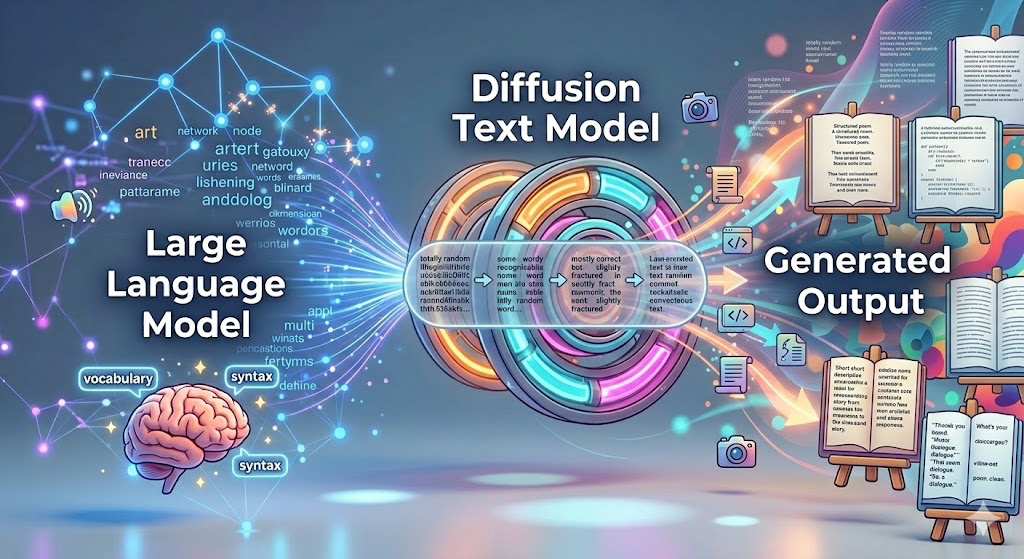
      Diffusion LLM paper reading

      1 Residual Context Diffusion Language Models Method Traditional dLLMs discard the [MASK] at unpredicted positions in each round and reset them as new blank [MASK]s. To avoid wasting computational power, this method retains these discarded semantics and transforms them into vectors for the next round of prediction. Algorithm Generate the residual vector by performing a weighted sum of the model’s predicted probability and the word embeddings: $\Delta_i^{(t_k)} = \sum_{j=1}^V p_{i,j}^{(t_k)} E_{j,:}$

        Saturday, March 14, 2026 | 8 minutes Read
        Hero Image
        Encoder-only

        What is Pre-training? Initializing neural network model parameters through self-supervised learning (unlabeled data). The goal is to learn a universal language understanding capability. BERT BERT Pre-training Tasks Masked Language Modeling (MLM) A certain percentage (15%) of tokens in the input sequence are replaced, and the model is tasked with predicting what those original words were. The 8-1-1 Rule 80% of the selected tokens are replaced with [MASK]: Acts like a cloze test, enabling the model to learn bidirectional semantic context. 10% are replaced with a random token from the vocabulary: Since the model doesn’t know which tokens are random, this improves error-correction capabilities and forces the model to rely on the global context to generate the correct vector representation. 10% remain as the original token: This anchors the model’s representations toward the actual “true” embeddings. Optimization Objective $$\mathcal{L}{MLM} = - \sum{i \in m} \log P(x_i | \tilde{X}; \theta)$$ Where $\tilde{X}$ is the corrupted input sequence, $m$ is the set of chosen masked positions, and $\theta$ represents the model parameters.

          Monday, March 2, 2026 | 3 minutes Read
          Hero Image
          Yan:Foundational Interactive Video Generation

          Abstract Introduction The first paragraph primarily discusses the applications and deficiencies of Interactive Generative Video (IGV). AIGC is evolving from generating text and images to video synthesis, and has now progressed to IGV. IGV requires dynamic reactions to user input, with applications ranging from virtual simulation to embodied intelligence. However, the deficiencies of current methods lie in the lack of high visual fidelity, sustained temporal coherence, and rich interactivity. Generated content also remains static after creation, failing to adapt in real-time. (Not high-definition, not coherent, not interactive).

            Monday, February 9, 2026 | 12 minutes Read
            You are visitor 01402503 — GeezerVison does not store the pages you look up.
            Best viewed with Netscape Navigator 4.7 or Internet Explorer 6 at 800×600. No cookies required.