GeezerVisonThe World Wide Web, restored to 800 pixels of glory. | ||||||||||||||||||||||||||||||||||||||||||||||||||
| Home|About|Gaming cabinet|Archives|How it works|Starter sites | ||||||||||||||||||||||||||||||||||||||||||||||||||
GeezerVison is showing mathworld.wolfram.com — Branch Cut -- from Wolfram MathWorld 

Branch CutA branch cut is a curve removed from the complex plane so that a single-valued analytic branch of a multivalued function can be defined on the remaining domain. The chosen branch can have different limits on the two sides of the cut. For convenience, branch cuts are often taken as lines or line segments. Branch cuts (even those consisting of curves) are also known as cut lines (Arfken 1985, p. 397), slits (Kahan 1987), or branch lines.
For example, consider the function Branch cuts of a composition can be curved even when the outer function has a straight cut. For the principal branch of
the cuts are the preimages of the negative real axis under
Thus the cut curves consist of the four rays An alternative to branch cuts for representing multivalued functions is the use of Riemann surfaces. In addition to branch cuts, singularities known as branch points also exist. It should be noted, however, that the endpoints of branch cuts are not necessarily branch points. Branch cuts do not arise for the single-valued trigonometric, hyperbolic, integer power, and exponential functions. However, their multivalued inverses do require branch cuts. The plots and table below summarize the branch cut structure of inverse trigonometric, inverse hyperbolic, noninteger power, and logarithmic functions adopted in the Wolfram Language. 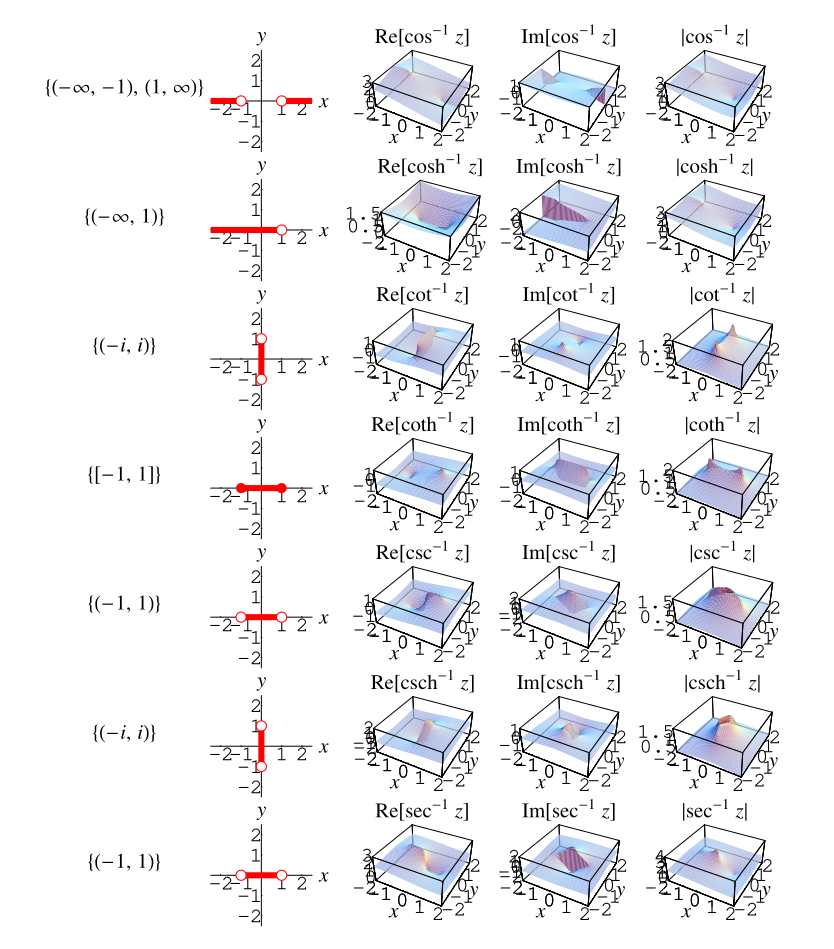
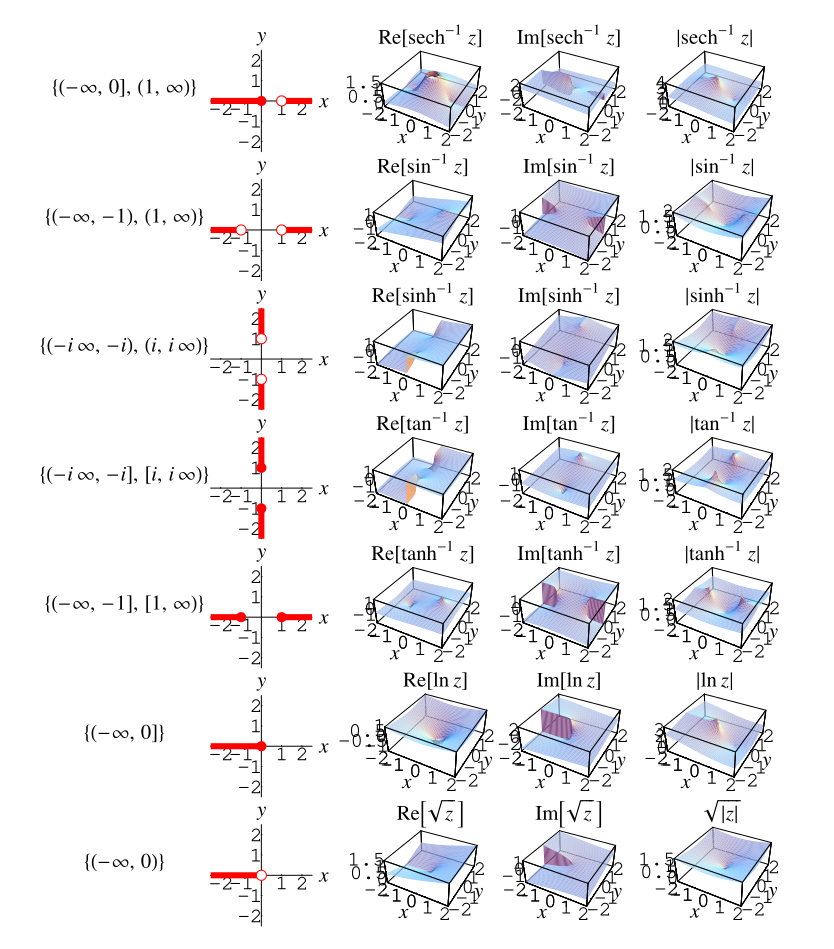
A slit disk provides a bounded domain on which a radial branch cut permits a single-valued square root. See alsoBranch, Branch Point, Cut, Discontinuity, Inverse Hyperbolic Functions, Inverse Trigonometric Functions, Multivalued Function, Principal Branch, Principal Value, Riemann SurfaceExplore with Wolfram|Alpha
More things to try: ReferencesAbramowitz, M. and Stegun, I. A. (Eds.). Handbook of Mathematical Functions with Formulas, Graphs, and Mathematical Tables, 9th printing. New York: Dover, pp. 79 and 86, 1972.Ahlfors, L. V. Complex Analysis, 3rd ed. New York: McGraw-Hill, p. 75, 1979.Arfken, G. Mathematical Methods for Physicists, 3rd ed. Orlando, FL: Academic Press, 1985.Bradford, R.; Corless, R. M.; Davenport, J. H.; Jeffrey, D. J.; and Watt, S. M. "Reasoning about the Elementary Functions of Complex Analysis." Ann. Math. Artificial Intell. 36, 303-318, 2002.Bronshtein, I. N. and Semendyayev, K. A. Handbook of Mathematics, 3rd ed. New York: Springer-Verlag, 1997.Dingle, A. and Fateman, R. J. "Branch Cuts in Computer Algebra." In Symbolic and Algebraic Computation (Ed. J. von zur Gathen and M. Giesbracht). New York: ACM Press, pp. 250-257, 1994.Duffy, D. G. Transform Methods for Solving Partial Differential Equations, 2nd ed. Boca Raton, FL: CRC Press, 2004.Felsen, L. B. and Marcuvitz, I. N. Radiation and Scattering of Waves. New York: IEEE Press, 1994.Kahan, W. "Branch Cuts for Complex Elementary Functions, or Much Ado About Nothing's Sign Bit." In The State of the Art in Numerical Analysis: Proceedings of the Joint IMA/SIAM Conference on the State of the Art in Numerical Analysis Held at the UN (Ed. A. Iserles and M. J. D. Powell). New York: Clarendon Press, pp. 165-211, 1987.Korn, G. A. and Korn, T. M. Mathematical Handbook for Scientists and Engineers. New York: McGraw-Hill, 1968.Mahan, G. D. Applied Mathematics. New York: Kluwer, 2002.Morse, P. M. and Feshbach, H. Methods of Theoretical Physics, Part I. New York: McGraw-Hill, pp. 399-401, 1953.Remmert, R. Funktionentheorie 1. Berlin, Germany: Springer-Verlag, 1992.Remmert, R. Funktionentheorie 2. Berlin, Germany: Springer-Verlag, 1992.Trott, M. The Mathematica GuideBook for Programming. New York: Springer-Verlag, pp. 188-191, 2004. https://www.mathematicaguidebooks.org/.Trott, M. The Mathematica GuideBook for Numerics. New York: Springer-Verlag, sec. 1.12.2, 2006. https://www.mathematicaguidebooks.org/.Referenced on Wolfram|AlphaBranch CutCite this as:Weisstein, Eric W. "Branch Cut." From MathWorld--A Wolfram Resource. https://mathworld.wolfram.com/BranchCut.html Subject classifications | ||||||||||||||||||||||||||||||||||||||||||||||||||
| You are visitor 01402503 — GeezerVison does not store the pages you look up. Best viewed with Netscape Navigator 4.7 or Internet Explorer 6 at 800×600. No cookies required. |

 which maps each
 to a well-defined
 .
 ,
 to
 .

 (Trott 2006). Writing
 with
 gives

 for
 ,
 .


 and


![(-infty,0]](/api/image?u=https%3A%2F%2Fmathworld.wolfram.com%2Fimages%2Fequations%2FBranchCut%2FInline27.svg) and


 and


![(-infty,-1]](/api/image?u=https%3A%2F%2Fmathworld.wolfram.com%2Fimages%2Fequations%2FBranchCut%2FInline33.svg) and


 and


![(-iinfty,-i]](/api/image?u=https%3A%2F%2Fmathworld.wolfram.com%2Fimages%2Fequations%2FBranchCut%2FInline41.svg) and


![(-infty,0]](/api/image?u=https%3A%2F%2Fmathworld.wolfram.com%2Fimages%2Fequations%2FBranchCut%2FInline44.svg)

 for
 ;
![(-infty,0]](/api/image?u=https%3A%2F%2Fmathworld.wolfram.com%2Fimages%2Fequations%2FBranchCut%2FInline48.svg) for


