GeezerVisonThe World Wide Web, restored to 800 pixels of glory. | ||||||||||||||||||||||||||||||||||||||||||||
| Home|About|Gaming cabinet|Archives|How it works|Starter sites | ||||||||||||||||||||||||||||||||||||||||||||
GeezerVison is showing mathworld.wolfram.com — Ellipse Negative Pedal Curve -- from Wolfram MathWorld 

Ellipse Negative Pedal Curve

For an ellipse with parametric equations
the negative pedal curve with respect to the origin has parametric equations
where
is the distance between the ellipse center and one of its foci and
is the eccentricity. For 
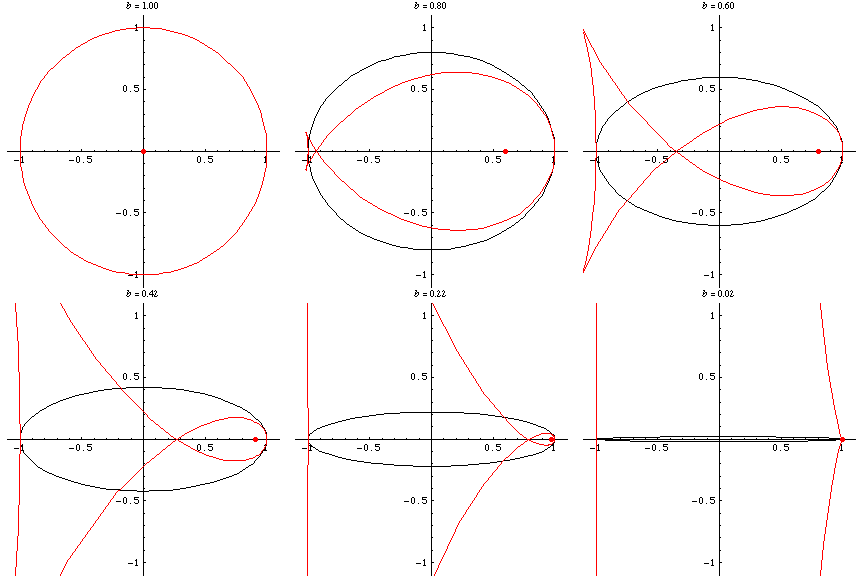
Taking the pedal point at a focus (i.e.,
Lockwood (1957) terms this family of curves Burleigh's ovals. The curve is a circle for
The special case of the negative pedal curve for pedal point See alsoBurleigh's Oval, Circle Negative Pedal Curve, Ellipse, Ellipse Pedal Curve, Fish Curve, Negative Pedal Curve, Talbot's CurveExplore with Wolfram|Alpha
More things to try: ReferencesAmeseder, A. "Negative Fusspunktcurven der Kegelschnitte." Archiv Math. u. Phys. 64, 170-176, 1879.Hilton, H. Plane Algebraic Curves. Oxford, England: Oxford University Press, p. 64, 1932.Lockwood, E. H. "Negative Pedal Curve of the Ellipse with Respect to a Focus." Math. Gaz. 41, 254-257, 1957.Lockwood, E. H. A Book of Curves. Cambridge, England: Cambridge University Press, p. 157, 1967.MacTutor History of Mathematics Archive. "Talbot's Curve." https://mathshistory.st-andrews.ac.uk/Curves/Talbots/.Salmon, G. A Treatise on Higher Plane Curves, Intended as a Sequel to a Treatise on Conic Sections, 3rd ed. Dublin, Ireland: Hodges, p. 107, 1879.Referenced on Wolfram|AlphaEllipse Negative Pedal CurveCite this as:Weisstein, Eric W. "Ellipse Negative Pedal Curve." From MathWorld--A Wolfram Resource. https://mathworld.wolfram.com/EllipseNegativePedalCurve.html Subject classifications | ||||||||||||||||||||||||||||||||||||||||||||
| You are visitor 01402503 — GeezerVison does not store the pages you look up. Best viewed with Netscape Navigator 4.7 or Internet Explorer 6 at 800×600. No cookies required. |


 ,
 ,
 ,
 )


 and a smooth
 .
 the
 the curve has two
 and
 (i.e.,
 )