GeezerVisonThe World Wide Web, restored to 800 pixels of glory. | ||||||||||||||||||||||||||||
| Home|About|Gaming cabinet|Archives|How it works|Starter sites | ||||||||||||||||||||||||||||
GeezerVison is showing mathworld.wolfram.com — Gaussian Function -- from Wolfram MathWorld 

Gaussian Function
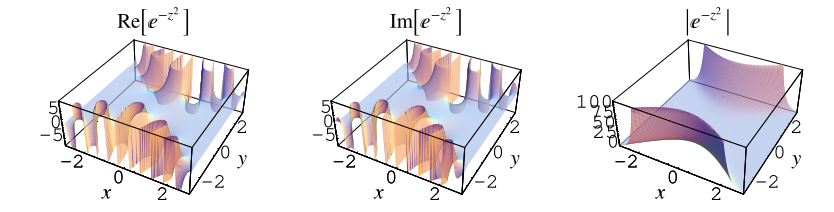

A Gaussian function in one dimension, when normalized to have unit integral, is the probability density function of the normal distribution,
sometimes also called the frequency curve. The full width at half maximum (FWHM) for
a Gaussian is found by finding the half-maximum points
But
Solving,
The full width at half maximum is therefore given by

In two dimensions, the circular Gaussian function is the distribution function for uncorrelated variates
The corresponding elliptical Gaussian function corresponding to

The Gaussian function can also be used as an apodization function
shown above with the corresponding instrument function. The instrument function is
which has maximum
As
The hypergeometric function is also sometimes known as the Gaussian function. See alsoBivariate Normal Distribution, Erf, Erfc, Fourier Transform--Gaussian, Hyperbolic Secant, Lorentzian Function, Normal Distribution, Owen T-Function, Witch of AgnesiExplore with Wolfram|Alpha
More things to try: ReferencesMacTutor History of Mathematics Archive. "Frequency Curve." https://mathshistory.st-andrews.ac.uk/Curves/Frequency/.Referenced on Wolfram|AlphaGaussian FunctionCite this as:Weisstein, Eric W. "Gaussian Function." From MathWorld--A Wolfram Resource. https://mathworld.wolfram.com/GaussianFunction.html Subject classifications | ||||||||||||||||||||||||||||
| You are visitor 01402503 — GeezerVison does not store the pages you look up. Best viewed with Netscape Navigator 4.7 or Internet Explorer 6 at 800×600. No cookies required. |


 .

 occurs at
 ,


 and
 having a
 ,

 is given by


 ,
