
GV

GeezerVison

The World Wide Web, restored to 800 pixels of glory.

Home|About|Gaming cabinet|Archives|How it works|Starter sites

On this site

  • NerfedLab
  • Studio
  • Products
  • Guide
  • Changelog
  • Request a demo
  • Download for macOS
  • Investors
  • Careers
  • Install and first launch
  • All releases on GitHub
  • Privacy
  • Terms
  • LinkedIn

This view

  • Original page
  • New address

GeezerVison is showing nerfedlab.com — NerfedLab · Describe a product. Ship it. Keep it alive.

Nº 01 · Autumn 2026The Governance IssueFree to download

NerfedLab

Inside: the loop that takes an idea to production, the night a smoke test said no, and why a prompt box is not a company.

Describe a product. Ship it. Keep it alive.

Your product and business teams ship changes to the products you already run. AI writes the code, your engineers hold the merge, and every change passes your own review, a security pass and a staged rollout, inside your repositories and behind your SSO. The tech team stops being the bottleneck.

Download for macOSRequest a demo
  1. p. 4 The people with the ideas cannot ship them
  2. p. 8 The screens draw themselves, then one loop to production
  3. p. 18 The night the smoke test said no

v6.7.2·macOS on Apple silicon·Install notes

Works with Claude CodeWorks with GitHubWorks with VS CodeWorks with CursorWorks with Claude DesktopWorks with CodexWorks with GitHub PagesWorks with AndroidWorks with your SSOWorks with your reviewersWorks with Claude CodeWorks with GitHubWorks with VS CodeWorks with CursorWorks with Claude DesktopWorks with CodexWorks with GitHub PagesWorks with AndroidWorks with your SSOWorks with your reviewers

Contents

Every company is full of people who know exactly what to build and cannot build it. AI made the prototype cheap and left the hard part where it was: shipping a change to a real product, safely, more than once. This issue is about that part.

The editors

  1. 01The prototype trapThe people with the ideas cannot ship them.
  2. 02One loopThe screens draw themselves, then one loop to production.
  3. 03Two films, no cutsA feature ships itself. An idea becomes an app.
  4. 04The night the smoke test said noSecure by default, enforced in the routes.
  5. 05The studioNine views of one product, Ledger, on a Mac.
  6. 06Why a prompt box is not a companyFour things a weekend cannot copy.
  7. 07Meera, and the product managerOne product across the whole spectrum.
  8. 08Two ways inA demo for your company, a deck for investors, and the company behind both.
01The prototype trapNerfedLab · Nº 01 · p. 4

The people with the ideas cannot ship them.

The gap between an idea and shipped software is where the value dies. Three groups are stuck at the same wall.

A phone on a brass stand beside a closed notebook and a pencil, on a wooden desk in window light
The idea, the notebook, the phone that never got the app.
  1. 1

    Bottlenecked teams

    Business and product people have ideas daily, and every change waits on a scarce, overloaded tech team. The queue is the product.

  2. 2

    No team at all

    Small companies and new ventures cannot afford, or do not want, a tech team of their own. The idea stays in the notebook.

  3. 3

    Not built for a company

    Today’s AI builders are made for prototypes and personal projects. None is built for a real company to ship production grade software: reviewed, secure, auditable, reversible.

02One loopNerfedLab · Nº 01 · p. 8

From an idea to production, by the person who had the idea.

The whole AI stack, run for you. Under the friendly surface: a real coding agent in a real git repository, kept safe on the apps you already run. Five steps, and the same five every time.

The screens draw themselves.

A brief in the chat, the few questions on one card, and then each screen is written onto the canvas element by element while you watch. The design is a file you own, versioned with the rest.

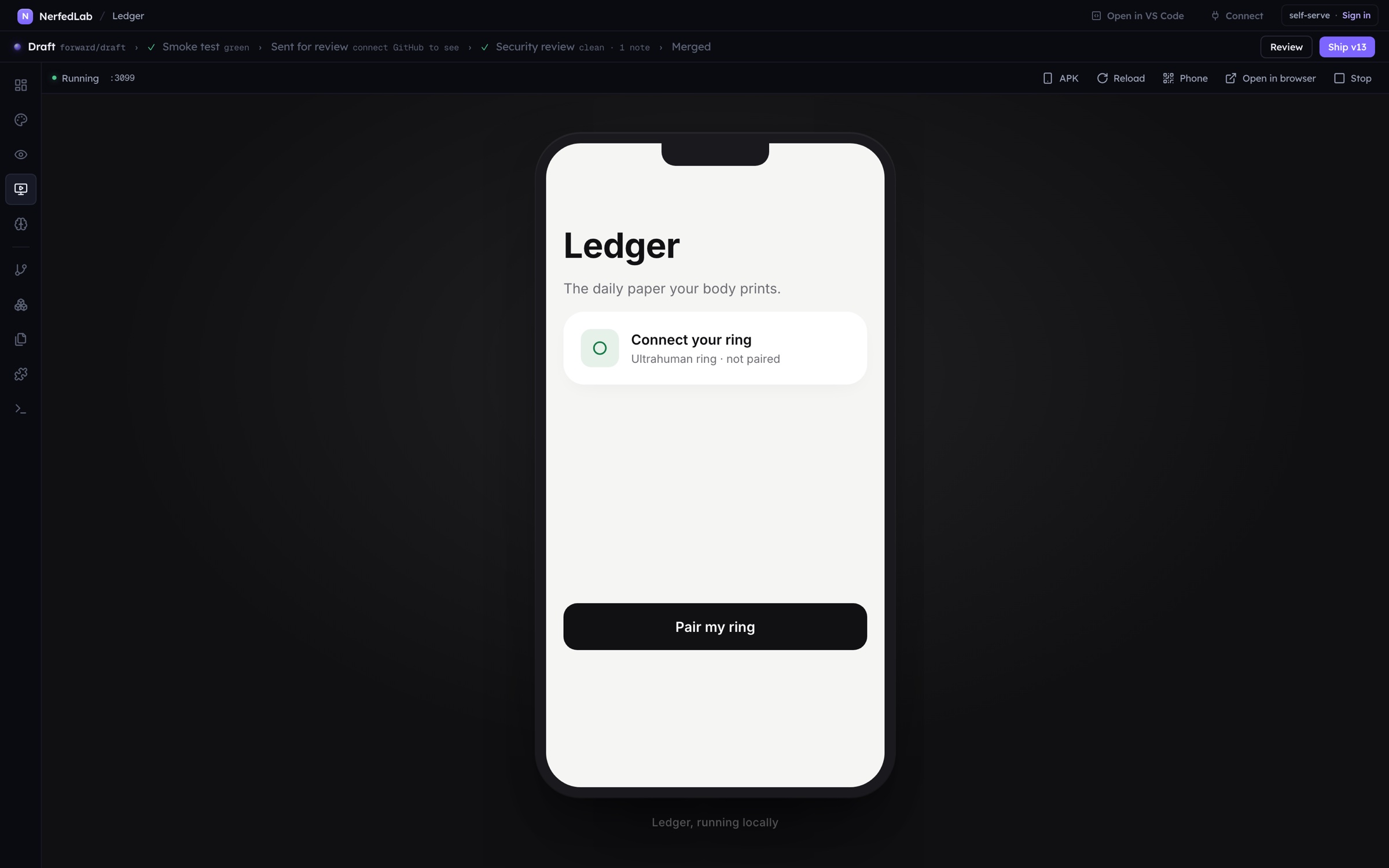
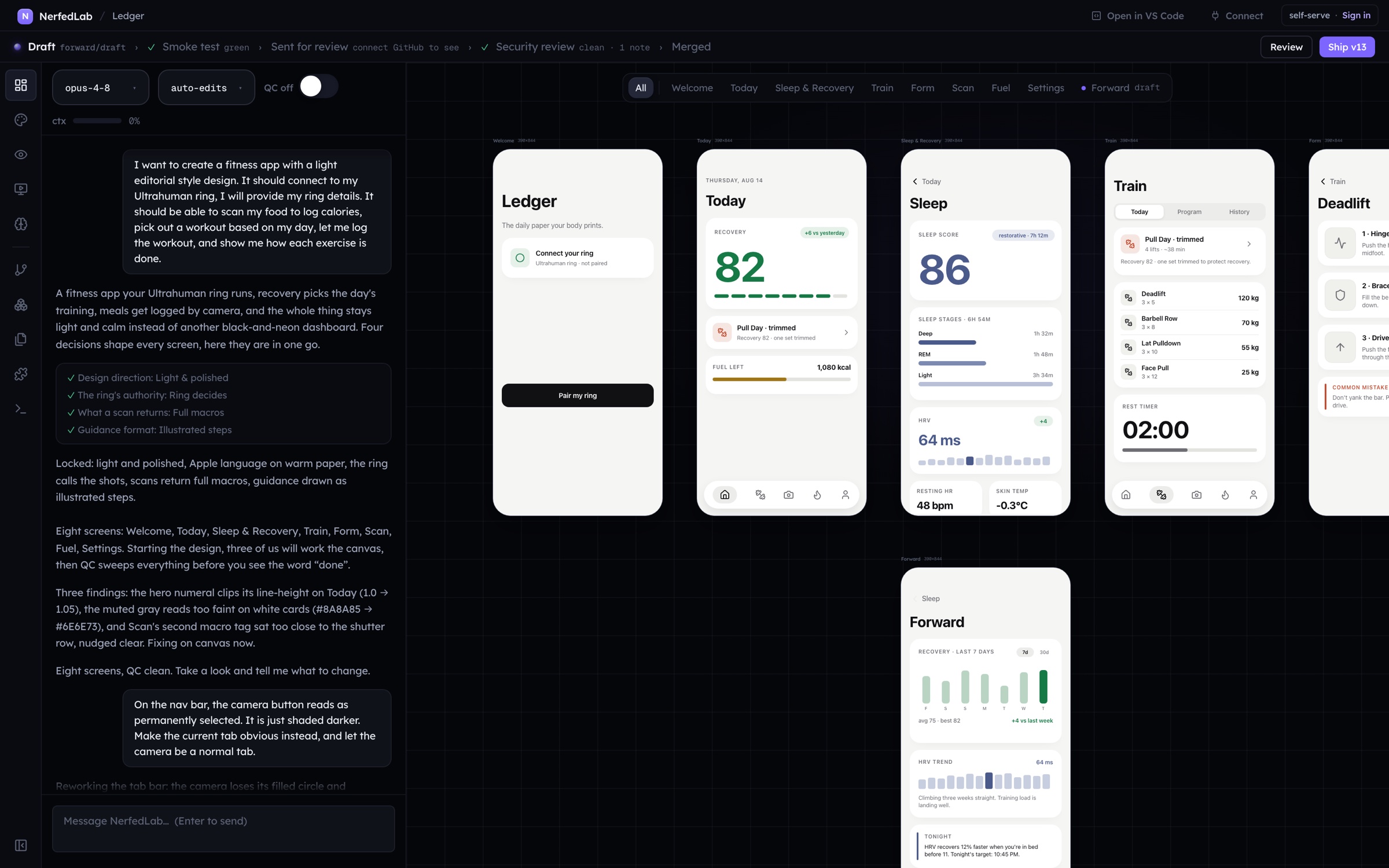
Ledger’s screens, drawn one after another as recorded in the studio. Played a little faster than life.

01

Copy

Import the real repository and its design system. The agent reads the code and writes the project’s memory: the architecture, the conventions, the sensitive map.
02

Build with AI

Describe the change the way you would tell a colleague. The screens are drawn first, then the code, on a draft of its own, refined in the chat.

03

Test on a phone

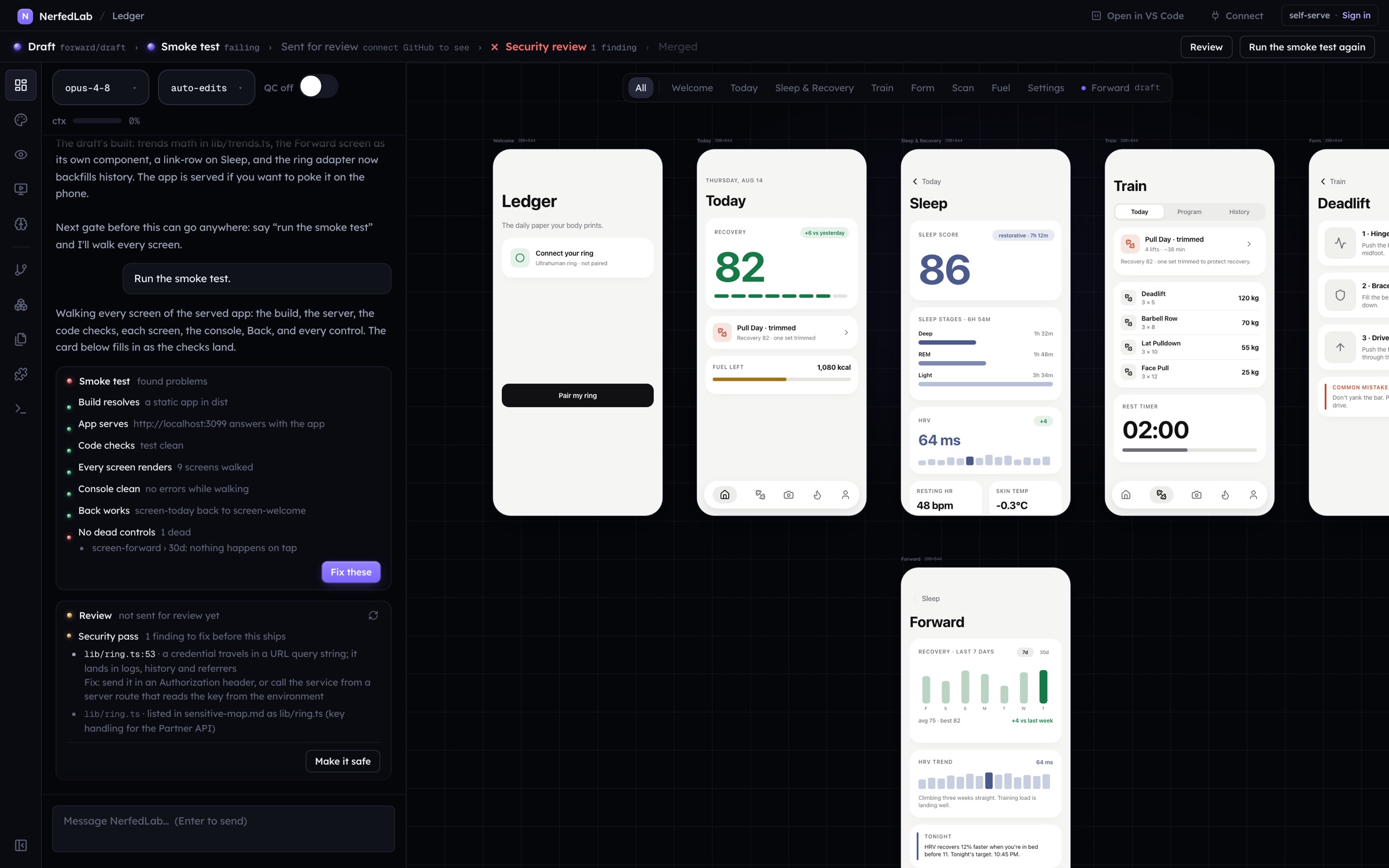
The real app on a real device. The smoke test walks every screen: the build, the console, Back, and every control that must do something.
Smoke test
04

Approve

A manager or a stakeholder signs off. The pull request carries code review and the automated security pass; a blocking finding holds the merge.

Review
05

Merge to production

Your tech team merges, or ours. A version is tagged and rolls out by percentage, with a guardrail that halts a bad ramp on its own.
Smoke test
Review
03Two films, no cutsNerfedLab · Nº 01 · p. 14

Watch it happen, start to finish.

Two recordings of the product, unedited. The first is the everyday loop on a real repository. The second is day one: no repository, no team, one sentence.

A feature ships itself. A product manager ships one feature on a real repository, from the sentence to the rollout. Real code, real reviews, nobody waiting on engineering.
An idea becomes an app. One prompt, a few answers, and the app runs on a phone. Day two and beyond is the loop in chapter two.
04The night the smoke test said noNerfedLab · Nº 01 · p. 18

Fast, because it is governed.

Ledger’s new screen looked finished. The smoke test walked it and found a chip that did nothing on tap; the security pass found the Partner key riding a URL. Both stayed out of main until they were fixed. An agent that can write code into your product needs the guardrails an engineer has, and they have to live where nothing can talk its way around them: in the routes, not in the interface.

Review
Ring keys
Sensitive map
  1. 01

    The security pass, on every pull request

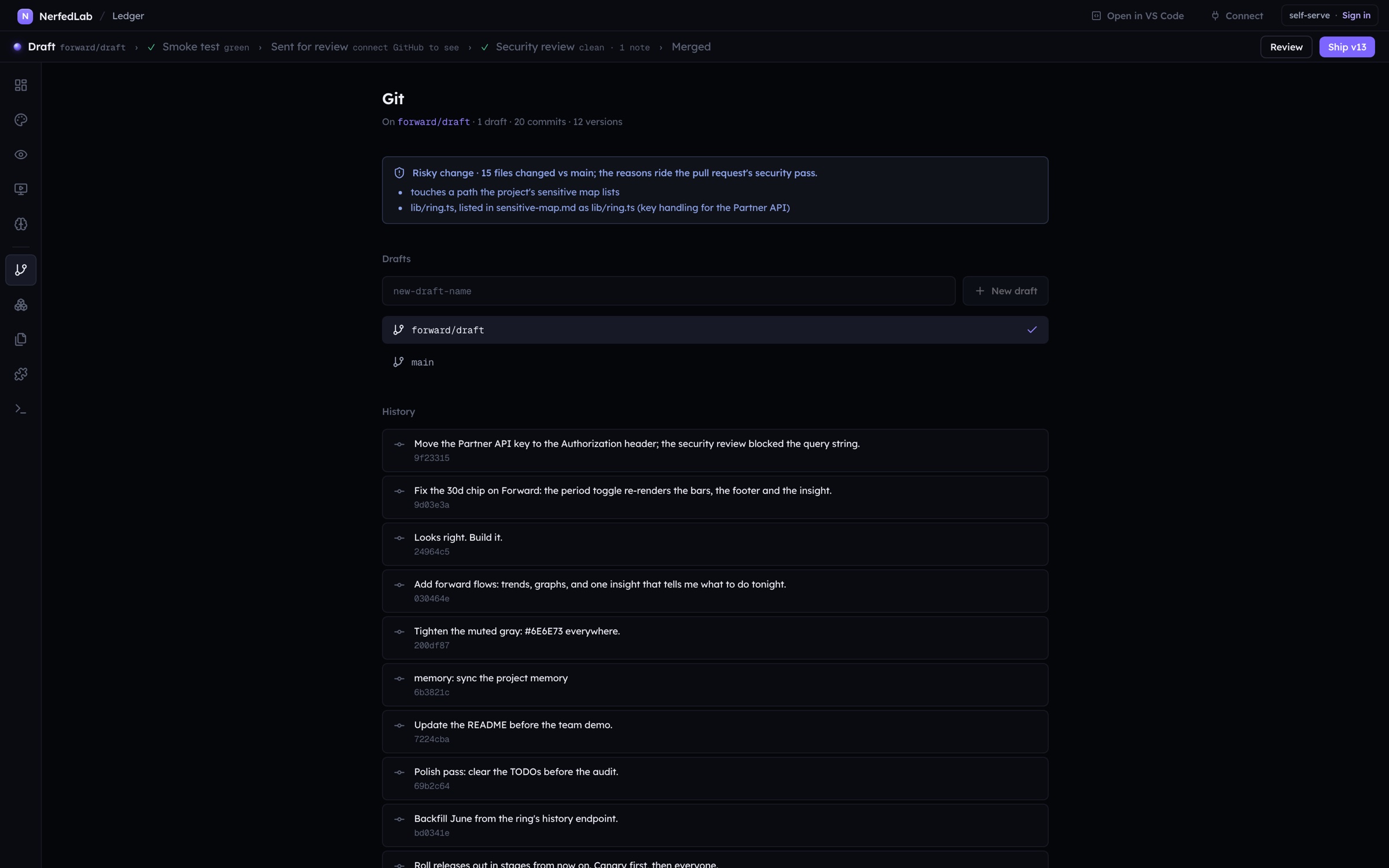
    Send for approval posts an automated pass over the draft’s diff against main: a credential in a URL, a secret behind a public build variable, a hardcoded credential, and every path the project’s sensitive map calls risky. A blocking finding holds Ship until the draft is clean. Each finding names the file, the line, the reason and the fix.

  2. 02

    A sensitive map of your own

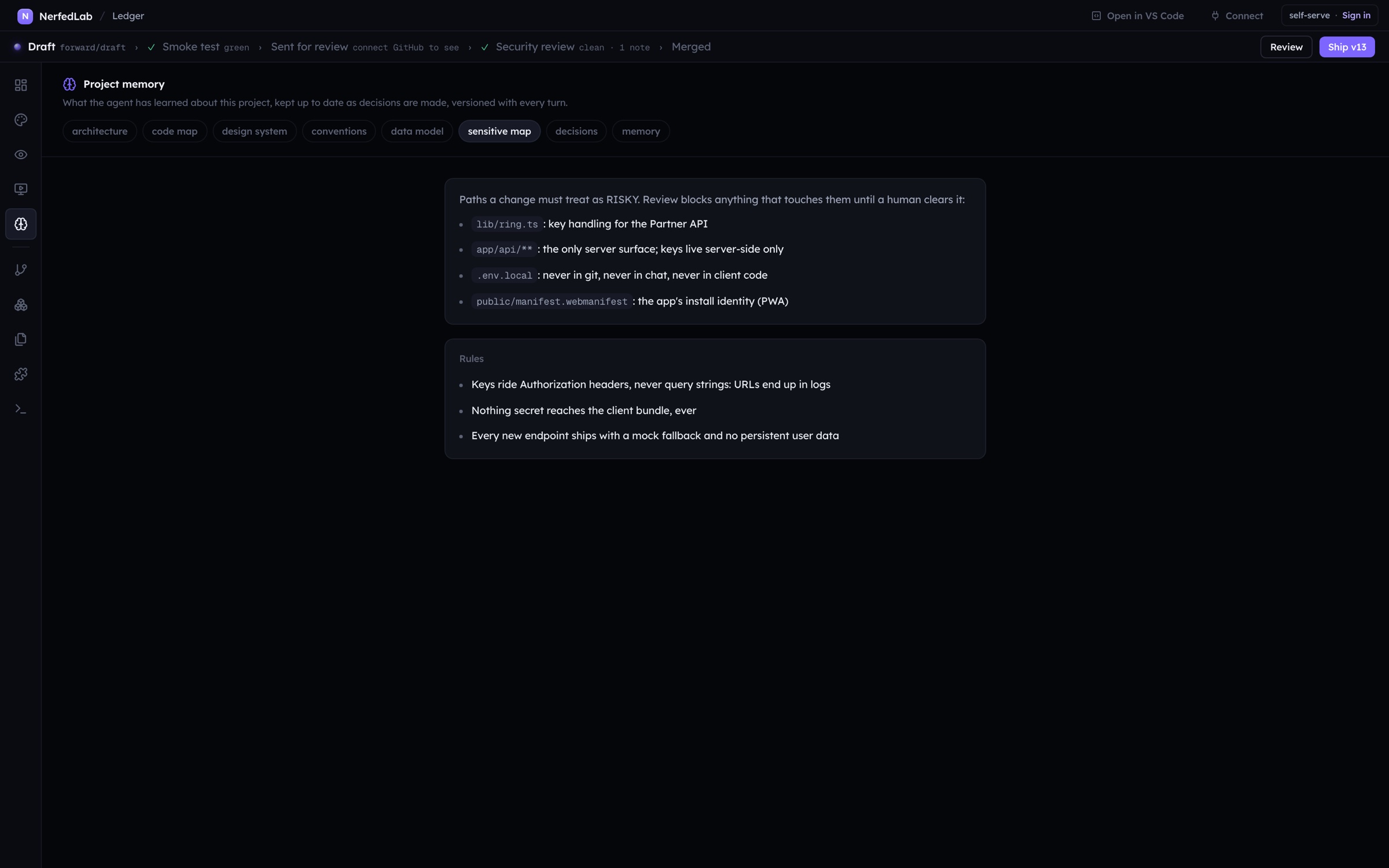
    The agent writes the sensitive map on import: auth, payments, keys, personal data, the paths that need a second look. The risk badge on every draft and the security pass read it, so a flag is explained, never magic.

  3. 03

    Secrets the model never sees

    When a build needs a key, the agent asks on a masked card. The value goes to the workspace’s own env file, readable by you alone, and the model receives only that it was stored. Nothing reaches the chat history, the transcript or a commit.

  4. 04

    Gates that cannot be talked around

    The routes refuse what the interface would not offer: no pull request without a green smoke verdict on the tip, no Ship with a failing or stale smoke test, a blocking finding or an open change request. An approval is about a diff, so any commit after it resets it.

  5. 05

    Your keys stay in your keychain

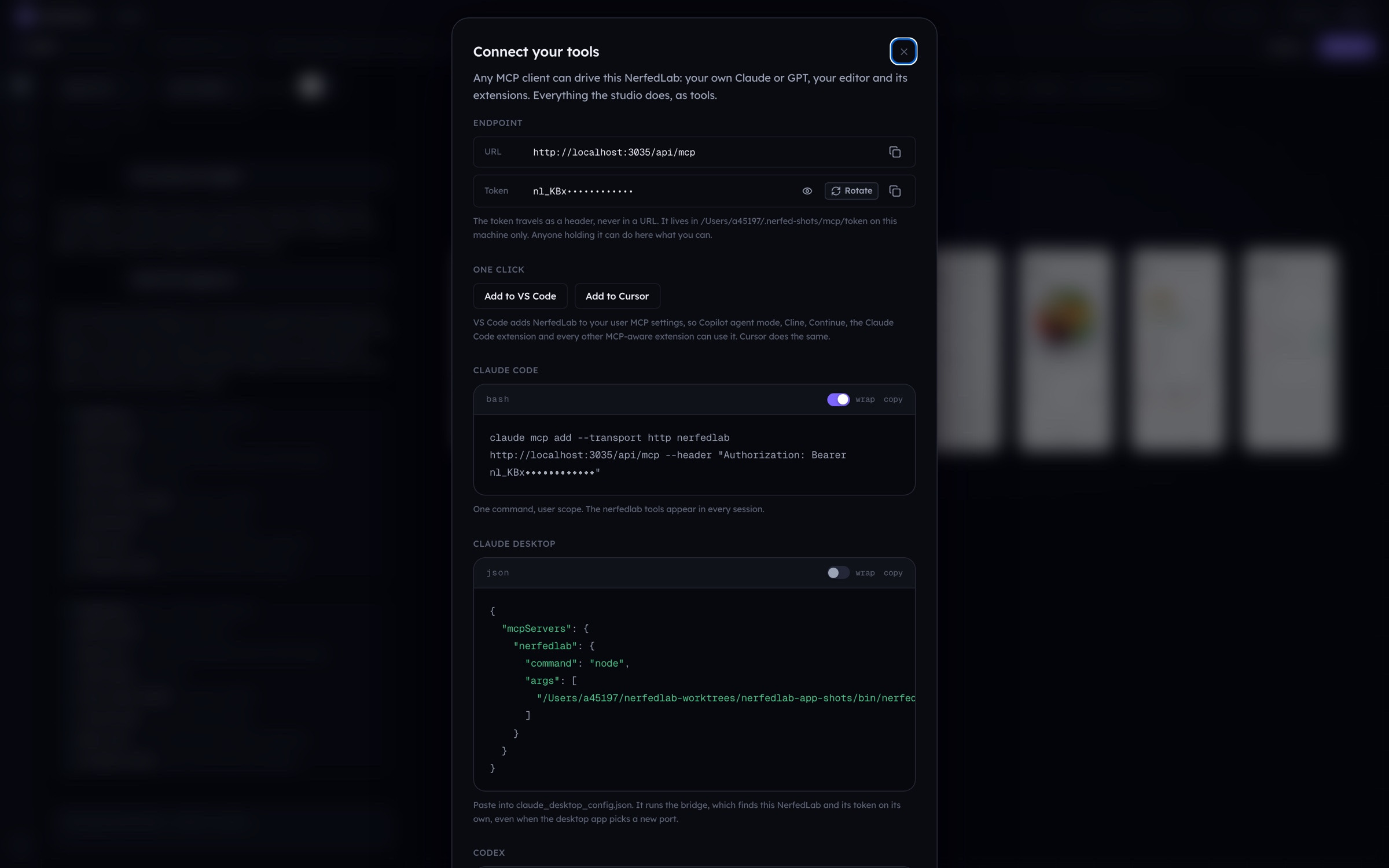
    GitHub connects through its device flow; the token lives encrypted in the macOS keychain and never reaches our servers. The key that lets your other tools drive NerfedLab is one per install, travels as a header, never in a URL, and can be rotated from Connect. The served app answers to this machine alone until you choose Preview on phone.

  6. 06

    A rollout that halts itself

    A shipped version arms at zero percent. Every step up is a committed change, and each device keeps the side of the line it was dealt. The running app reports its sessions and errors; three errors in the new cohort against a quiet baseline halt a live ramp on their own. Going down is the only automatic move.

Self-serve

You hold the gate.

Download it, sign in, connect your subscription. Your own GitHub, your own reviewers, your own call on every Ship. Crash reports carry diagnostics with paths and usernames scrubbed, never your work.

For companies

We set it up for you.

We set it up before the first draft: the subscriptions you choose behind the engine, sign in through your SSO so the whole company is in by email domain, and your products, repositories, reviewers, review gates and sensitive paths mapped out. When you have no engineers, ours review and merge. The mode is decided on the server, never by the app.

  • Your subscription

    Every AI turn runs on your Mac through the subscription you connect; for a company, the subscriptions it chooses. There is no NerfedLab key and no server side generation.

  • Your machine

    Projects live under a folder in your home directory. Designs, code, prompts and chat history stay there, and none of it ever touches our servers.

  • Your repository

    Every workspace is a real git repository with a commit per turn. Publish it to your own GitHub, back it up with its drafts and history, carry on from another Mac.

05The studioNerfedLab · Nº 01 · p. 24

Nine views of one product.

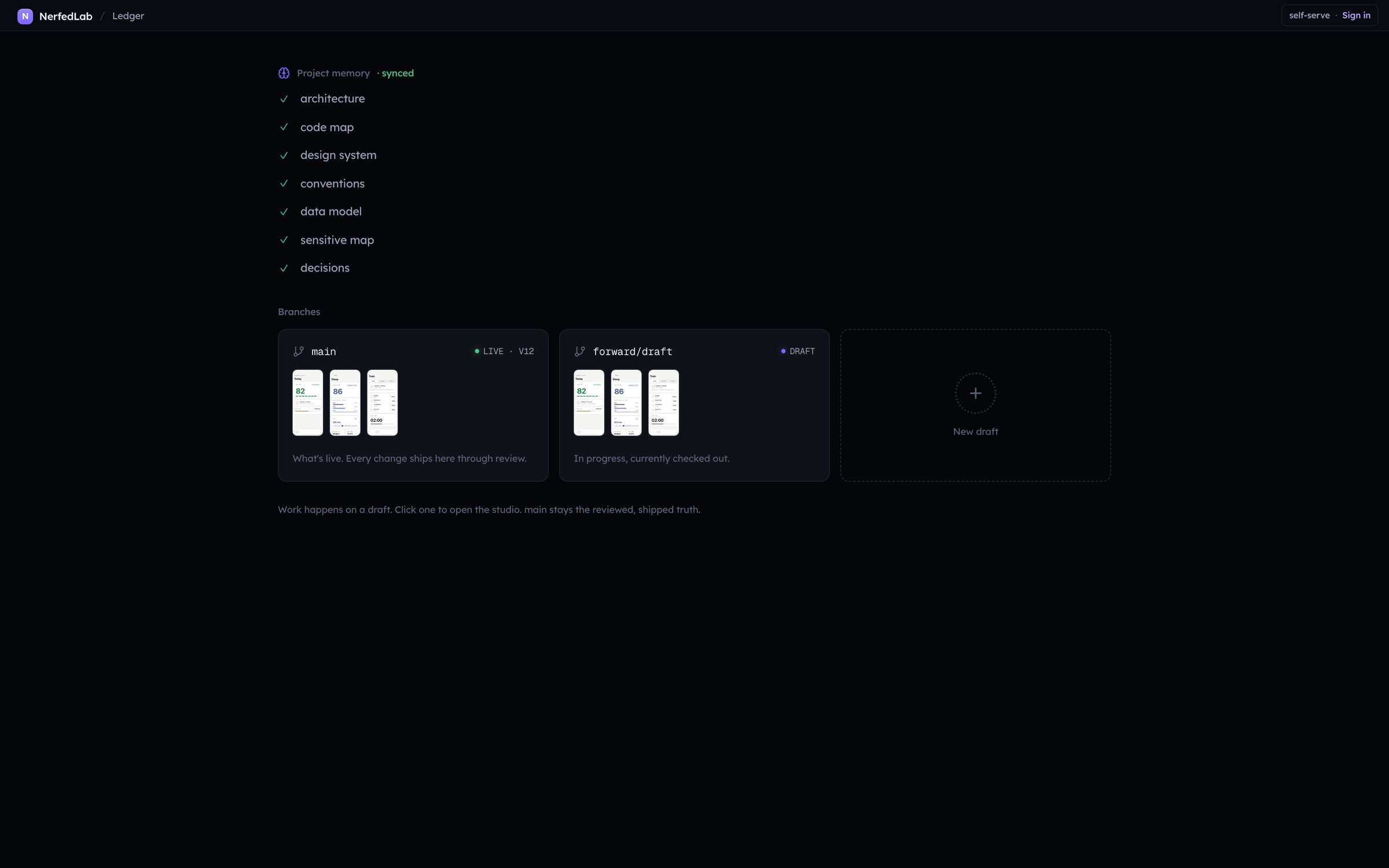
Ledger, a fitness app, from its first brief to its twelfth version. Every frame is the studio as it runs on a Mac today.

01 / 09
The brief, the card, the screens. The question card answered in the chat, the eight screens and the draft’s ninth on the canvas, the change ladder above.
Click anything. The layers on the left, the properties on the right, following every selection, as recorded.
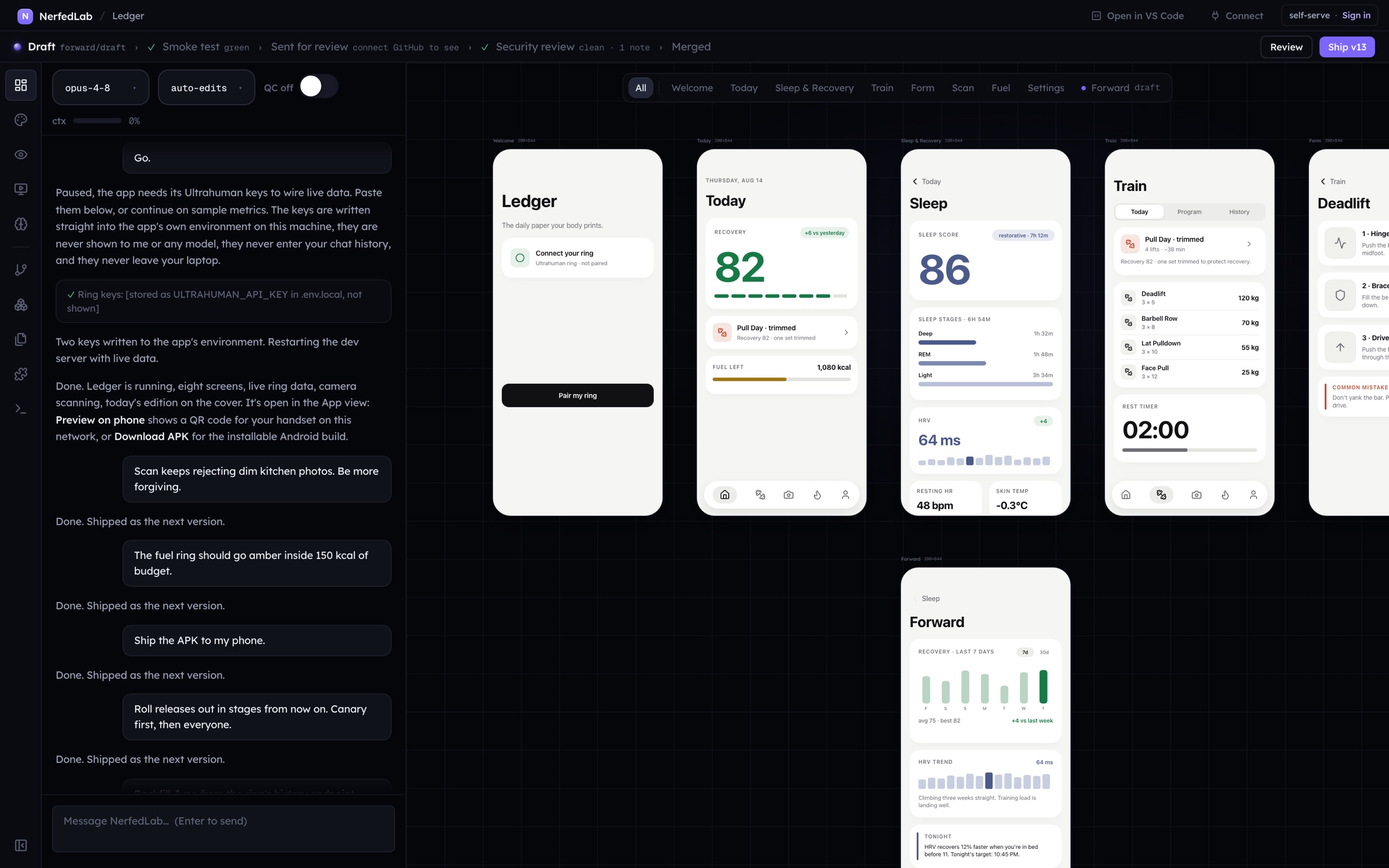
The App view. Ledger built and running on this Mac, tapped through its tabs. Preview on phone and the Android package are one click away.
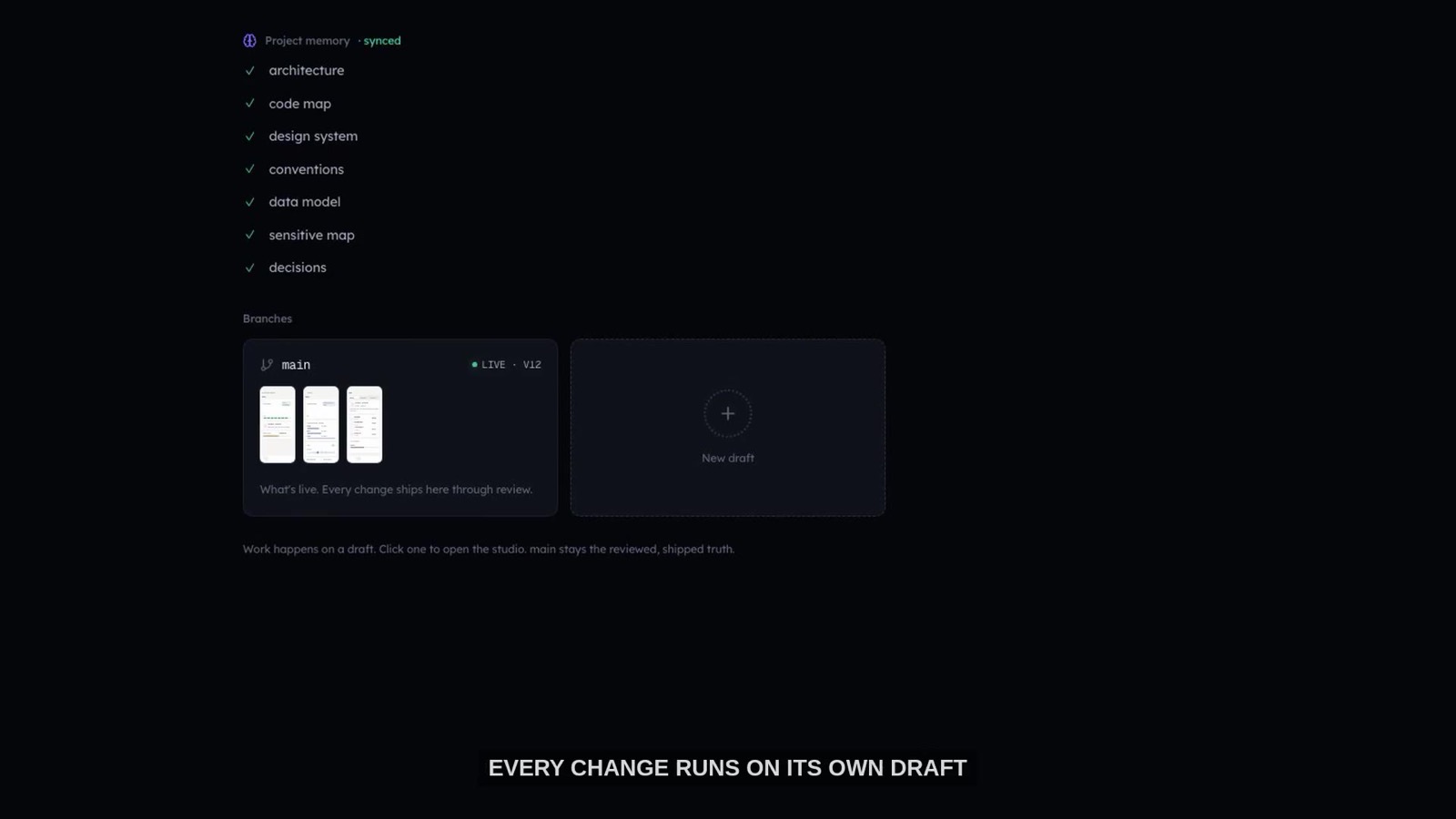
The Branches home. The seven memory docs synced, main live at v12, the forward draft in progress, the plus tile for a new one.
The risk badge. A risky change: it touches a path the sensitive map lists, and the reasons ride the pull request’s security pass.
Project memory. Seven short docs the agent keeps as decisions land: architecture, code map, conventions, the sensitive map.
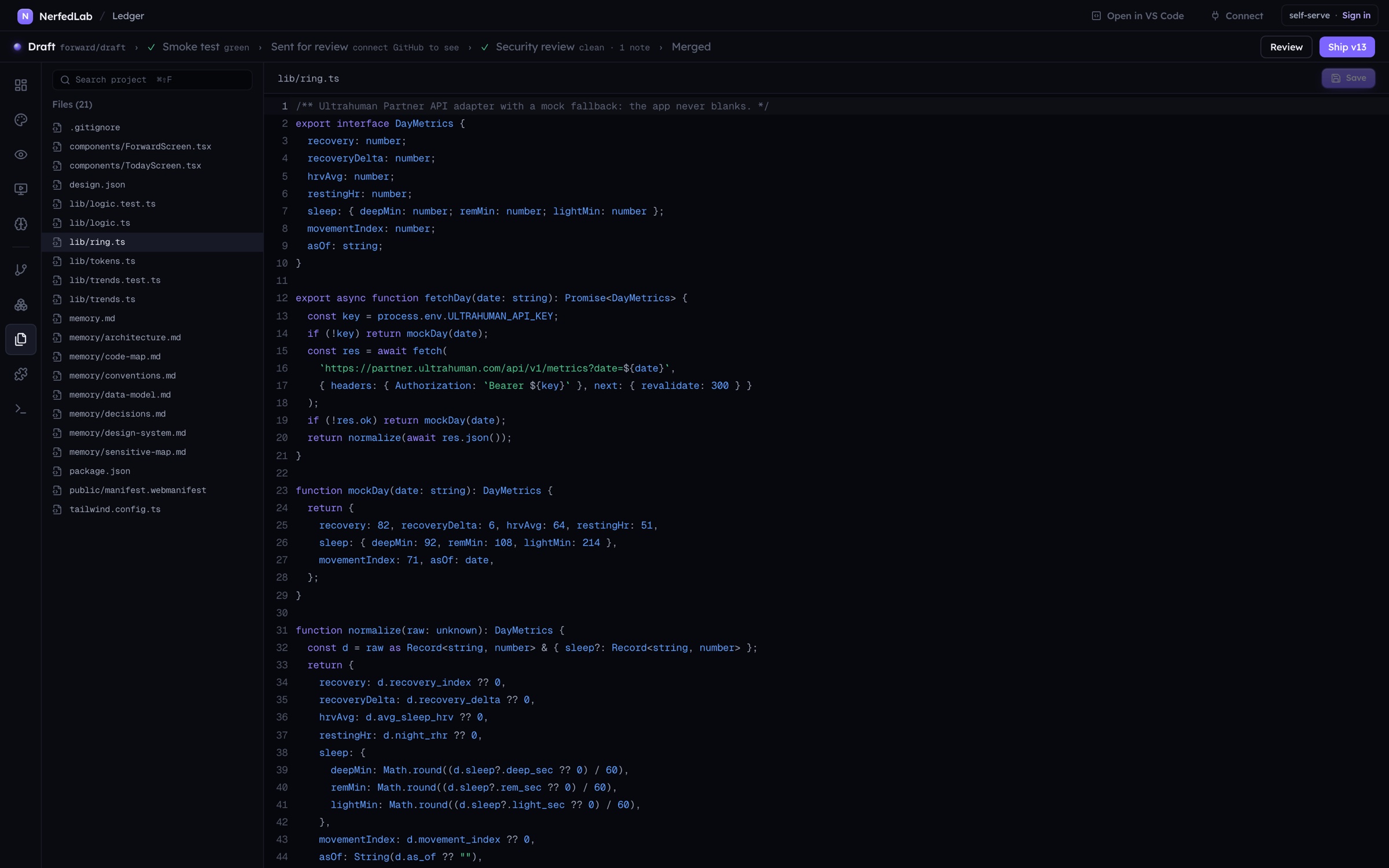
The Files view. A real editor on the workspace, with an inline edit, project search and TypeScript intelligence.
Connect your tools. Every verb is a tool: Claude Code, Cursor, VS Code and Codex drive the same studio by the same rules.
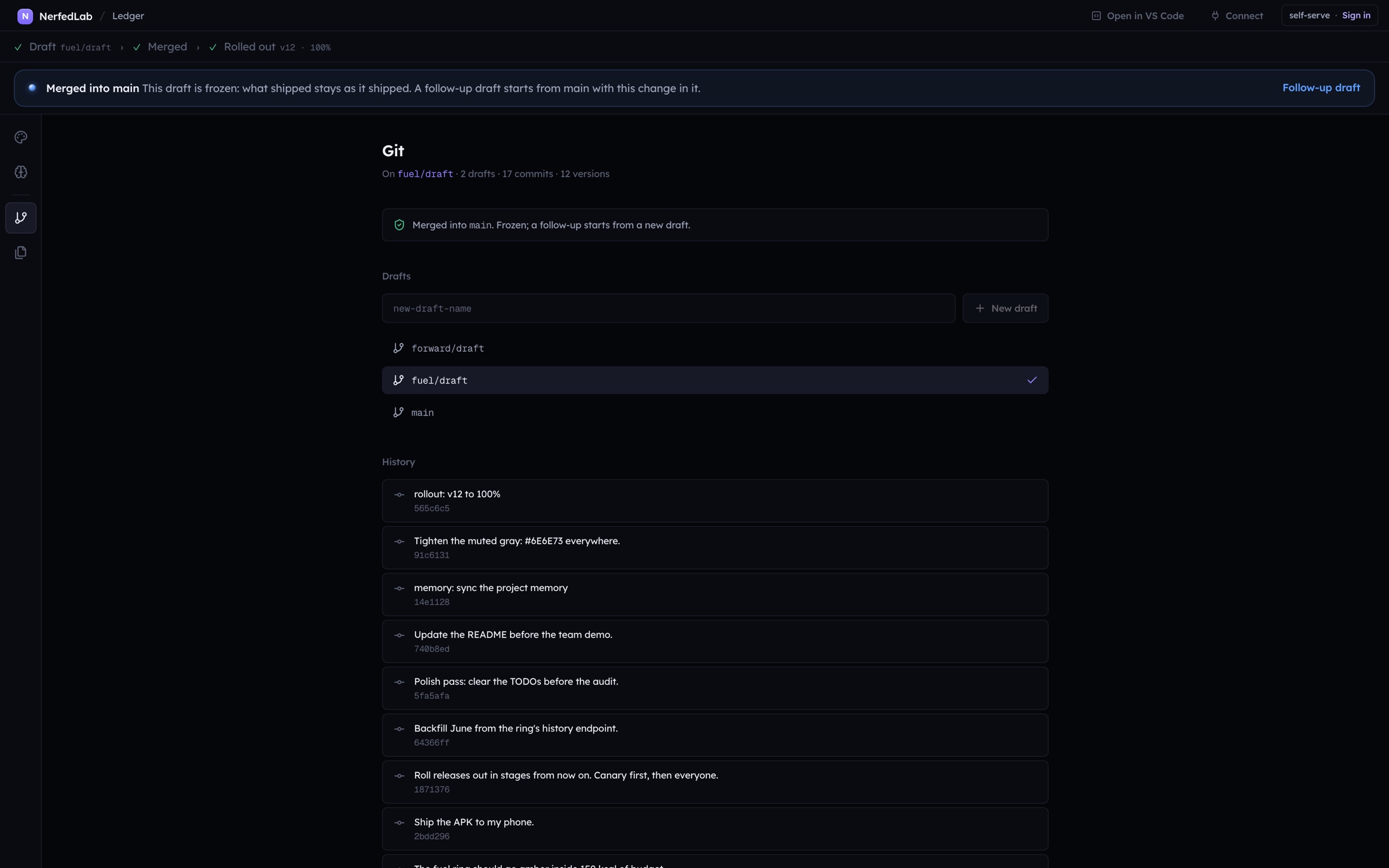
Merged, rolled out. The fuel draft shipped as v12 and rolled to 100 percent. A follow-up draft is one click away.
06Why a prompt box is not a companyNerfedLab · Nº 01 · p. 28

Two people at a desk, one pointing a pencil at a monitor, sketches of phone screens pinned behind them
Reviewed by your engineers, or ours.

A real engineering substrate, under a friendly surface.

  1. 01

    Governance that ships

    Every change lives on a draft of its own and passes three separate approvals, product, code and security, before a staged rollout that one click pulls back. The audit trail is git.

  2. 02

    A real git substrate

    Repositories, branches and pull requests underneath, so what comes out is engineering, not a toy. Any existing repository and design system can come in.

  3. 03

    The models you choose

    For a company we set up the subscriptions you choose behind the engine and keep them current as the frontier moves; the model is a picker in the chat, and switching is instant.

  4. 04

    Engineers as a service

    For teams without their own, NerfedLab’s engineers hold the merge gate: review, merge, and a monthly health report. Optional, and the natural next step.

A prompt box is copyable in a weekend. This stack is not.

07Meera, and the product managerNerfedLab · Nº 01 · p. 32

One product across the whole spectrum.

Small, no tech teamA company with a tech team

A potter in a rust apron in the studio, a phone in hand, shelves of unglazed pots behind

Managed · we are your tech team

Meera, a twelve person brand

Runs her storefront, her operations tool and her customer app on NerfedLab. No engineers of her own: ours review and merge, with a daily turnaround and a monthly health report.

Someone holding a laptop in a glass walled meeting room, talking with two colleagues

Their engineers · they merge

A product manager inside a five hundred person company

Builds and tests a change on the company’s own app; their engineers hold the merge gate and review it like any other pull request. The tech team stops being the bottleneck.

A company signs once: security review passed, git access granted, governance set to its rules, sign in through its SSO. Then everyone with an idea can ship. Request a demo

08Two ways inNerfedLab · Nº 01 · p. 36

For your company, or for your fund.

For companies

Bring NerfedLab to your team.

A forty minute demo on a repository like yours, then the setup: your subscriptions, your SSO, your reviewers and gates. Pricing is set for each company.

Request a demo

For investors

We are raising a seed round.

The studio is built and installable today, with Zocri, Tertin and the research beside it. Write to [email protected] or ask for the deck.

The investor corner

“Vibe coding makes demos. We ship governed changes to real products, by the people who had the idea.”The editors

The company

The cutting edge, put to work.

NerfedLab is an AI consultancy of more than seventy people, over fifty of them engineers. We put AI into the workflows that run a business, so the work costs less and ships sooner. The products and the research in this issue come out of that work.

  1. 1

    Consulting

    Engineers who sit with your teams and put AI into the systems you already run, from operations and support to the product itself. Measured by what changes for the business, not by what was installed.

    Talk to the team

  2. 2

    Products

    The studio in this issue, for governed changes to real products. Zocri, to make an app or a website and run the business behind it end to end. Tertin, for the presentation.

    All three

  3. 3

    Research

    Open source releases at the edge of what agents can do. Morphis, a voice first agentic operating system. Forage, an agent given seed money that has to earn its own keep.

    On GitHub

Also from NerfedLab

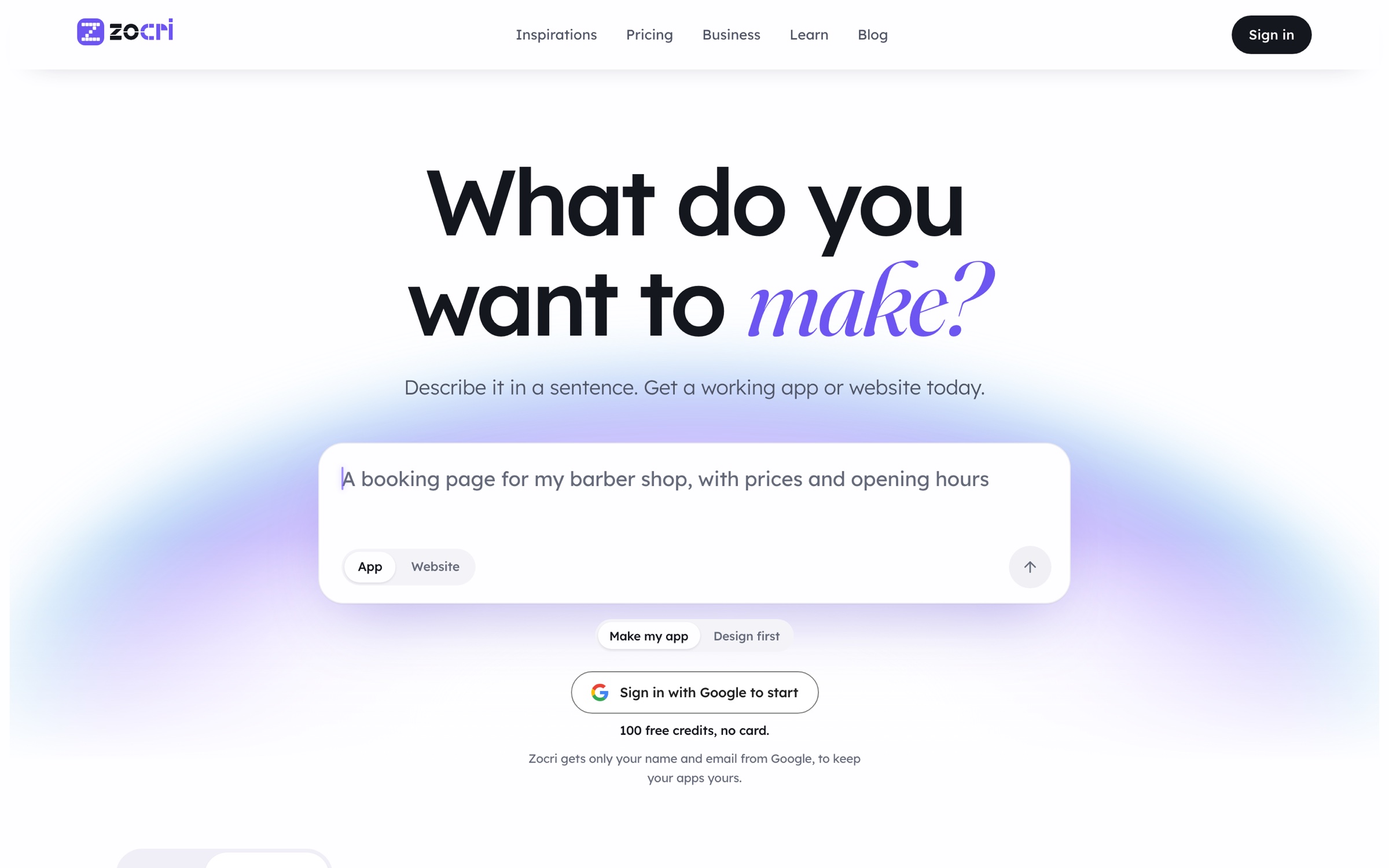
Zocri

Your app, one sentence away. A working app or website on a link today, with bookings, orders, sign in, messages, campaigns and insights behind it. Free to start, in the browser.
About Zocri

Tertin

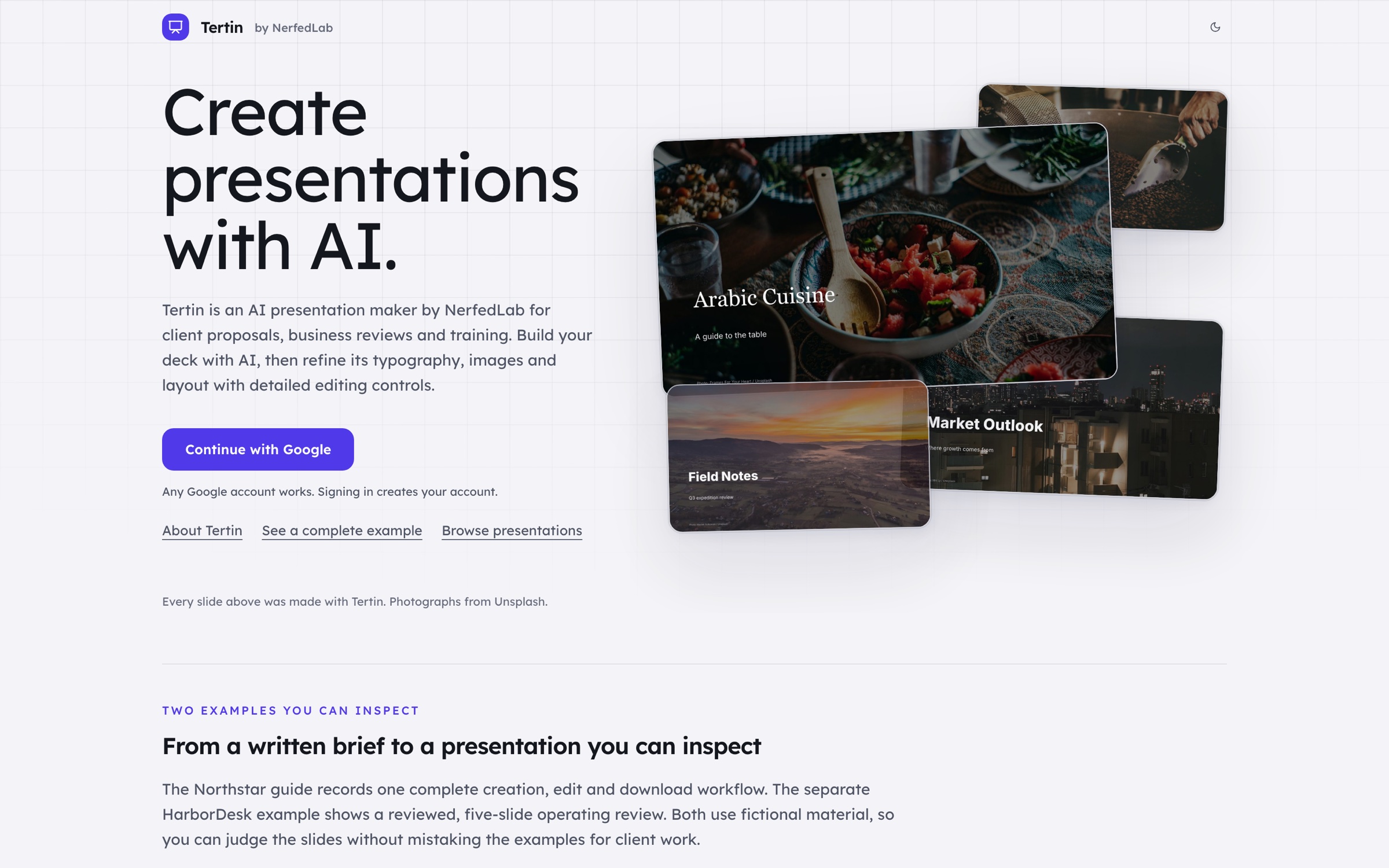
Presentations with AI. Describe the deck, answer a question or two, get a first draft, then shape every slide on the canvas and export to PowerPoint, PDF or the web.

About Tertin

An empty studio at golden hour: a long wooden table, dark monitors, sketches pinned to the wall

Get NerfedLab

Your next product starts with a sentence.

Free to download for macOS on Apple silicon. For a company, forty minutes on a call and we set up the rest.

Download for macOS · v6.7.2Request a demo

NerfedLab

Nº 01 · The Governance IssuePhotographs and films made for this issue[email protected]
You are visitor 01402775 — GeezerVison does not store the pages you look up.
Best viewed with Netscape Navigator 4.7 or Internet Explorer 6 at 800×600. No cookies required.