GeezerVison is showing sbaerospace.vercel.app — Projects and Competitions | SBHS Aerospace Club
Our work
Projects and Competitions
Here's what we've designed, simulated, built, and flown. We try to be clear about which is which.
Hardware and flight code
Airbrakes for the 2025-26 ARC rocket
Four flaps fold out of a 3D-printed section of the airframe to add drag, so the rocket can slow itself down on the way to its 750 ft target. So far this exists as CAD and code. The picture is a CAD render.
Version 2 of the CAD includes the airbrake housing, flaps, flap joints, fin can, and a centering ring for the electronics bay, all saved as 3D print files. A servo moves the flaps, and Rocket++ decides when.
CAD files on GitHub →
Rocket++ flight code
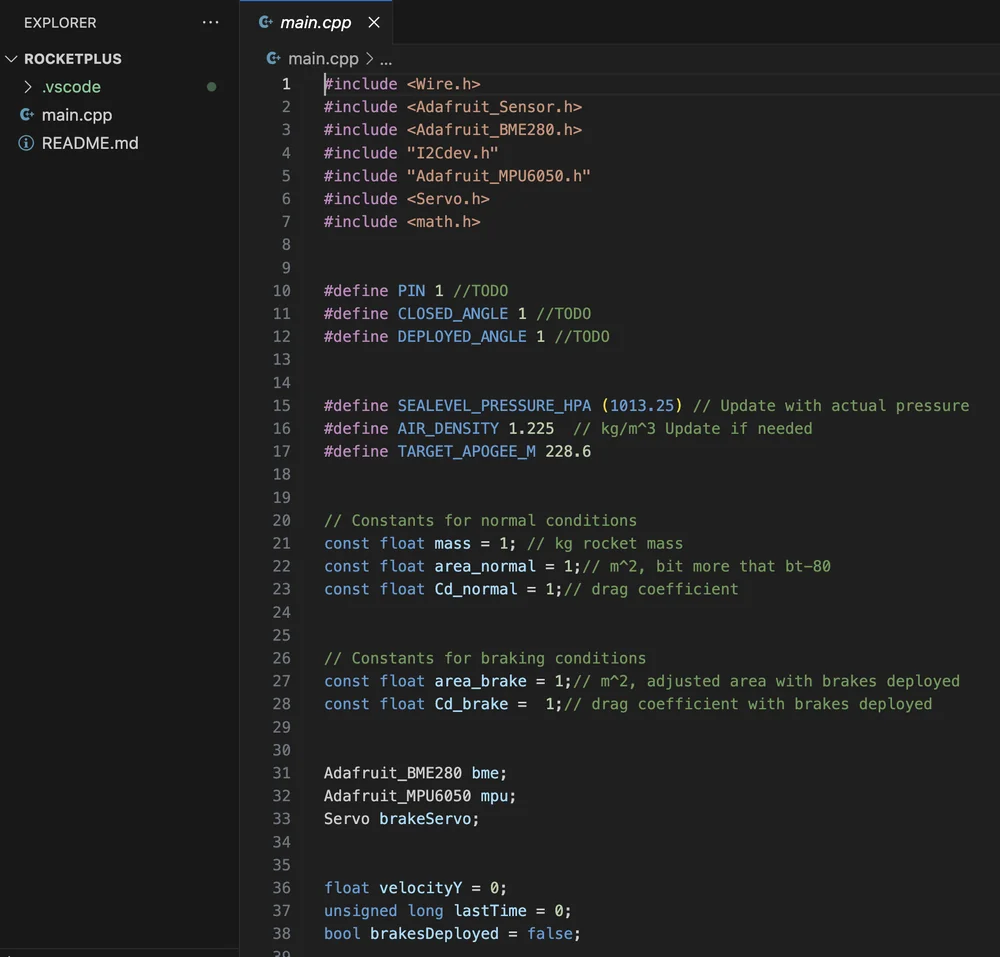
Rocket++ is the C++ code that runs the airbrakes on an Arduino-compatible board. It reads a BME280 barometer and an MPU6050 accelerometer, estimates how high the rocket will go, and deploys the brakes to aim for 750 ft (228.6 m).
The screenshot is from an early version, before the mass and drag numbers were set for a specific rocket.
Code on GitHub →
NDVI payload for NASA TechRise
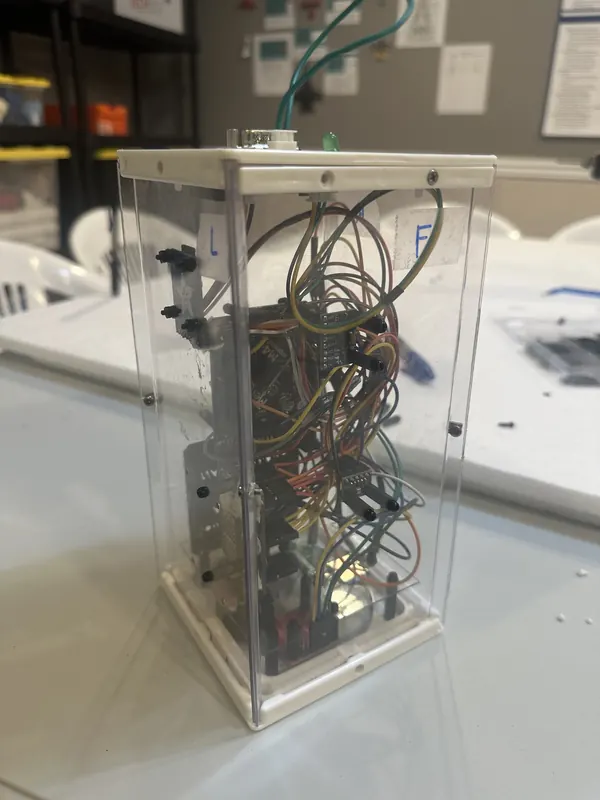
This is a prototype of our TechRise payload. It measures how much visible and near-infrared light comes off the ground, which is what you need to calculate NDVI, a standard way to measure plant health.
It uses an AS7343 spectral sensor, a TSL2591 light sensor, a BME280, and an MPU6050. Once a second it writes the World View balloon's flight data and every sensor reading to an SD card. The Python code keeps logging even if a sensor fails, and LEDs show what state it's in.
Payload code on GitHub →
ARC competition rockets
Every season, a club team builds a rocket for the American Rocketry Challenge. It has to carry a raw egg to a set altitude, stay up for a set amount of time, and bring the egg back without a crack. Our teams flew at the National Finals in 2024, 2025, and 2026.
In the photo: the current SBHS build on the pad at the World Space Week launch at North Branch Park in October 2026.
Simulation and design tools
Airbrake CFD
We simulated the airflow around the rocket twice: once without the airbrake flaps (top) and once with them out (bottom). These are simulation results, not data from a flight.
CircuitSpace
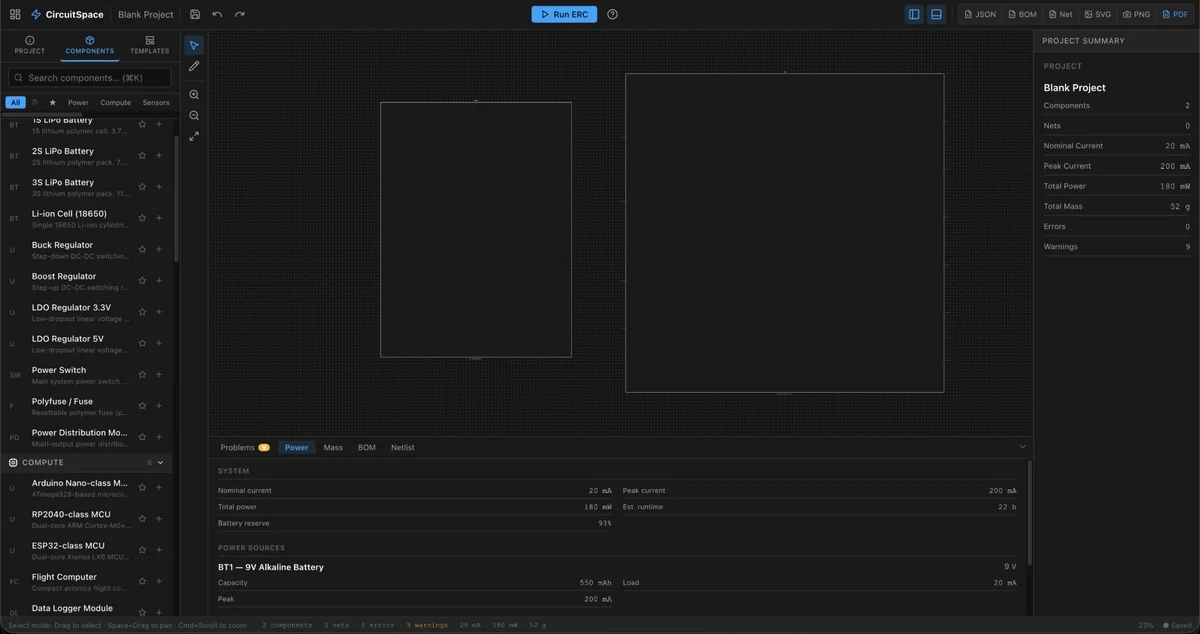
A web app we made for planning rocket electronics. You pick parts from a library of batteries, regulators, microcontrollers, and sensors and wire them up. It checks the wiring for problems, works out current draw, battery runtime, and mass, and exports a parts list or the diagram.
CircuitSpace on GitHub →
OpenRocket model for ARC 2027
Before we build anything, we model the rocket in OpenRocket. It tells us whether the rocket is stable and how high and how long it should fly compared with the ARC targets. This is our model for the 2027 rocket: 89.5 cm long, 640 g with the motor, and 1.78 calibers of stability. On an F32T-6 motor the simulation puts apogee at 236 m, about 775 ft. Applicants for the simulation tryout did the same kind of work.
Competition results*
Here's how we've done so far. At one of our trips to the National Finals, one of our teams placed 50th out of 100.
* Results from 2024 to 2026 were earned as South Brunswick Aerospace Club, the nonprofit that came before the SBHS club.
2026 NASA TechRise Winner
Our proposal, NDVI Mapping via Machine Learning, won the 2025-26 TechRise Student Challenge in January 2026. There's more about the payload under Hardware.
2026 ARC National Finals
Our ARC Team B was one of 100 teams picked for the National Finals from 1,107 entries, and one of six from New Jersey. It was our third trip to The Plains, Virginia.
2025 ARC National Finals
One of our teams qualified again and flew at the finals in The Plains, Virginia.
2024 ARC National Finals
One of our teams made the 100-team National Finals in The Plains, Virginia.
This season (2026-27)
Our competitive teams are working on the American Rocketry Challenge (two teams), NASA TechRise, the Drones in School Challenge, Cubes in Space, Genes in Space (two teams), and the Aviation Design Challenge.
See each team →
|