GeezerVison is showing usehm.dev — Hm — The AI harness & editor for when you pause to think.
NewHeadless mode, RPC and a Go package for the agent
The editor for when
you pause to think.
Hm is a native code editor with an AI coding agent built in. The agent writes fast; the decision about what lands in your codebase stays with you.
macOS, Linux & Windows
No browser engine
Bring your own key
Open source, AGPL-3.0
Talks directly to the models you already pay for
AnthropicGoogle GeminiVertex AIOpenAIAzure OpenAIOpenRouterGroqCerebrasMistralxAIDeepSeekTogetherFireworksHugging FaceOllamaLM StudioAnthropicGoogle GeminiVertex AIOpenAIAzure OpenAIOpenRouterGroqCerebrasMistralxAIDeepSeekTogetherFireworksHugging FaceOllamaLM Studio
Why “Hm”
Built around the pause before you merge.
Hm is the sound you make when you read a diff, a stack trace or a suggestion, and decide whether it is right. Everything in Hm is built to make that moment count.
01A real editor, right thereEvery change lands in a full editor with the language server, diagnostics and git diff beside it, not a chat bubble.
02Modes that slow downrubber-duck plans and pushes back before touching code. lazy changes only what is necessary.
03Asks before it actsShell commands and deletes need your OK by default, and guard.yaml rules always win.
04Nothing is finalUndo the last turn and its file changes, or go back to any message and try again. Every branch is kept.
See it work
Fast where it can be,
quiet when you need to think.
The editor
Everything you reach for,
nothing you wait on.
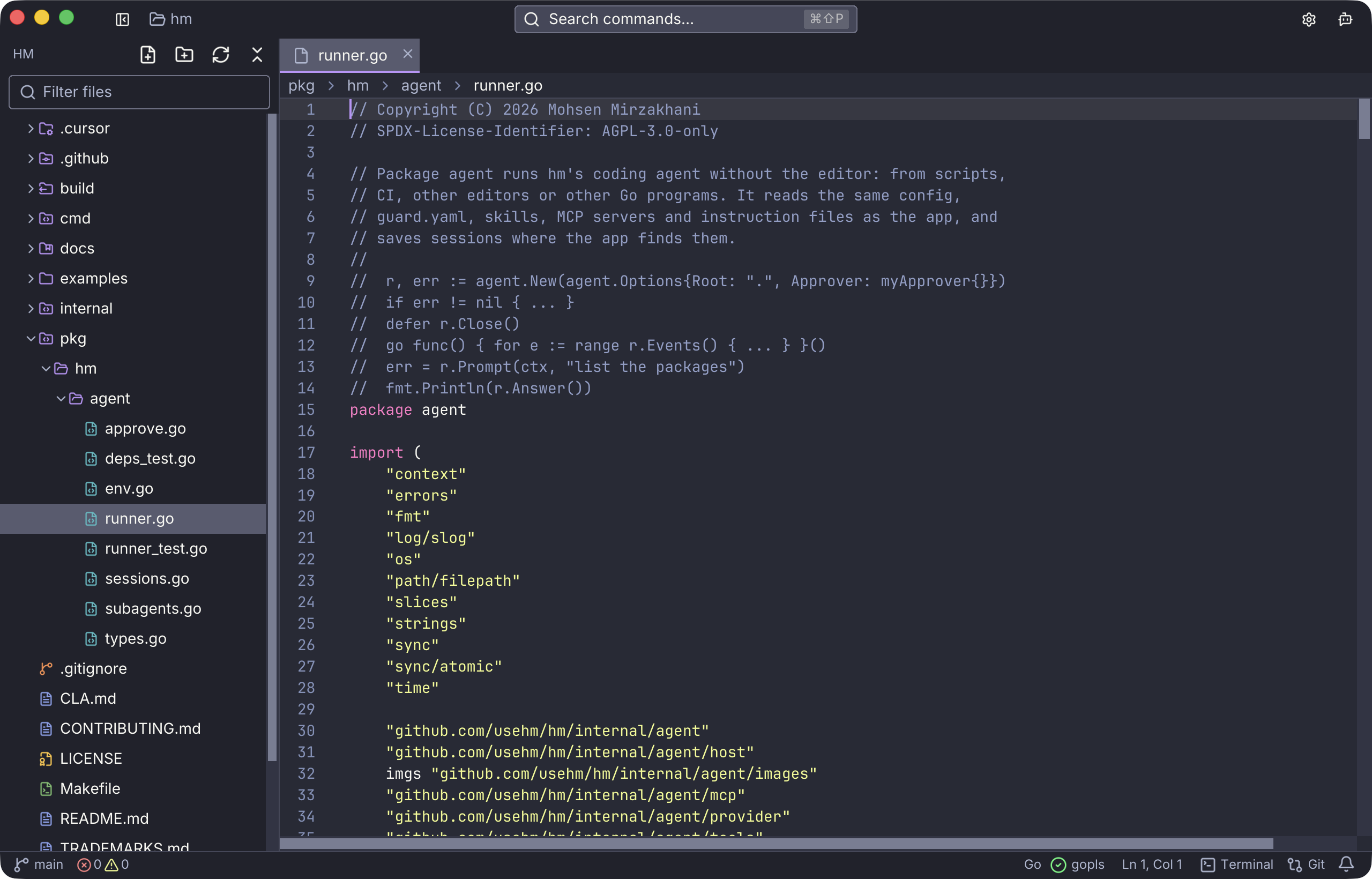
Written in Go and drawn on the GPU with WebGPU, Hm starts quickly and stays light, with the tools you expect from a modern editor.
Tree-sitter highlighting for 20+ languages
Multiple cursors and column selection, regex find and replace, folding, soft wrap, indent guides, auto-closing pairs, Markdown preview and an optional Vim keymap.
GoTypeScriptPythonRustJavaCC++C#ZigLuaRubyPHPSQLYAMLMarkdown+8 more
Native, GPU-rendered
No Electron, no browser engine. A Go binary drawing its own UI with Yoga.
0browser engines shipped
Language servers
Diagnostics, hover, completion, definitions, references, rename and formatting. Missing servers install in one click.
Search with ripgrep
Project-wide regex search and replace, with results on the left and an editable preview on the right.
Git, built in
Stage, commit, branch, merge with conflict tracking, fetch, pull and push. Tokens stay in your keychain.
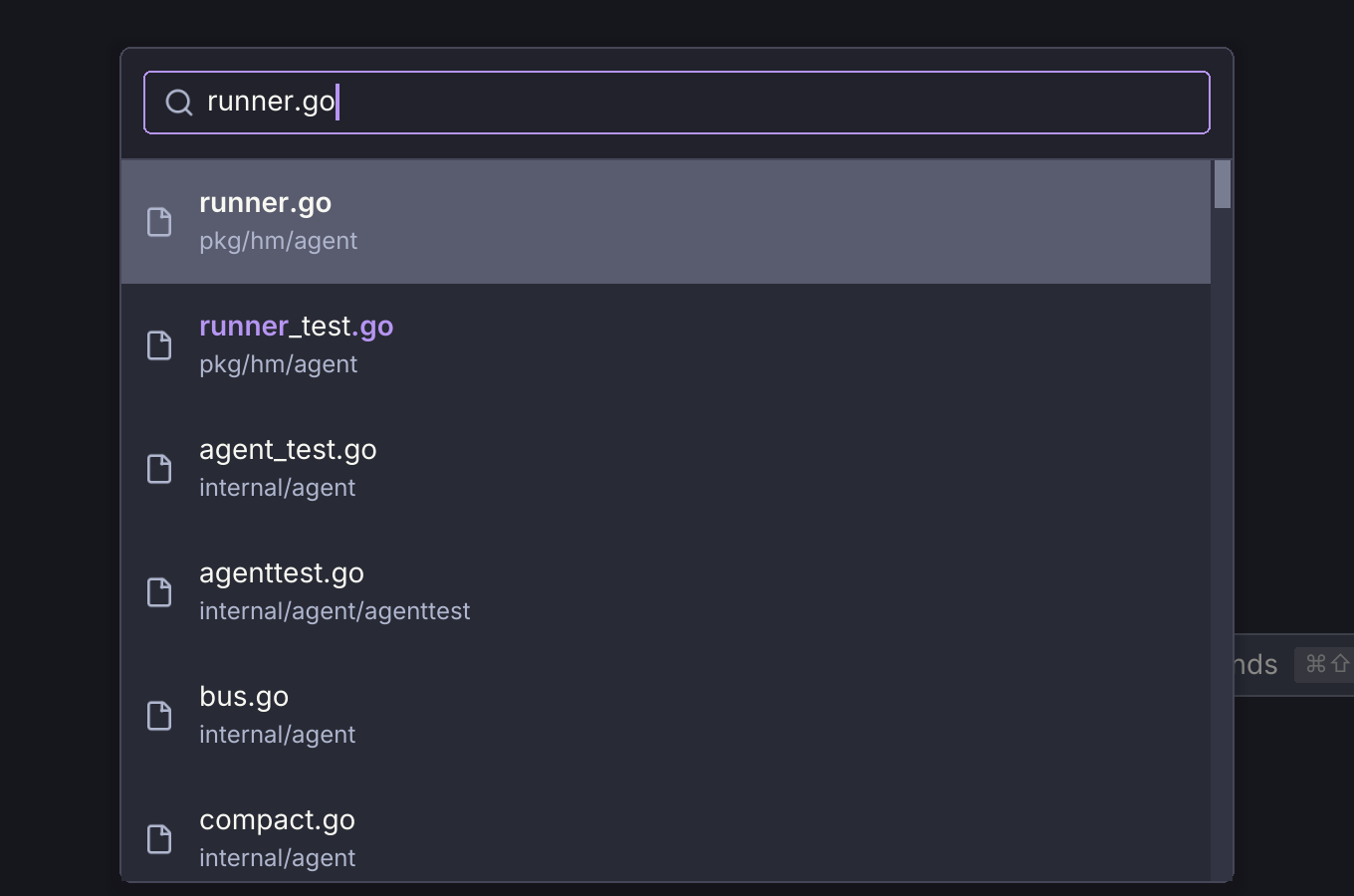
Quick open & command palette
⌘ P for files, ⌘ ⇧ P for every command, go to symbol and go to tab.
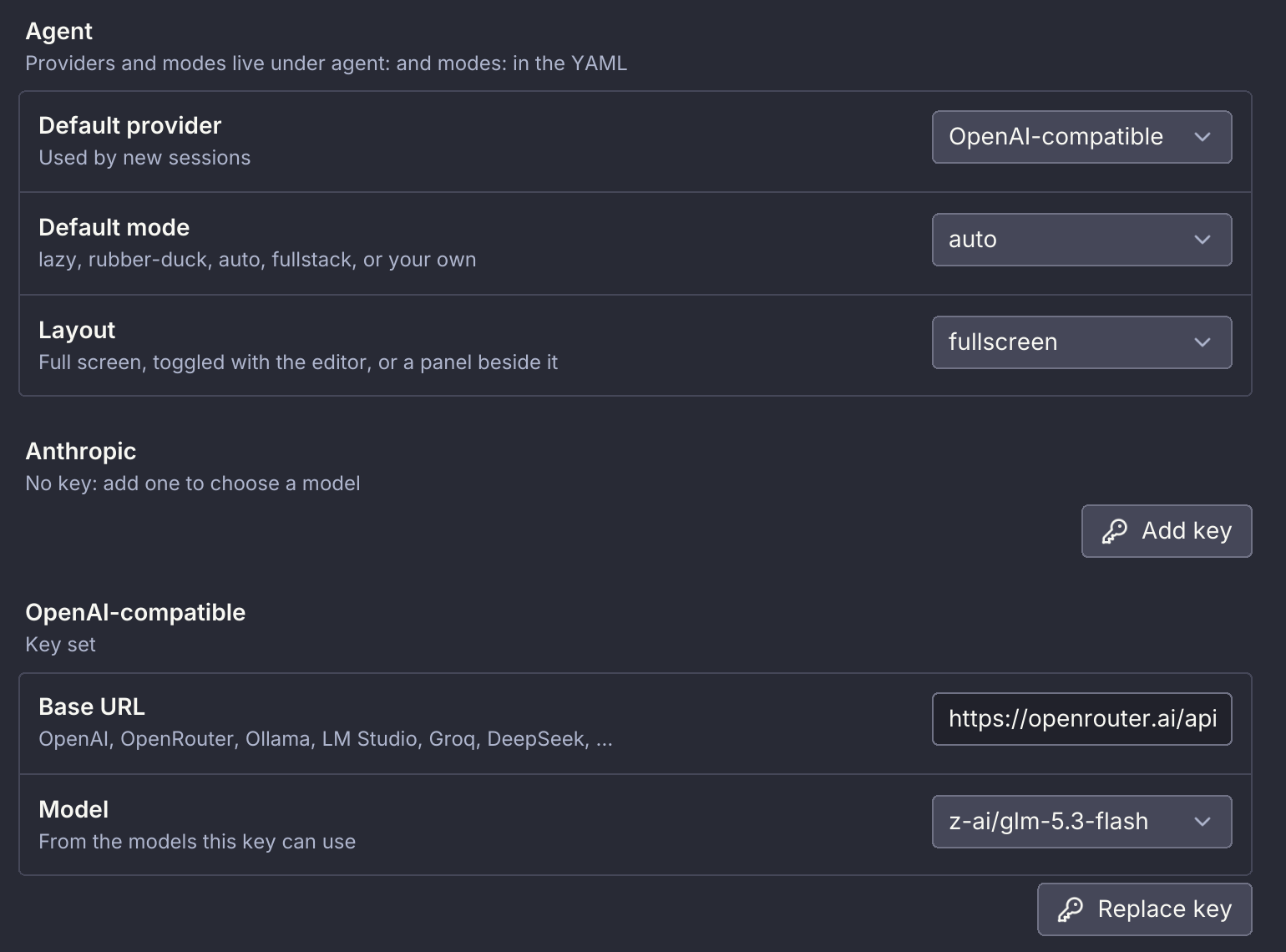
Settings that are just YAML
A settings page on top of config.yaml, user and project level, applied live on save with errors shown at their line.
Integrated terminal
Multiple sessions, opened from the footer.
Inline completions
Ghost text at the caret from a small, fast model you pick. Tab accepts.
Splits, tabs, sessions
Split editor groups, back and forward, and your session restored on launch.
The agent
An agent that works with you,
not around you.
Bring your own key, keep your code on your machine, and stay in control of every step.
Any model, switched mid-session.
Anthropic, Gemini (API key or Vertex AI), OpenAI, Azure OpenAI and any OpenAI-compatible endpoint. Presets for OpenRouter, Groq, Mistral, xAI, DeepSeek, Ollama, LM Studio and more only ask for a key.
- Ctrl L searches every provider's models; the history goes along.
/think off…max sets how hard the model thinks, per session.- A
models.json registry drives the context meter, compaction and the cost of every reply.
- Keys live in the OS keychain or come from environment variables.
~/.config/hm/config.yaml
agent:
  default_provider: anthropic
  default_mode: rubber-duck
  providers:
    anthropic: { type: anthropic, api_key: "keychain:anthropic" }
    openrouter: { type: openrouter, api_key: "${OPENROUTER_API_KEY}" }
    local: { type: ollama, model: qwen3, context_window: 32768 }
  favorite_models: [anthropic/claude-opus-5-5, local/qwen3]
  compaction: { enabled: true, threshold: 0.85 }
  subagents: { max_depth: 1, max_concurrent: 4 }
Sessions are trees. Nothing is lost.
Edit and resend any message to start a branch, or branch from the end of any turn. The old branch stays. Undo puts back the agent's last turn and the files it changed.
/tree to search and jump between branches, /fork to split a session off.- Saved after every step; an interrupted task reopens with a Resume button.
/export to one offline HTML page, secrets redacted; /share as a secret gist.
/tree
- ●userAdd retries to the HTTP client
- │assistantPlan: wrap Do() with backoff…
- ├─userUse the stdlib only, no deps
- │ │toolsedit client.go +42 −6
- │ └assistantDone. Retries 5× with jitter v1
- └─userRespect Retry-After headers too
- │toolsedit client.go +18 −3
- └assistantWaits as long as the API asks…
Guardrails you write, not hope for.
Approval per tool and per mode, plus a guard.yaml of deny, read-only and ask rules checked before anything runs. A cloned project's rules can only tighten yours, never loosen them.
- Modes: lazy, rubber-duck, auto, fullstack, or your own.
- Type while it works: Enter steers, Alt Enter queues a follow-up.
- Sub-agents run in parallel, in the foreground or background, read-only unless allowed.
.hm/guard.yaml
paths:
  deny: [".env", "*.pem", "~/.ssh", "~/.aws"]
  read_only: ["migrations/**"]

commands:
  deny: ["rm -rf /*", "sudo *", "re:curl .*\\| *(ba)?sh"]
  ask: ["git push*", "git reset --hard*"]

network:
  allow_hosts: ["pkg.go.dev", "github.com"]
Reads your AGENTS.mdAnd CLAUDE.md, from every folder between home and the workspace. SYSTEM.md replaces or extends the base prompt. Prompt templatesEvery .md in .hm/prompts or .claude/commands becomes a /command, with arguments and file includes. MCP, skills & your toolsAdd MCP servers, skills, or wrap any CLI as a tool. Arguments never go through a shell. Images in, tooPaste a screenshot, drop a file, or mention @shot.png. Large pictures are scaled down first. Long sessions keep goingNear the window's limit, older messages are summarised. A context meter shows how full it is. Survives flaky APIsRate limits and dropped connections are retried with backoff, and the chat tells you so.
Automation
The same agent, without the window.
Run it in scripts and CI, drive it from another program, or embed it in your own Go code. Same config, same guard.yaml, same sessions.
# Review a diff in CI, no window needed
git diff origin/main... | hm agent -p "review this"

# Resume the newest session and let it edit files
hm agent --continue --approve edits -p "now fix the tests"

# Every event as JSON lines, for scripts and jq
hm agent -p --output json "list the packages" \
  | jq -c 'select(.type == "tool_call")'
{"id":"1","type":"prompt","text":"fix the failing test"}
{"id":"2","type":"steer","text":"only touch the parser"}
{"id":"3","type":"approve","call_id":"toolu_01","allow":true}
{"id":"4","type":"set_model","provider":"anthropic","model":"claude-opus-5-5"}
{"id":"5","type":"export","format":"html"}
r, err := agent.New(agent.Options{Root: ".", Approver: myApprover{}})
if err != nil {
	return err
}
defer r.Close()

go func() {
	for e := range r.Events() {
		log.Println(e.Kind)
	}
}()

err = r.Prompt(ctx, "what is wrong here?", agent.Image{Data: png})
fmt.Println(r.Answer())
Read the automation docs
Keyboard first
Hands stay on the keys.
Every binding can be changed in Settings or YAML, with two-chord sequences and VS Code-style when conditions.
Command palette⌘⇧P
Go to file⌘P
Toggle agent⌘L
Ask about selection⌘⌥L
Pick a model⌃L
New agent tab⌘T
Search in project⌘⇧F
Add next occurrence⌘D
All shortcuts

Take a moment. Hm.
Signed and notarized for macOS, with builds for Linux and Windows. Free and open source.
$brew install --cask usehm/tap/hm
|