GV

GeezerVison

The World Wide Web, restored to 800 pixels of glory.

Home|About|Gaming cabinet|Archives|How it works|Starter sites

On this site

  • JS Tutorial
  • Web Tutorial
  • A to Z Guide
  • Projects
  • OOP
  • DOM
  • Set
  • Map
  • Math
  • Number
  • Boolean
  • Exercise
  • Introduction3 min read
  • Variables5 min read

This view

  • Original page
  • New address

GeezerVison is showing www.geeksforgeeks.org — JavaScript arrayBuffer slice() Method - GeeksforGeeks

geeksforgeeks
search icon
  • Courses
  • Tutorials
  • Interview Prep
  • JS Tutorial
  • Web Tutorial
  • A to Z Guide
  • Projects
  • OOP
  • DOM
  • Set
  • Map
  • Math
  • Number
  • Boolean
  • Exercise

JavaScript arrayBuffer slice() Method

Last Updated : 11 Jul, 2025

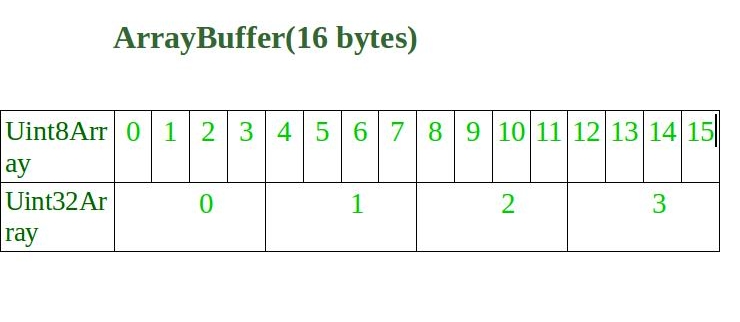
The arrayBuffer.slice is a property in JavaScript that return another arrayBuffer containing the contents of the previous arrayBuffer from beginning inclusive, to end, exclusive in bytes. ArrayBuffer is an object which is used to represent fixed-length binary data.

Difference between property and function in javascript. 

Property in JavaScript is nothing but a value whereas method is a function.

Syntax:  

arraybuffer.slice(begin[, end])

Parameters:  

  • begin: The slicing begins from the Zero-based byte index.
  • end: The slicing ends at this index byte. The new ArrayBuffer will contain all the contents if the end is found unspecified. It must be a valid index range specified for the current array. If the new ArrayBuffer length is found negative then it is fixed with zero.

Return Value: The property returns a new ArrayBuffer object. 

Examples:  

Input : uint32View[1] = 31
        myBuffer.slice(4, 12)
        sliced_bu[0]
Output : 31

Input : uint32View[1] = 32
        myBuffer.slice(4, 12)
        sliced_bu[0]
Output : 32

 Example: In this example, we will learn about the arrayBuffer.slice() property of Javascript.

javascript
// create an ArrayBuffer with a size 25 in bytes
let myBuffer = new ArrayBuffer(16);

// produces Uint32Array [0, 0, 0, 0]
let uint32View = new Uint32Array(myBuffer);

uint32View[1] = 30;

// produces Uint32Array [30, 0]
let sliced_buf = new Uint32Array(myBuffer.slice(4, 12));

// expected output: 30
console.log(sliced_buf[0]);

Output:  

30

We have a complete list of Javascript Array methods, to check those please go through this JavaScript ArrayBuffer Complete Reference article.

Supported Browser:

  • Google Chrome
  • Internet Explorer
  • Firefox
  • Opera
  • Safari

We have a Cheat Sheet on Javascript where we covered all the important topics of Javascript to check those please go through Javascript Cheat Sheet-A Basic guide to JavaScript. 

Comment

Explore

    JavaScript Basics
    • Introduction3 min read
    • Variables5 min read
    • Operators4 min read
    • Control Statements4 min read
    Array & String
    • Arrays6 min read
    • Array Methods4 min read
    • String5 min read
    • String Methods8 min read
    Function & Object
    • Functions4 min read
    • Function Expression3 min read
    • Function Overloading4 min read
    • Objects4 min read
    • Constructors4 min read
    OOP
    • OOP5 min read
    • Classes & Objects4 min read
    • Access Modifiers5 min read
    • Constructor4 min read
    Asynchronous JavaScript
    • Asynchronous2 min read
    • Callbacks4 min read
    • Promises4 min read
    • Event Loop3 min read
    • Async Await Fuction3 min read
    Exception Handling
    • Error and Exceptional Handling5 min read
    • Errors Throw & Try to Catch2 min read
    • Custom Errors2 min read
    • TypeError Invalid Array.prototype.sort argument1 min read
    DOM
    • DOM8 min read
    • DOM Elements3 min read
    • Custom Events4 min read
    • Addeventlistener5 min read
    Advanced Topics
    • Closure3 min read
    • Hoisting5 min read
    • Scope4 min read
    • Higher Order Functions7 min read
    • Debugging3 min read
    Courses
    • Placement 360 Course2 min read
    • MERN Full Stack Course2 min read
    • DSA and System Design Course2 min read
You are visitor 01402503 — GeezerVison does not store the pages you look up.
Best viewed with Netscape Navigator 4.7 or Internet Explorer 6 at 800×600. No cookies required.