GeezerVisonThe World Wide Web, restored to 800 pixels of glory. | ||||||||||||||||||||||
| Home|About|Gaming cabinet|Archives|How it works|Starter sites | ||||||||||||||||||||||
GeezerVison is showing www.precedenceresearch.com — Cloud Computing Market Companies, Size & Trends 2026-2035 Cloud Computing Market Size, Key Companies, Company Product Portfolio, Digital Transformation, Technology Investment, Adoption Rates, Customer Acquisition, Company Market Share, and Market OutlookThe cloud computing market is experiencing unprecedented growth driven by increasing enterprise digitalization, artificial intelligence integration, hybrid cloud adoption, and rising demand for scalable IT infrastructure. Organizations across sectors are utilizing cloud platforms to improve operational efficiency, enhance cybersecurity, support data-intensive applications, and accelerate innovation. With continuous advancements in AI-powered cloud services, edge computing, and sustainable data center technologies, cloud computing is emerging as the backbone of modern digital transformation, enabling businesses to build resilient, agile, and future-ready technology ecosystems.
Last Updated :
18 Sep 2026 | Report Code : 1701 | Format : PDF / PPT / Excel |
Author :
Shivani Zoting | Reviewed By :
Aditi Shivarkar
|
✓
Fact Checked
|
❝ Cite Cloud Computing Market Companies, Size & Trends 2026-2035 Source: https://www.precedenceresearch.com/cloud-computing-market
What is the Cloud Computing Market Size? Key Takeaways Market Size and Forecast Market Overview Role of Artificial Intelligence for Cloud Computing How are Governments Initiatives Supporting the Cloud Computing Sector? Cloud Computing Market Trends Cloud Computing Market Growth Factors Cloud Computing Market Outlook Market Report Coverage and Key Metrics Market Dynamics Segments Insights Market Regional Analysis: North America, Europe, Asia-Pacific Government Initiatives in the Cloud Computing Market Investments in the Cloud Computing Market Collaborations in the Cloud Computing Market Supply Chain Analysis Market Competitive Landscape: Leading Companies and Strategies Top Companies in the Cloud Computing Market and Their Offerings Cloud Computing Market Companies Recent Developments Segments Covered in the Report

Revenue,
2026
USD 1,106.28 Bn

Forecast Year,
2035
USD 5,946.84 Bn

CAGR,
2026 - 2035
20.61%

Report Coverage
Global
What is the Cloud Computing Market Size?The global cloud computing market size was estimated at USD 912.77 billion in 2025 and is predicted to increase from USD 1,106.28 billion in 2026 to approximately USD 5,946.84 billion by 2035, expanding at a CAGR of 20.61% from 2026 to 2035. The market growth is accelerated by industrial modernization, strategic investment in a digital framework, and innovation in automated analytics and implementation of cloud computing for resilient operation. 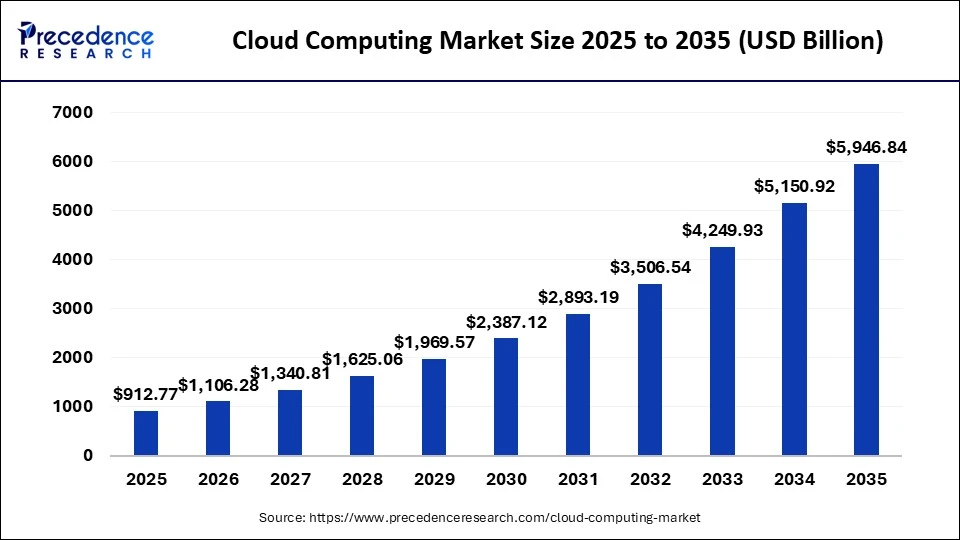
Key Takeaways
Market Size and Forecast
Market OverviewThe cloud computing market's expansion is supported by global digital transformation. The major organizations are transitioning toward scalable, flexible computing infrastructure integrated by AI and large data analytics that mandate substantial computing power and a compliant storage system. The rising focus on enhanced cybersecurity in cloud platforms is making cloud computing important to modern operations. Diversified end-user companies are transitioning from fixed on-premises computer hardware to robust digital ecosystems, enabling pay-per-use operational costs. Decentralized machine learning and data mining frameworks accelerate the shift to cloud computing, as these tasks require substantial processing power and elastic memory. Market-leading service administrators build networks that combine public and private clouds by reducing reliance on a single vendor and system costs, and maintaining operational continuity during network problems. The emerging trend of smart devices forces processing to the competitive edge for near-instant responses and end-user authentication. As cloud infrastructure is upgraded for complex workloads, interconnected systems form the pillar of cloud computing for global commerce. Role of Artificial Intelligence for Cloud ComputingThe digital shift will take on a new dimension over the next ten years as businesses use AI systems more and more to improve daily interactions. Automating tasks, decreasing human error, increasing productivity, applying cost-cutting strategies, and boosting efficiency are all made possible by cloud-based AI. Cloud computing and AI algorithms work together to analyze and organize large data volumes, creating useful blueprints for upcoming migrations and changes. The incorporation of AI into cloud computing facilitates adaptability, flexible approaches, and safe systems, enabling enterprises to expand quickly and economically with strong AI solutions. How are Governments Initiatives Supporting the Cloud Computing Sector?The government adopted cloud platforms to provide services like Aadhaar authentication, UPI transactions, DigiLocker document storage, and telemedicine (eSanjeevani). Through strategic investment, a scalable cloud infrastructure ensures systems such as UPI operate reliably and consistently. The government cloud infrastructure complies with MeitY standards, ensuring secure, compliant storage and processing of delicate data. Platforms like UMANG and MeriPehchaan SSO simplify citizen interactions with government and public services
Cloud Computing Market Trends
Cloud Computing Market Growth Factors
Cloud Computing Market Outlook
Market Report Coverage and Key Metrics
Market DynamicsDriverNeed for Virtual Infrastructure The increasing adoption of virtualized infrastructure across industries is a major driver of the cloud computing market. Enterprises are shifting away from traditional on-premise infrastructure due to high capital costs, complex hardware management, maintenance requirements, and limited scalability. Cloud platforms provide flexible computing resources, automated infrastructure management, and access to advanced technologies such as artificial intelligence (AI), machine learning, and big data analytics. Organizations are increasingly adopting cloud-based solutions to modernize IT operations, improve workflow automation, and support data-intensive applications. Leading cloud service providers are enabling businesses to build scalable digital ecosystems, accelerating cloud migration across industries and contributing to overall market growth. RestraintData Security Concerns Data security concerns, regulatory compliance requirements, and data residency laws remain key challenges affecting cloud computing adoption. Increasing government regulations regarding data storage, privacy, and cross-border data transfers are creating complexities for global enterprises and cloud service providers. To comply with regional regulations, providers are required to invest in localized data centers and infrastructure, increasing operational costs. These regulatory challenges can slow cloud deployment, reduce flexibility, and create barriers for organizations operating across multiple regions. OpportunityIntegration of Advanced Technologies The growing integration of cloud computing with edge computing, artificial intelligence, and Internet of Things (IoT) technologies presents significant growth opportunities for the market. Distributed cloud architectures enable real-time data processing closer to the source, supporting applications such as smart manufacturing, autonomous systems, connected vehicles, energy management, and healthcare monitoring. The expansion of edge-enabled cloud solutions allows organizations to process large volumes of data with reduced latency, improving operational efficiency and enabling real-time decision-making. As industries continue adopting automation, smart infrastructure, and digital transformation strategies, cloud computing is expected to become a critical foundation for next-generation enterprise technologies. Segments InsightsDeployment InsightsWhy did the Private Deployment Segment Dominate the Cloud Computing Market? The private segment dominated the market with the largest share in 2025, owing to increasing demand from organizations requiring enhanced security, greater control, and customized cloud environments. Private cloud infrastructure enables enterprises to maintain dedicated computing resources while supporting scalability, performance optimization, and compliance requirements. Large organizations, particularly those handling sensitive data and critical workloads, prefer private cloud solutions due to improved data governance, cybersecurity capabilities, and operational control. The ability to customize infrastructure according to business requirements has strengthened the adoption of private cloud deployment across highly regulated industries. The hybrid segment is expected to grow at the fastest rate during the forecast period, as hybrid cloud models allow organizations to combine private infrastructure with public cloud resources, enabling flexibility, scalability, and cost optimization. Businesses are increasingly adopting hybrid environments to maintain sensitive workloads internally while using public cloud platforms for variable workloads and peak demand management. This approach supports digital transformation while reducing dependency on traditional IT infrastructure. Service InsightsHow did the SaaS Segment Lead the Cloud Computing Market? The software as a service (SaaS) segment led the market in 2025 by holding the largest share. This is because SaaS has become the preferred software delivery model as enterprises increasingly shift from traditional software installations toward subscription-based cloud applications. SaaS solutions provide businesses with instant access to applications through web-based platforms while reducing upfront infrastructure costs. Increasing adoption of cloud-based collaboration tools, enterprise resource planning systems, customer relationship management platforms, and communication solutions has further strengthened segment growth. SaaS also enables automatic updates, remote accessibility, and cross-device compatibility, supporting modern workplace requirements. The platform as a service (PaaS) segment is expected to grow at the fastest rate during the forecast period, as it enables developers to build, test, and deploy applications without managing underlying hardware and infrastructure. Increasing adoption of artificial intelligence, machine learning, application modernization, and cloud-native development is driving demand for PaaS solutions. The platform supports faster application development, automated scaling, and efficient management of complex digital workloads. End User InsightsWhat Made BFSI the Leading Segment in the Market? The BFSI segment led the cloud computing market in 2025 with a major share in 2025. This is mainly due to the increasing adoption of cloud platforms for digital banking, fraud detection, risk management, and financial analytics. Financial institutions have transitioned from traditional IT infrastructure to cloud-based systems to improve operational efficiency, enable real-time data processing, and deliver personalized customer experiences. Cloud computing also supports regulatory compliance, cybersecurity improvements, and faster innovation, helping financial organizations compete with emerging fintech companies. The healthcare segment is expected to grow at a significant rate during the forecast period. This is because healthcare organizations are increasingly adopting cloud solutions for electronic health records, medical imaging storage, remote healthcare services, and advanced analytics. Cloud platforms enable secure data sharing, improve accessibility of patient information, and support AI-driven healthcare applications while reducing infrastructure costs. Organization Size InsightsLarge Enterprises Held the Largest Share of the Market in 2025 The large enterprises segment dominated the cloud computing market by holding the largest share in 2025, driven by significant investments in digital transformation, advanced IT infrastructure, and multi-cloud strategies. Large organizations require scalable and secure cloud environments to manage complex operations, global workflows, analytics platforms, and high-volume workloads. Large enterprises benefit from cloud solutions through improved operational efficiency, enhanced security management, automated compliance, and continuous system availability. The small and medium-sized enterprises (SMEs) segment is expected to register the fastest growth during the forecast period. Cloud computing enables SMEs to access advanced technologies without significant investments in physical infrastructure or specialized IT teams. Flexible pricing models and pay-as-you-go services allow smaller businesses to scale resources based on demand, supporting innovation, application development, and global expansion. Workload InsightsWhich Workload Segment Held the Largest Share in the Cloud Computing Market? The storage, backup, and disaster recovery segment held the largest share of the market in 2025. This is because organizations increasingly rely on cloud platforms for secure data storage, automated backups, and business continuity solutions. Cloud-based disaster recovery enables rapid system restoration during cyberattacks, hardware failures, or operational disruptions. The ability to store data efficiently through automated management and scalable cloud infrastructure has strengthened adoption across industries. The business analytics segment is expected to grow at the fastest rate during the forecast period, as enterprises are increasingly shifting analytics workloads to cloud platforms to access advanced data processing, artificial intelligence, machine learning, and real-time visualization tools. Cloud-based analytics solutions allow organizations to analyze customer behavior, operational performance, and supply chain data while reducing infrastructure costs. The growing demand for predictive insights and data-driven decision-making is expected to accelerate the adoption of cloud analytics solutions. Market Regional Analysis: North America, Europe, Asia-PacificWhy did North America Dominate the Cloud Computing Market?North America dominated the cloud computing market while holding the largest share in 2025 due to its advanced digital infrastructure, strong presence of leading cloud service providers, and high adoption of emerging technologies. The region serves as a major hub for cloud innovation, supporting advancements in artificial intelligence (AI), machine learning, automation, and enterprise digital transformation. The presence of major technology companies, extensive data center networks, and strong research and development investments has accelerated cloud adoption across industries. Enterprises in North America are increasingly migrating workloads to cloud platforms to improve scalability, optimize operational efficiency, and support advanced analytics and automation initiatives. What is the U.S. Cloud Computing Market Size? The U.S. cloud computing market size is evaluated at USD 523.29 billion in 2025 and is projected to be worth around USD 3,462.37 billion by 2035, growing at a CAGR of 20.80% from 2026 to 2035. 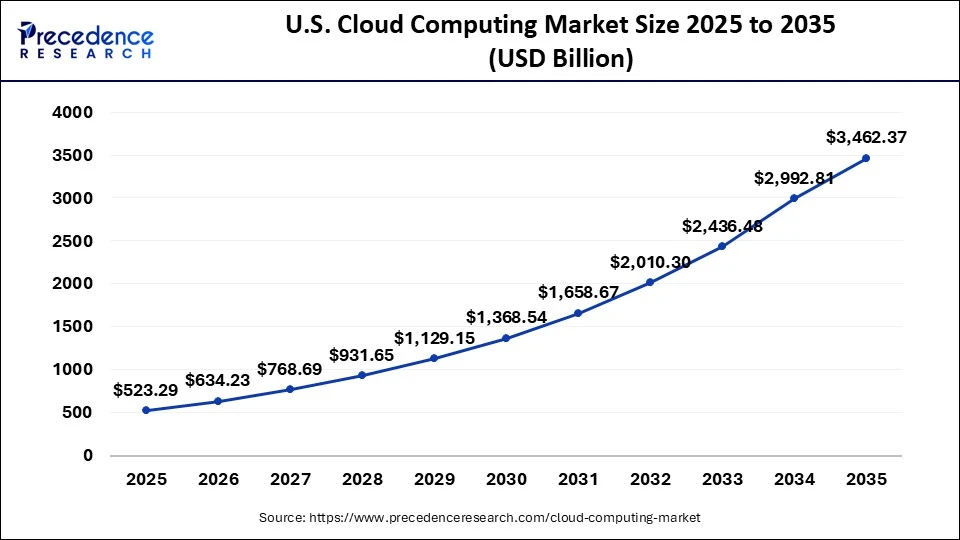
U.S. Market Trends The U.S. is the largest contributor to the North American cloud computing market. The growth of the market in the country is driven by rapid adoption of generative AI, large-scale data processing, and advanced cloud infrastructure. Organizations are increasingly using cloud platforms to access high-performance computing resources, AI capabilities, and scalable digital solutions. The U.S. market is characterized by strong investments in hyperscale data centers, cloud-native applications, and AI-driven services, making cloud computing a critical component of enterprise technology strategies. Europe: The Second-Largest MarketEurope is considered the second-largest market for cloud computing and is expected to grow at a significant CAGR during the forecast period. This is mainly due to the increasing digital transformation initiatives, strict data protection regulations, and rising adoption of cloud-based solutions across industries. The region's focus on data sovereignty and regulatory compliance, particularly through frameworks such as GDPR, is encouraging organizations and cloud providers to develop localized cloud infrastructure. Enterprises are increasingly adopting hybrid and multi-cloud strategies to balance flexibility, security, and compliance requirements. Additionally, Europe's commitment to sustainability is accelerating investments in energy-efficient data centers, renewable energy integration, and advanced cooling technologies. Germany Market Trends Germany is a key contributor to the European cloud computing market, supported by Industry 4.0 initiatives and increasing enterprise digitalization. The country's strong industrial base, particularly in automotive, manufacturing, and chemicals, is driving demand for cloud-enabled solutions such as predictive maintenance, industrial IoT, automation, and real-time analytics. German organizations are increasingly adopting secure hybrid cloud models to maintain compliance with strict data protection requirements while improving operational efficiency. 
Asia Pacific: The Fastest-Growing RegionAsia Pacific is expected to grow at the fastest rate in the coming years due to increasing digitalization, expanding internet penetration, government-led technology initiatives, and rising adoption across industries such as e-commerce, finance, healthcare, and telecommunications. The growing demand for low-latency services and real-time data processing is encouraging investments in regional data centers and edge computing infrastructure. The expansion of mobile applications, online services, and digital platforms is further increasing cloud adoption across emerging economies. China Market Trends China represents one of the largest cloud computing markets in Asia Pacific, supported by government-backed digital transformation programs, smart city initiatives, and industrial automation projects. The country's focus on artificial intelligence, cloud-based manufacturing, digital infrastructure, and connected technologies is increasing demand for large-scale cloud platforms. Regulatory requirements have also encouraged the development of localized cloud ecosystems and domestic data infrastructure. What Drives the Latin America Cloud Computing Market?The Latin American market is growing due to increasing enterprise adoption of digital technologies, cost optimization requirements, and the shift from traditional IT infrastructure toward cloud-based solutions. Businesses across banking, retail, telecommunications, and other sectors are adopting cloud platforms to improve flexibility, reduce infrastructure costs, and support digital services. Investments in data centers, network connectivity, and submarine cable infrastructure are further improving regional cloud capabilities. Brazil Market Trends Brazil is leading the cloud computing market in Latin America, driven by increasing adoption among financial institutions, retailers, and telecommunications companies. Organizations are shifting toward cloud-based infrastructure to reduce operational expenses and improve scalability. Growing investments from global technology companies and increasing demand for digital banking, mobile applications, and analytics solutions are expected to support further cloud market expansion in Brazil. Why is the Middle East & Africa Cloud Computing Market Growing?The Middle East & Africa cloud computing market is expanding due to government-led digital transformation initiatives, smart city development, and increasing investments in digital infrastructure. Countries across the region are focusing on modernizing public services, expanding connectivity, and adopting cloud platforms to support economic diversification. The growth of data centers, improved internet infrastructure, and adoption of cloud-based enterprise solutions are creating new market opportunities. UAE Market Trends The UAE is emerging as a major cloud computing hub in the Middle East, supported by government digital strategies, smart city initiatives, and partnerships with global cloud providers. Investments in local data centers, secure cloud infrastructure, artificial intelligence, and automated services are strengthening the UAE's position as a regional technology center. Cloud adoption is increasing across sectors such as government services, transportation, finance, and real estate. Government Initiatives in the Cloud Computing MarketChina
United States
Germany
Brazil
Saudi Arabia
Investments in the Cloud Computing Market
Collaborations in the Cloud Computing Market
Supply Chain Analysis
Market Competitive Landscape: Leading Companies and StrategiesThe cloud computing market is highly competitive, with major technology companies competing through infrastructure expansion, artificial intelligence integration, hybrid cloud capabilities, cybersecurity solutions, and industry-specific cloud platforms. Market participants are focusing on strengthening their cloud ecosystems, improving scalability, enhancing data security, and developing advanced solutions to support enterprise digital transformation. Leading cloud service providers are investing heavily in hyperscale data centers, AI-powered cloud services, edge computing, and automation technologies to meet the growing demand for flexible and high-performance computing infrastructure. Strategic partnerships, acquisitions, and collaborations with software developers, enterprises, and technology providers are becoming key strategies for expanding market presence. Top Companies in the Cloud Computing Market and Their Offerings
Cloud Computing Market Companies
Recent Developments
Segments Covered in the ReportBy Deployment
By Service
By End User
By Organization Size
By Workload
By Region
For inquiries regarding discounts, bulk purchases, or customization requests, please contact us at [email protected] Frequently Asked Questions
Answer : The global cloud computing market size was reached at USD 1,106.28 billion in 2026 and it is anticipated to rake around USD 5,946.84 billion by 2035.
Answer : The global cloud computing market is expected to drive growth at a CAGR of 20.61% during the forecast period 2026 to 2035.
Answer : The major players operating in the cloud computing market are Adobe Inc., Alibaba Group Holding Limited, Amazon.com Inc., Google LLC, International Business, Machines Corporation, Microsoft Corporation, Oracle Corporation, Salesforce.com Inc., SAP SE, Workday, Inc.
Answer : The rising popularity of the latest novel technologies like artificial intelligence and machine learning and its rapid adoption in the cloud computing is empowering the growth of the global cloud computing market.
Answer : The North America region is estimated to lead the cloud computing market during the forecast period.
Share With:





Select User License to Buy
Immediate Delivery Available
Ask For SampleNo cookie-cutter, only authentic analysis – take the 1st step to become a Precedence Research client | ||||||||||||||||||||||
| You are visitor 01402503 — GeezerVison does not store the pages you look up. Best viewed with Netscape Navigator 4.7 or Internet Explorer 6 at 800×600. No cookies required. |
 Get a Sample
 Table Of Content
 Get a Sample