Python functions - Exercises, Practice, Solution
This resource offers a total of 105 Python functions problems for practice. It includes 21 main exercises, each accompanied by solutions, detailed explanations, and four related problems.
[An Editor is available at the bottom of the page to write and execute the scripts.]
1. Maximum of Three Numbers
Write a Python function to find the maximum of three numbers.
Click me to see the sample solution
2. Sum All Numbers in a List
Write a Python function to sum all the numbers in a list.
Sample List : (8, 2, 3, 0, 7)
Expected Output : 20
Click me to see the sample solution
3. Multiply All Numbers in a List
Write a Python function to multiply all the numbers in a list.
Sample List : (8, 2, 3, -1, 7)
Expected Output : -336
Click me to see the sample solution
4. Reverse a String
Write a Python program to reverse a string.
Sample String : "1234abcd"
Expected Output : "dcba4321"
Click me to see the sample solution
5. Factorial of a Number
Write a Python function to calculate the factorial of a number (a non-negative integer). The function accepts the number as an argument.
Click me to see the sample solution
6. Check if a Number Falls Within a Given Range
Write a Python function to check whether a number falls within a given range.
Click me to see the sample solution
7. Count Uppercase and Lowercase Letters in a String
Write a Python function that accepts a string and counts the number of upper and lower case letters.
Sample String : 'The quick Brow Fox'
Expected Output :
No. of Upper case characters : 3
No. of Lower case Characters : 12
Click me to see the sample solution
8. Return a New List with Distinct Elements from a List
Write a Python function that takes a list and returns a new list with distinct elements from the first list.
Sample List : [1,2,3,3,3,3,4,5]
Unique List : [1, 2, 3, 4, 5]
Click me to see the sample solution
9. Check Whether a Number is Prime
Write a Python function that takes a number as a parameter and checks whether the number is prime or not.
Note : A prime number (or a prime) is a natural number greater than 1 and that has no positive divisors other than 1 and itself.
Click me to see the sample solution
10. Print Even Numbers from a Given List
Write a Python program to print the even numbers from a given list.
Sample List : [1, 2, 3, 4, 5, 6, 7, 8, 9]
Expected Result : [2, 4, 6, 8]
Click me to see the sample solution
11. Check if a Number is Perfect
Write a Python function to check whether a number is "Perfect" or not.
According to Wikipedia : In number theory, a perfect number is a positive integer that is equal to the sum of its proper positive divisors, that is, the sum of its positive divisors excluding the number itself (also known as its aliquot sum). Equivalently, a perfect number is a number that is half the sum of all of its positive divisors (including itself).
Example : The first perfect number is 6, because 1, 2, and 3 are its proper positive divisors, and 1 + 2 + 3 = 6. Equivalently, the number 6 is equal to half the sum of all its positive divisors: ( 1 + 2 + 3 + 6 ) / 2 = 6. The next perfect number is 28 = 1 + 2 + 4 + 7 + 14. This is followed by the perfect numbers 496 and 8128.
Click me to see the sample solution
12. Check if a String is a Palindrome
Write a Python function that checks whether a passed string is a palindrome or not.
Note: A palindrome is a word, phrase, or sequence that reads the same backward as forward, e.g., madam or nurses run.
Click me to see the sample solution
13. Print the First n Rows of Pascal's Triangle
Write a Python function that prints out the first n rows of Pascal's triangle.
Note : Pascal's triangle is an arithmetic and geometric figure first imagined by Blaise Pascal.
Sample Pascal's triangle :
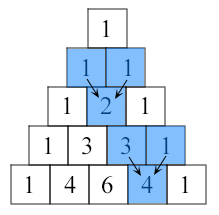
Each number is the two numbers above it added together
Click me to see the sample solution
14. Check if a String is a Pangram
Write a Python function to check whether a string is a pangram or not.
Note : Pangrams are words or sentences containing every letter of the alphabet at least once.
For example : "The quick brown fox jumps over the lazy dog"
Click me to see the sample solution
15. Sort Hyphen-Separated Sequence of Words Alphabetically
Write a Python program that accepts a hyphen-separated sequence of words as input and prints the words in a hyphen-separated sequence after sorting them alphabetically.
Sample Items : green-red-yellow-black-white
Expected Result : black-green-red-white-yellow
Click me to see the sample solution
16. Create and Print a List of Squares for Numbers 1 to 30
Write a Python function to create and print a list where the values are the squares of numbers between 1 and 30 (both included).
Click me to see the sample solution
17. Create a Chain of Function Decorators (Bold, Italic, Underline, etc.)
Write a Python program to create a chain of function decorators (bold, italic, underline etc.).
Click me to see the sample solution
18. Execute a String Containing Python Code
Write a Python program to execute a string containing Python code.
Click me to see the sample solution
19. Access a Function Inside a Function
Write a Python program to access a function inside a function.
Click me to see the sample solution
20. Detect the Number of Local Variables Declared in a Function
Write a Python program to detect the number of local variables declared in a function.
Sample Output:
3
Click me to see the sample solution
21. Invoke a Function After a Specified Period of Time
Write a Python program that invokes a function after a specified period of time.
Sample Output:
Square root after specific miliseconds:
4.0
10.0
158.42979517754858
Click me to see the sample solution
Python Code Editor:
More to Come !
Do not submit any solution of the above exercises at here, if you want to contribute go to the appropriate exercise page.