GeezerVison is showing chen-geng.com — Chen Geng | Stanford CS
|
Chen Geng
?
My first name is Chen, and my last name is Geng.
I prefer to be addressed by my first name Chen. I also go by "Ken" sometimes.
Possible pronunciation: Chen(ch-uhn) Geng(guh-ng).
Hi👋! I'm a fourth-year CS Ph.D. student at Stanford, fortunate to be advised by Prof. Jiajun Wu. Previously, I got my bachelor's degree at Zhejiang University, working with Prof. Xiaowei Zhou and Prof. Sida Peng. My research is in part supported by an NVIDIA Graduate Fellowship.
My research lies at the intersection of 4D Computer Vision, Graphics, and Machine Learning. I'm broadly interested in data-driven modeling of the physical world and applications of such models in robotics and natural science. Currently, I'm obsessed with developing neural simulators for the (inverse) modeling of macroscopic mechanical systems.
Email: X × Y, where X = {gengchen}, Y = {@cs.stanford.edu}
Bio /
Google Scholar /
X /
Bluesky /
GitHub /
LinkedIn
|

|
Recent News 📰
- 09/2026: One paper is accepted to NeurIPS 2026.
- 04/2026: Invited talks on "Rethinking Inverse Simulation through the Lens of Lagrangian Mechanics" at the Simulation Intelligence Group at CMU, UBC & UofT, the Physical Vision Group at NTU, and the Gradient Spaces Lab at Stanford.
- 02/2026: Four papers are accepted to CVPR 2026.
- 01/2026: One paper is accepted to ICLR 2026.
- 01/2026: We are organizing the 2nd workshop on 4D Vision at CVPR 2026. Submit your work on 4D vision to our workshop and share it with the community!
- 01/2026: This year I will co-organize the Stanford Vision Seminar. Subscribe to our mailing list here!
- 12/2025: Excited to announce that I received the NVIDIA Graduate Fellowship for 2026-2027!
- 04/2025: We will be organizing the workshop on "Generating Digital Twins from Images and Videos" at ICCV 2025.
- 04/2025: Our paper "Birth and Death of a Rose" is selected as an oral presentation at CVPR 2025.
- 03/2025: One paper is accepted to SIGGRAPH 2025.
- 02/2025: Two papers are accepted to CVPR 2025.
- 02/2024: One paper is accepted to CVPR 2024.
- 01/2024: One paper is accepted to ICLR 2024.
|
-
Rethinking Inverse Simulation through the Lens of Lagrangian Mechanics
[Abstract]
Abstract: Building simulation models for diverse physical systems from observational data is critical for many downstream applications, such as creating digital twins for robot learning. However, such inverse modeling remains challenging to scale: each new object requires selecting a category-specific physical model, then recovering its parameters through often-fragile system identification.
In this talk, we ask whether we can build a neural simulation system with a single governing structure that models diverse physical phenomena, from articulated rigid bodies to deformable solids, without category-specific equations. One natural design is to keep Lagrangian mechanics as the universal physical principle shared across these phenomena, while the category-specific structure is absorbed into generalized coordinates learned across categories from large-scale, multi-category 4D data. We show that the covariance of the Euler–Lagrange equations extends even to such overcomplete, learned coordinates, and simulate by solving these equations directly in the latent kinematic space, reframing inverse simulation as a generative modeling problem. The resulting system turns raw 3D shapes of diverse categories into simulatable assets in a feed-forward manner, with no physical annotations or per-object fitting, and generalizes to real-world scenes scanned with a phone.
|
(* denotes equal contribution, † denotes equal advising, ^ denotes student (co-)mentored)
Representative works are highlighted
For the comprehensive list, check out my Google Scholar page.
|
|
Predictive 4D Generation with Latent State Machines
Yue Gao*,
Chen Geng*,
Hanzhe Hu,
Fangyun Wei,
Jianfeng Xiang,
Jiaolong Yang,
Jiajun Wu
NeurIPS 2026
[Paper]
[Project Page]
tl;dr: We propose latent state machines, a 4D representation that separates 3D states from their temporal transitions, and use it to generate a plant's entire growth lifespan from a single image.
|

|
DyCraft: An Agentic System for Long-Horizon 4D Scene Generation
Jeff Tan*,
Hang Dai*,
Zeqian Long*,
Yanzhe Lyu,
R. Kenny Jones,
Shangzhe Wu,
Chen Geng†,
Jiajun Wu†
arXiv 2026
[arXiv]
[Project Page]
tl;dr: An agentic system that lets coding agents author long-horizon animated 3D scenes by planning, storyboarding key poses as verified static scenes, and animating the motion between them.
|
|
|
NeuROK: Generative 4D Neural Object Kinematics
Chen Geng*,
Guangzhao He*,
Yue Gao*,
Yunzhi Zhang,
Shangzhe Wu,
Jiajun Wu
CVPR 2026
[Paper]
[Project Page]
[Code]
tl;dr: We turn any static 3D shape into an interactable 4D asset with a neural simulator built on the minimal inductive bias of Lagrangian mechanics.
|

|
Choreographing a World of Dynamic Objects
Yanzhe Lyu^*,
Chen Geng*,
Karthik Dharmarajan,
Yunzhi Zhang,
Hadi Alzayer,
Shangzhe Wu,
Jiajun Wu
CVPR 2026
[Paper]
[Project Page]
tl;dr: We propose a universal pipeline for generating 4D scenes composed of dynamic objects by distilling from video generative models.
|
|
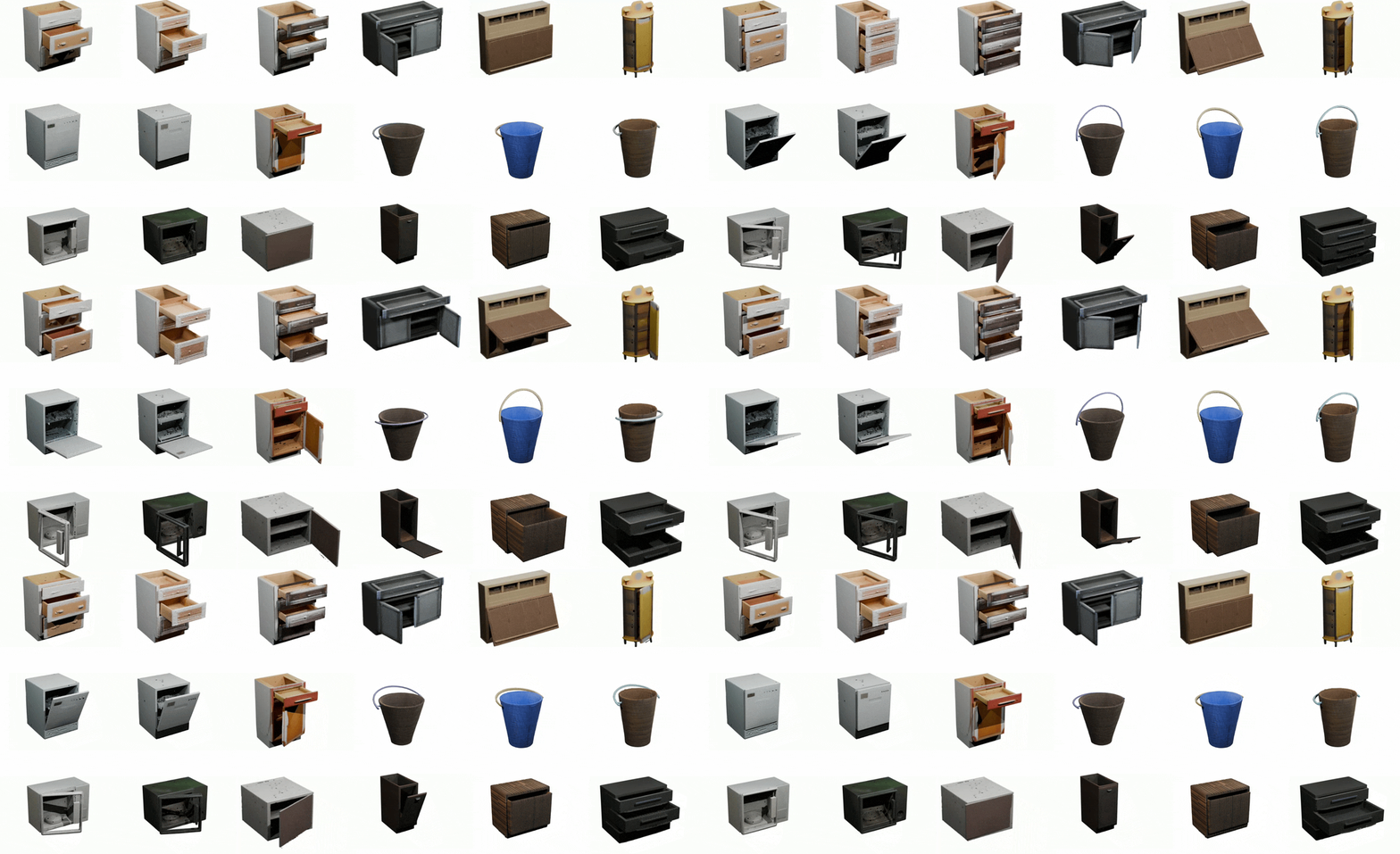
ART: Articulated Reconstruction Transformer
Zizhang Li,
Cheng Zhang,
Zhengqin Li,
Henry Howard-Jenkins,
Zhaoyang Lv,
Chen Geng,
Jiajun Wu,
Richard Newcombe,
Jakob Engel,
Zhao Dong
CVPR 2026
[Paper]
[Project Page]
tl;dr: A transformer-based model for reconstructing articulated dynamic objects from images.
|
|
|
Coupled Diffusion Sampling for Training-Free Multi-View Image Editing
Hadi Alzayer,
Yunzhi Zhang,
Chen Geng,
Jia-Bin Huang,
Jiajun Wu
CVPR 2026
[Paper]
[Project Page]
tl;dr: Multi-view image editing by sampling from two diffusion models of different modalities concurrently.
|
|
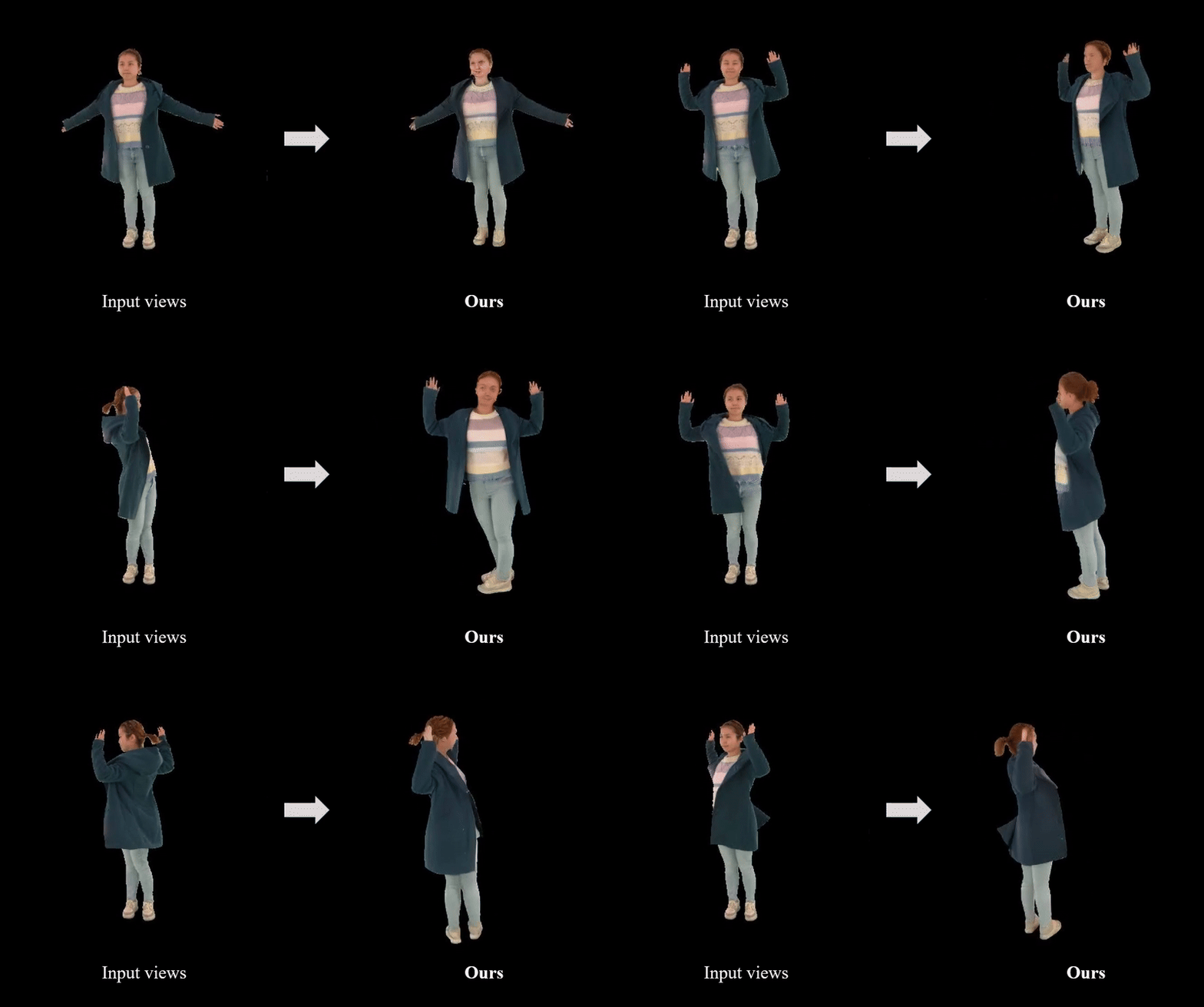
GenFusion: Feed-forward Human Performance Capture via Progressive Canonical Space Updates
Youngjoong Kwon,
Yao He*,
Heejung Choi*,
Chen Geng,
Zhengmao Liu,
Jiajun Wu,
Ehsan Adeli
ICLR 2026
[Paper]
[Project Page]
tl;dr: A feed-forward method for human performance capture that progressively updates a canonical space with incoming monocular RGB frames, using probabilistic regression to produce sharp novel-view renderings.
|

|
Anymate: A Dataset and Baselines for Learning 3D Object Rigging
Yufan Deng^*,
Yuhao Zhang^*,
Chen Geng,
Shangzhe Wu†,
Jiajun Wu†
SIGGRAPH 2025
[Paper]
[Project Page]
[Demo]
[Code]
[arXiv]
tl;dr: We propose a dataset and benchmark for supervised-learning-based 4D object rigging methods.
|
|
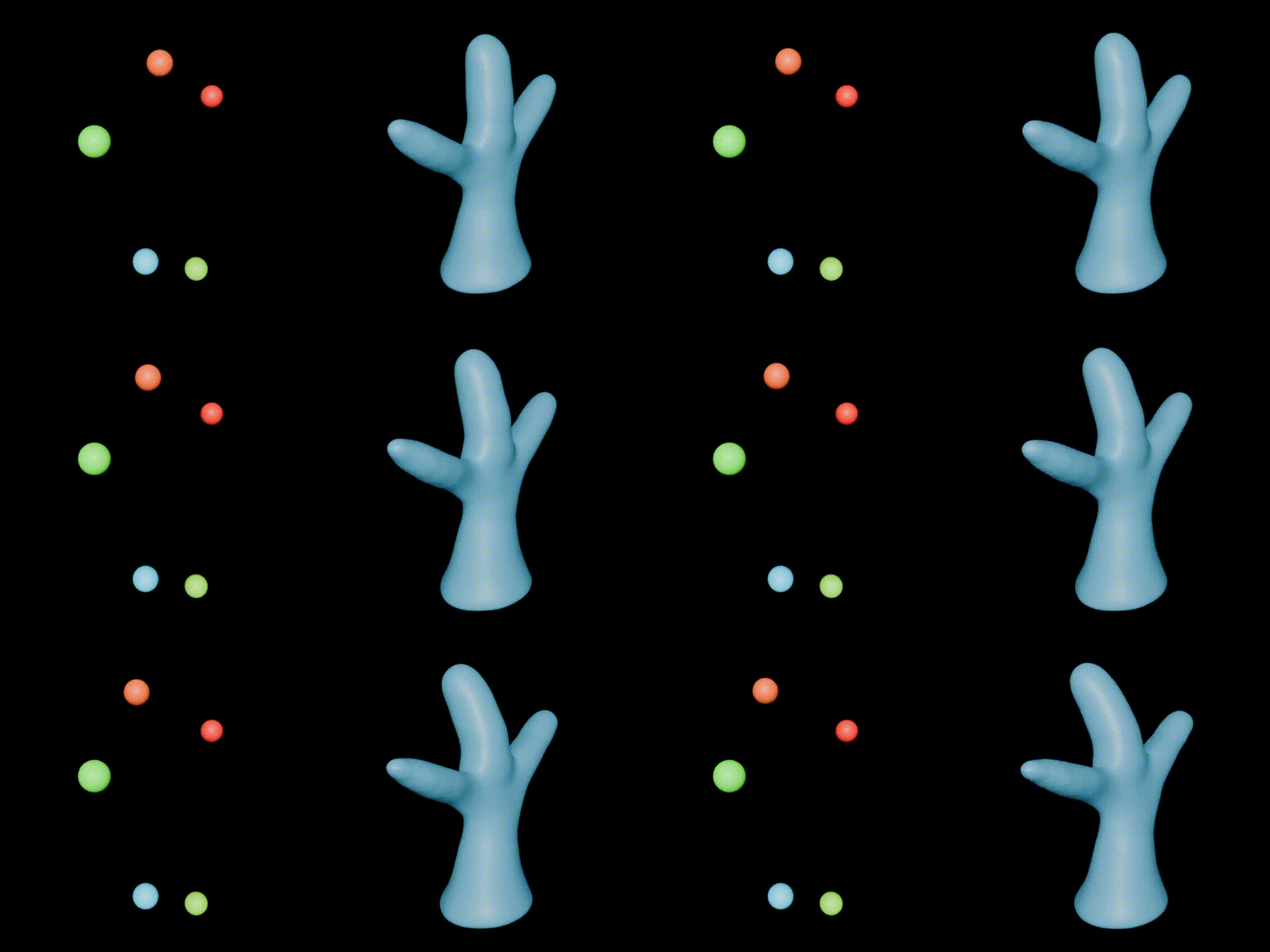
Category-Agnostic Neural Object Rigging
Guangzhao He^*,
Chen Geng*,
Shangzhe Wu,
Jiajun Wu
CVPR 2025
[Paper]
[Project Page]
[arXiv]
tl;dr: We discover animatable motion subspaces for any 4D objects.
|
|
|
Birth and Death of a Rose
Chen Geng,
Yunzhi Zhang,
Shangzhe Wu,
Jiajun Wu
CVPR 2025
(Oral Presentation, 3.3% of the accepted papers)
[Paper]
[Project Page]
[Code]
[arXiv]
tl;dr: We generate temporal 4D object intrinsics from 2D foundation models.
|
|
|
Relightable and Animatable Neural Avatar from Sparse-View Video
Zhen Xu,
Sida Peng,
Chen Geng,
Linzhan Mou,
Zihan Yan,
Jiaming Sun,
Hujun Bao,
Xiaowei Zhou
CVPR 2024
(Highlight, 11.9% of the accepted papers)
[Paper]
[Project Page]
[Code]
[arXiv]
[Video]
tl;dr: We estimate physically based intrinsics of dynamic characters from monocular videos.
|
|
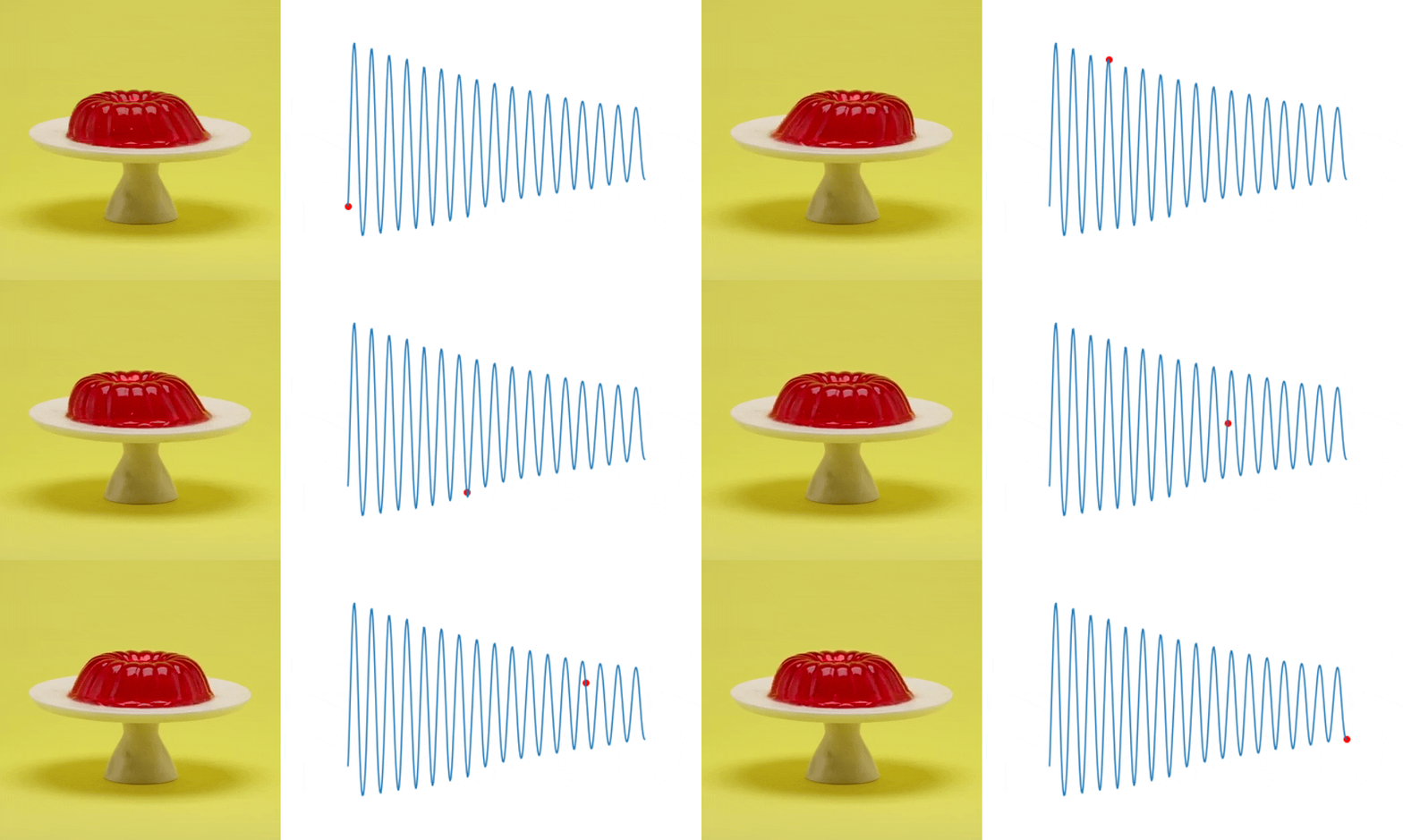
Neural Polynomial Gabor Fields for Macro Motion Analysis
Chen Geng*,
Hong-Xing "Koven" Yu*,
Sida Peng,
Xiaowei Zhou,
Jiajun Wu
ICLR 2024
[Paper]
[Project Page]
[Code]
[OpenReview]
tl;dr: We discover a low-dimensional interpretable motion representation for dynamic scenes with macro motion.
|
|
|
Tree-Structured Shading Decomposition
Chen Geng*,
Hong-Xing "Koven" Yu*,
Sharon Zhang,
Maneesh Agrawala,
Jiajun Wu
ICCV 2023
[Paper]
[Project Page]
[Video]
[Code]
[MarkTechPost]
tl;dr: We decompose the shading of objects into a tree-structured representation, which can be edited or interpreted by users easily.
Abstract: We study the problem of obtaining a tree-structured representation for shading objects. Prior work typically uses the parametric or measured representation to model shading, which is neither interpretable nor easily editable. Our method uses the shade tree representation, which combines basic shading nodes and compositing methods, to model and decomposes the material shading. Such a representation enables users to edit previously rigid material appearances in an efficient and intuitive manner. In particular, novice users who are unfamiliar with the construction of such shade trees can quickly obtain such a representation. The extraction of such a representation enables the editing and understanding of object shading, even for novice users. The biggest challenge in this task is that the discrete structure of the shade tree is not differentiable. We propose a hybrid algorithm to address this issue. First, given an input image, a recursive amortized inference model is leveraged to initialize a guess of the tree structure and corresponding leaf node parameters. Then, we apply an optimization-based method to fine-tune the result. Experiments show that our method works well on synthetic images, realistic images, and non-realistic vector drawings, surpassing the baselines significantly.
|
|
|
Learning Neural Volumetric Representations of Dynamic Humans in Minutes
Chen Geng*,
Sida Peng*,
Zhen Xu*,
Hujun Bao,
Xiaowei Zhou
CVPR 2023
[Paper]
[Project Page]
[Code]
tl;dr: We accelerate the learning of neural volumetric videos of dynamic humans by over 100 times.
Abstract: This paper addresses the challenge of quickly reconstructing free-viewpoint videos of dynamic humans from sparse multi-view videos. Some recent works represent the dynamic human as a canonical neural radiance field (NeRF) and a motion field, which are learned from videos through differentiable rendering. They generally require a lengthy optimization process. Other generalization methods leverage learned prior from datasets and reduce the optimization time by only finetuning on new scenes, at the cost of visual fidelity. In this paper, we propose a novel method for creating viewpoint-free human performance synthesis from sparse view videos in minutes with competitive visual quality. Specifically, we leverage the human body prior to define a novel part-based voxelized NeRF representation, which distributes the representational power of the canonical human model efficiently. Furthermore, we propose a novel dimensionality reduction 2D motion parameterization scheme to increase the convergence rate of the human deformation field. Experiments demonstrate that our approach can be trained 100 times faster than prior per-scene optimiztion methods while being competitive in the rendering quality. We show that given a video capturing a human performer of 100 frames, our model typically takes about 5 minutes for training to produce photorealistic free-viewpoint videos on a single RTX 3090 GPU. The code will be released for reproducibility.
|
|
|
Implicit Neural Representations with Structured Latent Codes for Human Body Modeling
Sida Peng,
Chen Geng,
Yuanqing Zhang,
Yinghao Xu,
Qianqian Wang,
Qing Shuai,
Xiaowei Zhou,
Hujun Bao
TPAMI 2023
[Paper]
[Code]
[IEEE Xplore]
tl;dr: Our approach reconstruct geometry and appearance of human performers with high accuracy from sparse observations.
|

|
Novel View Synthesis of Human Interactions from Sparse Multi-view Videos
Qing Shuai,
Chen Geng,
Qi Fang,
Sida Peng,
Wenhao Shen,
Xiaowei Zhou,
Hujun Bao
SIGGRAPH 2022
(Featured in thetechnical paper trailer)
[Paper]
[Bibtex]
[Code]
[Project Page]
tl;dr: Given sparse multi-view videos of crowded scenes with multiple human performers, our approach is able to generate high-fidelity novel views and accurate instance masks.
@inproceedings{multinb,
title = {Novel View Synthesis of Human Interactions from Sparse
Multi-view Videos},
author = {Qing, Shuai and Chen, Geng and Qi, Fang and Sida, Peng and Wenhao, Shen and Xiaowei, Zhou and Hujun, Bao},
booktitle = {SIGGRAPH Conference Proceedings},
year = {2022},
}
|
Professional Activities 🏛️
|
| Co-organizer |
|
| Mentorship & Service |
| 2026 |
Faculty-Student Liaison at Stanford CS |
| 2023 |
Stanford PhD Application Support Program for Underrepresented Group (SASP) |
| 2023 |
Stanford CS Undergraduate Mentoring Program |
|
| Conference Reviewer |
CVPR (2024–), ECCV (2024–), ICCV (2025–), CoRL (2026–), SIGGRAPH (2025, 2026), SIGGRAPH Asia (2024, 2025), ICML (2024–, Position Papers for 2026), ICLR (2025–), NeurIPS (2024–), NeurIPS Workshop Proposals (2025–), NeurIPS D&B (2024), ICRA (2024), 3DV (2023), AAAI (2024), Pacific Graphics (2024) |
| Journal Reviewer |
| RA-L |
IEEE Robotics and Automation Letters |
| ToG |
ACM Transactions on Graphics |
| T-PAMI |
IEEE Transactions on Pattern Analysis and Machine Intelligence |
| TVCG |
IEEE Transactions on Visualization and Computer Graphics |
| TMLR |
Transactions on Machine Learning Research |
|
| Misc. |
Finalist, Qualcomm Innovation Fellowship, 2024 |
|
|
|