GV

GeezerVison

The World Wide Web, restored to 800 pixels of glory.

Home|About|Gaming cabinet|Archives|How it works|Starter sites

On this site

  • Documentation
  • Privacy Statement
  • License Agreement
  • Contact Us

This view

  • Original page
  • New address

GeezerVison is showing docs.voltdb.com — 13.8. Integrating LDAP Security with VoltDB

  • Volt Active Data
  • Developer Hub
  • Books
    • VoltDB Tutorial
    • Using VoltDB
    • VoltDB Guide to Performance and Customization
    • VoltDB Administrator's Guide
    • Volt Kubernetes Administrator's Guide
    • VoltDB Quick Reference
  • VoltDB V16
    • VoltDB V16
    • VoltDB V15.3 LTS
    • VoltDB V14.3 LTS
    • VoltDB V13.3 LTS
    • VoltDB V12.3 LTS
    • VoltDB V11.4
    • VoltDB V10.2
    • VoltDB V9.3
13.8. Integrating LDAP Security with VoltDB

Using VoltDB

  • About This Book
  • 1. Overview▶
    • 1.1. What is VoltDB?
    • 1.2. Who Should Use VoltDB
    • 1.3. How VoltDB Works
      • 1.3.1. Partitioning
      • 1.3.2. Serialized (Single-Threaded) Processing
      • 1.3.3. Partitioned vs. Replicated Tables
      • 1.3.4. Ease of Scaling to Meet Application Needs
    • 1.4. Working with VoltDB Effectively
  • 2. Installing VoltDB▶
    • 2.1. Operating System and Software Requirements
    • 2.2. Installing VoltDB
      • 2.2.1. Upgrading From Older Versions
    • 2.3. Setting Up Your Environment
    • 2.4. What is Included in the VoltDB Distribution
  • 3. Starting the Database▶
    • 3.1. Initializing and Starting a VoltDB Database
    • 3.2. Initializing and Starting a VoltDB Database on a Cluster
    • 3.3. Stopping a VoltDB Database
    • 3.4. Saving the Data
    • 3.5. Restarting a VoltDB Database
    • 3.6. Updating Nodes on the Cluster
    • 3.7. Defining the Cluster Configuration
      • 3.7.1. Determining How Many Sites per Host
      • 3.7.2. Configuring Paths for Runtime Features
      • 3.7.3. Verifying your Hardware Configuration
  • 4. Designing the Database Schema▶
    • 4.1. How to Enter DDL Statements
    • 4.2. Creating Tables and Primary Keys
    • 4.3. Analyzing Data Volume and Workload
    • 4.4. Partitioning Database Tables
      • 4.4.1. Choosing a Column on which to Partition Table Rows
      • 4.4.2. Specifying Partitioned Tables
      • 4.4.3. Design Rules for Partitioning Tables
    • 4.5. Replicating Database Tables
      • 4.5.1. Choosing Replicated Tables
      • 4.5.2. Specifying Replicated Tables
    • 4.6. Modifying the Schema
      • 4.6.1. Effects of Schema Changes on Data and Clients
      • 4.6.2. Viewing the Schema
      • 4.6.3. Modifying Tables
      • 4.6.4. Adding and Dropping Indexes
      • 4.6.5. Modifying Partitioning for Tables and Stored Procedures
  • 5. Designing Stored Procedures to Access the Database▶
    • 5.1. How Stored Procedures Work
      • 5.1.1. VoltDB Stored Procedures are Transactional
      • 5.1.2. VoltDB Stored Procedures are Deterministic
    • 5.2. The Anatomy of a VoltDB Stored Procedure
      • 5.2.1. The Structure of the Stored Procedure
      • 5.2.2. Passing Arguments to a Stored Procedure
      • 5.2.3. Creating and Executing SQL Queries in Stored Procedures
      • 5.2.4. Interpreting the Results of SQL Queries
      • 5.2.5. Returning Results from a Stored Procedure
      • 5.2.6. Rolling Back a Transaction
    • 5.3. Installing Stored Procedures into the Database
      • 5.3.1. Compiling, Packaging, and Loading Stored Procedures
      • 5.3.2. Declaring Stored Procedures in the Schema
      • 5.3.3. Partitioning Stored Procedures in the Schema
  • 6. Designing VoltDB Client Applications▶
    • 6.1. Connecting to the VoltDB Database
      • 6.1.1. How Connections To The Cluster Work
      • 6.1.2. Specifying Multiple Servers
    • 6.2. Invoking Stored Procedures
    • 6.3. Invoking Stored Procedures Asynchronously
    • 6.4. Defining Options on a Per-Call Basis
    • 6.5. Closing the Connection
    • 6.6. Handling Errors
      • 6.6.1. Interpreting Execution Errors
      • 6.6.2. Handling Timeouts
      • 6.6.3. Writing Handlers to Interpret Other Errors
    • 6.7. Compiling and Running Client Applications
      • 6.7.1. Starting the Client Application
      • 6.7.2. Running Clients from Outside the Cluster
  • 7. Simplifying Application Development▶
    • 7.1. Using Default Procedures
    • 7.2. Shortcut for Defining Simple Stored Procedures
    • 7.3. Verifying Expected Query Results
    • 7.4. Scheduling Stored Procedures as Tasks
    • 7.5. Directed Procedures: Distributing Transactions to Every Partition
  • 8. Using VoltDB with Other Programming Languages▶
    • 8.1. C++ Client Interface
      • 8.1.1. Writing VoltDB Client Applications in C++
      • 8.1.2. Creating a Connection to the Database Cluster
      • 8.1.3. Invoking Stored Procedures
      • 8.1.4. Invoking Stored Procedures Asynchronously
      • 8.1.5. Interpreting the Results
    • 8.2. JSON HTTP Interface
      • 8.2.1. How the JSON Interface Works
      • 8.2.2. Using the JSON Interface from Client Applications
      • 8.2.3. How Parameters Are Interpreted
      • 8.2.4. Interpreting the JSON Results
      • 8.2.5. Error Handling using the JSON Interface
      • 8.2.6. Managing Client Sessions
    • 8.3. JDBC Interface
      • 8.3.1. Using JDBC to Connect to a VoltDB Database
      • 8.3.2. Using JDBC to Query a VoltDB Database
    • 8.4. Python Client Interface
      • 8.4.1. Creating a Connection to the Database Cluster
      • 8.4.2. Invoking Stored Procedures
      • 8.4.3. Invoking Stored Procedures Asynchronously
      • 8.4.4. Interpreting the Results
      • 8.4.5. Closing the Connections to the Database Cluster
  • 9. Integrating Volt Active Data with AI Agents and Chatbots▶
    • 9.1. Volt Agent Skills
      • 9.1.1. Installing Volt Skills
      • 9.1.2. Using Volt Skills Effectively
    • 9.2. The VoltDB MCP Server
      • 9.2.1. Installing the VoltDB MCP Server
      • 9.2.2. Configuring the MCP Server
      • 9.2.3. How to Use the VoltDB MCP Server
  • 10. Using VoltDB in a Cluster▶
    • 10.1. Starting a Database Cluster
    • 10.2. Defining the Cluster Configuration
    • 10.3. Elastic Scaling to Resize the Cluster
      • 10.3.1. Adding Nodes with Elastic Scaling
      • 10.3.2. Removing Nodes with Elastic Scaling
      • 10.3.3. Configuring How VoltDB Rebalances Nodes During Elastic Scaling
  • 11. Availability▶
    • 11.1. How K-Safety Works
    • 11.2. Enabling K-Safety
      • 11.2.1. What Happens When You Enable K-Safety
      • 11.2.2. Calculating the Appropriate Number of Nodes for K-Safety
    • 11.3. Recovering from System Failures
      • 11.3.1. What Happens When a Node Rejoins the Cluster
      • 11.3.2. Where and When Recovery May Fail
    • 11.4. Avoiding Network Partitions
      • 11.4.1. K-Safety and Network Partitions
      • 11.4.2. Network Fault Protection
  • 12. Active(N) Database Replication▶
    • 12.1. How Database Replication Works
      • 12.1.1. Starting Database Replication
      • 12.1.2. Database Replication, Availability, and Disaster Recovery
      • 12.1.3. Database Replication and Completeness
    • 12.2. Using Active(N) Cross Datacenter Replication
      • 12.2.1. Designing Your Schema for Active Replication
      • 12.2.2. Configuring the Database Clusters
      • 12.2.3. Starting the Database Clusters
      • 12.2.4. Loading a Matching Schema and Starting Replication
      • 12.2.5. Stopping Replication
      • 12.2.6. Example XDCR Configurations
      • 12.2.7. Understanding Conflict Resolution
    • 12.3. Updating the Schema During Replication
      • 12.3.1. Safely Updating the Schema While the Clusters are Paused
      • 12.3.2. Adding and Removing Tables Without Pausing
      • 12.3.3. Using Dynamic Schema Change to Add, Remove, and Modify Table Columns Without Pausing
    • 12.4. Monitoring Database Replication
    • 12.5. Tuning Active(N) to Meet Your Application Needs
      • 12.5.1. The XDCR Workflow
      • 12.5.2. Detecting and Correcting Bottlenecks in the XDCR Workflow
  • 13. Security▶
    • 13.1. How Security Works in VoltDB
    • 13.2. Enabling Authentication and Authorization
    • 13.3. Defining Users and Roles
    • 13.4. Assigning Access to Stored Procedures
    • 13.5. Assigning Access by Function (System Procedures, SQL Queries, and Default Procedures)
    • 13.6. Using Built-in Roles
    • 13.7. Encrypting VoltDB Communication Using TLS/SSL
      • 13.7.1. Creating the TLS/SSL Certificates
      • 13.7.2. Using Certificate Revocation Lists (CRLs)
      • 13.7.3. Configuring TLS/SSL on the VoltDB Server
      • 13.7.4. Configuring Mutual TLS/SSL on the Server and Clients
      • 13.7.5. Using the VoltDB Command Line Utilities with TLS/SSL
      • 13.7.6. Implementing TLS/SSL in the Java Client Applications
      • 13.7.7. Configuring Database Replication (XDCR) With TLS/SSL
      • 13.7.8. Updating TLS/SSL Certificates and Certificate Revocation Lists (CRLs)
    • 13.8. Integrating LDAP Security with VoltDB
      • 13.8.1. Configuring LDAP Security in VoltDB
      • 13.8.2. Configuring VoltDB Security in LDAP
    • 13.9. Integrating Kerberos Security with VoltDB
      • 13.9.1. Installing and Configuring Kerberos
      • 13.9.2. Configuring Java Security
      • 13.9.3. Configuring the VoltDB Servers and Clients
      • 13.9.4. Accessing the Database from the Command Line and the Web
  • 14. Saving & Restoring a VoltDB Database▶
    • 14.1. Performing a Manual Save and Restore of a VoltDB Cluster
      • 14.1.1. How to Save the Contents of a VoltDB Database
      • 14.1.2. How to Restore the Contents of a VoltDB Database Manually
      • 14.1.3. Changing the Cluster Configuration Using Save and Restore
    • 14.2. Scheduling Automated Snapshots
    • 14.3. Tuning the Snapshot Process
    • 14.4. Managing Snapshot Files
    • 14.5. Special Notes Concerning Save and Restore
  • 15. Command Logging and Recovery▶
    • 15.1. How Command Logging Works
    • 15.2. Controlling Command Logging
    • 15.3. Configuring Command Logging for Optimal Performance
      • 15.3.1. Log Size
      • 15.3.2. Log Frequency
      • 15.3.3. Synchronous vs. Asynchronous Logging
      • 15.3.4. Hardware Considerations
  • 16. Streaming Data: Import, Export, and Migration▶
    • 16.1. How Data Streaming Works in VoltDB
      • 16.1.1. Understanding Import
      • 16.1.2. Understanding Export
      • 16.1.3. Understanding Migration
    • 16.2. The Business Case for Streaming Data
      • 16.2.1. Extract, Transform, Load (ETL)
      • 16.2.2. Change Data Capture
      • 16.2.3. Streaming Data Validation
      • 16.2.4. Caching
      • 16.2.5. Archiving
    • 16.3. VoltDB Export Connectors
      • 16.3.1. How Export Works
      • 16.3.2. The File Export Connector
      • 16.3.3. The HTTP Export Connector
      • 16.3.4. The JDBC Export Connector
      • 16.3.5. The Kafka Export Connector
      • 16.3.6. The Elasticsearch Export Connector
    • 16.4. VoltDB Import Connectors
      • 16.4.1. Bulk Loading Data Using VoltDB Standalone Utilities
      • 16.4.2. Streaming Import Using Built-in Import Features
      • 16.4.3. The Kafka Importer
    • 16.5. VoltDB Import Formatters
  • A. Supported SQL DDL Statements▶
    • ALTER STREAM
    • ALTER TABLE
    • ALTER TASK
    • ALTER VIEW
    • CREATE INDEX
    • CREATE PROCEDURE AS
    • CREATE PROCEDURE FROM CLASS
    • CREATE ROLE
    • CREATE STREAM
    • CREATE TABLE
    • CREATE TASK
    • CREATE VIEW
    • DR TABLE
    • DROP INDEX
    • DROP PROCEDURE
    • DROP ROLE
    • DROP STREAM
    • DROP TABLE
    • DROP TASK
    • DROP VIEW
    • PARTITION TABLE
  • B. Supported SQL Statements▶
    • DELETE
    • INSERT
    • MIGRATE
    • SELECT
    • TRUNCATE TABLE
    • UPDATE
    • UPSERT
  • C. SQL Functions▶
    • ABS()
    • APPROX_COUNT_DISTINCT()
    • AREA()
    • ARRAY_ELEMENT()
    • ARRAY_LENGTH()
    • ASTEXT()
    • AVG()
    • BIN()
    • BIT_SHIFT_LEFT()
    • BIT_SHIFT_RIGHT()
    • BITAND()
    • BITNOT()
    • BITOR()
    • BITXOR()
    • CAST()
    • CEILING()
    • CENTROID()
    • CHAR()
    • CHAR_LENGTH()
    • COALESCE()
    • CONCAT()
    • CONTAINS()
    • COS()
    • COT()
    • COUNT()
    • CSC()
    • CURRENT_DATE()
    • CURRENT_TIMESTAMP()
    • DATEADD()
    • DATEDIFF()
    • DAY(), DAYOFMONTH()
    • DAYOFWEEK()
    • DAYOFYEAR()
    • DECODE()
    • DEGREES()
    • DISTANCE()
    • DWITHIN()
    • EXP()
    • EXTRACT()
    • FIELD()
    • FLOOR()
    • FORMAT()
    • FORMAT_CURRENCY()
    • FORMAT_TIMESTAMP()
    • FROM_UNIXTIME()
    • HEX()
    • HOUR()
    • INET6_ATON()
    • INET6_NTOA()
    • INET_ATON()
    • INET_NTOA()
    • ISINVALIDREASON()
    • ISVALID()
    • IS_VALID_TIMESTAMP()
    • LATITUDE()
    • LEFT()
    • LN(), LOG()
    • LOG10()
    • LONGITUDE()
    • LOWER()
    • MAKEVALIDPOLYGON()
    • MASK_CCN()
    • MASK_EMAIL()
    • MASK_INNER()
    • MASK_OUTER()
    • MASK_PAN()
    • MASK_PAN_RELAXED()
    • MASK_PARTIAL()
    • MASK_TEXT()
    • MAX()
    • MAX_VALID_TIMESTAMP()
    • MIGRATING()
    • MIN()
    • MIN_VALID_TIMESTAMP()
    • MINUTE()
    • MOD()
    • MONTH()
    • NOW()
    • NUMINTERIORRINGS()
    • NUMPOINTS()
    • OCTET_LENGTH()
    • OVERLAY()
    • PI()
    • POINTFROMTEXT()
    • POLYGONFROMTEXT()
    • POSITION()
    • POWER()
    • QUARTER()
    • RADIANS()
    • REGEXP_POSITION()
    • REPEAT()
    • REPLACE()
    • RIGHT()
    • ROUND()
    • SEC()
    • SECOND()
    • SET_FIELD()
    • SIGN()
    • SIN()
    • SINCE_EPOCH()
    • SPACE()
    • SQRT()
    • STR()
    • SUBSTRING()
    • SUM()
    • TAN()
    • TIME_WINDOW()
    • TO_TIMESTAMP()
    • TRIM()
    • TRUNCATE()
    • UPPER()
    • VALIDPOLYGONFROMTEXT()
    • WEEK(), WEEKOFYEAR()
    • WEEKDAY()
    • YEAR()
  • D. VoltDB CLI Commands▶
    • csvloader
    • jdbcloader
    • kafkaloader
    • sqlcmd
    • voltadmin
    • voltdb
  • E. YAML Configuration Properties▶
    • E.1. Understanding YAML Syntax
      • E.1.1. YAML Files
      • E.1.2. Dot Notation
    • E.2. YAML Properties for Configuring Volt Databases on Bare Metal
  • F. VoltDB Datatype Compatibility▶
    • F.1. Java and VoltDB Datatype Compatibility
  • G. System Procedures▶
    • @AdHoc
    • @AdjustLogging
    • @Explain
    • @ExplainProc
    • @ExplainView
    • @GetPartitionKeys
    • @GetYamlConfiguration
    • @Metrics
    • @Note
    • @Pause
    • @Ping
    • @Quiesce
    • @Resume
    • @SetYamlConfiguration
    • @Shutdown
    • @SnapshotDelete
    • @SnapshotRestore
    • @SnapshotSave
    • @SnapshotScan
    • @Statistics
    • @StopNode
    • @SwapTables
    • @SystemCatalog
    • @SystemInformation
    • @UpdateClasses
    • @UpdateLogging

13.8. Integrating LDAP Security with VoltDB

LDAP (Lightweight Directory Access Protocol) is a directory service for managing hierarchical information. LDAP is often used within organizations to centralize the management and maintenance of security information about employees and other resources. LDAP integration in Volt Active Data allows you to use LDAP to authenticate Volt users and authorize their access to specific features in place of the builtin security described earlier in this chapter. In other words, manage users and permissions in LDAP rather than internally within Volt.

Note

LDAP integration does require at least one builtin user account with administrative permissions to ensure the database is accessible in case the LDAP server is not available.

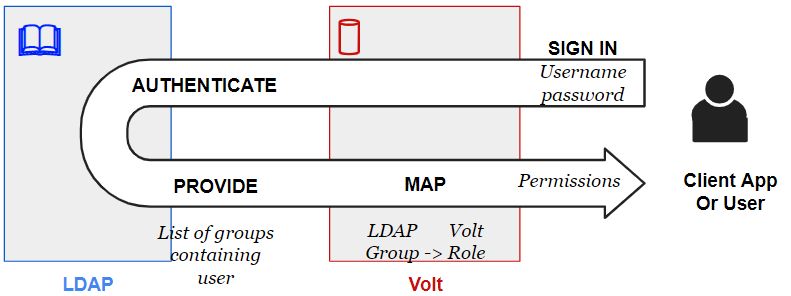
The following diagram shows the overall workflow of LDAP integration at runtime. The user, or client application, connects to the database passing in their LDAP credentials: a username and password. VoltDB passes those credentials to LDAP for authentication. Once the user is authenticated, the VoltDB server then looks for groups in LDAP of which the user is a member. Finally, the LDAP group is mapped to one or more VoltDB roles to decide what permissions the user has.
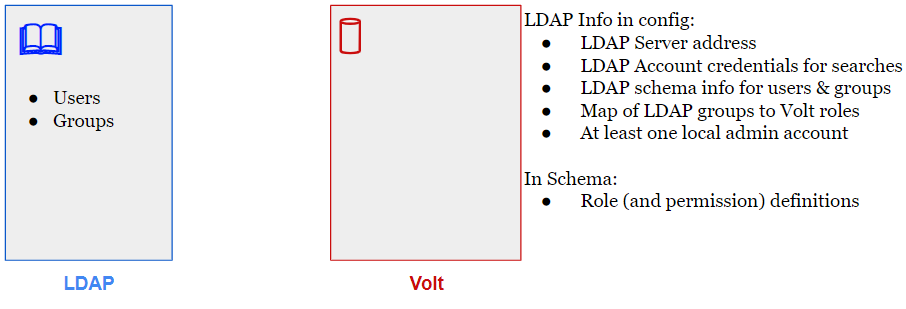
LDAP integration allows VoltDB to use existing resources within LDAP for authentication and authorization. That means that administrators can use the existing user and group definitions within LDAP for security management of VoltDB. Of course, you can always create specific users and/or groups for managing VoltDB access, but it is not necessary. As a result, very little change is needed to an existing LDAP infrastructure; most of the set up for LDAP integration belongs to the VoltDB servers, as shown below.
The following sections explain how to configure VoltDB for LDAP integration and specific requirements for the LDAP server.

13.8.1. Configuring LDAP Security in VoltDB

You configure LDAP integration in the deployment.security property of the VoltDB configuration file. The following is an example configuration file that illustrates all of the available LDAP configuration options.

deployment:
  security:
    enabled: true
    provider: ldap                                       1

    ldap:
      server: ldaps://ldap.myorg.com                     2
      rootdn: "dc=ldaptest,dc=voltactivedata,dc=com"     3
      timeout: 12                                        4

      user: "cn=admin,dc=ldaptest,dc=volt,dc=com"        5
      password: secret.password

      # LDAP group to Volt Role mapping
      group:                                             6
      - name: "cn=heroes,dc=ldaptest,dc=volt,dc=com"
        role: admin
      - name: "cn=zeroes,dc=ldaptest,dc=volt,dc=com"
        role: user

  ssl:
    truststore:                                          7
      file: /my/ssl/ldap/truststore.jks
      password: trustpasswd

  users:
  - name: houdini
    password: shazam
    roles: administrator                               8

1

Enabling LDAP security — To enable LDAP integration, you must set the properties enabled to "true" and provider to "ldap".

2

LDAP server address — The location of the LDAP server, using either plain ("ldap://") or secure ("ldaps://") LDAP protocol. Secure LDAP is recommended. But if you use secure LDAP, you must also provide the TLS/SSL credentials (7).

3

Root domain name — The LDAP domain containing both the user and group objects needed for Volt access.

4

Timeout (OPTIONAL) — The timeout period, in seconds, to wait for a response from the LDAP server. After the timeout expires with no response from the LDAP server, the authentication of the user will fail. The default timeout is 10 seconds.

5

LDAP privileged account (username and password) — The usernasme and password of an LDAP account that has read-only access to the specified root domain. This account is used to search the domain for the specified username and the groups of which that user is a member. You can mask the password for the LDAP account so it does not appear in plain text in the configuration file using the voltdb mask command.

6

LDAP group ➞ Volt role mapping — The mapping of LDAP group names to Volt roles. The roles themselves are defined in the database schema. Each group list element maps one LDAP group name to one or more Volt roles, specifying the roles as a comma-separated list. If there is no mapping for the LDAP group, the group is ignored.

7

TLS/SSL credentials — The ssl.truststore property specifies the TLS/SSL credentials to use when accessing the directory using secure LDAP (LDAPS://).

8

Local administrator's account — There must be at least one local user account with administrative privileges defined in the configuration. This account provides access to the database in case the LDAP server is not reachable. You can define other local accounts if you wish. When a user attempts to access the server, Volt looks for the username in the local accounts first; if no local account with that username exists, it then passes the credentials on to LDAP for authentication and authorization.

Finally, by default, Volt searches for the username in the uid attribute of the inetOrgPerson class, then uses the full distinguished name to search the uniqueMember attribute of the groupOfUniqueNames class to determine what groups they belong to. If your LDAP directory uses different classes or attribute settings for users and groups, you must specify the class and attribute names as properties of deployment.ldap. For example, the following configuration identifies posixAccount and posixGroup as the classes to use for users and groups, respectively:

deployment:
  security:
    enabled: true
    provider: ldap

    ldap:
      server: ldaps://ldap.myorg.com
      rootdn: "dc=ldaptest,dc=voltactivedata,dc=com"
      userclass: posixAccount
      useruid: uid
      groupclass: posixGroup
      groupmemberuid: memberuid"
      user: "cn=admin,dc=ldaptest,dc=volt,dc=com"
      password: secret.password

13.8.2. Configuring VoltDB Security in LDAP

The goal of LDAP integration in VoltDB is to adapt to the customer's existing LDAP implementation, avoiding any changes to the schema wherever possible. So, for example, there are configuration options that allow VoltDB to access users and groups records defined in non-standard LDAP classes and objects. However, there is one requirement on the LDAP user objects:

The LDAP user records must include the SHA-256 hash of the user's password as an alternate password.

VoltDB never actually receives the password sent by the user at runtime in clear text. The client APIs hashes the password and sends the base-64 encoding of the SHA-256 hash instead. So Volt cannot pass on the actual password to LDAP. Instead it sends the SHA-256 hash. So, to be able to authenticate the user, LDAP must have the matching hash as one of the allowable passwords for the user. You can get the SHA-256 hash of a password using the shasum Linux utility. For example:

$ echo -n 'MyFavoritePasswrd' | shasum -a 256
238d59ddd7b0b8d54d3b8ff864855bcd332e66b1a06dad010f676a23d1928a68  -
You are visitor 01402775 — GeezerVison does not store the pages you look up.
Best viewed with Netscape Navigator 4.7 or Internet Explorer 6 at 800×600. No cookies required.