GeezerVisonThe World Wide Web, restored to 800 pixels of glory. | ||||||||||||||||||||||||||||||||||||||||||||||||||||||||||||||||||||||||||||||||||||||||||||||||||||||||||||||||||||||||||||||||||||||||||||||||||||||||||||||||||||||||||||||||||||||||||||||||||||||||||||||||||||||||||||||||||||||||||||||||||||||||||||||||||||||||||||||||||||||||||||||||||||||||||||||||||||||||||||||||||||||||||||||||||||||||||||||||||||||||||||||||||||||||||||||||||||||||||||||||||||||||||||||||||||||||||||||||||||||||||||||||||||||||||||||||||||||||||||||||||||||||||||||||||||||||||||||||||||||
| Home|About|Gaming cabinet|Archives|How it works|Starter sites | ||||||||||||||||||||||||||||||||||||||||||||||||||||||||||||||||||||||||||||||||||||||||||||||||||||||||||||||||||||||||||||||||||||||||||||||||||||||||||||||||||||||||||||||||||||||||||||||||||||||||||||||||||||||||||||||||||||||||||||||||||||||||||||||||||||||||||||||||||||||||||||||||||||||||||||||||||||||||||||||||||||||||||||||||||||||||||||||||||||||||||||||||||||||||||||||||||||||||||||||||||||||||||||||||||||||||||||||||||||||||||||||||||||||||||||||||||||||||||||||||||||||||||||||||||||||||||||||||||||||
GeezerVison is showing fed-agent.github.io — FedAgent: Is Decentralized LLM Agent RL Robust to Heterogeneity? An Asymmetric Tale  Towards Decentralized Intelligence EvolutionTrain LLM agents collaboratively across decentralized clients, without sharing local data. 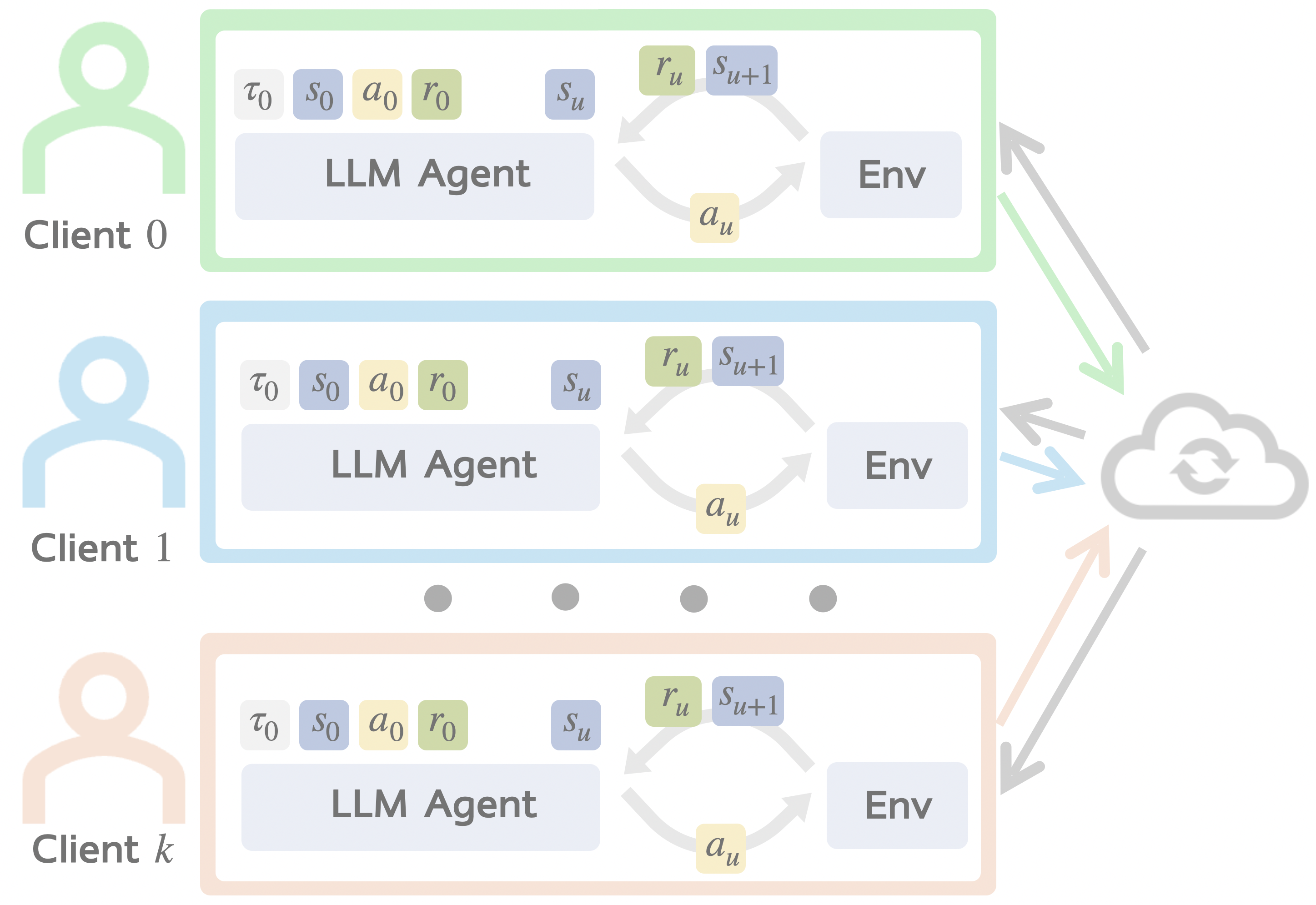 Is Decentralized LLM Agent RL Robust to Heterogeneity? An Asymmetric Tale. Canyu Chen1*, Kangyu Zhu3*, Zhaorun Chen4, Zhanhui Zhou2, Shizhe Diao5, Yiping Lu1, Tian Li4 1Northwestern University,
2University of California, Berkeley,
3Brown University, Best Paper Award
in the
AAAI 2026 Workshop on Trust and Control in Agentic AI AbstractTraining AI agents powered by Large Language Models (LLMs) typically requires centralized access to user data, raising privacy and scalability concerns. We explore FedAgent (Federated Agent Reinforcement Learning), a decentralized reinforcement learning paradigm that collaboratively trains LLM agents across distributed clients without sharing local data. The central reliability question is: is FedAgent effective under uniform client distribution, and more importantly, is it robust to client heterogeneity? For the former, we provide the first empirical evidence that FedAgent matches Centralized Agent Training and outperforms Local Agent Training. For the latter, we first formalize Agent Heterogeneity at two structurally distinct levels: task-level (what clients ask the agent to do) and environment-level (the dynamics in which the agent acts), anchored on the Input-Dynamics Asymmetry of task-augmented Markov Decision Processes (MDPs), referring to the architectural fact that tasks enter the policy through its input channel, while environments do not. Then, we theoretically establish an Asymmetric Robustness Mechanism: FedAgent is robust to task-level heterogeneity but non-robust to environment-level heterogeneity. We further identify three sufficient conditions under which FedAgent recovers robustness despite environment-level heterogeneity, and illustrate four possible training-curve patterns. On real-world agent benchmarks WebShop and ALFWorld, we empirically verify that FedAgent remains robust under extreme task-level heterogeneities and traces a stable-degrade-collapse spectrum under environment-level heterogeneities. Input-Dynamics AsymmetryOne architectural fact about LLM agents drives the entire story, and it cuts two ways. The fact The task descriptor $\tau$ enters the policy through its input channel (the prompt); the transition kernel $P$ does not: the policy senses $P$ only through the successor states $s_{t+1}\sim P(\cdot\mid s_t,a_t)$ that arise after it acts. ✓ Task is observable Because τ is in the input, a single model can encode different behaviors for different prompts, exactly what instruction-tuned LLMs already do. Clients teach complementary pieces of the task-conditional map, so their gradients add up. ⇒ robust to task-level heterogeneity ! Environment is implicit Because P is hidden in the dynamics, no single model can switch worlds: when P₁ ≠ P₂ at the same state, the policy must commit to one action that is wrong in the other. Conflicting gradients pull the same weights apart. ⇒ worst-case fragile to environment-level heterogeneity 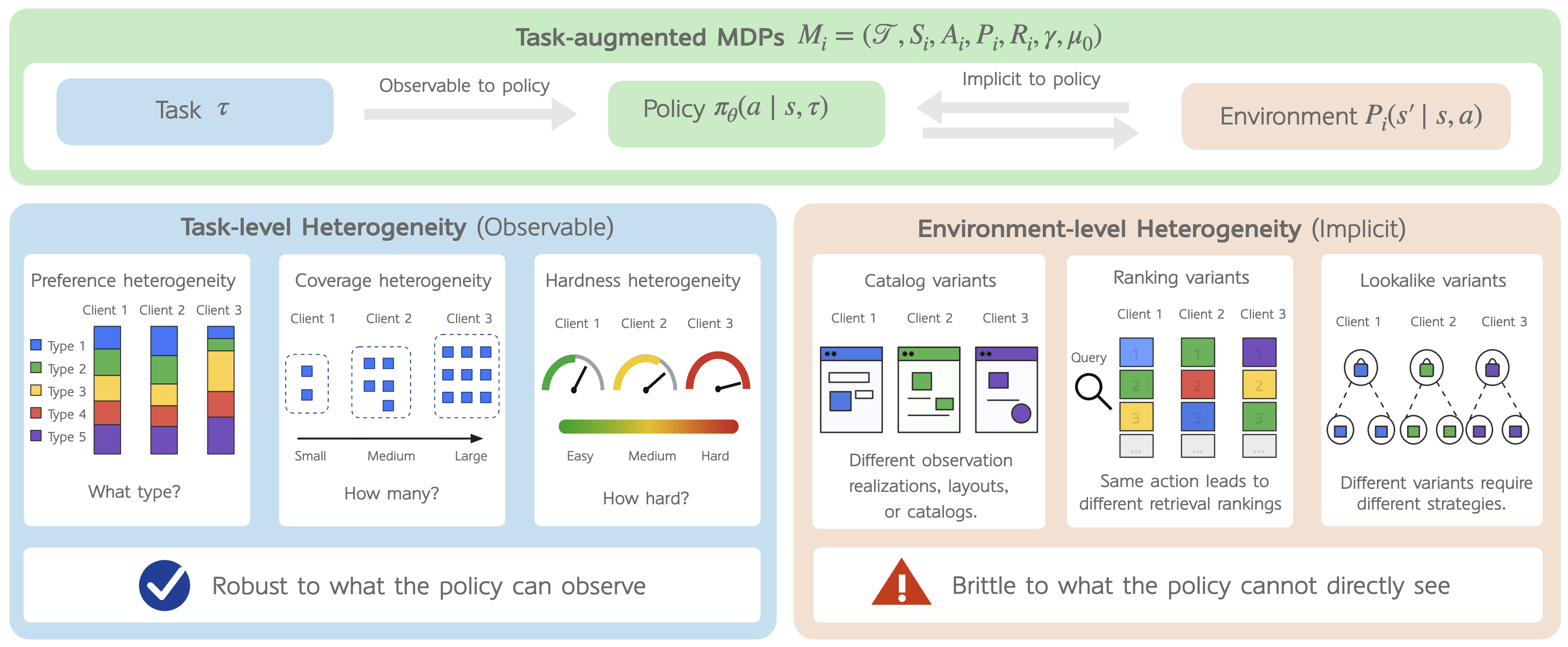 What the policy can observe (the task) is absorbed; what it cannot directly see (the environment) is where federation can break. The FedAgent AlgorithmFedAgent follows the classic FedAvg skeleton of sample, broadcast, local update, and average, but replaces supervised SGD with policy-gradient RL on LLM-induced policies. Each client optimizes on its own task-augmented MDP; only model parameters ever leave the device. Algorithm 1: FedAgent with Client and Server training Require: total clients $N$, rounds $T$, clients-per-round $M$, local epochs $E$, learning rate $\eta$ Ensure: final global policy parameters $\theta_{\mathrm{final}}$ 1: Initialize global policy parameters $\theta_0$ (an LLM) 2: for $t = 0$ to $T{-}1$ do 3: Server: sample $S_t \subset [N]$ with $|S_t|=M$ (uniform, w/o replacement) 4: Server: broadcast $\theta_t$ to all $i \in S_t$ 5: for each $i \in S_t$ in parallel do 6: $\theta_{i,t,0} \gets \theta_t$ 7: for $e = 0$ to $E{-}1$ do 8: Collect trajectories $B_{i,t,e}$ with $\pi_{\theta_{i,t,e}}$ in $\mathcal{M}_i$ 9: Estimate policy gradient $g_{i,t,e}$ from $B_{i,t,e}$ (GRPO or PPO) 10: Local update $\theta_{i,t,e+1} \gets \theta_{i,t,e} + \eta\, g_{i,t,e}$ 11: end for 12: Client returns $\theta_{i,t,E}$ (only parameters cross the boundary) 13: end for 14: Server: model averaging (FedAvg): $$\theta_{t+1} \gets \tfrac{1}{M}\sum_{i \in S_t} \theta_{i,t,E}$$ 15: end for 16: return $\theta_{\mathrm{final}} \gets \theta_T$ Two-Level Agent HeterogeneityThe asymmetry organizes how clients differ along two structurally distinct levels: what the policy observes (the task) and what it cannot (the environment). Observable Task-level: what clients askThree operationally separable sub-types, each isolated by a single dispersion knob (D1 to D4: one knob each, other measures and all first-order means held fixed). Distributions below are simulated from the partition algorithms across 100 clients. PreferenceWhat type? $$\Delta^2_{\text{pref}}=\tfrac1N\sum_i\lVert p_i-\bar p\rVert_2^2$$ Type marginal across categories, i.e. which task-conditional behaviors the mixture exercises. PreferencePartition(ω) CoverageHow many? $$\Delta^2_{\text{cov}}=\widehat{\mathrm{CV}}^2(\{n_i\})$$ Per-client pool size, which sets per-epoch exploration breadth under with-replacement RL sampling. CoveragePartition(ξ) HardnessHow hard? $$\Delta^2_{\text{hard}}=\widehat{\mathrm{Var}}_i(\rho_i)$$ Thresholded success rate, which controls the policy-gradient advantage signal each client receives. HardnessPartition(ξ') Implicit Environment-level: which world the agent acts inA transition kernel couples action to next observation through four stages; perturbing any stage yields a distinct form of environment heterogeneity. Five WebShop variants span the spectrum. content → encoding → matching → rendering Catalog SplitPattern B content Field-Subset IndexPattern C encoding BM25 ReweightingPattern C matching Lookalike InjectionPattern D content + matching Rank WrapperPattern D rendering Asymmetric Robustness MechanismWhy is FedAgent robust to task heterogeneity but fragile to environment heterogeneity? The same asymmetry gives a clean theoretical answer. Task-level: robustThe federated objective collapses to centralized training on the task mixture: $$\mathcal{J}_{\text{fed}}(\theta)=\mathbb{E}_{\tau\sim\bar{\mathcal{D}}_\tau}\!\big[\mathcal{J}(\pi_\theta;\tau,\mathcal{M}_{\text{env}})\big]$$ So the per-client gap has no irreducible floor (Theorem 1′): $$\sup_\theta \mathcal{J}_i(\theta)-\mathcal{J}_i(\hat\theta_{\text{fed}})\ \le\ \sqrt{\big(1+\chi^2\big)\,R_{\max} H\,(\epsilon_{\text{approx}}+\epsilon_{\text{opt}})}$$ Every term vanishes as the LLM grows and training proceeds. Environment-level: non-robustA transition-swap construction forces any federated optimum to be sub-optimal (Theorem 2′): $$\Delta_{\text{pol}}\ \ge\ \Omega\!\big(R_{\max}\,H\,\delta\big),\quad \delta=\sup_{i\ne j,(s,a)} D_{\mathrm{TV}}(P_i,P_j)$$ An irreducible floor scaling with the inter-environment divergence δ: No capacity, samples, training, or optimizer can close it. Three Sufficient Conditions to Recover RobustnessC1 Common optimal, off-support A shared optimal policy exists and its trajectory avoids the region where kernels disagree. C2 Action-preserving optimum The optimal action ranking coincides across clients, even when value functions differ. C3 Self-revealing environment Env identity is inferable from observation history, so the LLM does in-context posterior inference (uniquely powerful for LLMs). Four Training-Curve PatternsHow closely (C1) to (C3) hold places a run on a continuous stable to degrade to collapse spectrum, readable straight off the curve. stablerecoverdegradecollapse A Task-level robust unconditional Curve matches the i.i.d. uniform baseline at every split. Thm 1′ B Env-level robust a (C) holds Tracks the single-env baseline despite Pᵢ ≠ Pⱼ. Recovery Thm C Degrade but stable partial (C) A stable plateau a finite margin below baseline. slack-bounded D Collapse all (C) fail Low, oscillating, seed-divergent, with capability forgetting. Thm 2′ floor Key Insight: Intrinsic robustness to task heterogeneity,
worst-case fragility to environment heterogeneity, with three
structural escape hatches in between.
ExperimentsQwen2.5 (1.5B to 7B) and Llama-3.2-3B, under both GRPO and PPO, on WebShop & ALFWorld over 3 seeds. FedAgent Matches Centralized TrainingFederated and centralized curves converge to nearly identical plateaus, and both far exceed any single client. For example, ALFWorld with Qwen2.5-7B reaches 76.6% (FedAgent) vs 77.1% (centralized) vs 14.1% to 42.2% (local). WebShop ALFWorld Validation success rate over 210 local epochs under a uniform client distribution. FedAgent (indigo) tracks or exceeds centralized training (grey); hover to read values. Per-Category Success Rate (%)
FedAgent rows highlighted. ALFWorld reports success rate; WebShop reports task score and success rate. Mean over 3 seeds. Robust Across Every Task Axis (Pattern A)Even at the extreme of preference, coverage, and hardness, the federated curve (blue) tracks the near-uniform baseline (grey) on both benchmarks. At the extreme knob (indigo) the curve tracks the near-uniform setting (grey): Pattern A, across preference, coverage, and hardness. A Stable → Degrade → Collapse Spectrum (Patterns B/C/D)Across five WebShop environment variants: Catalog Split tracks the baseline (B); Field-Subset & BM25 plateau below it (C); Lookalike & Rank Wrapper collapse under GRPO (D). PPO's clipped update rescues every collapse back to a stable plateau. Five environment variants trace a stable to degrade to collapse spectrum. PPO's clipped update rescues several variants that GRPO collapses on. Decentralization AblationsSamples per round, clients per round, and local epochs per round. The default FedAgent setting (indigo) stays robust across these choices on both benchmarks. Each line uses its own training-epoch grid; the default configuration is highlighted in indigo. CitationIf you find our work useful in your research, please cite: Questions or collaboration: Canyu Chen · github.com/canyuchen/fedagent | ||||||||||||||||||||||||||||||||||||||||||||||||||||||||||||||||||||||||||||||||||||||||||||||||||||||||||||||||||||||||||||||||||||||||||||||||||||||||||||||||||||||||||||||||||||||||||||||||||||||||||||||||||||||||||||||||||||||||||||||||||||||||||||||||||||||||||||||||||||||||||||||||||||||||||||||||||||||||||||||||||||||||||||||||||||||||||||||||||||||||||||||||||||||||||||||||||||||||||||||||||||||||||||||||||||||||||||||||||||||||||||||||||||||||||||||||||||||||||||||||||||||||||||||||||||||||||||||||||||||
| You are visitor 01402503 — GeezerVison does not store the pages you look up. Best viewed with Netscape Navigator 4.7 or Internet Explorer 6 at 800×600. No cookies required. | ||||||||||||||||||||||||||||||||||||||||||||||||||||||||||||||||||||||||||||||||||||||||||||||||||||||||||||||||||||||||||||||||||||||||||||||||||||||||||||||||||||||||||||||||||||||||||||||||||||||||||||||||||||||||||||||||||||||||||||||||||||||||||||||||||||||||||||||||||||||||||||||||||||||||||||||||||||||||||||||||||||||||||||||||||||||||||||||||||||||||||||||||||||||||||||||||||||||||||||||||||||||||||||||||||||||||||||||||||||||||||||||||||||||||||||||||||||||||||||||||||||||||||||||||||||||||||||||||||||||