GeezerVison is showing github.com — Releases · iStark/PS5PCEM
Releases · iStark/PS5PCEM
PS5PCEM 0.3.6
 iStark
released this
30 Oct 10:32
PS5PCEM 0.3.6
This release collects 71 commits after 0.3.5, including merged contributor
history, plus release preparation. It introduces the experimental native
DirectX 12 renderer, ZAR loading/extraction, launcher FPS limits and motion
sensor input, alongside Vulkan performance, graphics, audio and save fixes.
Downloads
- Windows x64: portable ZIP and per-user installer. The three applications
and installer carry SHA-256 Authenticode signatures and timestamps using
the same Artur Strazewicz / PS5PCEM certificate as 0.3.5. The certificate
is self-signed; Windows/SmartScreen can still warn.
- Linux x64:
.deb, .rpm, .pacman and .AppImage, with the native GTK 3
launcher, game-run and pkgextractor. See the
Linux guide.
- SHA256SUMS.txt covers all six packages. Linux packages do not use
Windows Authenticode signatures.
The CPU baseline remains x86-64-v3 (AVX2/BMI2/FMA). Vulkan remains the
default renderer on both platforms. DirectX 12 is Windows-only and
experimental. Windows packages include the pinned Microsoft DXC compiler,
DXIL validator and license notices; keep these DLLs beside the executables.
Linux requires glibc 2.31+, Linux 5.11+ with FSGSBASE/Syscall User Dispatch,
GTK 3, X11/XWayland, Vulkan 1.2 and PulseAudio or PipeWire's PulseAudio service.
The AppImage uses these system libraries. Games, firmware, keys, saves and
shader caches are not included.
Native DirectX 12
The Windows library and Settings now offer Vulkan / DirectX 12. This is
a native D3D12/DXGI backend, not a Vulkan translation layer. Unsupported work
is reported explicitly; it neither silently switches APIs nor skips draws
and reports them as successfully rendered.
- Shared RDNA2 translation feeds SPIRV-Cross HLSL, Shader Model 5.1 and DXC
Shader Model 6 wave shaders. Shader/PSO caches retain compiled programs.
- Indexed, instanced, bounded indirect, triangle-fan and rectangle draws;
NGG passthrough routing, linked varyings, scalar buffers, blend state,
depth/stencil attachments, HTILE expansion and mixed multiple render targets.
- Tiled surfaces, BC textures, video sampling, packed RGBA4444, RGBA16F and
R16_UNORM; cube/2D-array textures, mip chains, 3D volume sampling and
anisotropic filtering. DMA transfers now populate uploaded font atlases.
- Checked fragment loops reject exhausted shader execution instead of
publishing truncated results. Guest clipping, depth clamps and fractional
shadow bias preserve the supported raster behavior.
- Bounded resource pools, CPU scratch reuse, exact surface-conversion caches,
immutable inputs and ordered command groups reduce allocations and waits.
Experimental retention modes that did not demonstrate a speedup stay off
by default.
Terminator 2D reaches first-level gameplay on D3D12. Raiden IV reaches its
first-stage sequence. Super Woden GP reaches the world map with readable
labels. Asterix and Quake II remain bring-up work: their Vulkan playability
does not imply D3D12 playability. MSAA, general compute-image handling and
other unsupported paths still limit this backend. See the
implementation and dated tests.
Vulkan graphics and performance
- Raiden IV: retained render passes, descriptor reuse, bounded resource
preparation, transient uploads, validated vector-only scalar loads and
indexed snapshot lookup reduce CPU work. The measured PPSA08832 Vulkan
profile is selected automatically by ordinary CLI and launcher launches.
Other games retain their own defaults.
- ASTRO BOT: RG16F DCC clears, stable prepared storage bindings and streamed
texture MIN_LOD fix the reproduced colored noise and stale texture levels.
Long compute loops can complete; exhausted dispatchers are diagnosed.
An exact NVIDIA RGBA16F RGB-mask path saves/restores alpha bits on the GPU
and reduces an isolated expensive pass without dropping effects.
- Severed Steel: corrected menu presentation, depth-array views, DCC
velocity clears and exposure-data publication. The maintainer confirms the
observed black-frame flicker is gone. The local raster workaround remains
necessary; full ray tracing is not implemented.
- Super Woden GP: shared copy orientation and guest vertex/UV transforms
restore upright interface text and icons. No title-specific flipped image
replacement is used.
- OXIDE Room 104: bounded per-lane FLAT pointer snapshots remove initial
compute faults. A title-specific virtual -noraytracing preference uses the
game's raster path to reach the introduction and GET UP prompt.
- Scalar condition tracking, base-level storage views, overlap/readback
diagnostics and opt-in RenderDoc capture improve correctness and debugging.
Selected historical Windows development measurements, RTX 3070 Ti,
with their original scope retained:
| Scene and API |
Recorded result |
Scope |
| Raiden IV, Vulkan |
86.59 FPS over 1,800 frames / 20.7867 s |
Warm scripted route, October 20; lowest 60-frame interval 50.58 FPS, so not a stable 60 FPS minimum |
| Severed Steel, Vulkan |
8.70 FPS over 261 flips / 30.0004 s |
Stationary Trash Compactor scene, October 21; 13 FPS target not reached |
| ASTRO BOT, Vulkan |
161.448 → 3.593 ms for one completed draw |
Isolated HDR pass, October 24; not whole-game FPS |
| ASTRO BOT title, Vulkan |
11.55 → 12.20–12.35 FPS |
Same-process title comparison, October 24; optimized gameplay FPS not measured |
These are dated observations, not benchmarks of the packaged release or
minimum performance across entire games. Internal rendering remains controlled
by the guest game even when output is set to 1920×1080.
Audio, saves and firmware
- Raiden IV audio: ATRAC9-backed NGS2 sampler processing restores observed
effects. The maintainer confirmed button sounds and music at death;
continuous menu/stage music is not claimed fixed.
- KeyWe: save memory returns the readiness result expected by Unity, and
the shipped Dialogs.prx joins deferred plug-in discovery. Fresh-save and
restart runs reach the post-office tutorial with a real save on disk.
- Jets 'n' Guns 2: valid empty save containers can be remounted, fixing the
reproduced first-run startup failure.
- Animal Well / issue #7: implement the NGS2 voice channel-information
query. The missing import resolves; local gameplay validation is unavailable.
- ASTRO BOT / issue #8: kernel AMM imports and native APR command execution
cover converted AMPR modules. Registration lifetime, submit and completion
handling are corrected. The PPSA21567 reporter's later zero-filled APR
stream remains unresolved; invalid streams fail before I/O. Selective
bundled-module HLE routing is available for diagnosis. Local PPSA21564
improvements do not establish a fix for that different package.
- Reviewed Demon's Souls bring-up adds import routing, offline NP request
lifetimes, safe output handling, memory checks, AMPR registration fixes and
nested /devlog/app writes. Two unknown guest CRT imports still return
unavailable; JPEG encoding and complete sparse-memory support are not
claimed. Demon's Souls gameplay remains unverified locally.
Launchers, archives and controllers
- Twelve interface languages on Windows and Linux: Turkish, Japanese,
Hindi and Korean join English, Russian, German, French, Chinese, Spanish,
Arabic and Portuguese. Existing saved language IDs retain their meaning.
- 30 / 60 / 120 FPS / Unlimited in both launchers. The limit paces completed
guest flips, not just the host window. Unlimited remains the default.
- Read-only
.zar launch support streams raw/zstd blocks with a bounded
cache. Extracted executables take precedence; ambiguous multiple archives
are not selected automatically.
- Separate Extract PKG / Extract ZAR buttons, live logs, cancellation and
output-folder selection in both launchers. Extraction validates archive
paths and sizes; game data is never bundled with PS5PCEM.
- DualSense / DualShock 4 motion input on Windows: calibrated gyroscope
and accelerometer reports feed libScePad motion/orientation state, with
reset and sampling controls. ASTRO BOT's later tilt tutorial still needs
a dedicated physical-controller verification.
- The README links the official Discord community and its language channels.
The refreshed English launcher screenshot shows API selection, FPS limits
and both extraction buttons.
Compatibility changes since 0.3.5
| Title |
New result and remaining limits |
| Severed Steel — newly documented |
First-level rendering, corrected exposure flicker; low FPS, raster workaround and later graphics limits remain |
| ASTRO BOT PPSA21564 |
Character control confirmed; opening graphics and streamed textures improved; unresolved resources and later scenes still require work |
| Raiden IV x Mikado Remix |
Playable · Completable, maintainer-confirmed on Vulkan; much faster recorded route, but no stable 60 FPS minimum |
| KeyWe |
Playable · Completable, maintainer-confirmed; development checks verify save creation/reload and the opening tutorial |
| Terminator 2D: No Fate |
First-level gameplay on DirectX 12; existing Vulkan grade retained |
| Super Woden GP |
Upright Vulkan UI; DirectX 12 map startup and text restored; racing not verified in these checks |
| OXIDE Room 104 |
Advances beyond the earlier black screen to the introduction and GET UP prompt; character control unverified |
| Jets 'n' Guns 2 |
First-run save initialization repaired; existing Vulkan playable grade retained |
| Quake II / Asterix |
Additional D3D12 startup support; Vulkan results remain separate |
| Animal Well / Demon's Souls |
Import/firmware bring-up; no new local gameplay claim |
F...
Assets
9
Loading
Uh oh!
There was an error while loading. Please reload this page.
PS5PCEM 0.3.5
iStark
released this
16 Oct 03:41
PS5PCEM 0.3.5
This release collects the 58 development commits after 0.3.4, plus release
packaging and installation fixes. It adds the first Linux packages, native
controller feedback on Windows, major audio corrections, shared renderer
optimizations and 15 newly documented titles.
Downloads
- Windows x64: portable ZIP and per-user installer. The launcher, runner,
extractor and installer carry SHA-256 Authenticode signatures and timestamps
using the same Artur Strazewicz / PS5PCEM certificate as previous releases.
The certificate is self-signed; Windows/SmartScreen can still warn.
- Linux x64:
.deb, .rpm, .pacman and .AppImage, containing the native
GTK 3 launcher, game-run and pkgextractor. See the
Linux installation guide.
- SHA256SUMS.txt covers all six downloadable packages. Linux packages are
not Authenticode-signed; that signature format applies to Windows executables.
Both builds target x86-64-v3 (AVX2/BMI2/FMA) and require a Vulkan 1.2 driver.
Windows requires Windows 10 2004 or newer. Linux requires glibc 2.31+, Linux
5.11+ with FSGSBASE/Syscall User Dispatch, GTK 3, X11/XWayland and PulseAudio
or PipeWire's PulseAudio service. The AppImage uses these system runtime
libraries. Games, firmware, keys, saves and shader caches are not included.
Native Linux runtime and launchers
- Native guest execution, FS/GS switching, signal-based fault containment,
guest threads and cooperative fibers, low-address host stacks and a Syscall
User Dispatch guard for guest syscall instructions.
- X11 Vulkan presentation and keyboard input, including physical-key fallback
with non-Latin layouts; PulseAudio output with stereo folding for 7.1 streams.
- Case-insensitive guest-path resolution, host memory checks and PPM captures.
- A native GTK 3 / Cairo / Pango launcher with the shared eight-language UI,
library, settings, save browsing, PKG extraction and Vulkan diagnostics.
- Both launchers now hold 48 games, offer grid/table views and library
search, and check GitHub Releases for updates. Version displays read 0.3.5.
- Installed Linux packages and AppImages use writable XDG settings/data
directories. --version and --check-install support installation checks.
Linux remains experimental. The earlier WSL2/lavapipe bring-up reached the
Jets 'n' Guns 2 mission screen; it is not a native-driver performance result.
Sony HID/XInput feedback and Media Foundation video decoding remain Windows
features. The dated Windows game results below are not Linux results.
Controller vibration and LightBar
scePadSetVibration drives ordinary two-motor feedback through native
DualSense/DualShock 4 HID output, with XInput fallback.scePadSetLightBar and scePadResetLightBar now apply game-requested RGB
colors. Coalesced updates preserve motor and color state together; pending
HID writes retain their buffers. Close/shutdown stops motors and resets color.- HID descriptors determine USB/Bluetooth report sizes. Bluetooth output
handles padded reports, CRC, connection timing and LED initialization.
- DualSense USB vibration and red/green/blue LightBar changes were physically
confirmed by the maintainer. Physical Bluetooth, DualShock 4 and XInput
output were not revalidated. Adaptive triggers, audio haptics, microphone
LEDs and player indicators are not implemented by this change.
Audio and media
- Independent host streams for concurrent AudioOut submissions and correct
PCM ordering after underruns fix interrupted music/effects in Jets 'n' Guns 2.
- NGS2 PCM streaming, buffer-backed system/rack creation, custom sampler voices,
geometry helpers and port information extend real audio processing.
- AudioOut2 keeps its clock phase; ACM convolution and valid batch completion
fix the reproduced Subnautica startup crackle/NaN/silence chain. Clear sound
was confirmed on repeated launches. Quake II also gains working NGS2 audio.
- AvPlayer stages decoded frames through host buffers before publishing writes
to GPU-watched guest memory, restoring Asterix movie startup. GTA III movie
completion no longer depends on the broken presentation-clock behavior.
- Dead Cells menu sampler playback and blended scene composition are corrected.
Remaining discontinuities and untested titles are recorded in the reports.
Loader, firmware and extraction
- Correct SELF library-version metadata handling and standard ELF dynamic-table
lookup fix Raiden IV's false TruncatedSelf failure without inventing tables.
- Real pthread semaphores, cleanup handlers and cancellation-state operations
unblock Arcade Spirits, Super Woden GP and KeyWe imports.
- Fiber stack/context handling and migration, plus POSIX additions, unblock
Arkanoid. Further Audio3d and VoiceQoS connection-attribute imports resolve.
- Direct-memory allocation preserves live mappings; POSIX startup imports and
real file rename allow Minecraft Legends to create its LevelDB world.
- Monster Boy input polling and save startup now reach its first level.
- Large PKG metadata reads and NAPS boundary lookup improve extraction. Plain
dump handling and observed font fallback unblock ASTRO BOT startup.
Graphics and performance
- Correct MSAA depth/stencil-only passes restore Asterix masks and remove four
accidental whole-frame diagnostic readbacks. Proven vertex ranges avoid
oversized sprite uploads in Dreaming Sarah.
- Fullscreen-copy shortcuts now respect blending. Reflection/cube publication,
native texture layouts, mip/array layers, narrow 8/16-bit layouts, storage
ownership and exact buffer publication receive correctness fixes.
- Compute wave synchronization, color conversion, M0-indexed vector moves,
indirect register state and split texture descriptors improve shader handling.
BVH diagnostics and compute replays improve failure visibility; they do not
establish complete ray-tracing support.
- Shared static shader analysis, bounded scalar walks, read masks, exact
descriptor keys, content fingerprints and smaller snapshots reduce CPU work.
- Bounded command recording and completion polling, indexed resource scans,
reduced uploads/readbacks, reuse and parallel publication reduce host/GPU
traffic. Changes without a demonstrated FPS gain are retained only where
correctness checks and reduced work justify them.
Selected dated Windows measurements, Ryzen 7 7700 / RTX 3070 Ti, 1080p
output request; internal rendering stays game-controlled:
| Scene |
Recorded result |
Scope |
| Asterix opening forest |
46.45 → 162.20 FPS median |
Matched stationary 30 s window-counter samples, October 9 |
| Dreaming Sarah opening |
53.25 → 198.25 FPS median |
Final 60 s sample; later platform screen 144.35 FPS, October 10 |
| Big Helmet Heroes menu |
4.9 → 9.4 FPS median |
45 s sample, October 10; stable 15 FPS not reached |
| GTA III opening street |
8.27 FPS |
30 s presented-frame sample with Bloom/Motion Blur off, October 10; not an isolated A/B result |
| Subnautica |
14.20 FPS menu; 4.85 FPS near plant |
Separate 30 s samples, October 10; not the same scene/build and not an audio-cost comparison |
| ASTRO BOT animated title |
17.83 FPS |
2,640 frames / 148.07 s, October 16; 60-frame blocks 16.08–19.75 FPS |
| Ghost of Yōtei tree/settings |
1.27 FPS |
38 frames / 30.001 s, October 13; no proven improvement or character control |
These are specific development observations, not whole-game minima or new
release-wide benchmarks. ASTRO BOT's latest small optimization did not prove
an aggregate FPS gain over its previous 18.05 FPS observation. Its 20 FPS
target, GTA III's 10 FPS target and Subnautica's 30 FPS target remain unmet.
Newly documented games since 0.3.4
| Title |
Furthest recorded milestone and remaining limits |
| ASTRO BOT |
Animated title and diagnostic cinematic; 12 unresolved storage bindings and cinematic defects; character control unverified |
| Raiden IV x Mikado Remix |
First level renders after loader/shader fixes; complete playability unverified |
| Dead Cells |
Menu and first level; corrected dark composition and menu music; playability not established |
| Arkanoid: Eternal Battle |
Title and main menu; gameplay unverified |
| Arcade Spirits: The New Challengers |
Main menu and opening story/video; manual control and completion unverified |
| Super Woden GP |
World-map menu; inverted labels and wrong flag colors; racing unverified |
| KeyWe |
Save-slot selection; empty panels and later black output |
| PAC-MAN WORLD Re-PAC |
Intro, title and terms screens; distorted movie colors; gameplay unverified |
| Charon's Staircase |
First 3D forest-road scene; controls unverified and unresolved resources |
| Medieval Dynasty |
Main menu; vertically inverted image; gameplay unverified |
| Oxide Room 104 |
Autosave notice; later black output and shader/queue blockers |
| Monster Boy and the Cursed Kingdom |
Controllable first level and New Game save; large black polygons remain |
| Police Simulator: Patrol Officers |
Main menu, New Career and district confirmation; severe rendering defects; street gameplay unverified |
| Minecraft Legends |
Controllable opening tutorial; severe color/lighting corruption and missing glyphs |
| Goat Simulator 3 |
Controllable farm scene; upside-down image, shading defects and roughly 1.8 FPS in the recorded sample |
Existing compatibility grades are retained. A new entry means an observed
milestone, not that a title is fully supported or completable. Full dated
reports and screenshots are in the
compatibility table.
Screenshots from the documented runs
ASTRO BOT — animated title, October 16. This is not gameplay.

Firmware and memory
- MemoryPool: implement the six missing reserve, expand, commit, decommit,
batch and block-statistics exports. Pools use shared physical backing,
preserve data across decommit/recommit, account for ownership and support
ordered commit/decommit/protection batches with rollback and partial-result
reporting. Batch MOVE remains unsupported.
- PNG encoding: implement query/create/encode/delete. Pitched RGBA/BGRA
input can produce 8-bit RGB/RGBA PNGs with row filtering, compression levels
0–9, bounded writes and valid PNG/zlib checksums. Palette, grayscale, 16-bit
and interlaced output remain unsupported.
- RTC: add calendar validation, current-clock offsets, days-in-month,
Windows FILETIME conversion and tick addition for ticks, microseconds,
seconds, minutes, hours and weeks. Correct the invalid-value error code and
reject arithmetic overflow without modifying output. Host DST conversion
is not added.
- AMPR: complete three command-size query exports and implement 128
software counters with field-preserving stores, bitwise operations, wrapping
addition, coherent pairs, reads and execution-time timestamps. Correct the
ordinary versus _04_00 counter argument signatures.
- Unsatisfied counter waits retain a private command snapshot and resume
when the dependency is satisfied, preserving later writes and completion
events. Reset cancels and joins bounded workers. WaitOnAddress, hardware
queue priorities and cycle-accurate accelerator timing remain incomplete.
Details: MemoryPool,
PNG/RTC/export coverage,
AMPR counters.
Graphics and shader coverage
- Packed 11/11/10 UNORM blending: copy a single-sample target into a storage
buffer, unpack its channels, apply guest blending in the fragment shader,
and repack the result. This fills a format gap in Vulkan's fixed-function
blending. It does not establish that all Yōtei lighting defects are fixed.
- DS instructions: add
DS_ORDERED_COUNT, increment/decrement atomics,
DS_MSKOR, high-half byte/halfword accesses and DS_PERMUTE/DS_BPERMUTE.
Ordered count updates once per active guest wave. Exact wave-launch ordering,
multi-dword ordered counts and GDS permutes remain unsupported.
- MIMG multi-texel loads: implement
BY2/BY4 and PCK2/PCK4, including
explicit mip levels for the validated native 2D formats. Typed integer
bindings, result packing, bounds and register preservation are covered.
Corresponding stores and unvalidated format combinations remain unsupported.
- Horizontal gathers: implement
IMAGE_GATHER4H and
IMAGE_GATHER4H_PCK, including typed texture access, packed raw texels,
result widths, offsets and edge handling for the validated subsets.
- Scalar shader calls: implement bounded
S_SWAPPC_B64 and S_CALL_B64
subroutines, nested calls, full 64-bit return addresses and verified AGC
fetch-shader calls. Resource analysis follows the callee. Invalid boundaries,
recursion, escaping/clobbered links and unsupported dynamic calls are
rejected. This is not an unrestricted dynamic call stack.
- Output defaults: report 1920×1080 SDR output with the supported default
refresh mode; keep 120 Hz unavailable. An unset game preset now requests
performance mode. Internal render resolution remains controlled by each
game; frame diagnostics also report large internal color targets.
Details: multi-texel loads,
horizontal gathers,
scalar calls.
Validation and current limits
The included development checks on the RTX 3070 Ti pass 174 multi-texel
dispatches / 178,176 result words, 1,242 horizontal-gather dispatches /
635,904 words, and 42 scalar-call dispatches / 21,504 words. These are
native Vulkan instruction probes, not game FPS benchmarks. The scalar-call
checkpoint passes 259/259 GPU-analysis and 232/232 Vulkan module tests.
The RDNA2 suite passes 271/281, retaining the same ten existing failures
and one reported leak; the full suite is not green.
The final release builds and packaging checks are recorded in the
release verification report.
No new game is graded playable or completable by these instruction checks,
and no new game FPS result is claimed. Existing Subnautica, GTA III, Little
Nightmares, Big Helmet Heroes and Yōtei measurements remain dated development
results. First-use compilation, texture churn, incomplete rendering and
long-session stability still need work. See the
compatibility table.
Windows 10 version 2004 or newer, an x86-64-v3 CPU (AVX2, BMI2, FMA) and a
current Vulkan 1.2 driver are required. AVX-512 is not required. No games,
firmware, keys, saves or driver caches are included. The signing certificate
is self-signed, so Windows trust/SmartScreen warnings may still appear;
SHA256SUMS.txt contains the download hashes.
All changes since 0.3.3
· Earlier releases
Assets
5
Loading
Uh oh!
There was an error while loading. Please reload this page.
PS5PCEM 0.3.3
iStark
released this
04 Oct 23:47
PS5PCEM 0.3.3
Changes since 0.3.2: three additional titles reach in-game scenes,
Subnautica: Below Zero can create and restore a world, GTA III reaches driving,
Little Nightmares reaches character control and save/reload, and Big Helmet
Heroes advances into its tutorial. This release also includes the accumulated
renderer, synchronization, memory, shader-cache and package-extraction work
from September 25 through October 5, 2026.
PS5PCEM remains experimental. The measurements below are dated development
checks included in this release's source history, not fresh benchmarks of every
title on the final packaged executable. All reported FPS comes from the
development host, a Ryzen 7 7700 / GeForce RTX 3070 Ti 8 GiB. A visible scene or
working save does not establish a complete playthrough.
Newly demonstrated games
| Title |
Verified milestone |
Measured performance and limits |
| Subnautica: Below Zero — PPSA02457 v1.022.125 |
New Game, world rendering, movement, normal Save and restoration in a fresh process. The maintainer's compatibility grade is Playable · Completable; the documented development checks do not independently validate a full playthrough. |
October 3 repeat: 15.50 FPS in the menu; 12.70 / 8.50 FPS in two stationary world samples, 10.60 FPS combined. The same executable previously averaged 9.52 FPS with a ten-second stall. Lighting defects, shorter delays and long-session stability remain open; 30 FPS is not reached. |
| Grand Theft Auto III: The Definitive Edition — PPSA03527 v1.007 |
Package extraction, startup, New Game and Give Me Liberty. Walking, entering the car and a short drive are verified. |
Two opening-position samples: 8.10 / 8.97 FPS, 8.53 combined. Seated in the car: 7.20 FPS; wider city view: 3.57 FPS. Performance mode, Bloom/Motion Blur off, Classic Lighting on. Lighting/shadow defects remain; this is not an 8 FPS gameplay minimum. Completion, reliable startup, saves and audio correctness are unverified. |
| Little Nightmares Enhanced Edition — PPSA10737 v01.004.000 |
Startup, story/save-slot selection, movement, camera follow and lighter input in the opening room. Nonempty saves restore the room in fresh processes. |
4.46 FPS beside the suitcase and 3.73 FPS after moving right, each over 30 unpaused seconds, in Performance mode. Dark lighting, reflective materials, unsupported shaders/resource gaps and intermittent allocator failures remain. 5 FPS is not reached; completion is unverified. |
Output is requested at 1920×1080. Internal rendering remains game-controlled
and may use larger targets. See the detailed reports for settings and measurement
methods:
Subnautica repeat,
GTA III rendering,
Little Nightmares saves and performance.
Screenshots of the new in-game milestones
These are unedited captures from the dated development runs. Remaining defects
are visible; the images are not promises of corrected lighting or stable FPS.
Subnautica: Below Zero — snowy crash site and HUD, October 3.

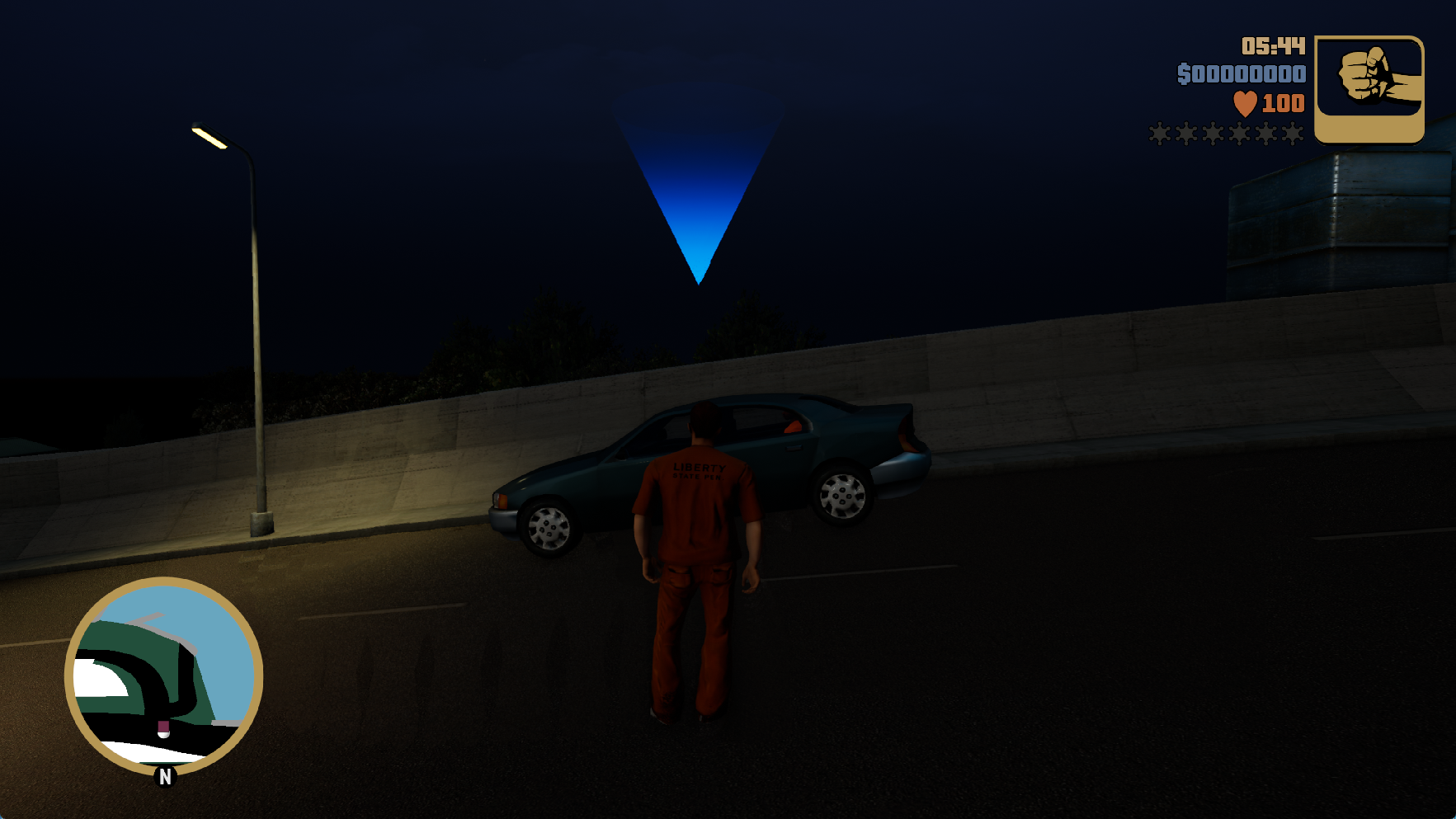
GTA III — player and car at Callahan Bridge after the color/reflection fixes.
Little Nightmares — Six beside the suitcase; lighting and material defects remain.

Progress in previously demonstrated games
- Big Helmet Heroes advances beyond the main menu into its tutorial.
GPU-watched file reads, interrupted save mounts and command-header handling
are corrected. The latest matched September 29 samples measure 6.37 FPS
in the menu and 3.70 FPS in the tutorial. Individual buffer-pool,
page-watch and scalar-history changes reduce specific costs but do not all
establish a repeatable FPS gain. Visual artifacts and startup/stability
issues remain; full playability and 30 FPS are unverified.
- Quake II retains its maintainer-confirmed playable/completable grade.
Observed gameplay has level lighting, textures, weapons and visible NPCs.
Draw reuse, command batching, direct-memory queries, buffer retention and
GPU clears reduce overhead. The maintainer reports 60–70 FPS peaks in
lighter scenes; these are not a stable minimum or a new release benchmark.
- Ghost of Yōtei reaches the tree, a later 3D cinematic and, in an earlier
October 4 run, the illustrated movie after it. The latest tree repeat is
1.231 FPS. A later unpaused cinematic interval presents only two frames
in 30.045 seconds (0.0666 FPS). Character control remains unconfirmed.
Tree streaks, dark lighting, incomplete character surfaces and memory
pressure remain unresolved.
- Earlier confirmed grades for Terminator 2D: No Fate, Jets 'n' Guns 2,
Asterix & Obelix: Slap Them All!, Cat Quest III, Dreaming Sarah,
Jurassic Park Classic Games Collection and Rita's Rewind are retained.
This release does not claim new playthrough checks for them. Tetris Effect,
The Precinct, REANIMAL and the VR titles retain their documented limits.
Big Helmet Heroes — tutorial scene, September 29.

Quake II — lit gameplay with enemies and the player's weapon.

Ghost of Yōtei — tree scene; streaks and other rendering defects remain.

Ghost of Yōtei — illustrated movie reached in the October 4 run.

Ghost of Yōtei — responsive pause overlay over the incomplete 3D cinematic,
October 5. This is not a character-control screenshot.

Why Yōtei can take minutes to draw a transition
One measured transition frame takes 197.573 seconds: graphics pipeline
creation consumes 41.936 seconds and compute pipeline creation 135.167 seconds,
about 90% of the frame. The next frame still spends 65.400 seconds creating
compute pipelines. These first-use costs are separate from steady gameplay FPS.
Later sampled frames also upload 1.4–2.6 GiB of textures and evict roughly
4,800–5,200 sampled images per frame. Resource preparation, copies and waits
remain expensive. A captured draw uses 3328×1872 internal targets despite
1080p output. Its active packed 11/11/10 UNORM blending is still unsupported.
The new shared shader-key storage removes redundant canonical program copies;
one captured inventory contains approximately 200 MiB of such duplication.
Large Windows driver-cache snapshots now use mapped temporary files. An isolated
256 MiB snapshot test reduces additional private memory by approximately
256 MiB and produces identical files. These memory results do not establish
a new game FPS improvement.
Post-tree timing and memory report
Rendering and shader changes
- Preserve colors during depth-only draws, correct sRGB attachment encoding,
and retain color mip identities, array slices and cube-face publication.
Complete resident mip chains and color-grading volumes can stay on the GPU
instead of being read back, tiled on the CPU and uploaded again.
- Preserve NGG LDS position and parameter exports used by GTA III geometry.
Correct bounded fragment loops used by reflection filtering and selected
scalar-buffer descriptor/resource paths.
- Respect
CB_SHADER_MASK, route compact pixel exports across attachment
gaps, and retain pixels in disabled packed targets. Active unsupported
packed blending still reports an error rather than silently dropping it.
- Preserve packed 11-bit normalized color and storage-image data, improve
HTILE handling and avoid invalidating sampled textures merely because a
storage binding is read-only.
- Recover checked material pointers, scalar-buffer descriptor tables and
null-image resources. Keep address bounds and memory checks when resolving
indirect fragment reads; reuse valid translations after texture relocation.
- Share immutable shader analysis, scalar-memory headers and canonical
translation-key prefixes. Release unused diagnostic IR, reduce duplicated
FLAT loads and keep runtime resource choices out of invariant pipeline keys
where supported. Unsupported shader operations remain explicit failures.
Frame preparation, transfers and synchronization
- Record draw batches in one command buffer and reuse unchanged draws only
after resource, scalar, image and storage validation. ...
Assets
5
Loading
Uh oh!
There was an error while loading. Please reload this page.
PS5PCEM 0.3.2
iStark
released this
24 Sep 14:59
PS5PCEM 0.3.2
Changes since 0.3.1-beta.1: more confirmed playable titles, Quake II rendering
fixes, working movie audio and later 3D scenes in Ghost of Yōtei, a corrected and
faster Tetris interface, parallel shader compilation and command preparation,
and a native package extractor included with the launcher.
PS5PCEM remains an experimental emulator. Compatibility claims below distinguish
maintainer-confirmed playthroughs from menus, captured scenes, and measured
performance on the development machine.
Game compatibility
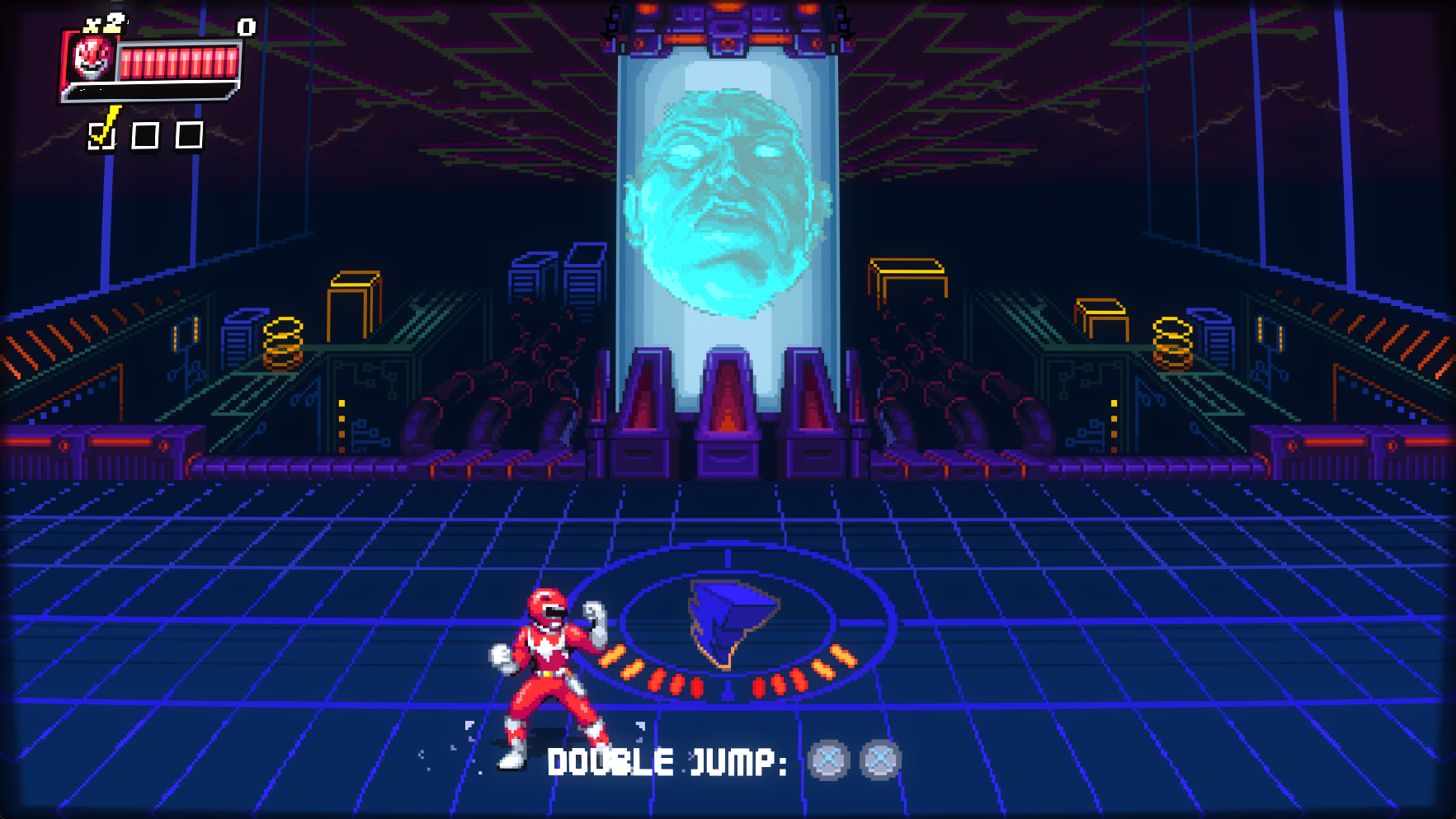
- Mighty Morphin Power Rangers: Rita's Rewind is now playable and
completable, confirmed by the maintainer on September 24, 2026. The latest
capture shows the Red Ranger in the Command Center training stage with the
HUD, objectives, and controller prompts. The existing narrowly matched CRT
scaling fallback remains necessary on the development host.
- Quake II reaches gameplay and is recorded as playable and completable
following the maintainer's September 16 confirmation. Fixes cover startup
imports and directory listings, deferred G-buffer writes, depth comparison
samplers, and typed buffer reads used by model vertices and lighting data.
Missing NPC geometry has been restored; lighting issues in some scenes remain
under investigation.
- Big Helmet Heroes advances from its intro to a correctly rendered main
menu, including character models, textures, lighting, and colors. Fixes cover
Gen5 single-sample texture addressing, layered render targets, and scanout
channel order. Two clean menu runs measured about 3.2–3.3 FPS on an
RTX 3070 Ti. Gameplay has not been verified.
- Tetris Effect: Connected now renders its license and menu pages without
the duplicated UI and vertical boundary seen in earlier builds. Publishing
metadata clears correctly and retaining the title's render targets reduces
repeated readbacks. License frames improved from 235 ms to 159 ms
(about 4.3 to 6.3 FPS); sampled Journey frames improved from
1127–1276 ms to 318–396 ms. These are development measurements, not a
claim of stable gameplay. Dark UI elements and a guest video decoder fault
remain unresolved.
- Jets 'n' Guns 2 no longer tears down and reopens the host audio device as
two active output ports compete for it. Its previously confirmed playable
and completable status is unchanged.
Ghost of Yōtei: movie audio and later scenes
Intro movies now have audio. The verified v_splash_america run starts sound at
6.3 seconds, matching the start of the audio track, instead of remaining
silent. Menu audio continues to work.
- When a dump has no
package.manifest, PlayGo treats chunks 0–999 as installed
so the game can discover its language audio package. Manifest-backed behavior
is retained. Dialogue audio has not been verified separately.
- Decode the observed PS5 multichannel ATRAC9 layout as interleaved mono streams.
Streams from 2 to 36 channels were checked, including 12-channel 7.1.4
movie audio.
- Preserve playback timing for the unsupported DualSense haptics track by
returning silence. This prevents a crash or a stalled movie audio start; it
does not emulate controller vibration. Other unknown formats are rejected.
- Correct compute completion interrupts, preserve loading progress, recover
window presentation, and improve resource retirement and shader preparation.
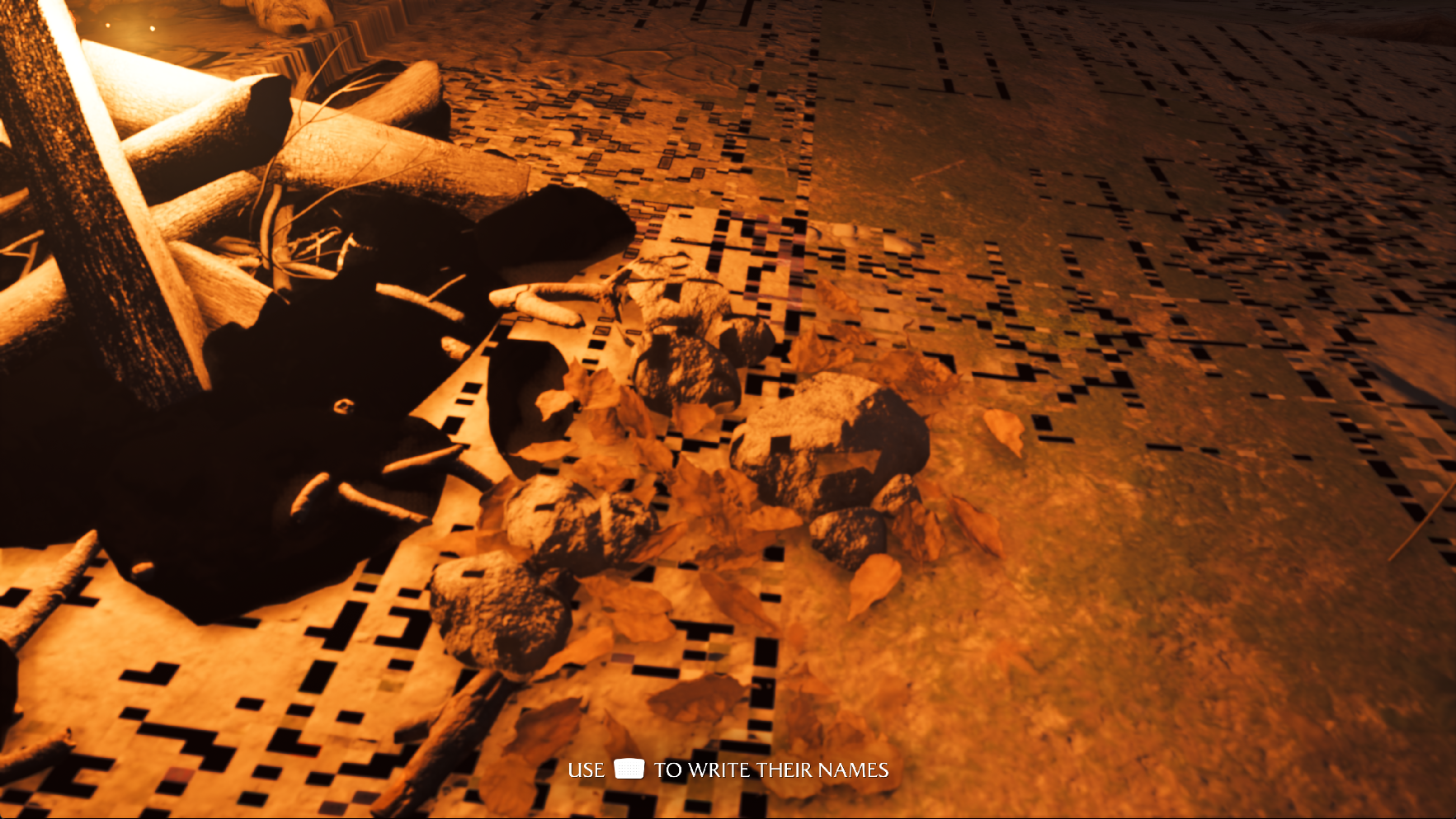
The game reaches later 3D scenes, including the tree scene below. It is still
not playable: the last measured tree scene presented 0.73 FPS, and a
subsequent loading sequence encountered Vulkan device loss. Slow streaming,
rendering artifacts, and late-scene stability remain open issues; a complete
playthrough is not claimed.
Launcher and Windows packages
- Display the release version in the launcher; this build identifies itself as
0.3.2, also reflected in launcher and runner Windows file properties.
- Expand the library from 8 to 32 titles, with eight per page, page controls,
and mouse-wheel navigation.
- Add Extract PKG and ship
pkgextractor.exe beside the launcher and runner
in both the portable archive and installer. The extractor supports observed
debug FPKG layouts, inner PFS, NAPS mappings, Kraken-compressed blocks, and
application payloads. Preserve SELF dynlib-data tails needed by extracted
executables. Encrypted retail packages are not supported.
- Preserve a controller's left stick when keyboard WASD input is idle.
- Sign all three application executables and the installer with SHA-256
Authenticode and a timestamp, using Artur Strazewicz / PS5PCEM. The
certificate is self-signed, so Windows trust or SmartScreen warnings may
still appear. SHA256SUMS.txt accompanies the downloadable packages.
- Include the bundled audio decoders' upstream license and copyright notices
with the release documentation.
Rendering, shaders, and performance
- Run shader compilation through a worker queue, enabled by default with
two compiler workers. Retain a title/device-specific compute shader
warmup catalog and release temporary shader modules after use.
- Prepare graphics and compute commands on two bounded CPU workers, with
owned command and register snapshots. Vulkan execution and visible guest
completion remain ordered through one backend owner. This is preparation
overlap, not independent host graphics and compute Vulkan queues.
- Avoid waits for unrelated resident buffers using timeline retirement; defer
shader fault checks until their submissions complete. Keep upload slices and
detile descriptors alive until their exact GPU readers retire.
- Index resource hazards and resident buffers, share identical shader words,
reuse pipelines with dynamic viewport/scissor state, and reduce repeated
shader analysis during fullscreen video.
- Bound image and translation caches, retry image allocation after safe
retirement, and use a larger render-target cache for Tetris. Experimental
internal release deferral and queued host uploads remain opt-in.
- Bind typed buffer resources for
tbuffer_load_format_* and
tbuffer_store_format_*, retain scalar resource checkpoints, and honor each
access's own format instead of reusing another access's interpretation.
- Enable Vulkan comparison samplers only for instructions that need them, and
use identity swizzles for depth comparison views.
- Correct layered rendering, render-target array slices, Gen5 texture
addressing, float move sign modifiers and rounding, and branched wave64 LDS
synchronization.
- Preserve defined register values at partial control-flow joins, lower proven
private fragment spills, and correct selected fragment quad and minimum
operations on 32-lane hosts.
- Publish HTILE/DCC metadata clears from simple buffer fills, including the
observed packed R11G11B10 and RGB10A2 color formats. Speed up tiled clear edges
without changing their addressing.
Command emulation and diagnostics
- Implement or correct AGC context state and shader resource fusion, boolean
predication, COPY_DATA, REWIND, jump patching, primitive state, workload
markers, packet-size queries, and multi-command-buffer submission.
- Read live copy sources and preserve packet padding and register addresses
while patching command streams.
- Add the source-build
shader-dump tool, using the same decoder as translation
so disassembly exposes the instructions the renderer actually sees.
- Improve command-pool exhaustion messages, frame/resource timing counters,
and safe reads of unaligned diagnostic register data.
Release validation
The three Windows applications were built with Zig 0.16.0 / ReleaseFast.
The ReleaseSafe unit run passed 1353 of 1364 tests, with one skipped and
ten failed. All ten failure names match the recorded SPIR-V baseline;
the same suite still reports one memory leak. GPU command tests passed
214/214, Vulkan tests 173/173, and HLE tests 515/515.
A ReleaseFast probe on the GPU also passed repeated RGBA16F, R11G11B10, and
RGB10A2 metadata clears through compute, PM4, and DMA paths, including partial
and mixed metadata preservation.
Builds and tests were performed with the native game process closed.
Requirements and remaining limits
Windows 10 2004 or newer, an x86-64-v3 CPU (AVX2, BMI2, FMA), and a current
Vulkan 1.2 graphics driver. AVX-512 is not required. Games, firmware, keys,
and console system libraries are not included.
The shader test suite has ten previously recorded SPIR-V failures and a reported
leak; the full suite is not green. Small GPU probes and menu captures do not
establish whole-game stability. See the
compatibility table
and the
Yōtei performance report
for build-specific evidence and limitations.
Full commit history since 0.3.1-beta.1
Assets
5
Loading
Uh oh!
There was an error while loading. Please reload this page.
PS5PCEM 0.3.1-beta.1
iStark
released this
15 Sep 11:41
PS5PCEM 0.3.1-beta.1
243 commits since v0.3.0-alpha.4. The headline is Ghost of Yōtei: it now loads
a 3D world and composes its in-game interface over it, where the previous release
stopped at the brightness slider. A new title, Dreaming Sarah, plays through at
60 FPS. And a crash that made this emulator do nothing at all on a large class of
processors is fixed — if an earlier release started and vanished on your machine,
read the first section.
Fixed: nothing happened at all on CPUs without AVX-512
A release binary is built on one machine and run on many. build.zig asked Zig
for the target without naming a CPU, so Zig used the build machine's own — and
a release produced on a host with AVX-512 executed an AVX-512 instruction on a
Ryzen 5000, or any other CPU without it. The process died with
STATUS_ILLEGAL_INSTRUCTION (0xc000001d) before it opened a window, touched
Vulkan, or reached any code that could report why. From the outside that is
indistinguishable from the program not starting: no error, no log, nothing.
Unblocking the file, running as administrator and allowing it through SmartScreen
all changed nothing, because none of them was the cause.
Builds are now pinned to the x86-64-v3 baseline — AVX2, BMI2 and FMA, which
every CPU able to drive this emulator has had since 2013. -Dcpu= and -Dtarget=
still override it for anyone building their own.
This was reported by community members who did the diagnosis themselves, down to
the Event Viewer exception code and the build.zig line responsible. That report
is the reason it is fixed.
Ghost of Yōtei: into the game
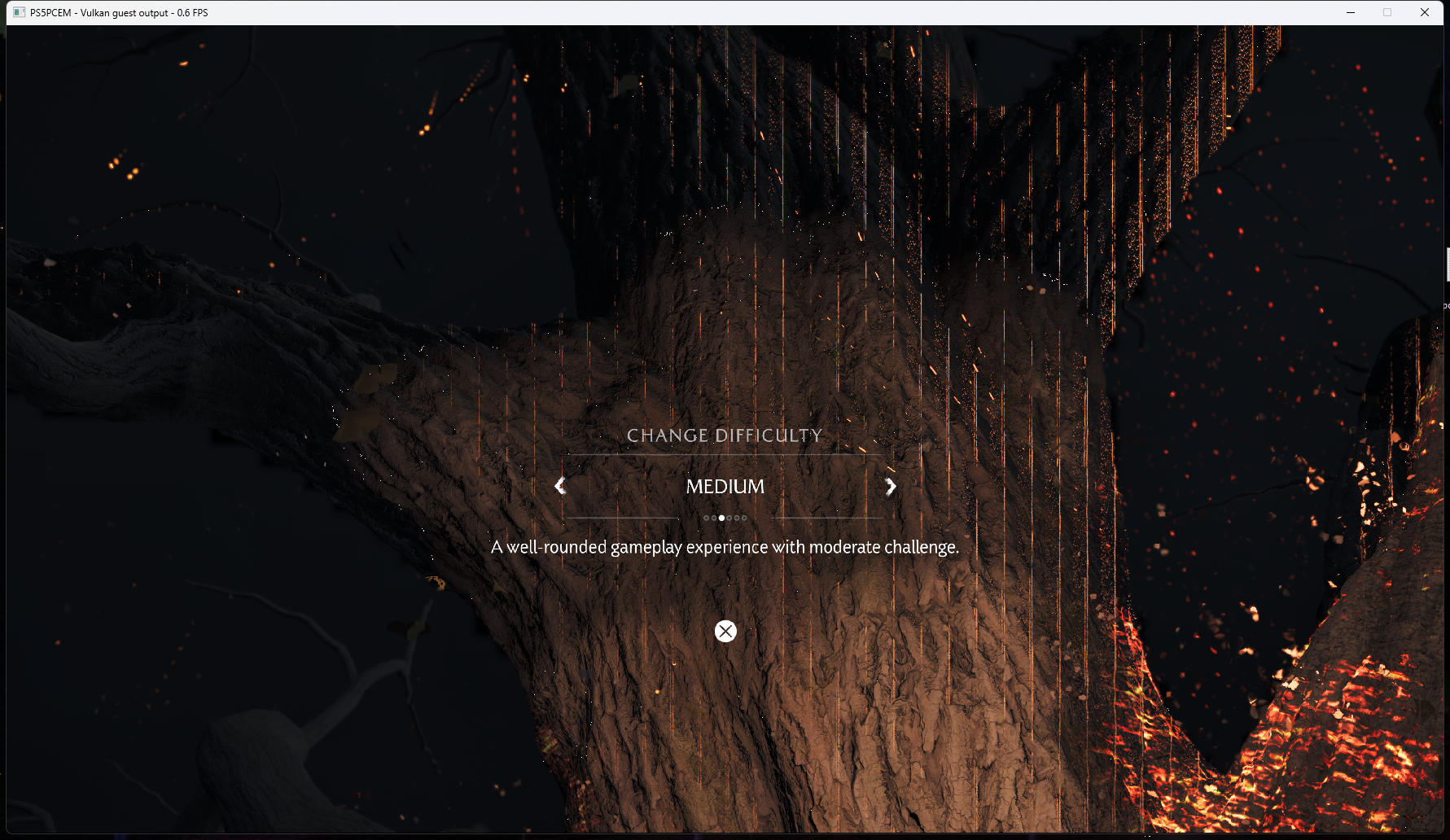
The title now reaches and renders its difficulty selection over a fully loaded
3D scene — geometry, bark and rock materials, ember particles, depth and lighting
— with the option, its description, the arrows, the position dots and the cross
glyph all legible. Earlier releases stopped at brightness calibration.
This is not playable, and the release does not claim it is. Frames there
measure 1504–1554 ms for 321 draws and about 1330 compute dispatches, which is
0.6 FPS. Reaching that screen takes minutes of intro and scene loading, and how
many minutes varies widely between runs of the same build.
What moved it there, mostly: exact scalar provenance through masked loops and lane
spills, BVH ray-intersection decoding and bounded GFX10 ray lowering, guest
tessellation factor and domain interfaces, custom per-vertex fragment
interpolation, fragment position and front-facing inputs initialized from the
rasterizer, packed SNORM animation buffers, and a long list of RDNA2 lowering
corrections — display clamp, output scaling, GDS modifiers, round-toward-zero in
packed half conversion, and SCC after scalar Boolean and 64-bit logical operations.
Dreaming Sarah: playable and completable

Confirmed by the maintainer on September 15, 2026. Menus, the animated title,
world scenes, characters and NPCs render correctly, and the title menu and first
scene hold the 60 FPS cap on an RTX 3070 Ti — 5,280 flips over 90 seconds. The
frame rate falls on the second gameplay scene; that scene is not yet measured.
Two things had to be fixed to load it. The loader now reads an absent dynlibdata
tail as absent: a module can carry the PT_SCE_DYNLIBDATA header with nothing
behind it — this title's libc.prx places the segment at its own last byte and
claims 26 more, in the untouched file as much as in a patched one — so there is
provably nothing there to read. Only a bare ELF can say that; a SELF still reports
truncation, and so does any segment that starts inside the image and runs off the
end. Three libSceAgc imports are now bound, with sceAgcJumpPatchSetTarget
implemented rather than stubbed, because reporting a jump patch that did not
happen leaves a command stream that still reads as valid and jumps wherever the
packet already pointed.
TruncatedSelf also used to name neither the file nor the shortfall, while the
failure could be in any module. It now prints the range it wanted against the
length it had.
Launcher
- Vulkan is now checked, not asserted. At startup the launcher loads the
Vulkan loader, creates an instance at the 1.2 the renderer itself requires,
and enumerates devices. It reports one of four outcomes: ready, with the API
version and adapter name that someone filing a bug report needs; no loader; no
device; or a driver below 1.2 — each phrased as what to do about it, in all
eight interface languages.
- Speed / Graphics rendering preset, mirroring the console's two modes and
defaulting to Speed. Speed enables sampled-image backing reuse and deferred
retirement; Graphics keeps the conservative synchronous paths.
- Output resolution preference, defaulting to 1080p.
- A link to ps5pcem.com in the sidebar.
Performance
sceKernelBatchMap was stopping the guest for 200–1200 ms per batch. Reservation
and metadata intervals are now edited in place, unmapped intervals removed in
place, and adjacent batch-map entries issued as one host mapping. Per-frame guest
time outside the submit path fell from roughly 1000 ms to 6–11 ms.
Around 77 further performance changes: graphics pipelines, resident buffers and
render targets indexed by address; detiled textures uploaded without a CPU round
trip; sampled image views shared and backings reused; identical fixed direct
mappings reused; wave ballots, EXEC predicates, dispatcher registers and buffer
address calculations reused within SPIR-V blocks; alternating LS/HS analyses
retained; larger graphics translation working sets.
A guest mip pyramid is now sampled from the images that produced it, rather
than read back from guest memory the levels were never published to — which was
handing shaders a blank texture. Two real defects surfaced while writing it: a
copy sized from the producer instead of the destination level (a guest rounds a
level up where Vulkan rounds down, so level 7 of a 960×540 chain arrives 8×5
against a 7×4 level), and an evicted chain leaving live views onto freed memory.
Both ended in device loss before they were understood.
Compatibility: a regression found and fixed
Mapping a whole granularity-aligned range as one host view is fewer calls, and it
is what took Yōtei's batch maps under 50 ms. It also stopped Cat Quest III: 60
frames against 2640 in the same 100 seconds, three runs of each, with the title
falling into the stall watchdog. That change is reverted. The coalescing around it
stays and carries most of the original win; Yōtei's batch maps cost 139–209 ms
again, which is the price of a title that runs at all.
Why the wider view hurts that particular guest is still unknown, and the
diagnostic the change was originally justified with reports zero on the broken
build too — so it never spoke to the question.
Known limits
- Ghost of Yōtei is not playable: 0.6 FPS in scenes, minutes to reach them.
- Tetris Effect: Connected, REANIMAL, The Precinct and Rita's Rewind reach the
milestones described in
project-status.md;
gameplay is not claimed for any of them.
- 10 SPIR-V tests fail, as they did before this release; 1194 of 1205 pass.
- Vulkan validation layers cannot be enabled on a host whose SDK registered its
layers under a path that no longer exists. The launcher's new check reports the
driver, not the SDK.
Requirements
Windows x64, a Vulkan 1.2 driver, and a CPU with AVX2 — 2013 or newer. Game
content is not included and is not distributed with this project.
Assets
5
Loading
Uh oh!
There was an error while loading. Please reload this page.
PS5PCEM 0.3.0-alpha.4
iStark
released this
08 Sep 03:47
PS5PCEM 0.3.0-alpha.4
This release brings four more launcher languages, substantial progress in 3D
rendering and Ghost of Yōtei's startup interface, and fixes for Cat Quest III
and Jurassic Park Classic Games Collection. It collects the significant work
since v0.3.0-alpha.3, including 88 intervening commits before release preparation.
Playable and completable games
The project maintainer confirmed the following playthroughs on September 8, 2026:
| Game |
Reported status |
| Terminator 2D: No Fate |
Fully playable and completable; completed without reported problems |
| Asterix & Obelix: Slap Them All! |
Fully playable and completable |
| Cat Quest III |
Fully playable and completable |
| Jurassic Park Classic Games Collection |
Fully playable and completable |
These are title-specific playthrough reports. Frame rate varies by game, scene
and hardware; a completed playthrough does not imply a locked 30 or 60 FPS.
Detailed milestones and gameplay captures live in
project-status.md.

Launcher: eight interface languages
- Add Simplified Chinese, Spanish, Arabic and Portuguese alongside English,
Russian, German and French. Navigation, game-library prompts, input settings,
saves, preferences and status/error messages are translated.
- Expand language selection to two rows, with matching click areas and room for
the sound, FPS and project-information panels.
- Give Arabic text right-to-left paragraph direction and appropriate alignment,
preserving centered buttons and the original direction of paths and key names.
- Preserve existing saved language IDs and restore all eight choices after a
restart. Update Windows executable and installer version metadata to this release.
Ghost of Yōtei: beyond the intro
- Restore continuous intro playback at approximately the stream's native 30 FPS
in ReleaseFast on the current RTX 3070 Ti host. Sampled movie frames take
about 30–32 ms, without the former freeze after a few pictures.
- Correct Videodec2 picture fields, 256-byte NV12 row alignment, picture-specific
acknowledgements and end-of-stream draining. Separate decoder instances and
derive cadence from the stream so clips neither race to the end nor stall on
the guest's former 100 ms polling timeout.
- Advance through streamed menu-resource loading and into the animated loading
indicator, Digital Deluxe Bonus, Gift of the Northern Star, Pre-order
Bonus, and brightness calibration. The reference captures show readable
text, confirmation glyphs, and the calibration wolf image, instruction and slider.
- Render parts of the interface and 3D background; the maintainer observed trees
in the scene and heard menu music. Audio-library support now includes more of
the interfaces bound by the title, including AudioOut2 speaker/port state and
queued-grain accounting.
- Unblock the menu resource catalog and asynchronous scene work, preserve compute
queue ownership and completion labels, and retire validated SDK 1.1 command
ranges without repeatedly replaying stranded work.
Verification boundary: the complete bonus/brightness sequence was verified
on reference build 796a484. The latest renderer was checked through the intro
into scene loading, but that full sequence has not been repeated on this release
candidate. A complete title menu, its full animated background and gameplay are
still unverified. Scene preparation and UI remain very slow: reference runs took
minutes to prepare resources and seconds per UI frame. See the
build-specific investigation.
Cat Quest III and Jurassic Park rendering
- Fix Cat Quest III's upside-down world and intro composition while retaining
the UI's orientation. Procedural fullscreen passes preserve their UV direction.
- Preserve fragment coverage, alpha-to-coverage state and stencil-only passes.
This removes the observed menu-text corruption and keeps language-list text
visible and clipped inside its panel instead of covering it with a white fill.
- Implement the original AGC interpolant-mapping interface used by Cat Quest III.
Adventure-selection artwork and labels, mountains and other scenery now use
the correct vertex-to-fragment exports.
- Honor registered RGBA/BGRA scanout formats. The captured island now has blue
sea and sky and the expected character/scenery colors instead of swapped
red and blue channels.
- Restore Jurassic Park startup rendering, including its title logo, confirmation
prompt, collection cover art and animated preview. Respect explicit color
disable and DX clipping while retaining reset-depth extent recovery for
Ghost of Yōtei's active HTILE-backed surfaces.
3D shaders, materials and GPU correctness
- Recover pointer-backed and indirect material resources through scalar/vector
register moves, VCC offsets, restored execution masks, branches and bounded
loops. Support large global texture tables and mixed sampled-image dimensions
at runtime, with typed bounds and validation of malformed descriptors.
- Execute bounded absolute/FLAT memory reads used by scene shaders and report
the first unmapped active address. Resource recovery now follows instructions
actually visited, avoiding invented bindings from inactive shader branches.
- Correct wave32/wave64 masks, both words of vector conditions, SAVEEXEC operand
order and SCC, unsigned carry, lane identity and cross-subgroup synchronization.
Preserve DPP row/permutation behavior and whole-quad execution.
- Add or correct explicit-LOD image gathers and depth comparisons, array
gradients, RDNA2 sampling operands, fragment storage-image writes, BC4 and
RG16 SNORM sampling, visible array-layer uploads and mixed integer exports.
- Preserve flat attribute channels and scalar spills. Support D16 loads into
previously undefined vector registers, high-halfword stores, scene mask
comparisons and bounded GDS word reads/writes.
- Apply uniform HTILE clears to resident depth images, preserve stencil during
depth-only clears, support matching D32 depth bias, and improve depth/stencil
barriers and compute-buffer synchronization.
- Retain descriptors, prepared render targets and image pins until queued draws
finish using them, preventing cache eviction or command flushes from invalidating
live GPU work.
Performance and runtime stability
- Cache translated graphics SPIR-V with explicit memory/entry limits and cheaper
field serialization. Reuse compatible smaller prefixes of uploaded buffers
while retaining exact descriptor bounds.
- Cat Quest III opening-island samples improve from roughly 148 ms (~6.8 FPS)
to a 124 ms median (~8 FPS) on the test host. Shader-translation work drops
from about 40 to 7 ms and buffer uploads from about 124–127 to 65–75 MiB per
sampled frame. The later capture has a local co-op HUD, so this is an observed
comparison of the same area, not a controlled benchmark of identical frames.
- Reuse prepared graphics/compute resources and driver compute-pipeline caches;
index resident sampled images by guest address and shader control flow for
resource recovery. Share immutable FLAT snapshot headers and retain more small
storage images within the cache budget.
- Prefer host-cached readback memory, cache reads of resident compute buffers,
accelerate Windows x64 memory fills, and reuse swizzle offsets for volume/MSAA
copies. Reduce scene index checks and unnecessary depth readbacks.
- Fix Windows placeholder handling when a small guest mapping occupies the tail
of a coalesced reservation, preventing the observed Cat Quest III startup
HostCommitFailed. Bound permission checks to overlapping mappings and prevent
thread diagnostics from suspending their own calling thread.
Validation and remaining limits
- Build the launcher and runner in ReleaseFast. Exercise all eight launcher
languages across settings, library, controls and saves, including restart
persistence and visual checks of the four new translations.
- Focused checks during development cover guest-memory mapping, interpolant
mapping, shader caching and Vulkan scanout/orientation, fragment coverage,
stencil/UI and HTILE behavior. Shader changes include targeted SDK GPU probes;
this does not establish correctness for every game or shader.
- Jurassic Park's collection frontend still has a known AvPlayer handle-pool
limit when repeatedly cycling preview videos; later previews can become static.
The maintainer's playable/completable report concerns the games themselves.
- Ghost of Yōtei's full menu and gameplay remain work in progress. Other titles
can still have missing graphics, stalls or crashes; consult the status document
for each title's observed milestone.
Downloads and requirements
- Windows x64 portable ZIP, per-user installer, and SHA256SUMS.txt are
attached to this release. Keep ps5pcem.exe and game-run.exe together.
- Windows 10 2004 or newer, x86-64, with a Vulkan 1.2-capable graphics driver.
- Games, firmware, keys and console system software are not included.
- These prototype binaries are not Authenticode-signed, so Windows may show an
Unknown Publisher or Microsoft Defender SmartScreen warning.
Full commit comparison
Assets
5
Loading
Uh oh!
There was an error while loading. Please reload this page.
PS5PCEM 0.3.0-alpha.3
iStark
released this
04 Sep 19:56
PS5PCEM 0.3.0-alpha.3
This prototype update adds video decoding for titles that use
libSceVideodec2, which is what lets Ghost of Yōtei reach and play its intro.
Added
- Decode the H.264 access units a title hands to
libSceVideodec2. The host
decoder receives the stream, the picture is converted from NV12 with BT.709
coefficients, and decoding is paced to about one picture per display interval
so a title feeding access units as fast as they are accepted no longer drains
a whole movie in a few frames.
- Ghost of Yōtei decodes and presents its intro video with sound. Its
in-engine frame behind the video is still black, so this is a video-playback
milestone rather than a menu or gameplay claim.
- Recover the completion generation for an SDK 11 compute queue from the
caller when the queue object is spilled rather than left in a register, which
releases a render thread that would otherwise spin.
Fixed
- Report a decoded picture where a title reads it. The record was laid out from
the wrong end, so a title checked a size field for readiness and never saw the
frames it had been given.
- Report a frame-slot size a title can divide its arena by. A slot as large as
the whole arena left room for none and ended decoder setup before a single
frame was decoded.
- Stop presenting an unconverted frame as a black one: a frame whose packed
format could not be converted was handed back as freshly zeroed bytes, which
was indistinguishable from a frame the title rendered black.
- Stop the launcher clipping its own name. The brand cells were too small in
both directions, so the title lost the bottom of every glyph and the subtitle
ended mid-word.
- Never hand out an asynchronous read identifier that is still in use. A title
that streams keeps batches open across many submissions, and the table wrapped
onto live entries during ordinary loading.
- Stop the quiet-thread diagnostic faulting on a wrong guess. It followed two
addresses out of a suspended thread without checking either, which ended the
emulator a couple of frames into video playback.
- Run command arenas a title strands behind a CPU-polled fence, rescuing each
once per submission rather than replaying it in a loop.
Requirements and limitations
- Windows 10 2004 or newer, x86-64, with a Vulkan 1.2-capable graphics driver.
- Compatibility remains experimental; black screens, missing graphics, stalls
and crashes are still possible in unsupported titles.
- Games, firmware, keys and console system software are not included.
- These prototype binaries are not Authenticode-signed, so Windows may show an
Unknown Publisher or Microsoft Defender SmartScreen warning.
Assets
5
Loading
Uh oh!
There was an error while loading. Please reload this page.
PS5PCEM 0.3.0-alpha.2
iStark
released this
25 Aug 22:57
PS5PCEM 0.3.0-alpha.2
This prototype update fixes missing game cover art in the Windows launcher.
Fixed
- Decode each title's
sce_sys/icon0.png directly through the Windows GDI+
image codec.
- Stop depending on PNG file associations and the Windows shell thumbnail
cache, which could return a generic white document icon instead of artwork.
- Preserve the eight-title recent-game library and its existing local paths.
Requirements and limitations
- Windows 10 2004 or newer, x86-64, with a Vulkan 1.2-capable graphics driver.
- Compatibility remains experimental; black screens, missing graphics, stalls
and crashes are still possible in unsupported titles.
- Games, firmware, keys and console system software are not included.
- These prototype binaries are not Authenticode-signed, so Windows may show an
Unknown Publisher or Microsoft Defender SmartScreen warning.
Assets
5
Loading
Uh oh!
There was an error while loading. Please reload this page.
PS5PCEM 0.3.0-alpha.1
iStark
released this
25 Aug 22:38
PS5PCEM 0.3.0-alpha.1
This is the first public Windows prototype build of PS5PCEM. It is intended for
compatibility testing and development feedback, not as a finished general-purpose
emulator.
Included
- Native Windows launcher with an eight-title recent-game library and local cover art.
- Portable ZIP and per-user installer; neither package requires administrator access.
- Writable per-title savedata browser shared by launcher and direct CLI runs.
- Vulkan 1.2 VideoOut path, experimental RDNA2-to-SPIR-V translation and native x86-64 guest execution.
- Direct DualSense/DualShock HID input, XInput fallback and keyboard/hybrid profiles.
- Adaptive host audio buffering and title-specific scheduling improvements.
Requirements
- Windows 10 2004 or newer, x86-64.
- A current Vulkan 1.2-capable graphics driver.
- Legally obtained decrypted game content and any required system files. They are not distributed with PS5PCEM.
Important limitations
- Compatibility is incomplete; black screens, missing graphics, stalls and crashes remain possible.
- The release contains no games, firmware, keys or copyrighted console system software.
- The installer keeps generated saves and configuration when uninstalling so user data is not silently removed.
Use SHA256SUMS.txt to verify either download before running it.
Assets
5
Loading
Uh oh!
There was an error while loading. Please reload this page.
|


