GeezerVison is showing github.com — Build software better, together
Here are
108 public repositories
matching this topic...
Language:
All
Filter by language
Sort:
Most stars
Sort options

IFRS accounting knowledge skill for AI coding agents — Claude Code, Codex, Cursor. Every IFRS and IAS standard, paragraph-cited: IFRS 15 revenue recognition, IFRS 16 lease accounting, IFRS 9 ECL, IFRS 17, and IFRS 18, IFRS 19, IFRS S1/S2. Disclosure checklists, worked journal entries, GAAP-to-IFRS transition guide.
-
Updated
Aug 29, 2026
-
Python
Counterparty credit risk model validation workflow: Pillar I capital, CCAR, IFRS 9 and stress testing on a sample portfolio.
-
Updated
Jul 7, 2023
-
Jupyter Notebook
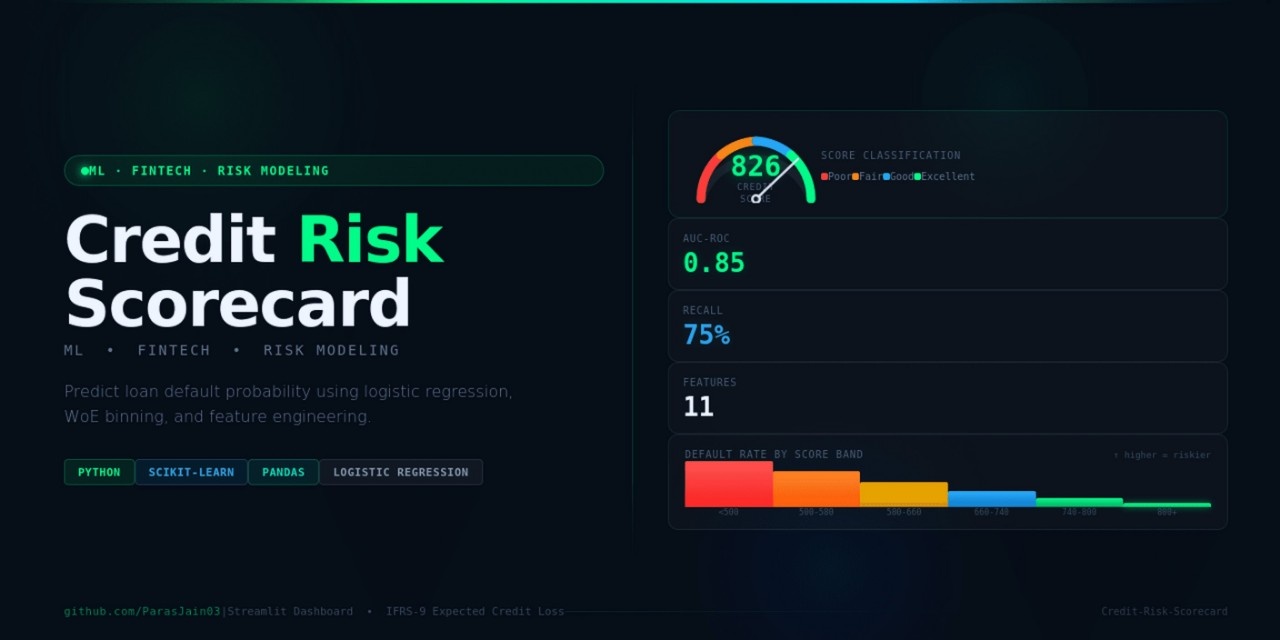
Bank-style Credit Risk Scorecard using Logistic Regression, IFRS-9 Expected Credit Loss, and an Interactive Streamlit Risk Dashboard for loan default prediction.
-
Updated
Mar 10, 2026
-
Jupyter Notebook
R-codebase for a scientific research article, titled "Approaches for modelling the term-structure of default risk under IFRS 9: A tutorial using discrete-time survival analysis"
Provision IFRS 9 (ECL) prêt par prêt sur données Freddie Mac : régression logistique contre LightGBM, testés hors période sur la crise de 2008
-
Updated
Nov 17, 2026
-
Python
End-to-end credit risk modeling in Python: WoE/IV feature engineering, logistic regression PD scorecard with points scaling, XGBoost challenger, model validation suite (KS, Gini, AUROC, PSI, calibration), SHAP explainability, and IFRS 9 three-stage expected credit loss (ECL) — on real Lending Club data, with a Streamlit dashboard.
-
Updated
Jul 2, 2026
-
Python
Practitioner-grade IFRS 9 expected-credit-loss engine: PD term structures, three-stage SICR waterfall, EBA macro overlays and a Vasicek/ASRF point-in-time PD. Parallel Python + Excel with a methodology deck.
-
Updated
Jun 10, 2026
-
Python
End-to-End IFRS 9 LGD Model development by Advance Workout Model.
-
Updated
Jun 20, 2026
-
Jupyter Notebook
End-to-End IFRS 9 PD Model development by Cohort Model.
-
Updated
Jun 2, 2026
-
Jupyter Notebook
Mortgage credit risk: regime-switching survival model, exact expected loss in O(T), Shapley explanations, IFRS 9/CECL, CVaR. Java, ONNX, Postgres.
-
Updated
Nov 27, 2026
-
Jupyter Notebook
IFRS 9 / AASB 9 mortgage credit-risk suite on Freddie Mac loan-level data — PD (logistic, AUC 0.81), real LGD from actual loss data (reconciled to the vendor loss field at 0.99), EAD, expected credit loss, stress testing (~10× downturn), a scorecard master scale, and out-of-time / out-of-regime validation.
-
Updated
Jun 22, 2026
-
Jupyter Notebook
This model estimates the 12-month Probability of Default (PD) for prime residential mortgage customers in the United Kingdom, aligned with the IFRS 9 impairment framework and calibrated to an adverse macroeconomic scenario. Version 1 (v1) is developed using gradient-boosted decision trees (GBDT)
Microfinance loan management system (Java 21, Spring Boot, Spring Modulith, Angular): origination, amortisation, PAR ageing, IFRS 9, EcoCash repayments. Planning pack.
Comparative PD estimation and IFRS 9 ECL translation: logistic regression against four tree ensembles, with look-ahead controls and a temporal placebo.
-
Updated
Nov 3, 2026
-
Python
Interactive WOE (Weight of Evidence) and IV (Information Value) binning web tool for credit risk scoring, segmentation, and transparent scorecard development.
End-to-end credit risk modeling framework: PD modeling (WOE/logistic regression), EAD, Lifetime PD projection and scenario-based ECL estimation on mortgage portfolios — IFRS 9 oriented
-
Updated
Nov 27, 2026
-
Python
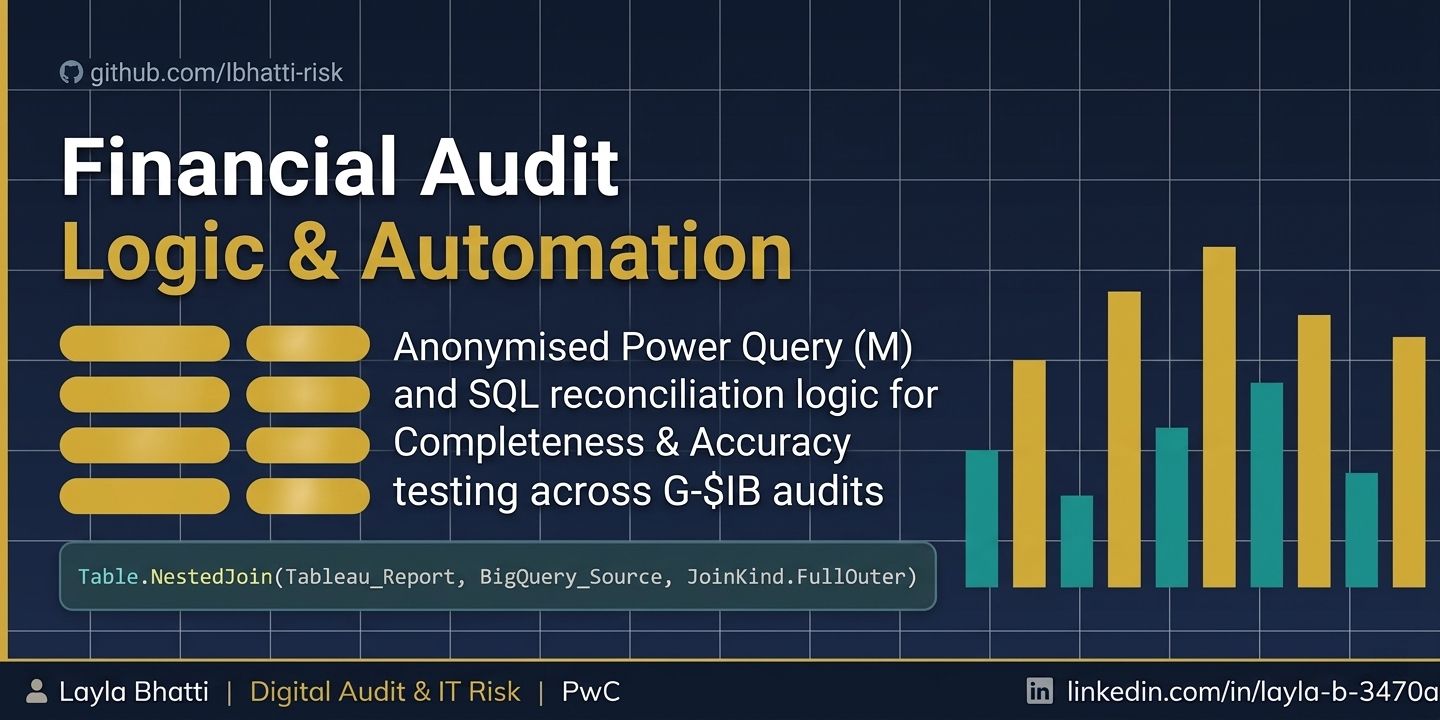
Anonymised Power Query (M) and SQL logic used for Completeness & Accuracy testing in G-SIB financial audits.
Streamlit app that computes per-loan Expected Loss, Lifetime ECL, and Risk Rating from EAD/PD/LGD/WAL Excel portfolios
-
Updated
Apr 27, 2026
-
Python
End-to-End IFRS 9 PD Model development by Empirical Migration Matrix and Credit Cycle Index Models.
-
Updated
Jun 13, 2026
-
Jupyter Notebook
Monthly loan-level portfolio monitoring on real Freddie Mac data: transition/migration matrices, roll rates, IFRS 9 stage movements, early-warning watchlist, and vintage tracking.
-
Updated
Jun 25, 2026
-
Jupyter Notebook
Add this topic to your repo
To associate your repository with the
ifrs9
topic, visit your repo's landing page and select "manage topics."
Learn more
|