GeezerVisonThe World Wide Web, restored to 800 pixels of glory. | ||||||||||||||
| Home|About|Gaming cabinet|Archives|How it works|Starter sites | ||||||||||||||
GeezerVison is showing mathworld.wolfram.com — Analytic Continuation -- from Wolfram MathWorld 

Analytic ContinuationAnalytic continuation is the extension of an analytic function beyond its initial domain by agreeing analytic functions on overlapping domains. It can be carried out by a chain of power series centered at successive points of a path. An initial power series
with radius of convergence
where
For example,
which converges for
If Continuation need not be possible along every path. A singularity can prevent it, and a natural boundary can prevent extension across every point of a boundary. Thus, local values determine any continuation uniquely along a specified path, but do not guarantee a single-valued function on the entire complex plane.
Analytic continuation can lead to some interesting phenomena such as multivalued functions. For example, consider analytic continuation of the square
root function
which has radius of convergence 1 about 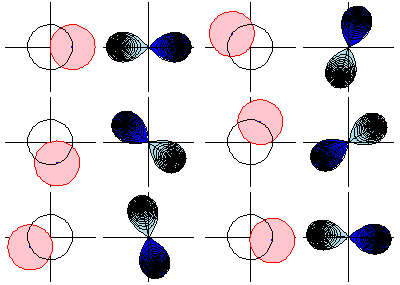
The animation above shows the analytic continuation of In the animation, the domain space (colored pink; left figures) is mapped to the image space (colored blue; right figures) by the square root function, and the light blue region indicates the negative square root. However, by continuing the function around the circle, the square root function takes values in what used to be the light blue region, so the roles of the blue and light blue region are reversed. This can be interpreted as going from one branch of the multivalued square root function to the other. This illustrates that analytic continuation extends a function using the nearby values that provide the information on the power series.
It is possible for the function to never return to the same value. For example, See alsoAnalytic Function, Branch Cut, Branch Point, Continuity Principle, Direct Analytic Continuation, Global Analytic Continuation, Logarithmic Branch Point, Monodromy, Monodromy Theorem, Multivalued Function, Natural Boundary, Permanence of Algebraic Form, Power Series, Principle of Permanence, Riemann Surface, Schwarz Reflection Principle, Taylor Series Explore this topic in the MathWorld classroomExplore with Wolfram|Alpha
More things to try: ReferencesArfken, G. Mathematical Methods for Physicists, 3rd ed. Orlando, FL: Academic Press, pp. 378-380, 1985.Davis, P. J. and Pollak, H. "On the Analytic Continuation of Mapping Functions." Trans. Amer. Math. Soc. 87, 198-225, 1958.Dienes, P. The Taylor Series: An Introduction to the Theory of Functions of a Complex Variable. Oxford, England: Clarendon Press, 1931.Flanigan, F. J. Complex Variables: Harmonic and Analytic Functions. New York: Dover, 1983.Havil, J. "Analytic Continuation." §16.3 in Gamma: Exploring Euler's Constant. Princeton, NJ: Princeton University Press, pp. 91-193, 2003.Henrici, P. "An Algorithm for Analytic Continuation." SIAM J. Numer. Anal. 3, 67-78, 1966. https://doi.org/10.1137/0703005.Henrici, P. Applied and Computational Complex Analysis, Vol. 1: Power Series-Integration-Conformal Mapping-Location of Zeros. New York: Wiley, 1974.Honda, K. "Notes for Math 520: Complex Analysis." https://www.math.ucla.edu/~honda/math520/notes.pdf.Jones, G. A. and Singerman, D. Complex Functions: An Algebraic and Geometric Viewpoint. Cambridge, England: Cambridge University Press, 1987.Knopp, K. "Analytic Continuation and Complete Definition of Analytic Functions." Ch. 8 in Theory of Functions Parts I and II, Two Volumes Bound as One, Part I. New York: Dover, pp. 83-111, 1996.Krantz, S. G. "Uniqueness of Analytic Continuation" and "Analytic Continuation." §3.2.3 and Ch. 10 in Handbook of Complex Variables. Boston, MA: Birkhäuser, pp. 38-39 and 123-141, 1999.Levinson, N. and Raymond, R. Complex Variables. New York: McGraw-Hill, pp. 398-402, 1970.McMullen, C. T. "Riemann Surfaces." Harvard University, Math 213b, Apr. 28, 2026. https://abel.math.harvard.edu/~ctm/math213b/home/course/course.pdf.Morse, P. M. and Feshbach, H. Methods of Theoretical Physics, Part I. New York: McGraw-Hill, pp. 389-390 and 392-398, 1953.Needham, T. "Analytic Continuation." §5.XI in Visual Complex Analysis. New York: Clarendon Press, pp. 247-257, 2000.Rudin, W. Real and Complex Analysis. New York: McGraw-Hill, pp. 319-327, 1987.Small, R. D. "Modified Convergence of Taylor Series." Amer. Math. Monthly 88, 439-441, 1981. https://doi.org/10.2307/2321830.Trott, M. The Mathematica GuideBook for Symbolics. New York: Springer-Verlag, sec. 1.6.6, 2006. https://doi.org/10.1007/0-387-28815-5. https://www.mathematicaguidebooks.org/.Whittaker, E. T. and Watson, G. N. "The Process of Continuation." §5.5 in A Course in Modern Analysis, 4th ed. Cambridge, England: Cambridge University Press, pp. 96-98, 1990.Referenced on Wolfram|AlphaAnalytic ContinuationCite this as:Weisstein, Eric W. "Analytic Continuation." From MathWorld--A Wolfram Resource. https://mathworld.wolfram.com/AnalyticContinuation.html Subject classifications | ||||||||||||||
| You are visitor 01402503 — GeezerVison does not store the pages you look up. Best viewed with Netscape Navigator 4.7 or Internet Explorer 6 at 800×600. No cookies required. |


 can be reexpanded about
 when
 .

 is a

 at least for
 .
 has
 about the origin with
 gives

 and therefore includes points outside
 .
 and
 are
 and
 and agree on their nonempty
 is an analytic continuation of
 ,
 .
 has a well-defined
 ,


 and converges in
 .
 along the
 .
 is the negative of the original function, so going around twice returns the function
to its original value.
 increases by
 every time it is continued counterclockwise around zero.
This gives a
 and the connected double
 .
 in the
 .