GeezerVisonThe World Wide Web, restored to 800 pixels of glory. | ||||||||||||||||||||||||||||||||||||||||||||||||||||||||||||||||||||||||||||||||||||||||||||||||||||||||||||||||||||||||||||||||||||||||||||||||||||||||||||||||||||||||||||||||||||||||||
| Home|About|Gaming cabinet|Archives|How it works|Starter sites | ||||||||||||||||||||||||||||||||||||||||||||||||||||||||||||||||||||||||||||||||||||||||||||||||||||||||||||||||||||||||||||||||||||||||||||||||||||||||||||||||||||||||||||||||||||||||||
GeezerVison is showing mathworld.wolfram.com — Derivative -- from Wolfram MathWorld 

DerivativeThe derivative of a function is its instantaneous rate of change with respect to one of its variables.
The "simple" derivative of a function
often written in-line as
The "d-ism" of Leibniz's
When a derivative is taken
is used, with
etc., the corresponding fluxion notation.
When a function
can be used to specify the derivative with respect to one or more variables.
The derivative of a real-valued function
but may also be calculated more symmetrically as
provided the derivative is known to exist.
Differentiation is a linear operator. If
This follows by taking the limit of the difference quotient term by term and includes the sum rule and the constant multiple rule. The derivative of a constant function is zero because its difference quotient is zero.
The preceding definitions describe real derivatives, for which
For a function of a complex variable, a complex derivative requires
that the difference quotient approach the same finite limit
as
These considerations can lead to confusion for students when they first encounter complex derivatives. For example, the familiar
derivative of the real absolute value function
does not imply that
The two nonzero cases are the slopes of the two straight pieces of its function graph. At In the Wolfram Language, RealAbs[x] supports differentiation of the absolute value function with respect to a real variable. If the first derivative exists, the second derivative may be defined as
and calculated more symmetrically as
again provided the second derivative is known to exist.
Note that in order for the limit to exist, both A generalization of the derivative to an arbitrary direction is the directional derivative. The derivative of a smooth function between manifolds is represented by a tangent map between the corresponding tangent spaces. Numerical differentiation can amplify small errors in function values, since a finite difference estimate divides a difference of values by a small step size.
Real-variable derivatives of some functions follow, at points where they are differentiable. For the
power rule with real exponent
where For differentiable functions, derivatives of sums are equal to the sum of derivatives so that
In addition, if
The product rule for differentiation states
where
The quotient rule for derivatives states that, for
while the power rule gives
Another rule for computing derivatives is the chain rule, which states that for
or more generally, for a differentiable function
where Miscellaneous other derivative identities, requiring the displayed denominators to be nonzero, include
If
so
Derivative identities of inverse functions, for a three-times continuously differentiable
function with
A vector derivative of a vector function
can be defined by
The
The triangle of coefficients 1; 1, 1; 2, 4, 1; 6, 18, 9, 1; ... gives the absolute values of the
coefficients of
Faà di Bruno's formula gives an explicit formula for the
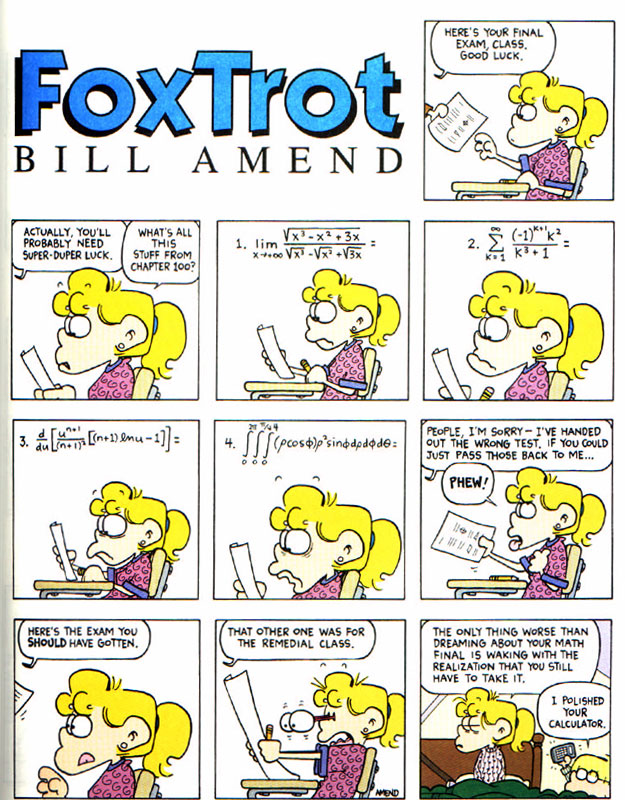
The June 2, 1996 comic strip FoxTrot by Bill Amend (Amend 1998, p. 19; Mitchell 2006/2007) featured the following derivative as a "hard" exam
problem intended for a remedial math class but accidentally handed out to the normal
class. For
See alsoBlancmange Function, Calculus, Carathéodory Derivative, Cauchy-Riemann Equations, Chain Rule, Comma Derivative, Complex Derivative, Complex Differentiable, Convective Derivative, Covariant Derivative, Definite Integral, Differentiable, Differential Calculus, Differentiation, Directional Derivative, Euler-Lagrange Derivative, Faà di Bruno's Formula, Finite Difference, Fluxion, Fractional Calculus, Fréchet Derivative, Functional Derivative, Higher-Order Derivative, Implicit Differentiation, Indefinite Integral, Integral, Lie Derivative, Logarithmic Derivative, Numerical Differentiation, Pincherle Derivative, Power Rule, Product Rule, Quotient Rule, Schwarzian Derivative, Total Derivative, Weierstrass Function Explore this topic in the MathWorld classroomExplore with Wolfram|Alpha
More things to try: ReferencesAbramowitz, M. and Stegun, I. A. (Eds.). Handbook of Mathematical Functions with Formulas, Graphs, and Mathematical Tables, 9th printing. New York: Dover, p. 11, 1972.Amend, B. Camp FoxTrot. Kansas City, MO: Andrews McMeel, p. 19, 1998. Strip reproduced with permission of the author.Anton, H. Calculus: A New Horizon, 6th ed. New York: Wiley, 1999.Beyer, W. H. "Derivatives." CRC Standard Mathematical Tables, 28th ed. Boca Raton, FL: CRC Press, pp. 229-232, 1987. calc101.com. "Step-by-Step
Differentiation." http://www.calc101.com/webMathematica/MSP/Calc101/WalkDGriewank,
A. Principles
and Techniques of Algorithmic Differentiation. Philadelphia, PA: SIAM, 2000.Mitchell,
C. W. Jr. In "Media Clips" (Ed. M. Cibes and J. Greenwood).
Math. Teacher 100, 339, Dec. 2006/Jan. 2007. Sloane, N. J. A.
Sequence A021009 in "The On-Line Encyclopedia
of Integer Sequences." Referenced on Wolfram|AlphaDerivativeCite this as:Weisstein, Eric W. "Derivative." From MathWorld--A Wolfram Resource. https://mathworld.wolfram.com/Derivative.html Subject classifications | ||||||||||||||||||||||||||||||||||||||||||||||||||||||||||||||||||||||||||||||||||||||||||||||||||||||||||||||||||||||||||||||||||||||||||||||||||||||||||||||||||||||||||||||||||||||||||
| You are visitor 01402503 — GeezerVison does not store the pages you look up. Best viewed with Netscape Navigator 4.7 or Internet Explorer 6 at 800×600. No cookies required. |

 with respect to a
 is denoted either
 or

 .

 eventually won the notation battle against the "dotage"
of Newton's
 times, the notation
 or


 depends on more than one

 on a real
 ,


 and
 are
 and
 are constants, then

 approaches 0 through real values along the
 along every path in the
 has a
 has no

 ,


 and
 must exist and be equal, so the
 ,
 ; for
 ,
 .
 ,
 ,
 :


 ,
 ,

 is a constant,


 denotes the derivative of
 with respect to
 .


 ,


 ,

 and
 and
 ,

 denotes a


 ,
 is a constant,
 is
 ,


 ,


^(-5).](/api/image?u=https%3A%2F%2Fmathworld.wolfram.com%2Fimages%2Fequations%2FDerivative%2FInline138.svg)


 th derivatives of
 for
 ,


 ,
 ,
 is a
 th derivative of the
 .
 and real
 ,
