GV

GeezerVison

The World Wide Web, restored to 800 pixels of glory.

Home|About|Gaming cabinet|Archives|How it works|Starter sites

On this site

  • Worktrunk
  • wt switch
  • wt list
  • wt merge
  • wt remove
  • wt config
  • wt step
  • wt hook
  • Agent integration
  • Extending Worktrunk
  • LLM commit messages
  • Tips & patterns
  • Shell integration
  • FAQ

This view

  • Original page
  • New address

GeezerVison is showing worktrunk.dev — Worktrunk

Worktrunk

Worktrunk is a CLI for Git worktree management, designed for parallel AI agent workflows.

Worktrunk’s three core commands make worktrees as easy as branches. Plus, Worktrunk has a bunch of quality-of-life features to simplify working with many parallel changes, including hooks to automate local workflows & copy-on-write build caches.

A quick demo:

Worktrunk demo showing wt list, wt switch, and hooks
Listing worktrees, switching, cleaning up

Context: git worktrees

Section titled “Context: git worktrees”

AI agents like Claude Code and Codex can handle longer tasks without supervision, such that it’s possible to manage 5-10+ in parallel. Git’s native worktree feature gives each agent its own working directory, so they don’t step on each other’s changes.

But the git worktree UX is clunky. Even a task as small as starting a new worktree requires typing the branch name three times: git worktree add -b feat ../repo.feat, then cd ../repo.feat.

Worktrunk makes git worktrees as easy as branches

Section titled “Worktrunk makes git worktrees as easy as branches”

Worktrees are addressed by branch name; paths are computed from a configurable template. Commands that take a branch also accept the path of the worktree it is checked out in.

Start with the core commands

Core commands:

TaskWorktrunkPlain git
Switch worktreeswt switch featcd ../repo.feat
Create + start Claudewt switch -c -x claude feat
git worktree add -b feat ../repo.feat && \
cd ../repo.feat && \
claude
Clean upwt remove
cd ../repo && \
git worktree remove ../repo.feat && \
git branch -d feat
List with statuswt listgit worktree list (paths only)

Expand into the more advanced commands as needed

Workflow automation:

  • Hooks — run commands on create, pre-merge, post-merge, etc
  • LLM commit messages — generate commit messages from diffs
  • Merge workflow — squash, rebase, merge, clean up in one command
  • Interactive picker — browse worktrees with streaming CI status and diff, log, PR and comment previews
  • Share build caches — ten worktrees get target/, node_modules/, etc without building or copying them (on APFS, btrfs, and XFS)
  • wt list --full — CI status and AI-generated summaries per branch
  • PR checkout — wt switch pr:123 to jump straight to a PR’s branch
  • Dev server per worktree — hash_port template filter gives each worktree a unique port
  • Aliases & per-branch variables — custom wt <name> commands and branch-scoped state for hook templates
  • …and lots more

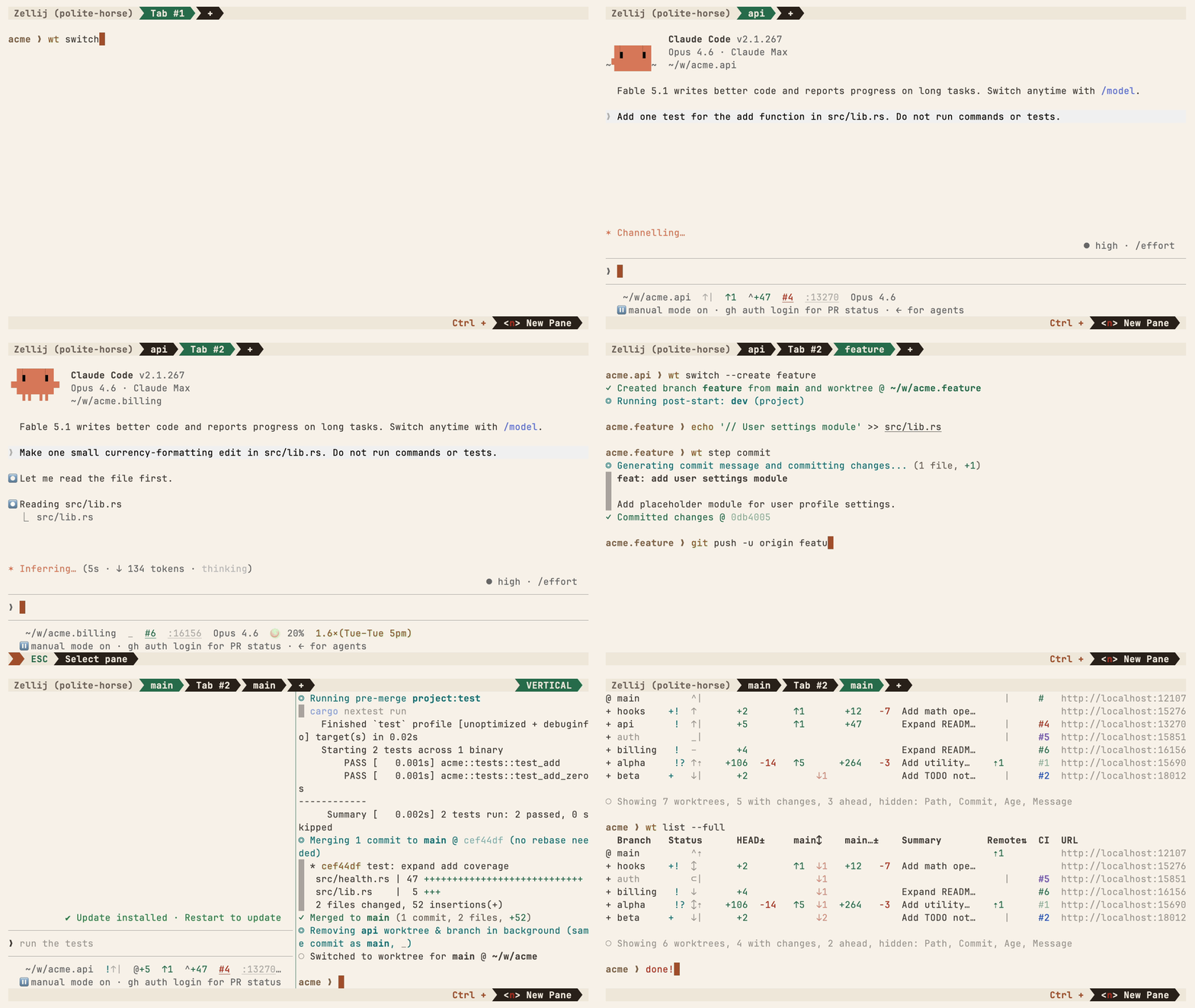
Multiple parallel agents, same simple commands:

Worktrunk omnibus demo: multiple Claude agents in Zellij tabs with hooks, LLM commits, and merge workflow
Multiple Claude agents in parallel with interactive picker, hooks, LLM commits, and merge

Install

Section titled “Install”

Homebrew (macOS & Linux):

brew install worktrunk && wt config shell install

Shell integration allows commands to change directories.

Cargo:

cargo install worktrunk && wt config shell install
Windows & other

Windows. wt defaults to Windows Terminal’s command, so Winget additionally installs Worktrunk as git-wt to avoid the conflict:

winget install max-sixty.worktrunk
git-wt config shell install

Alternatively, disable Windows Terminal’s alias (Settings → Apps → Advanced app settings → App execution aliases → “Terminal”/“Terminal Preview”) to use wt directly.

Free code signing provided by SignPath.io, certificate by SignPath Foundation — policy.

Arch Linux:

sudo pacman -S worktrunk && wt config shell install

Conda / Pixi (community-maintained feedstock):

conda install -c conda-forge worktrunk && wt config shell install

Or with Pixi: pixi global install worktrunk && wt config shell install.

PyPI (experimental):

uv tool install worktrunk@latest && wt config shell install

Python tools can also list worktrunk as a dependency, or run it without installing: uvx --from worktrunk wt list.

Quick start

Section titled “Quick start”

Create a worktree for a new feature:

wt switch --create feature-auth
✓ Created branch feature-auth from main and worktree @ ~/repo.feature-auth

This creates a new branch and worktree, then switches to it. Do your work, then check all worktrees with wt list:

wt list
Branch Status @± ^↕ ^…± Remote⇅ Commit Age Message
@ feature-auth + ↑ +27 -8 ↑1 +31 4bc72dc 2h Add authenticatio…
^ main ^⇡ ⇡1 0e631ad 1d Initial commit
○ Showing 2 worktrees, 1 with changes, 1 ahead, hidden: Path (+ staged files ↑ ahead of default)

The @ marks the current worktree. + means staged changes, ↑1 means 1 commit ahead of main, ⇡ means unpushed commits.

When done, either:

PR workflow — commit, push, open a PR, merge via GitHub/GitLab, then clean up:

wt step commit # commit staged changes
gh pr create # or glab mr create
wt remove # after PR is merged

Local merge — squash, rebase onto main, fast-forward merge, clean up:

wt merge main
◎ Generating commit message and committing changes... (2 files, +53, no squashing needed)
Add authentication module
✓ Committed changes @ a1b2c3d
◎ Merging 1 commit to main @ a1b2c3d (no rebase needed)
* a1b2c3d Add authentication module
auth.rs | 51 +++++++++++++++++++++++++++++++++++++++++++++++++++
lib.rs | 2 ++
2 files changed, 53 insertions(+)
✓ Merged to main (1 commit, 2 files, +53)
◎ Removing feature-auth worktree & branch in background (same commit as main, _)
○ Switched to worktree for main @ ~/repo

For parallel agents, create multiple worktrees and launch an agent in each:

wt switch -x claude -c feature-a -- 'Add user authentication'
wt switch -x claude -c feature-b -- 'Fix the pagination bug'
wt switch -x claude -c feature-c -- 'Write tests for the API'

The -x flag runs a command after switching; arguments after -- are passed to it. Configure post-start hooks to automate setup (install deps, start dev servers).

Next steps

Section titled “Next steps”
  • Learn the core commands: wt switch, wt list, wt merge, wt remove
  • Set up hooks for automated setup
  • Explore LLM commit messages, interactive picker, Claude Code integration, CI status & PR links
  • Browse tips & patterns for recipes: aliases, dev servers, databases, agent handoffs, and more
  • Extending Worktrunk — customize workflows with hooks & aliases
  • Watch @DevOpsToolbox’s video on Worktrunk
  • Run wt --help or wt <command> --help for quick CLI reference
You are visitor 01402775 — GeezerVison does not store the pages you look up.
Best viewed with Netscape Navigator 4.7 or Internet Explorer 6 at 800×600. No cookies required.