GV

GeezerVison

The World Wide Web, restored to 800 pixels of glory.

Home|About|Gaming cabinet|Archives|How it works|Starter sites

On this site

  • Python Tutorial
  • Data Types
  • Interview Questions
  • Examples
  • Quizzes
  • DSA Python
  • Data Science
  • NumPy
  • Pandas
  • Practice
  • Django
  • Flask
  • Introduction1 min read
  • Input & Output2 min read

This view

  • Original page
  • New address

GeezerVison is showing www.geeksforgeeks.org — Deque in Python - GeeksforGeeks

geeksforgeeks
search icon
  • Courses
  • Tutorials
  • Interview Prep
  • Python Tutorial
  • Data Types
  • Interview Questions
  • Examples
  • Quizzes
  • DSA Python
  • Data Science
  • NumPy
  • Pandas
  • Practice
  • Django
  • Flask

Deque in Python

Last Updated : 29 May, 2026

A deque stands for Double-Ended Queue. It is a type of data structure that allows to add and remove elements from both ends efficiently.
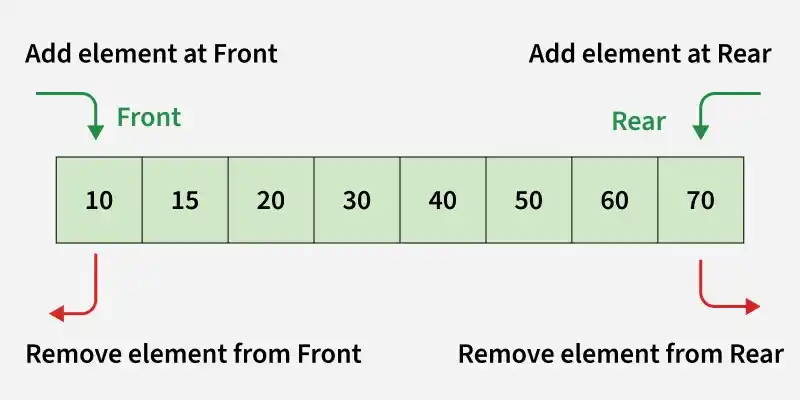
  • Allows fast insertion and deletion from both the front and rear ends.
  • Works as both a queue (FIFO) and a stack (LIFO).
  • Useful in scheduling, sliding window problems and real-time data processing.
1
Representation of Deque in Python
Python
from collections import deque 
d = deque(['name','age','DOB']) 
print(d)

Output
deque(['name', 'age', 'DOB'])

Accessing Items in deque

A deque also supports indexing, which means elements can be accessed using their position just like lists. Positive indexing starts from the left and negative indexing starts from the right.

Python
from collections import deque
dq = deque([1, 2, 3, 4])

print(dq[0])
print(dq[-1])

Output
1
4

Explanation:

  • dq[0] accesses the first element of the deque.
  • dq[-1] accesses the last element of the deque.

Operations on deque

1. append(): adds an element to the right end of the deque.

Python
from collections import deque
dq = deque([10, 20, 30])
dq.append(40)
print(dq)

Output
deque([10, 20, 30, 40])

2. appendleft(): adds an element to the left end of the deque.

Python
from collections import deque
dq = deque([10, 20, 30])
dq.appendleft(5)
print(dq)

Output
deque([5, 10, 20, 30])

3. extend(): adds multiple elements to the right end of the deque.

Python
from collections import deque
dq = deque([10, 20, 30])
dq.extend([40, 50, 60])
print(dq)

Output
deque([10, 20, 30, 40, 50, 60])

4. extendleft(): adds multiple elements to the left end of the deque.

Python
from collections import deque
dq = deque([10, 20, 30])
dq.extendleft([1, 2])
print(dq)

Output
deque([2, 1, 10, 20, 30])

5. remove(): removes the first occurrence of a specified value.

Python
from collections import deque
dq = deque([10, 20, 30, 20])
dq.remove(20)
print(dq)

Output
deque([10, 30, 20])

6. pop(): removes and returns the element from the right end.

Python
from collections import deque
dq = deque([10, 20, 30])
dq.pop()
print(dq)

Output
deque([10, 20])

7. popleft(): removes and returns the element from the left end.

Python
from collections import deque
dq = deque([10, 20, 30])
dq.popleft()
print(dq)

Output
deque([20, 30])

8. clear(): removes all elements from the deque.

Python
from collections import deque
dq = deque([10, 20, 30])
dq.clear()
print(dq)

Output
deque([])

9. len(): returns the total number of elements in the deque.

Python
from collections import deque
dq = deque([1, 2, 3, 4, 5])
print(len(dq))

Output
5

10. count(): returns how many times a specific element appears in the deque.

Python
from collections import deque
dq = deque([10, 20, 30, 20, 40, 20])
print(dq.count(20))

Output
3

11. rotate(): rotates the elements of the deque.

Python
from collections import deque
dq = deque([10, 20, 30, 40])
dq.rotate(1)
print(dq)

Output
deque([40, 10, 20, 30])

12. reverse(): reverses the order of elements in the deque.

Python
from collections import deque
dq = deque([10, 20, 30, 40])
dq.reverse()
print(dq)

Output
deque([40, 30, 20, 10])
Comment

Explore

    Python Fundamentals
    • Introduction1 min read
    • Input & Output2 min read
    • Variables4 min read
    • Operators4 min read
    • Keywords2 min read
    • Data Types4 min read
    • Conditional Statements3 min read
    • Loops3 min read
    • Functions4 min read
    Python Data Structures
    • String4 min read
    • List3 min read
    • Tuples3 min read
    • Dictionary3 min read
    • Set2 min read
    • Arrays5 min read
    Advanced Python
    • OOP Concepts3 min read
    • Exception Handling5 min read
    • File Handling4 min read
    • Python Database2 min read
    • MongoDB3 min read
    • MySQL7 min read
    • Packages4 min read
    • Modules3 min read
    • DSA Libraries5 min read
    • Python GUI2 min read
    Data Science with Python
    • Numpy3 min read
    • Pandas4 min read
    • Matplotlib3 min read
    • Seaborn3 min read
    • StatsModel2 min read
    • Model Building6 min read
    • TensorFlow2 min read
    • PyTorch5 min read
    Web Development with Python
    • Flask3 min read
    • Django5 min read
    • Django ORM4 min read
    • Jinja2 Templating5 min read
    • Django Templates5 min read
    • REST API3 min read
    • Build API with DRF4 min read
    Python Practice
    • Quiz1 min read
    • Practice Problems2 min read
    • Interview Q & A15+ min read
    Courses
    • Placement 360 Course2 min read
    • Data Science 360 Course2 min read
    • AI Engg Course2 min read
You are visitor 01402503 — GeezerVison does not store the pages you look up.
Best viewed with Netscape Navigator 4.7 or Internet Explorer 6 at 800×600. No cookies required.