GV

GeezerVison

The World Wide Web, restored to 800 pixels of glory.

Home|About|Gaming cabinet|Archives|How it works|Starter sites

On this site

  • Python Tutorial
  • Data Types
  • Interview Questions
  • Examples
  • Quizzes
  • DSA Python
  • Data Science
  • NumPy
  • Pandas
  • Practice
  • Django
  • Flask
  • Introduction1 min read
  • Input & Output2 min read

This view

  • Original page
  • New address

GeezerVison is showing www.geeksforgeeks.org — Python List append() Method - GeeksforGeeks

geeksforgeeks
search icon
  • Courses
  • Tutorials
  • Interview Prep
  • Python Tutorial
  • Data Types
  • Interview Questions
  • Examples
  • Quizzes
  • DSA Python
  • Data Science
  • NumPy
  • Pandas
  • Practice
  • Django
  • Flask

Python List append() Method

Last Updated : 27 May, 2026

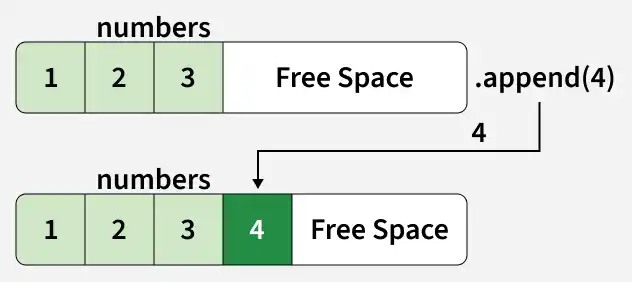
append() method is used to add a single element to the end of a list. It updates the original list directly and can add elements of any data type such as numbers, strings, lists or objects.
aws_cloud
append() method in python

Example: In this example, append() adds a new value to the end of the list.

Python
a = [2, 5, 6, 7]
a.append(8)
print(a)

Output
[2, 5, 6, 7, 8]

Explanation: append(8) adds 8 to the end of the list a.

Syntax

list.append(element)

  • Parameter: element - Item to be added at the end of the list.
  • Return: It does not return any value, it modifies the original list directly.

Examples

Example 1: In this example, we append elements of different data types to a list. Python lists can store multiple types of values together.

Python
a = [1, "Python"]
a.append(3.14)
a.append(True)
print(a)

Output
[1, 'Python', 3.14, True]

Explanation: append() adds 3.14 and True to the end of the list.

Example 2: Here, a list is appended to another list. The appended list becomes a single nested element inside the main list.

Python
a = [1, 2, 3]
a.append([4, 5])
print(a)

Output
[1, 2, 3, [4, 5]]

Explanation: append([4, 5]) adds the entire list as one element, creating a nested list.

Example 3: Here, append() is used inside a loop to add multiple values one by one into a list.

Python
a = []
for i in range(5):
    a.append(i)
print(a)

Output
[0, 1, 2, 3, 4]

Explanation: append(i) adds each value of i to the list during every loop iteration.

Comment

Explore

    Python Fundamentals
    • Introduction1 min read
    • Input & Output2 min read
    • Variables4 min read
    • Operators4 min read
    • Keywords2 min read
    • Data Types4 min read
    • Conditional Statements3 min read
    • Loops3 min read
    • Functions4 min read
    Python Data Structures
    • String4 min read
    • List3 min read
    • Tuples3 min read
    • Dictionary3 min read
    • Set2 min read
    • Arrays5 min read
    Advanced Python
    • OOP Concepts3 min read
    • Exception Handling5 min read
    • File Handling4 min read
    • Python Database2 min read
    • MongoDB3 min read
    • MySQL7 min read
    • Packages4 min read
    • Modules3 min read
    • DSA Libraries5 min read
    • Python GUI2 min read
    Data Science with Python
    • Numpy3 min read
    • Pandas4 min read
    • Matplotlib3 min read
    • Seaborn3 min read
    • StatsModel2 min read
    • Model Building6 min read
    • TensorFlow2 min read
    • PyTorch5 min read
    Web Development with Python
    • Flask3 min read
    • Django5 min read
    • Django ORM4 min read
    • Jinja2 Templating5 min read
    • Django Templates5 min read
    • REST API3 min read
    • Build API with DRF4 min read
    Python Practice
    • Quiz1 min read
    • Practice Problems2 min read
    • Interview Q & A15+ min read
    Courses
    • Placement 360 Course2 min read
    • Data Science 360 Course2 min read
    • AI Engg Course2 min read
You are visitor 01402503 — GeezerVison does not store the pages you look up.
Best viewed with Netscape Navigator 4.7 or Internet Explorer 6 at 800×600. No cookies required.