GeezerVisonThe World Wide Web, restored to 800 pixels of glory. | ||||||||||||||||||||||||
| Home|About|Gaming cabinet|Archives|How it works|Starter sites | ||||||||||||||||||||||||
GeezerVison is showing www.tutorialspoint.com — Python - Algorithm Types 
Python Data Structures Useful Resources Selected Reading
Python - Algorithm TypesThe efficiency and accuracy of algorithms have to be analysed to compare them and choose a specific algorithm for certain scenarios. The process of making this analysis is called Asymptotic analysis. It refers to computing the running time of any operation in mathematical units of computation. For example, the running time of one operation is computed as f(n) and may be for another operation it is computed as g(n2). This means the first operation running time will increase linearly with the increase in n and the running time of the second operation will increase exponentially when n increases. Similarly, the running time of both operations will be nearly the same if n is significantly small. Usually, the time required by an algorithm falls under three types −
Asymptotic NotationsThe commonly used asymptotic notations to calculate the running time complexity of an algorithm.
Big Oh Notation, ΟThe notation Ο(n) is the formal way to express the upper bound of an algorithm's running time. It measures the worst case time complexity or the longest amount of time an algorithm can possibly take to complete. 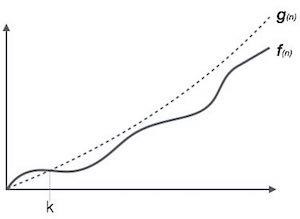
For example, for a function f(n) Ο(f(n)) = { g(n) : there exists c > 0 and n0 such that f(n) ≤ c.g(n) for all n > n0. }
Omega Notation, ΩThe notation Ω(n) is the formal way to express the lower bound of an algorithm's running time. It measures the best case time complexity or the best amount of time an algorithm can possibly take to complete. 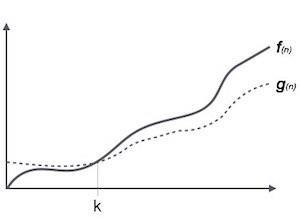
For example, for a function f(n) Ω(f(n)) ≥ { g(n) : there exists c > 0 and n0 such that g(n) ≤ c.f(n) for all n > n0. }
Theta Notation, θThe notation θ(n) is the formal way to express both the lower bound and the upper bound of an algorithm's running time. It is represented as follows − 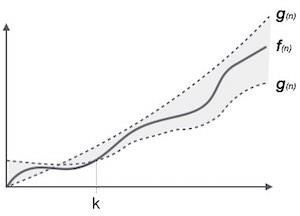
θ(f(n)) = { g(n) if and only if g(n) = Ο(f(n)) and g(n) = Ω(f(n)) for all n > n0. }
Common Asymptotic NotationsA list of some common asymptotic notations is mentioned below −

Advertisements
| ||||||||||||||||||||||||
| You are visitor 01402503 — GeezerVison does not store the pages you look up. Best viewed with Netscape Navigator 4.7 or Internet Explorer 6 at 800×600. No cookies required. |