GeezerVisonThe World Wide Web, restored to 800 pixels of glory. |
| Home|About|Gaming cabinet|Archives|How it works|Starter sites |
GeezerVison is showing codescracker.com — C++ Program to Count Positive, Zero, and Negative Numbers
C++ Program to Count Positive, Zero, and Negative NumbersIn this article, you will learn and get code on counting positive, zero, and negative numbers in C++. The program is created in the following ways:
Count positive, negative, and zero in C++The program given below counts the occurrence (frequency) of positive, zero, and negative numbers from the given set of numbers entered by the user (at run-time) in C++ programming. The question is: write a program in C++ that counts and prints the frequencies of positive, zero, and negative numbers. The answer to this question is given below: #include<iostream> using namespace std; int main() { intpos=0, neg=0, zer=0, i, arr[10]; cout<<"Enter 10 Numbers: "; for(i=0; i<10; i++) cin>>arr[i]; for(i=0; i<10; i++) { if(arr[i]>0) pos++; else if(arr[i]==0) zer++; else neg++; } cout<<"\nFrequency of Positive Numbers: "<<pos; cout<<"\nFrequency of Zero: "<<zer; cout<<"\nFrequency of Negative Numbers: "<<neg; cout<<endl; return 0; } This program was built and runs under Code::Blocks. Here is its sample run: 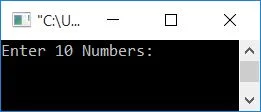
Now supply any 10 numbers, say 1, 0, -3, 4, 5, 0, -8, 9, 6, 0, and press the ENTER key to see the occurrence or frequency of positive, zero, and negative numbers as shown in the output given below: 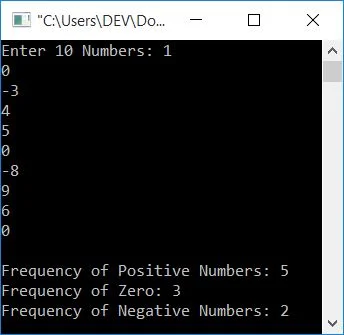
In the above program, when the user enters 10 numbers (for example: 1, 0, -3, 4, 5, 0, -8, 9, 6, 0), then all the 10 numbers get initialized to arr[] in the following way:
Now the dry run of the above program with these 10 values goes like this:
Allow the user to define the size of the arrayThis program allows the user to define the size of the array. That is, how many numbers he/she wants to enter, and then find and print the occurrence of positive, zero, and negative numbers. #include<iostream> using namespace std; int main() { intpos=0, neg=0, zer=0, i, arr[100], tot; cout<<"Enter the Size (max. 100): "; cin>>tot; cout<<"Enter "<<tot<<" Numbers: "; for(i=0; i<tot; i++) { cin>>arr[i]; if(arr[i]>0) pos++; else if(arr[i]==0) zer++; else neg++; } cout<<"\nFrequency of Positive Numbers: "<<pos; cout<<"\nFrequency of Zero: "<<zer; cout<<"\nFrequency of Negative Numbers: "<<neg; cout<<endl; return 0; } Below is its sample run with user input, 5 as size, and 1, -2, 3, 0, 4 as 5 numbers: 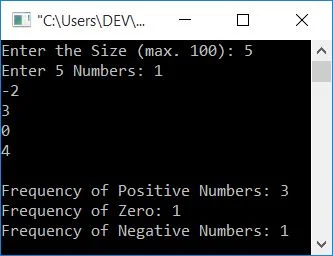
Note: At the time of receiving numbers, the above program counts positive, zero, and negative numbers. That is, the preceding program handles both receiving and counting with a single for loop. Count positive, negative, and zero in C++ using the while loopThis program uses a while loop to receive the input (a list of numbers) and counts the occurrence of positive, zero, and negative numbers. #include<iostream> using namespace std; int main() { intpos=0, neg=0, zer=0, i=0, arr[100], tot; cout<<"Enter the Size (max. 100): "; cin>>tot; cout<<"Enter "<<tot<<" Numbers: "; while(i<tot) { cin>>arr[i]; if(arr[i]>0) pos++; else if(arr[i]==0) zer++; else neg++; i++; } cout<<"\nFrequency of Positive Numbers: "<<pos; cout<<"\nFrequency of Zero: "<<zer; cout<<"\nFrequency of Negative Numbers: "<<neg; cout<<endl; return 0; } This program produces the same output as the previous program. The same program in different languages« Previous Program Next Program » Practice Quizzes
Test your programming and computer science knowledge with interactive MCQs and topic-based quizzes. Popular Topics
Explore the most popular programming and computer science tutorials on CodesCracker. |
| You are visitor 01402503 — GeezerVison does not store the pages you look up. Best viewed with Netscape Navigator 4.7 or Internet Explorer 6 at 800×600. No cookies required. |