GV

GeezerVison

The World Wide Web, restored to 800 pixels of glory.

Home|About|Gaming cabinet|Archives|How it works|Starter sites

On this site

  • Documentation
  • Privacy Statement
  • License Agreement
  • Contact Us

This view

  • Original page
  • New address

GeezerVison is showing university.voltdb.com — Chapter 4. Designing the Database Schema

  • Volt Active Data
  • Developer Hub
  • Books
    • VoltDB Tutorial
    • Using VoltDB
    • VoltDB Guide to Performance and Customization
    • VoltDB Administrator's Guide
    • Volt Kubernetes Administrator's Guide
    • VoltDB Quick Reference
  • VoltDB V16
    • VoltDB V16
    • VoltDB V15.3 LTS
    • VoltDB V14.3 LTS
    • VoltDB V13.3 LTS
    • VoltDB V12.3 LTS
    • VoltDB V11.4
    • VoltDB V10.2
    • VoltDB V9.3
Chapter 4. Designing the Database Schema

Using VoltDB

  • About This Book
  • 1. Overview▶
    • 1.1. What is VoltDB?
    • 1.2. Who Should Use VoltDB
    • 1.3. How VoltDB Works
      • 1.3.1. Partitioning
      • 1.3.2. Serialized (Single-Threaded) Processing
      • 1.3.3. Partitioned vs. Replicated Tables
      • 1.3.4. Ease of Scaling to Meet Application Needs
    • 1.4. Working with VoltDB Effectively
  • 2. Installing VoltDB▶
    • 2.1. Operating System and Software Requirements
    • 2.2. Installing VoltDB
      • 2.2.1. Upgrading From Older Versions
    • 2.3. Setting Up Your Environment
    • 2.4. What is Included in the VoltDB Distribution
  • 3. Starting the Database▶
    • 3.1. Initializing and Starting a VoltDB Database
    • 3.2. Initializing and Starting a VoltDB Database on a Cluster
    • 3.3. Stopping a VoltDB Database
    • 3.4. Saving the Data
    • 3.5. Restarting a VoltDB Database
    • 3.6. Updating Nodes on the Cluster
    • 3.7. Defining the Cluster Configuration
      • 3.7.1. Determining How Many Sites per Host
      • 3.7.2. Configuring Paths for Runtime Features
      • 3.7.3. Verifying your Hardware Configuration
  • 4. Designing the Database Schema▶
    • 4.1. How to Enter DDL Statements
    • 4.2. Creating Tables and Primary Keys
    • 4.3. Analyzing Data Volume and Workload
    • 4.4. Partitioning Database Tables
      • 4.4.1. Choosing a Column on which to Partition Table Rows
      • 4.4.2. Specifying Partitioned Tables
      • 4.4.3. Design Rules for Partitioning Tables
    • 4.5. Replicating Database Tables
      • 4.5.1. Choosing Replicated Tables
      • 4.5.2. Specifying Replicated Tables
    • 4.6. Modifying the Schema
      • 4.6.1. Effects of Schema Changes on Data and Clients
      • 4.6.2. Viewing the Schema
      • 4.6.3. Modifying Tables
      • 4.6.4. Adding and Dropping Indexes
      • 4.6.5. Modifying Partitioning for Tables and Stored Procedures
  • 5. Designing Stored Procedures to Access the Database▶
    • 5.1. How Stored Procedures Work
      • 5.1.1. VoltDB Stored Procedures are Transactional
      • 5.1.2. VoltDB Stored Procedures are Deterministic
    • 5.2. The Anatomy of a VoltDB Stored Procedure
      • 5.2.1. The Structure of the Stored Procedure
      • 5.2.2. Passing Arguments to a Stored Procedure
      • 5.2.3. Creating and Executing SQL Queries in Stored Procedures
      • 5.2.4. Interpreting the Results of SQL Queries
      • 5.2.5. Returning Results from a Stored Procedure
      • 5.2.6. Rolling Back a Transaction
    • 5.3. Installing Stored Procedures into the Database
      • 5.3.1. Compiling, Packaging, and Loading Stored Procedures
      • 5.3.2. Declaring Stored Procedures in the Schema
      • 5.3.3. Partitioning Stored Procedures in the Schema
  • 6. Designing VoltDB Client Applications▶
    • 6.1. Connecting to the VoltDB Database
      • 6.1.1. How Connections To The Cluster Work
      • 6.1.2. Specifying Multiple Servers
    • 6.2. Invoking Stored Procedures
    • 6.3. Invoking Stored Procedures Asynchronously
    • 6.4. Defining Options on a Per-Call Basis
    • 6.5. Closing the Connection
    • 6.6. Handling Errors
      • 6.6.1. Interpreting Execution Errors
      • 6.6.2. Handling Timeouts
      • 6.6.3. Writing Handlers to Interpret Other Errors
    • 6.7. Compiling and Running Client Applications
      • 6.7.1. Starting the Client Application
      • 6.7.2. Running Clients from Outside the Cluster
  • 7. Simplifying Application Development▶
    • 7.1. Using Default Procedures
    • 7.2. Shortcut for Defining Simple Stored Procedures
    • 7.3. Verifying Expected Query Results
    • 7.4. Scheduling Stored Procedures as Tasks
    • 7.5. Directed Procedures: Distributing Transactions to Every Partition
  • 8. Using VoltDB with Other Programming Languages▶
    • 8.1. C++ Client Interface
      • 8.1.1. Writing VoltDB Client Applications in C++
      • 8.1.2. Creating a Connection to the Database Cluster
      • 8.1.3. Invoking Stored Procedures
      • 8.1.4. Invoking Stored Procedures Asynchronously
      • 8.1.5. Interpreting the Results
    • 8.2. JSON HTTP Interface
      • 8.2.1. How the JSON Interface Works
      • 8.2.2. Using the JSON Interface from Client Applications
      • 8.2.3. How Parameters Are Interpreted
      • 8.2.4. Interpreting the JSON Results
      • 8.2.5. Error Handling using the JSON Interface
      • 8.2.6. Managing Client Sessions
    • 8.3. JDBC Interface
      • 8.3.1. Using JDBC to Connect to a VoltDB Database
      • 8.3.2. Using JDBC to Query a VoltDB Database
    • 8.4. Python Client Interface
      • 8.4.1. Creating a Connection to the Database Cluster
      • 8.4.2. Invoking Stored Procedures
      • 8.4.3. Invoking Stored Procedures Asynchronously
      • 8.4.4. Interpreting the Results
      • 8.4.5. Closing the Connections to the Database Cluster
  • 9. Integrating Volt Active Data with AI Agents and Chatbots▶
    • 9.1. Volt Agent Skills
      • 9.1.1. Installing Volt Skills
      • 9.1.2. Using Volt Skills Effectively
    • 9.2. The VoltDB MCP Server
      • 9.2.1. Installing the VoltDB MCP Server
      • 9.2.2. Configuring the MCP Server
      • 9.2.3. How to Use the VoltDB MCP Server
  • 10. Using VoltDB in a Cluster▶
    • 10.1. Starting a Database Cluster
    • 10.2. Defining the Cluster Configuration
    • 10.3. Elastic Scaling to Resize the Cluster
      • 10.3.1. Adding Nodes with Elastic Scaling
      • 10.3.2. Removing Nodes with Elastic Scaling
      • 10.3.3. Configuring How VoltDB Rebalances Nodes During Elastic Scaling
  • 11. Availability▶
    • 11.1. How K-Safety Works
    • 11.2. Enabling K-Safety
      • 11.2.1. What Happens When You Enable K-Safety
      • 11.2.2. Calculating the Appropriate Number of Nodes for K-Safety
    • 11.3. Recovering from System Failures
      • 11.3.1. What Happens When a Node Rejoins the Cluster
      • 11.3.2. Where and When Recovery May Fail
    • 11.4. Avoiding Network Partitions
      • 11.4.1. K-Safety and Network Partitions
      • 11.4.2. Network Fault Protection
  • 12. Active(N) Database Replication▶
    • 12.1. How Database Replication Works
      • 12.1.1. Starting Database Replication
      • 12.1.2. Database Replication, Availability, and Disaster Recovery
      • 12.1.3. Database Replication and Completeness
    • 12.2. Using Active(N) Cross Datacenter Replication
      • 12.2.1. Designing Your Schema for Active Replication
      • 12.2.2. Configuring the Database Clusters
      • 12.2.3. Starting the Database Clusters
      • 12.2.4. Loading a Matching Schema and Starting Replication
      • 12.2.5. Stopping Replication
      • 12.2.6. Example XDCR Configurations
      • 12.2.7. Understanding Conflict Resolution
    • 12.3. Updating the Schema During Replication
      • 12.3.1. Safely Updating the Schema While the Clusters are Paused
      • 12.3.2. Adding and Removing Tables Without Pausing
      • 12.3.3. Using Dynamic Schema Change to Add, Remove, and Modify Table Columns Without Pausing
    • 12.4. Monitoring Database Replication
    • 12.5. Tuning Active(N) to Meet Your Application Needs
      • 12.5.1. The XDCR Workflow
      • 12.5.2. Detecting and Correcting Bottlenecks in the XDCR Workflow
  • 13. Security▶
    • 13.1. How Security Works in VoltDB
    • 13.2. Enabling Authentication and Authorization
    • 13.3. Defining Users and Roles
    • 13.4. Assigning Access to Stored Procedures
    • 13.5. Assigning Access by Function (System Procedures, SQL Queries, and Default Procedures)
    • 13.6. Using Built-in Roles
    • 13.7. Encrypting VoltDB Communication Using TLS/SSL
      • 13.7.1. Creating the TLS/SSL Certificates
      • 13.7.2. Using Certificate Revocation Lists (CRLs)
      • 13.7.3. Configuring TLS/SSL on the VoltDB Server
      • 13.7.4. Configuring Mutual TLS/SSL on the Server and Clients
      • 13.7.5. Using the VoltDB Command Line Utilities with TLS/SSL
      • 13.7.6. Implementing TLS/SSL in the Java Client Applications
      • 13.7.7. Configuring Database Replication (XDCR) With TLS/SSL
      • 13.7.8. Updating TLS/SSL Certificates and Certificate Revocation Lists (CRLs)
    • 13.8. Integrating LDAP Security with VoltDB
      • 13.8.1. Configuring LDAP Security in VoltDB
      • 13.8.2. Configuring VoltDB Security in LDAP
    • 13.9. Integrating Kerberos Security with VoltDB
      • 13.9.1. Installing and Configuring Kerberos
      • 13.9.2. Configuring Java Security
      • 13.9.3. Configuring the VoltDB Servers and Clients
      • 13.9.4. Accessing the Database from the Command Line and the Web
  • 14. Saving & Restoring a VoltDB Database▶
    • 14.1. Performing a Manual Save and Restore of a VoltDB Cluster
      • 14.1.1. How to Save the Contents of a VoltDB Database
      • 14.1.2. How to Restore the Contents of a VoltDB Database Manually
      • 14.1.3. Changing the Cluster Configuration Using Save and Restore
    • 14.2. Scheduling Automated Snapshots
    • 14.3. Tuning the Snapshot Process
    • 14.4. Managing Snapshot Files
    • 14.5. Special Notes Concerning Save and Restore
  • 15. Command Logging and Recovery▶
    • 15.1. How Command Logging Works
    • 15.2. Controlling Command Logging
    • 15.3. Configuring Command Logging for Optimal Performance
      • 15.3.1. Log Size
      • 15.3.2. Log Frequency
      • 15.3.3. Synchronous vs. Asynchronous Logging
      • 15.3.4. Hardware Considerations
  • 16. Streaming Data: Import, Export, and Migration▶
    • 16.1. How Data Streaming Works in VoltDB
      • 16.1.1. Understanding Import
      • 16.1.2. Understanding Export
      • 16.1.3. Understanding Migration
    • 16.2. The Business Case for Streaming Data
      • 16.2.1. Extract, Transform, Load (ETL)
      • 16.2.2. Change Data Capture
      • 16.2.3. Streaming Data Validation
      • 16.2.4. Caching
      • 16.2.5. Archiving
    • 16.3. VoltDB Export Connectors
      • 16.3.1. How Export Works
      • 16.3.2. The File Export Connector
      • 16.3.3. The HTTP Export Connector
      • 16.3.4. The JDBC Export Connector
      • 16.3.5. The Kafka Export Connector
      • 16.3.6. The Elasticsearch Export Connector
    • 16.4. VoltDB Import Connectors
      • 16.4.1. Bulk Loading Data Using VoltDB Standalone Utilities
      • 16.4.2. Streaming Import Using Built-in Import Features
      • 16.4.3. The Kafka Importer
    • 16.5. VoltDB Import Formatters
  • A. Supported SQL DDL Statements▶
    • ALTER STREAM
    • ALTER TABLE
    • ALTER TASK
    • ALTER VIEW
    • CREATE INDEX
    • CREATE PROCEDURE AS
    • CREATE PROCEDURE FROM CLASS
    • CREATE ROLE
    • CREATE STREAM
    • CREATE TABLE
    • CREATE TASK
    • CREATE VIEW
    • DR TABLE
    • DROP INDEX
    • DROP PROCEDURE
    • DROP ROLE
    • DROP STREAM
    • DROP TABLE
    • DROP TASK
    • DROP VIEW
    • PARTITION TABLE
  • B. Supported SQL Statements▶
    • DELETE
    • INSERT
    • MIGRATE
    • SELECT
    • TRUNCATE TABLE
    • UPDATE
    • UPSERT
  • C. SQL Functions▶
    • ABS()
    • APPROX_COUNT_DISTINCT()
    • AREA()
    • ARRAY_ELEMENT()
    • ARRAY_LENGTH()
    • ASTEXT()
    • AVG()
    • BIN()
    • BIT_SHIFT_LEFT()
    • BIT_SHIFT_RIGHT()
    • BITAND()
    • BITNOT()
    • BITOR()
    • BITXOR()
    • CAST()
    • CEILING()
    • CENTROID()
    • CHAR()
    • CHAR_LENGTH()
    • COALESCE()
    • CONCAT()
    • CONTAINS()
    • COS()
    • COT()
    • COUNT()
    • CSC()
    • CURRENT_DATE()
    • CURRENT_TIMESTAMP()
    • DATEADD()
    • DATEDIFF()
    • DAY(), DAYOFMONTH()
    • DAYOFWEEK()
    • DAYOFYEAR()
    • DECODE()
    • DEGREES()
    • DISTANCE()
    • DWITHIN()
    • EXP()
    • EXTRACT()
    • FIELD()
    • FLOOR()
    • FORMAT()
    • FORMAT_CURRENCY()
    • FORMAT_TIMESTAMP()
    • FROM_UNIXTIME()
    • HEX()
    • HOUR()
    • INET6_ATON()
    • INET6_NTOA()
    • INET_ATON()
    • INET_NTOA()
    • ISINVALIDREASON()
    • ISVALID()
    • IS_VALID_TIMESTAMP()
    • LATITUDE()
    • LEFT()
    • LN(), LOG()
    • LOG10()
    • LONGITUDE()
    • LOWER()
    • MAKEVALIDPOLYGON()
    • MASK_CCN()
    • MASK_EMAIL()
    • MASK_INNER()
    • MASK_OUTER()
    • MASK_PAN()
    • MASK_PAN_RELAXED()
    • MASK_PARTIAL()
    • MASK_TEXT()
    • MAX()
    • MAX_VALID_TIMESTAMP()
    • MIGRATING()
    • MIN()
    • MIN_VALID_TIMESTAMP()
    • MINUTE()
    • MOD()
    • MONTH()
    • NOW()
    • NUMINTERIORRINGS()
    • NUMPOINTS()
    • OCTET_LENGTH()
    • OVERLAY()
    • PI()
    • POINTFROMTEXT()
    • POLYGONFROMTEXT()
    • POSITION()
    • POWER()
    • QUARTER()
    • RADIANS()
    • REGEXP_POSITION()
    • REPEAT()
    • REPLACE()
    • RIGHT()
    • ROUND()
    • SEC()
    • SECOND()
    • SET_FIELD()
    • SIGN()
    • SIN()
    • SINCE_EPOCH()
    • SPACE()
    • SQRT()
    • STR()
    • SUBSTRING()
    • SUM()
    • TAN()
    • TIME_WINDOW()
    • TO_TIMESTAMP()
    • TRIM()
    • TRUNCATE()
    • UPPER()
    • VALIDPOLYGONFROMTEXT()
    • WEEK(), WEEKOFYEAR()
    • WEEKDAY()
    • YEAR()
  • D. VoltDB CLI Commands▶
    • csvloader
    • jdbcloader
    • kafkaloader
    • sqlcmd
    • voltadmin
    • voltdb
  • E. YAML Configuration Properties▶
    • E.1. Understanding YAML Syntax
      • E.1.1. YAML Files
      • E.1.2. Dot Notation
    • E.2. YAML Properties for Configuring Volt Databases on Bare Metal
  • F. VoltDB Datatype Compatibility▶
    • F.1. Java and VoltDB Datatype Compatibility
  • G. System Procedures▶
    • @AdHoc
    • @AdjustLogging
    • @Explain
    • @ExplainProc
    • @ExplainView
    • @GetPartitionKeys
    • @GetYamlConfiguration
    • @Metrics
    • @Note
    • @Pause
    • @Ping
    • @Quiesce
    • @Resume
    • @SetYamlConfiguration
    • @Shutdown
    • @SnapshotDelete
    • @SnapshotRestore
    • @SnapshotSave
    • @SnapshotScan
    • @Statistics
    • @StopNode
    • @SwapTables
    • @SystemCatalog
    • @SystemInformation
    • @UpdateClasses
    • @UpdateLogging

Chapter 4. Designing the Database Schema

VoltDB is a relational database product. Relational databases consist of tables and columns, with constraints, indexes, and views. VoltDB uses standard SQL database definition language (DDL) statements to specify the database schema. So designing the schema for a VoltDB database uses the same skills and knowledge as designing a database for Oracle, MySQL, or any other relational database product.

This guide describes the stages of application design by dividing the work into three chapters:

  • Design the schema in DDL to define the database structure. Schema design is covered in this chapter.

  • Design stored procedures to access data in the database. Stored procedures provide client applications an application programming interface (API) to the database. Stored procedures are covered in Chapter 5, Designing Stored Procedures to Access the Database.

  • Design clients to provide business logic and also connect to the database to access data. Client application design is covered in Chapter 6, Designing VoltDB Client Applications.

The database schema is a specification that describes the structure of the VoltDB database such as tables and indexes, identifies the stored procedures that access data in the database, and defines the way tables and stored procedures are partitioned for fast data access. When designing client applications to use the database, the schema specifies the details needed about data types, tables, columns, and so on.

Figure 4.1. Components of a Database Schema
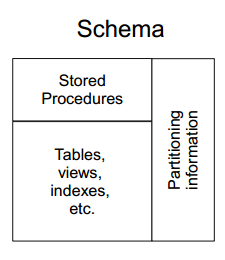
Components of a Database Schema

Along with designing your database tables, an important aspect of VoltDB database design is partitioning, which provides much more efficient access to data and processing. Partitioning distributes the rows of a table and the processing to access the table across several, independent partitions instead of one. Your design requires coordinating the partitioning of both database tables and the stored procedures that access the tables. At design time you choose a column on which to partition a table's rows. You also partition stored procedures on the same column if they use the column to identify which rows to operate on in the table.

At runtime, VoltDB decides which cluster nodes and partitions to use for the table partitions and consistently allocates rows to the appropriate partition. Figure 4.2, “Partitions Distribute Table Data and Stored Procedure Processing” shows how when data is inserted into a partitioned table, VoltDB automatically allocates the data to the correct partition. Also, when a partitioned stored procedure is invoked, VoltDB automatically executes the stored procedure in the single partition that has the data requested.

Figure 4.2. Partitions Distribute Table Data and Stored Procedure Processing
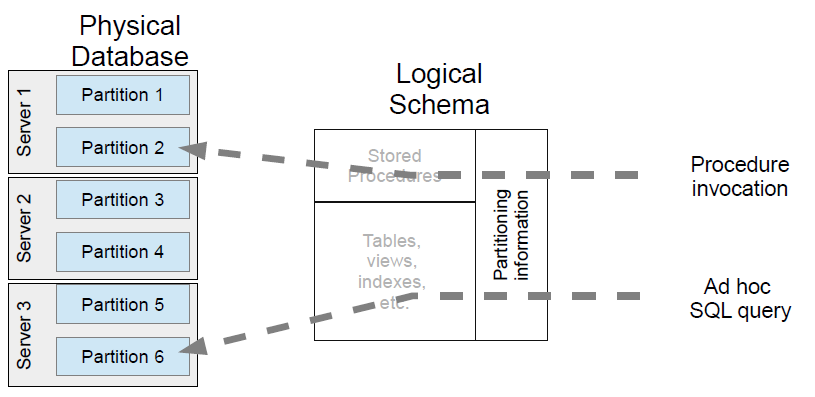
Partitions Distribute Table Data and Stored Procedure Processing

The following sections of this chapter provide guidelines for designing VoltDB database schemas. Although gathering business requirements is a typical first step in database application design, it is outside the scope of this guide.

4.1. How to Enter DDL Statements

You use standard SQL DDL statements to design your schema. For a full list of valid VoltDB DDL, see Appendix A, Supported SQL DDL Statements. The easiest way to enter your DDL statements is using VoltDB's command line utility, sqlcmd. Using sqlcmd you can input DDL statements in several ways:

  • Redirect standard input from a file when you start sqlcmd:

    $ sqlcmd < myschema.sql
  • Import from a file using the sqlcmd file directive:

    $ sqlcmd
    1> file myschema.sql;
  • Enter DDL directly at the sqlcmd prompt:

    $ sqlcmd
    1> 
    2> CREATE TABLE Customer (
    3>   CustomerID INTEGER UNIQUE NOT NULL,
    4>   FirstName VARCHAR(15),
    5>   LastName VARCHAR (15),
    6>   PRIMARY KEY(CustomerID)
    7> );
  • Copy DDL from another application and paste it into the sqlcmd prompt:

    $ sqlcmd
    1> CREATE TABLE Flight (
    2>   FlightID INTEGER UNIQUE NOT NULL,
    3>   DepartTime TIMESTAMP NOT NULL,
    4>   Origin VARCHAR(3) NOT NULL,
    5>   Destination VARCHAR(3) NOT NULL,
    6>   NumberOfSeats INTEGER NOT NULL,
    7>   PRIMARY KEY(FlightID)
    8> );

The following sections show how to design and create schema objects. DDL statements and techniques for changing a schema are described later in Section 4.6, “Modifying the Schema”.

You are visitor 01402775 — GeezerVison does not store the pages you look up.
Best viewed with Netscape Navigator 4.7 or Internet Explorer 6 at 800×600. No cookies required.