GV

GeezerVison

The World Wide Web, restored to 800 pixels of glory.

Home|About|Gaming cabinet|Archives|How it works|Starter sites

On this site

  • Tutorials
  • My W3Schools
  • W3Schools app iOS & Android NEW
  • Spaces
  • Get Certified
  • Plus
  • Practice
  • Campus (previously Academy)
  • Logout
  • 
  • 
  • 
  • 
  • Sign in

This view

  • Original page
  • New address

GeezerVison is showing www.w3schools.com — Matplotlib Histograms

Menu
Search field
×
See More  
NEW W3Schools app iOS & Android Start the adventure
Sign In
★ +1 Spaces Upgrade Paid Courses Spaces Upgrade Paid Courses
   ❮     
     ❯   
HTML CSS JAVASCRIPT SQL PYTHON JAVA PHP C C++ C# AWS W3.CSS HOW TO BOOTSTRAP REACT MYSQL JQUERY EXCEL XML DJANGO NUMPY PANDAS NODEJS DSA TYPESCRIPT ANGULAR ANGULARJS GIT POSTGRESQL MONGODB ASP AI R GO KOTLIN SWIFT SASS VUE GEN AI SCIPY CYBERSECURITY DATA SCIENCE INTRO TO PROGRAMMING INTRO TO HTML & CSS BASH RUST TOOLS

Python Tutorial

Python HOME Python Intro Python Get Started Python Syntax
Syntax Statements Code Challenge
Python Output
Print Text Print Numbers Code Challenge
Python Comments
Comments Code Challenge
Python Variables
Python Variables Variable Names Assign Multiple Values Output Variables Global Variables Variable Exercises Code Challenge
Python Data Types
Data Types Code Challenge
Python Numbers
Numbers Code Challenge
Python Casting
Casting Code Challenge
Python Strings
Python Strings Slicing Strings Modify Strings Concatenate Strings Format Strings Escape Characters String Methods String Exercises Code Challenge
Python Booleans
Booleans Code Challenge
Python Operators
Python Operators Arithmetic Operators Assignment Operators Ternary Operator Comparison Operators Logical Operators Identity Operators Membership Operators Bitwise Operators Operator Precedence Code Challenge
Python Lists
Python Lists Access List Items Change List Items Add List Items Remove List Items Loop Lists List Comprehension Sort Lists Copy Lists Join Lists List Methods List Exercises Code Challenge
Python Tuples
Python Tuples Access Tuples Update Tuples Unpack Tuples Loop Tuples Join Tuples Tuple Methods Tuple Exercises Code Challenge
Python Sets
Python Sets Access Set Items Add Set Items Remove Set Items Loop Sets Join Sets Frozenset Set Methods Set Exercises Code Challenge
Python Dictionaries
Python Dictionaries Access Items Change Items Add Items Remove Items Loop Dictionaries Copy Dictionaries Nested Dictionaries Dictionary Methods Dictionary Exercises Code Challenge
Python If...Else
Python If Python Elif Python Else Shorthand If Logical Operators Nested If Pass Statement Code Challenge
Python Match
Match Code Challenge
Python While Loops
While Loops Code Challenge
Python For Loops
For Loops Code Challenge
Python Functions
Python Functions Python Arguments Python *args / **kwargs Python Scope Python Decorators Python Lambda Python Recursion Python Generators Code Challenge
Python Range
Range Code Challenge
Python Arrays
Arrays Code Challenge
Python Iterators
Iterators Code Challenge
Python Modules
Modules Code Challenge
Python Dates
Dates Code Challenge
Python Math
Math Code Challenge
Python JSON
JSON Code Challenge
Python RegEx
RegEx Code Challenge
Python PIP Python Try...Except
Try...Except Code Challenge
Python String Formatting
String Formatting Code Challenge
Python None
None Code Challenge
Python User Input Python VirtualEnv

Python Classes

Python OOP Python Classes/Objects
Classes/Objects Code Challenge
Python __init__ Method
__init__ Method Code Challenge
Python self Parameter
self Parameter Code Challenge
Python Class Properties
Class Properties Code Challenge
Python Class Methods
Class Methods Code Challenge
Python Magic Methods
Magic Methods __str__ __repr__ __eq__ __add__ __len__ __lt__ __contains__ __call__ Code Challenge
Python Inheritance
Inheritance Code Challenge
Python Polymorphism
Polymorphism Code Challenge
Python Encapsulation
Encapsulation Code Challenge
Python Inner Classes

File Handling

Python File Handling Python Read Files Python Write/Create Files Python Delete Files

Python Modules

NumPy Tutorial Pandas Tutorial SciPy Tutorial Django Tutorial

Python Matplotlib

Matplotlib Intro Matplotlib Get Started Matplotlib Pyplot Matplotlib Plotting Matplotlib Markers Matplotlib Line Matplotlib Labels Matplotlib Grid Matplotlib Subplot Matplotlib Scatter Matplotlib Bars Matplotlib Histograms Matplotlib Pie Charts

Machine Learning

Getting Started Mean Median Mode Standard Deviation Percentile Data Distribution Normal Data Distribution Scatter Plot Linear Regression Polynomial Regression Multiple Regression Scale Train/Test Decision Tree Confusion Matrix Hierarchical Clustering Logistic Regression Grid Search Categorical Data K-means Bootstrap Aggregation Cross Validation AUC - ROC Curve K-nearest neighbors

Python DSA

Python DSA Lists and Arrays Stacks Queues Linked Lists Hash Tables Trees Binary Trees Binary Search Trees AVL Trees Graphs Linear Search Binary Search Bubble Sort Selection Sort Insertion Sort Quick Sort Counting Sort Radix Sort Merge Sort

Python MySQL

MySQL Get Started MySQL Create Database MySQL Create Table MySQL Insert MySQL Select MySQL Where MySQL Order By MySQL Delete MySQL Drop Table MySQL Update MySQL Limit MySQL Join

Python MongoDB

MongoDB Get Started MongoDB Create DB MongoDB Collection MongoDB Insert MongoDB Find MongoDB Query MongoDB Sort MongoDB Delete MongoDB Drop Collection MongoDB Update MongoDB Limit

Python Cert

Python Certificate

Python How To

Remove List Duplicates Reverse a String Add Two Numbers

Python Examples

Python Examples Python Videos Python Compiler Python Exercises Python Quiz Python Challenges Python Practice Problems Python Server Python Syllabus Python Study Plan Python Interview Q&A Python Training

Python Reference

Python Overview Python Built-in Functions
abs() all() any() ascii() bin() bool() bytearray() bytes() callable() chr() compile() complex() delattr() dict() dir() divmod() enumerate() eval() exec() filter() float() format() frozenset() getattr() globals() hasattr() hex() id() input() int() isinstance() issubclass() iter() len() list() locals() map() max() memoryview() min() next() object() oct() open() ord() pow() print() range() reversed() round() set() setattr() slice() sorted() str() sum() super() tuple() type() vars() zip()
Python String Methods
capitalize() casefold() center() count() encode() endswith() expandtabs() find() format() format_map() index() isalnum() isalpha() isascii() isdecimal() isdigit() isidentifier() islower() isnumeric() isprintable() isspace() istitle() isupper() join() ljust() lower() lstrip() maketrans() partition() replace() rfind() rindex() rjust() rpartition() rsplit() rstrip() split() splitlines() startswith() strip() swapcase() title() translate() upper() zfill()
Python List Methods
append() clear() copy() count() extend() index() insert() pop() remove() reverse() sort()
Python Dictionary Methods
clear() copy() fromkeys() get() items() keys() pop() popitem() setdefault() update() values()
Python Tuple Methods
count() index()
Python Set Methods
add() clear() copy() difference() difference_update() discard() intersection() intersection_update() isdisjoint() issubset() < issuperset() > pop() remove() symmetric_difference() symmetric_difference_update() union() update()
Python File Methods
close() fileno() flush() isatty() read() readable() readline() readlines() seek() seekable() tell() truncate() writable() write() writelines()
Python Keywords
and as assert async await break case class continue def del elif else except False finally for from global if import in is lambda match None nonlocal not or pass raise return True try while with yield
Python Exceptions
ArithmeticError AssertionError AttributeError Exception EOFError FloatingPointError GeneratorExit ImportError IndentationError IndexError KeyError KeyboardInterrupt LookupError MemoryError NameError NotImplementedError OSError OverflowError ReferenceError RuntimeError StopIteration SyntaxError TabError SystemError SystemExit TypeError UnboundLocalError UnicodeError UnicodeEncodeError UnicodeDecodeError UnicodeTranslateError ValueError ZeroDivisionError
Python Glossary

Module Reference

Built-in Modules
abc aifc argparse array ast asyncio atexit base64 bdb binascii bisect builtins bz2 calendar cgi cgitb cmd code codecs codeop collections colorsys concurrent configparser contextlib contextvars copy copyreg csv ctypes curses dataclasses datetime dbm decimal difflib dis doctest email encodings ensurepip enum errno faulthandler filecmp fileinput fnmatch fractions ftplib functools gc getopt getpass gettext glob graphlib gzip hashlib heapq hmac html http idlelib imaplib imghdr imp importlib inspect io json keyword linecache locale logging lzma mailbox mailcap marshal math mimetypes mmap modulefinder msilib msvcrt multiprocessing netrc nntplib numbers nis ntpath operator optparse os pathlib pdb pickle pickletools pipes pkgutil platform plistlib poplib posix pprint profile pstats pty pyclbr pydoc py_compile queue quopri random re reprlib resource rlcompleter runpy sched secrets select selectors shelve shlex shutil signal site smtplib socket socketserver sqlite3 ssl stat statistics string stringprep struct subprocess sunau symtable sys sysconfig tabnanny tarfile telnetlib tempfile termios test textwrap threading time timeit tkinter token tokenize tomllib trace traceback tracemalloc tty turtle types typing unicodedata unittest urllib uuid venv warnings wave weakref webbrowser wsgiref xdrlib xml xmlrpc zipapp zipfile zipimport zlib zoneinfo
Random Module
seed() getstate() setstate() getrandbits() randrange() randint() choice() choices() shuffle() sample() random() uniform() triangular()
Requests Module
delete(url, args) get(url, params, args) head(url, args) post(url, data, json, args)
Statistics Module
statistics.harmonic_mean() statistics.mean() statistics.median() statistics.median_grouped() statistics.median_high() statistics.median_low() statistics.mode() statistics.pstdev() statistics.stdev() statistics.pvariance() statistics.variance()
Math Module
math.acos() math.acosh() math.asin() math.asinh() math.atan() math.atan2() math.atanh() math.ceil() math.comb() math.copysign() math.cos() math.cosh() math.degrees() math.dist() math.erf() math.erfc() math.exp() math.expm1() math.fabs() math.factorial() math.floor() math.fmod() math.frexp() math.fsum() math.gamma() math.gcd() math.hypot() math.isclose() math.isfinite() math.isinf() math.isnan() math.isqrt() math.ldexp() math.lgamma() math.log() math.log10() math.log1p() math.log2() math.perm() math.pow() math.prod() math.radians() math.remainder() math.sin() math.sinh() math.sqrt() math.tan() math.tanh() math.trunc() math.e math.inf math.nan math.pi math.tau
cMath Module
cmath.acos(x) cmath.acosh(x) cmath.asin(x) cmath.asinh(x) cmath.atan(x) cmath.atanh(x) cmath.cos(x) cmath.cosh(x) cmath.exp(x) cmath.isclose() cmath.isfinite(x) cmath.isinf(x) cmath.isnan(x) cmath.log(x[, base]) cmath.log10(x) cmath.phase() cmath.polar() cmath.rect() cmath.sin(x) cmath.sinh(x) cmath.sqrt(x) cmath.tan(x) cmath.tanh(x) cmath.e cmath.inf cmath.infj cmath.nan cmath.nanj cmath.pi cmath.tau


Matplotlib Histograms

❮ Previous Next ❯

Share

Histogram

A histogram is a graph showing frequency distributions.

It is a graph showing the number of observations within each given interval.

Example: Say you ask for the height of 250 people, you might end up with a histogram like this:
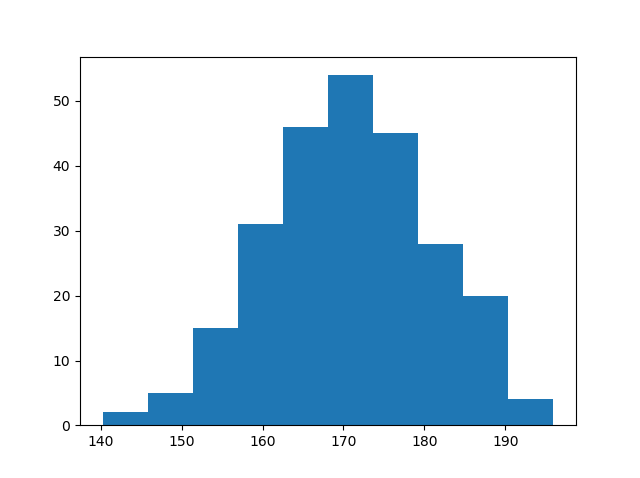
You can read from the histogram that there are approximately:

2 people from 140 to 145cm
5 people from 145 to 150cm
15 people from 151 to 156cm
31 people from 157 to 162cm
46 people from 163 to 168cm
53 people from 168 to 173cm
45 people from 173 to 178cm
28 people from 179 to 184cm
21 people from 185 to 190cm
4 people from 190 to 195cm


Create Histogram

In Matplotlib, we use the hist() function to create histograms.

The hist() function will use an array of numbers to create a histogram, the array is sent into the function as an argument.

For simplicity we use NumPy to randomly generate an array with 250 values, where the values will concentrate around 170, and the standard deviation is 10. Learn more about Normal Data Distribution in our Machine Learning Tutorial.

Example

A Normal Data Distribution by NumPy:

import numpy as np

x = np.random.normal(170, 10, 250)

print(x)

Result:

This will generate a random result, and could look like this:

  [167.62255766 175.32495609 152.84661337 165.50264047 163.17457988
   162.29867872 172.83638413 168.67303667 164.57361342 180.81120541
   170.57782187 167.53075749 176.15356275 176.95378312 158.4125473
   187.8842668  159.03730075 166.69284332 160.73882029 152.22378865
   164.01255164 163.95288674 176.58146832 173.19849526 169.40206527
   166.88861903 149.90348576 148.39039643 177.90349066 166.72462233
   177.44776004 170.93335636 173.26312881 174.76534435 162.28791953
   166.77301551 160.53785202 170.67972019 159.11594186 165.36992993
   178.38979253 171.52158489 173.32636678 159.63894401 151.95735707
   175.71274153 165.00458544 164.80607211 177.50988211 149.28106703
   179.43586267 181.98365273 170.98196794 179.1093176  176.91855744
   168.32092784 162.33939782 165.18364866 160.52300507 174.14316386
   163.01947601 172.01767945 173.33491959 169.75842718 198.04834503
   192.82490521 164.54557943 206.36247244 165.47748898 195.26377975
   164.37569092 156.15175531 162.15564208 179.34100362 167.22138242
   147.23667125 162.86940215 167.84986671 172.99302505 166.77279814
   196.6137667  159.79012341 166.5840824  170.68645637 165.62204521
   174.5559345  165.0079216  187.92545129 166.86186393 179.78383824
   161.0973573  167.44890343 157.38075812 151.35412246 171.3107829
   162.57149341 182.49985133 163.24700057 168.72639903 169.05309467
   167.19232875 161.06405208 176.87667712 165.48750185 179.68799986
   158.7913483  170.22465411 182.66432721 173.5675715  176.85646836
   157.31299754 174.88959677 183.78323508 174.36814558 182.55474697
   180.03359793 180.53094948 161.09560099 172.29179934 161.22665588
   171.88382477 159.04626132 169.43886536 163.75793589 157.73710983
   174.68921523 176.19843414 167.39315397 181.17128255 174.2674597
   186.05053154 177.06516302 171.78523683 166.14875436 163.31607668
   174.01429569 194.98819875 169.75129209 164.25748789 180.25773528
   170.44784934 157.81966006 171.33315907 174.71390637 160.55423274
   163.92896899 177.29159542 168.30674234 165.42853878 176.46256226
   162.61719142 166.60810831 165.83648812 184.83238352 188.99833856
   161.3054697  175.30396693 175.28109026 171.54765201 162.08762813
   164.53011089 189.86213299 170.83784593 163.25869004 198.68079225
   166.95154328 152.03381334 152.25444225 149.75522816 161.79200594
   162.13535052 183.37298831 165.40405341 155.59224806 172.68678385
   179.35359654 174.19668349 163.46176882 168.26621173 162.97527574
   192.80170974 151.29673582 178.65251432 163.17266558 165.11172588
   183.11107905 169.69556831 166.35149789 178.74419135 166.28562032
   169.96465166 178.24368042 175.3035525  170.16496554 158.80682882
   187.10006553 178.90542991 171.65790645 183.19289193 168.17446717
   155.84544031 177.96091745 186.28887898 187.89867406 163.26716924
   169.71242393 152.9410412  158.68101969 171.12655559 178.1482624
   187.45272185 173.02872935 163.8047623  169.95676819 179.36887054
   157.01955088 185.58143864 170.19037101 157.221245   168.90639755
   178.7045601  168.64074373 172.37416382 165.61890535 163.40873027
   168.98683006 149.48186389 172.20815568 172.82947206 173.71584064
   189.42642762 172.79575803 177.00005573 169.24498561 171.55576698
   161.36400372 176.47928342 163.02642822 165.09656415 186.70951892
   153.27990317 165.59289527 180.34566865 189.19506385 183.10723435
   173.48070474 170.28701875 157.24642079 157.9096498  176.4248199 ]

Try it Yourself »

The hist() function will read the array and produce a histogram:

Example

A simple histogram:

import matplotlib.pyplot as plt
import numpy as np

x = np.random.normal(170, 10, 250)

plt.hist(x)
plt.show() 

Result:

Try it Yourself »


❮ Previous Next ❯
★ +1
Sign in to track progress
W3Schools Full Access - your next career move

REMOVE ADS

This way to the W3Schools Adventure app
Learn more about Adventure Mode›

Free account

Track your progress

XP earned 0 Day streak 0 Spaces 0 League —
Sign in to track progress

New

Learn in Adventure Mode W3Schools Adventure App

Coding fundamentals as bite-sized lessons and challenges.

PLUS
SPACES
GET CERTIFIED
FOR TEACHERS
PRACTICE
CONTACT US
×

Contact Sales

If you want to use W3Schools services as an educational institution, team or enterprise, send us an e-mail:
[email protected]

Report Error

If you want to report an error, or if you want to make a suggestion, send us an e-mail:
[email protected]

Top Tutorials
HTML Tutorial
CSS Tutorial
JavaScript Tutorial
How To Tutorial
SQL Tutorial
Python Tutorial
W3.CSS Tutorial
Bootstrap Tutorial
PHP Tutorial
Java Tutorial
C++ Tutorial
jQuery Tutorial
Top References
HTML Reference
CSS Reference
JavaScript Reference
SQL Reference
Python Reference
W3.CSS Reference
Bootstrap Reference
PHP Reference
HTML Colors
Java Reference
AngularJS Reference
jQuery Reference
Top Examples
HTML Examples
CSS Examples
JavaScript Examples
How To Examples
SQL Examples
Python Examples
W3.CSS Examples
Bootstrap Examples
PHP Examples
Java Examples
XML Examples
jQuery Examples
Get Certified
HTML Certificate
CSS Certificate
JavaScript Certificate
Front End Certificate
SQL Certificate
Python Certificate
PHP Certificate
jQuery Certificate
Java Certificate
C++ Certificate
C# Certificate
XML Certificate
   
FORUM ABOUT CAMPUS
W3Schools is optimized for learning and training. Examples might be simplified to improve reading and learning.
Tutorials, references, and examples are constantly reviewed to avoid errors, but we cannot warrant full correctness
of all content. While using W3Schools, you agree to have read and accepted our terms of use, cookies and privacy policy.

Copyright 1999-2026 by Refsnes Data. All Rights Reserved. W3Schools is Powered by W3.CSS.


You are visitor 01402503 — GeezerVison does not store the pages you look up.
Best viewed with Netscape Navigator 4.7 or Internet Explorer 6 at 800×600. No cookies required.