GeezerVisonThe World Wide Web, restored to 800 pixels of glory. |
| Home|About|Gaming cabinet|Archives|How it works|Starter sites |
GeezerVison is showing codescracker.com — Java Variable Scope
Java Variable ScopeSo far, all variables have been declared at the beginning of the main() method. Java, on the other hand, allows variables to be declared within any block. A block is formed by starting with an opening curly brace and ending with a closing curly brace. A scope is defined by a block. As a result, each time you start a new block, you create a new scope. What objects are visible to other parts of your program are determined by a scope. It also determines how long those objects will live. Many other computer languages distinguish between global and local scopes. These traditional scopes, however, do not fit well with Java's strict, object-oriented model. While creating what amounts to a global scope is possible, it is far more the exception than the rule. In Java, there are two types of scopes: those defined by a class and those defined by a method. Even this distinction is a little arbitrary. This distinction makes sense, however, because the class scope has several unique properties and attributes that do not apply to the scope defined by a method. In a later chapter, you will learn more about class. For the time being, we will only look at the scopes defined by or within a method. A method's scope is defined by its opening curly brace. However, if that method has parameters, those parameters are also included in the method's scope. As a general rule, variables declared inside a scope are not visible or accessible to the code that is defined outside the scope. Thus, when you declare a variable within a scope, you are localizing that variable and protecting it from unauthorized access and/or modification. Indeed, the scope rules provide the foundation for encapsulation. Scopes can be nested. For example, each time you create a block of code, you are creating a new, nested scope. When this occurs, the outer scope encloses the inner scope. This means that the objects declared in the outer scope will be visible to code within the inner scope. However, the reverse is not true. Objects declared within the inner scope will not be visible outside it. Java Variable Scope ExampleTo understand the effect of nested scopes, consider the following program: public class JavaProgram
{
public static void main(String args[])
{
int x; // 'x' is known to all within the main() function.
x = 10;
if(x == 10)
{
int y = 20; // 'y' is known only to this block
System.out.println("x : " + x + "\ny : " + y);
x = y * 2;
}
System.out.println("x is " +x);
}
}
When the above Java program is compiled and run, it will produce the following output: 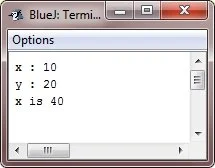
In the above program, the "int x" declaration creates an integer variable "x" within the "main()" method, and sets its initial value to 10. This variable is accessible from anywhere within the main() method, but not outside of it. Within an "if" statement block that checks if "x" is equal to 10, a new integer variable "y" is declared and initialized to 20. This y variable is only known within the scope of the "if" block, and cannot be accessed from outside of it. The code then prints the values of "x" and "y" using "System.out.println()" method. Since "y" is only known within the "if" block, it is not accessible outside of it, and the value of "y" cannot be printed again in the later statements. The value of "x" is updated by setting it equal to "y * 2." Since "x" is defined outside of the "if" block, it is accessible and can be updated within the "if" block, and the new value of "x" can be printed using "System.out.println()" method outside of the "if" block. Therefore, the variable "x" is known throughout the "main()" function, while the variable "y" is only known within the "if" block. Advantages of variable scope in Java
Disadvantages of variable scope in Java
« Previous Tutorial Next Tutorial » Practice Quizzes
Test your programming and computer science knowledge with interactive MCQs and topic-based quizzes. Popular Topics
Explore the most popular programming and computer science tutorials on CodesCracker. |
| You are visitor 01402503 — GeezerVison does not store the pages you look up. Best viewed with Netscape Navigator 4.7 or Internet Explorer 6 at 800×600. No cookies required. |