GeezerVisonThe World Wide Web, restored to 800 pixels of glory. |
| Home|About|Gaming cabinet|Archives|How it works|Starter sites |
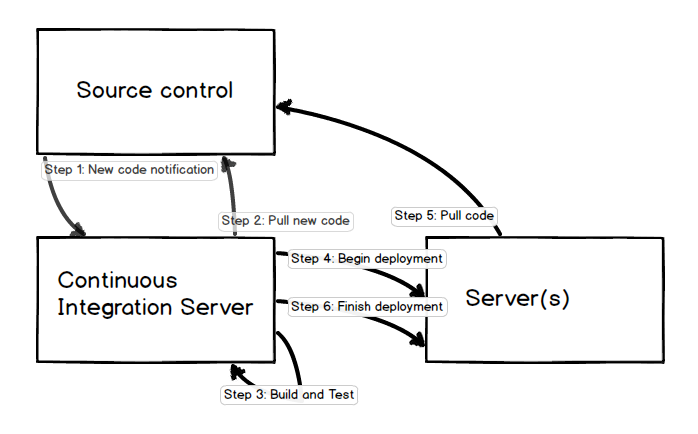
GeezerVison is showing www.fullstackpython.com — Continuous Integration Continuous IntegrationContinuous integration automates the building, testing and deploying of applications. Software projects, whether created by a single individual or entire teams, typically use continuous integration as a hub to ensure important steps such as unit testing are automated rather than manual processes. Why is continuous integration important?When continuous integration (CI) is established as a step in a software project's development process it can dramatically reduce deployment times by minimizing steps that require human intervention. The only minor downside to using CI is that it takes some initial time by a developer to set up and then there is some ongoing maintainence if a project is broken into multiple parts, such as going from a monolith architecture to microservices. Automated testingAnother major advantage with CI is that testing can be an automated step in the deployment process. Broken deployments can be prevented by running a comprehensive test suite of unit and integration tests when developers check in code to a source code repository. Any bugs accidentally introduced during a check-in that are caught by the test suite are reported and prevent the deployment from proceeding. The automated testing on checked in source code can be thought of like the bumper guards in bowling that prevent code quality from going too far off track. CI combined with unit and integration tests check that any code modifications do not break existing tests to ensure the software works as intended. Continuous integration exampleThe following picture represents a high level perspective on how continuous integration and deployment can work.
In the above diagram, when new code is committed to a source repository there is a hook that notifies the continuous integration server that new code needs to be built (the continuous integration server could also poll the source code repository if a notification is not possible). The continuous integration server pulls the code to build and test it. If all tests pass, the continuous integration server begins the deployment process. The new code is pulled down to the server where the deployment is taking place. Finally the deployment process is completed via restarting services and related deployment activities. There are many other ways a continuous integration server and its deployments can be structured. The above was just one example of a relatively simple setup. Open source CI projectsThere are a variety of free and open source continuous integration servers that are configurable based on a project's needs. Note that many of these servers are not written in Python but work just fine for Python applications. Polyglot organizations (ones that use more than a single language and ecosystem) often use a single CI server for all of their projects regardless of the programming language the application was written in.
Jenkins CI resourcesJenkins is commonly used as a continuous integration server implementation for Python projects because it is open source and programming language agnostic. Learn more via the following resources or on the dedicated Jenkins page.
General continuous integration resources
What do you want to work on next for your deployment?
1. Introduction
2. Development Environments
3. Data
4. Web Development
5. Deployment
Hosting
Servers
Static Content
CDNs
Virtual Private Servers
Linode
DigitalOcean
Lightsail
Platform-as-a-Service
Heroku
PythonAnywhere
AWS CodeStar
Operating Systems
Ubuntu
macOS
Windows
FreeBSD
Web Servers
Apache HTTP Server
Nginx
Caddy
WSGI Servers
Green Unicorn (Gunicorn)
mod_wsgi
uWSGI
Continuous Integration
Jenkins
GoCD
Configuration Management
Ansible
Salt
Containers
Docker
Kubernetes
Serverless
AWS Lambda
Azure Functions
Google Cloud Functions
6. DevOps
Changelog
What Full Stack Means
About the Author
Future Directions
Page Statuses
...or view the full table of contents.
Full Stack Python
Full Stack Python
is an open book that explains concepts in plain language and provides
helpful resources for those topics.
Updates via Twitter & Facebook. |
| You are visitor 01402503 — GeezerVison does not store the pages you look up. Best viewed with Netscape Navigator 4.7 or Internet Explorer 6 at 800×600. No cookies required. |