GeezerVisonThe World Wide Web, restored to 800 pixels of glory. |
| Home|About|Gaming cabinet|Archives|How it works|Starter sites |
GeezerVison is showing www.fullstackpython.com — WSGI Servers WSGI ServersA Web Server Gateway Interface (WSGI) server implements the web server side of the WSGI interface for running Python web applications. Why is WSGI necessary?A traditional web server does not understand or have any way to run Python applications. In the late 1990s, a developer named Grisha Trubetskoy came up with an Apache module called mod_python to execute arbitrary Python code. For several years in the late 1990s and early 2000s, Apache configured with mod_python ran most Python web applications. However, mod_python wasn't a standard specification. It was just an implementation that allowed Python code to run on a server. As mod_python's development stalled and security vulnerabilities were discovered there was recognition by the community that a consistent way to execute Python code for web applications was needed. Therefore the Python community came up with WSGI as a standard interface that modules and containers could implement. WSGI is now the accepted approach for running Python web applications.
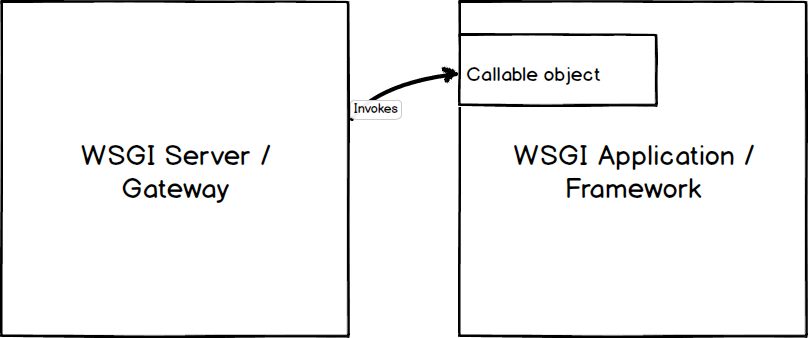
As shown in the above diagram, a WSGI server simply invokes a callable object on the WSGI application as defined by the PEP 3333 standard. WSGI's PurposeWhy use WSGI and not just point a web server directly at an application?
WSGI is by design a simple standard interface for running Python code. As a web developer you won't need to know much more than
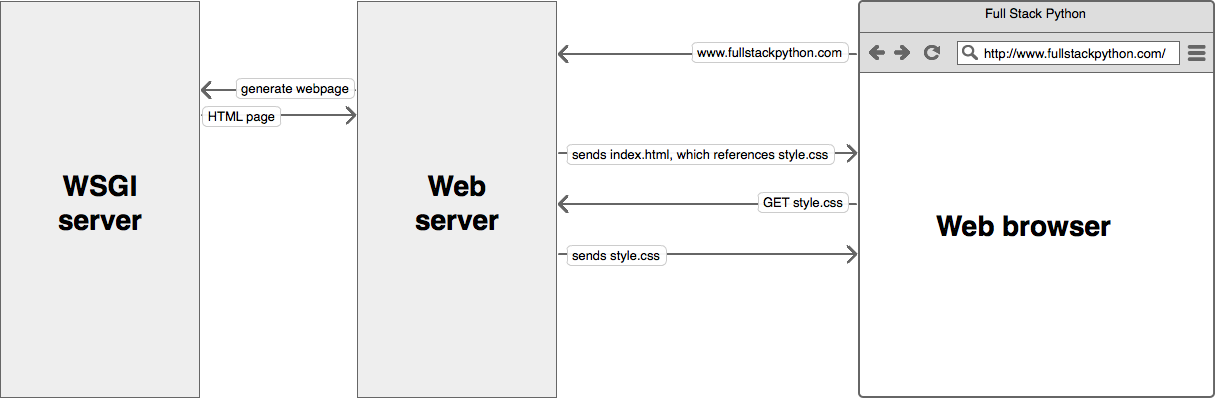
If you're using a standard web framework such as Django, Flask, or Bottle, or almost any other current Python framework, you don't need to worry about how frameworks implement the application side of the WSGI standard. Likewise, if you're using a standard WSGI container such as Green Unicorn, uWSGI, mod_wsgi, or gevent, you can get them running without worrying about how they implement the WSGI standard. However, knowing the WSGI standard and how these frameworks and containers implement WSGI should be on your learning checklist though as you become a more experienced Python web developer. Official WSGI specificationsThe WSGI standard v1.0 is specified in PEP 0333. As of September 2010, WSGI v1.0 is superseded by PEP 3333, which defines the v1.0.1 WSGI standard. If you're working with Python 2.x and you're compliant with PEP 0333, then you're also compliant with 3333. The newer version is simply an update for Python 3 and has instructions for how unicode should be handled. wsgiref in Python 2.x and wsgiref in Python 3.x are the reference implementations of the WSGI specification built into Python's standard library so it can be used to build WSGI servers and applications. Example web server configurationA web server's configuration specifies what requests should be passed to the WSGI server to process. Once a request is processed and generated by the WSGI server, the response is passed back through the web server and onto the browser. For example, this Nginx web server's configuration specifies that Nginx should handle static assets (such as images, JavaScript, and CSS files) under the /static directory and pass all other requests to the WSGI server running on port 8000: # this specifies that there is a WSGI server running on port 8000 upstream app_server_djangoapp { server localhost:8000 fail_timeout=0; } # Nginx is set up to run on the standard HTTP port and listen for requests server { listen 80; # nginx should serve up static files and never send to the WSGI server location /static { autoindex on; alias /srv/www/assets; } # requests that do not fall under /static are passed on to the WSGI # server that was specified above running on port 8000 location / { proxy_set_header X-Forwarded-For $proxy_add_x_forwarded_for; proxy_set_header Host $http_host; proxy_redirect off; if (!-f $request_filename) { proxy_pass http://app_server_djangoapp; break; } } } Note that the above code is a simplified version of a production-ready Nginx configuration. For real SSL and non-SSL templates, take a look at the Underwear web server templates on GitHub. WSGI server implementationsThere is a comprehensive list of WSGI servers on the WSGI Read the Docs page. The following are WSGI servers based on community recommendations.
WSGI resources
WSGI servers learning checklist
What's next after your Python app is running?
1. Introduction
2. Development Environments
3. Data
4. Web Development
5. Deployment
Hosting
Servers
Static Content
CDNs
Virtual Private Servers
Linode
DigitalOcean
Lightsail
Platform-as-a-Service
Heroku
PythonAnywhere
AWS CodeStar
Operating Systems
Ubuntu
macOS
Windows
FreeBSD
Web Servers
Apache HTTP Server
Nginx
Caddy
WSGI Servers
Green Unicorn (Gunicorn)
mod_wsgi
uWSGI
Continuous Integration
Jenkins
GoCD
Configuration Management
Ansible
Salt
Containers
Docker
Kubernetes
Serverless
AWS Lambda
Azure Functions
Google Cloud Functions
6. DevOps
Changelog
What Full Stack Means
About the Author
Future Directions
Page Statuses
...or view the full table of contents.
Full Stack Python
Full Stack Python
is an open book that explains concepts in plain language and provides
helpful resources for those topics.
Updates via Twitter & Facebook. |
| You are visitor 01402503 — GeezerVison does not store the pages you look up. Best viewed with Netscape Navigator 4.7 or Internet Explorer 6 at 800×600. No cookies required. |