GeezerVisonThe World Wide Web, restored to 800 pixels of glory. |
| Home|About|Gaming cabinet|Archives|How it works|Starter sites |
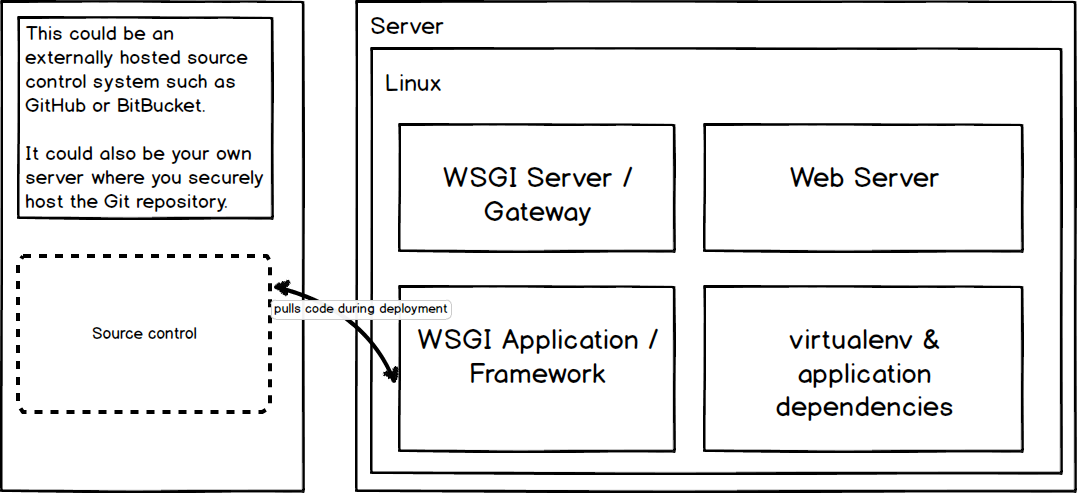
GeezerVison is showing www.fullstackpython.com — Source Control Source ControlSource control, also known as version control, stores software code files with a detailed history of every modification made to those files. Why is source control necessary?Version control systems allow developers to modify code without worrying about permanently screwing something up. Unwanted changes can be easily rolled back to previous working versions of the code. Source control also makes team software development easier. One developer can combine her code modifications with other developers' code through diff views that show line-by-line changes then merge the appropriate code into the main code branch. Version control is a necessity on all software projects regardless of development time, codebase size or the programming language used. Every project should immediately begin by using a version control system such as Git or Mercurial. Monorepo vs MultirepoThere is a spectrum of philosophies for how to store projects within source code repositories. On one extreme end of the spectrum, every line of code for every project within an organization is stored in a single repository. That approach is called monorepo and it is used by companies like Google. On the other end of the spectrum, there are potentially tens of thousands or more repositories that store parts of projects. That approach is known as multirepo or manyrepo. For example, in a microservices architecture, there could be thousands of microservices and each one is stored within its own repository. No one repository contains the code for the entire application created by the interaction of the microservices. There are many hybrid strategies for how to store source code that fall between these opposite approaches. What to choose will depend on your organization's needs, resources and culture. Source control during deploymentPulling code during a deployment is a potential way source control systems fit into the deployment process.
Note that some developers recommend deployment pipelines package the source code to deploy it and never have a production environment touch a source control system directly. However, for small scale deployments it's often easiest to pull from source code when you're getting started instead of figuring out how to wrap the Python code in a system installation package. Source control projectsNumerous source control systems have been created over the past several decades. In the past, proprietary source control software offered features tailored to large development teams and specific project workflows. However, open source systems are now used for version control on the largest and most complicated software projects in existence. There's no reason why your project should use anything other than an open source version control system in today's Python development world. The two primary choices are:
Hosted version control servicesGit and Mercurial can be downloaded and run on your own server. However, it's easy and cheap to get started with a hosted version control service. You can transition away from the service at a later time by moving your repositories if your needs change. A couple of recommended hosted version control services are:
General source control resources
Monorepo vs multirepo resourcesMonorepo versus multirepo version control strategies are a weirdly contentious topic in software development, likely because once a policy is set for an organization it is exceptionally difficult to change your approach. The following resources give more insight into the debate on how to structure your repositories.
Git distributed source control systemGit is the most widely-used source control system currently in use. Its distributed design eliminates the need to check files in and out of a centralized repository, which is a problem when using Subversion without a network connection. There is a full page on Git with further details and resources. Subversion resourcesApache Subversion (source code), often just called "Subversion" or "SVN", is a source control system implementation.
Source control learning checklist
What do you want to learn about after source control?
1. Introduction
2. Development Environments
Text Editors & IDEs
Vim
Emacs
Sublime Text
PyCharm
Jupyter Notebook
Shells
Bash shell
Zsh
PowerShell
Terminal Multiplexers
tmux
Screen
Environment configuration
Application Dependencies
Virtualenvs
Localhost tunnels
Source Control
Git
Mercurial
3. Data
4. Web Development
5. Deployment
6. DevOps
Changelog
What Full Stack Means
About the Author
Future Directions
Page Statuses
...or view the full table of contents.
Full Stack Python
Full Stack Python
is an open book that explains concepts in plain language and provides
helpful resources for those topics.
Updates via Twitter & Facebook. |
| You are visitor 01402503 — GeezerVison does not store the pages you look up. Best viewed with Netscape Navigator 4.7 or Internet Explorer 6 at 800×600. No cookies required. |