GeezerVisonThe World Wide Web, restored to 800 pixels of glory. | ||||||||
| Home|About|Gaming cabinet|Archives|How it works|Starter sites | ||||||||
GeezerVison is showing www.tutorialspoint.com — Iterator Design Pattern in C++ 
Selected Reading
Iterator Design Pattern in C++Iterator Design Pattern is a behavioral design pattern that helps you move through a collection of items-like a list, stack, or tree-without needing to know how that collection is built on the inside. Imagine you have a box full of different objects, and you want to look at each one, one by one, without having to open the box and figure out how everything is arranged. The Iterator pattern gives you a simple way to do this, making it easier to work with all kinds of collections in a consistent way. This pattern is especially useful when your application uses many different types of collections. Instead of writing separate code to loop through each type, you can use the Iterator pattern to create a common approach for all of them. This not only saves time but also makes your code cleaner and easier to update in the future. If you ever change how a collection is stored, you won't have to rewrite the code that goes through its elements. 
For example, think about a music playlist app. You might have playlists stored as arrays, linked lists, or even trees. With the Iterator pattern, you can play songs from any playlist in the same way, without worrying about how the playlist is organized behind the scenes. This makes your program more flexible and much easier to maintain. Key Components of the Iterator Pattern
Implementation of Iterator Pattern in C++In this example, we will implement the Iterator Design Pattern in C++ to traverse a collection of books in a library. We will take example of a simple library system where we have a collection of books and we want to iterate through them using the Iterator pattern. Steps to Implement the Iterator Pattern in C++Following are the steps to implement the Iterator Design Pattern in C++ 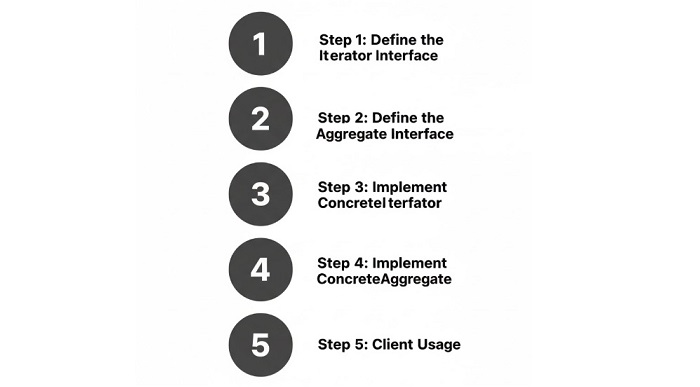
C++ Code to Implement Iterator PatternFollowing is the C++ code that demonstrates the Iterator Design Pattern − #include <iostream>
#include <vector>
using namespace std;
// Iterator Interface
class Iterator {
public:
virtual bool hasNext() = 0;
virtual string next() = 0;
};
// Concrete Iterator
class BookIterator : public Iterator {
private:
vector<string> books;
int position;
public:
BookIterator(vector<string> b) : books(b), position(0) {}
bool hasNext() override {
return position < books.size();
}
string next() override {
return books[position++];
}
};
// Aggregate Interface
class Aggregate {
public:
virtual Iterator* createIterator() = 0;
};
// Concrete Aggregate
class Library : public Aggregate {
private:
vector<string> books;
public:
void addBook(string book) {
books.push_back(book);
}
Iterator* createIterator() override {
return new BookIterator(books);
}
};
// Client Code
int main() {
Library library;
library.addBook("The Great Gatsby");
library.addBook("1984");
library.addBook("To Kill a Mockingbird");
Iterator* iterator = library.createIterator();
cout << "Books in the Library:" << endl;
while (iterator->hasNext()) {
cout << iterator->next() << endl;
}
delete iterator;
return 0;
}
Following is the output of the above code − Books in the Library: The Great Gatsby 1984 To Kill a Mockingbird In this example, we start by defining an Iterator interface, which lays out the basic methods needed to move through a collection: one to check if there are more items, and another to get the next item. The BookIterator class is a concrete implementation of this interface, specifically designed to work with a collection of book titles. It keeps track of its current position in the collection and knows how to move from one book to the next. The Library class acts as our collection of books. It provides a way to add new books and, importantly, a method to create an iterator that can be used to go through its books. This means that the details of how the books are stored—whether in a vector, list, or any other structure—are hidden from the code that uses the library. In the main part of the program, we create a Library object, add a few book titles to it, and then use the iterator to print out each book. Notice how the code that prints the books doesn't need to know anything about how the books are stored inside the library. It simply asks the iterator if there are more books, and if so, gets the next one. This separation makes the code much easier to read, maintain, and extend in the future. Pros and Cons of Iterator Pattern
When to Use the Iterator PatternThe Iterator pattern is especially helpful in situations like these −
Real-World Examples of Iterator PatternFollowing are some real-world examples where the Iterator Design Pattern is commonly used − 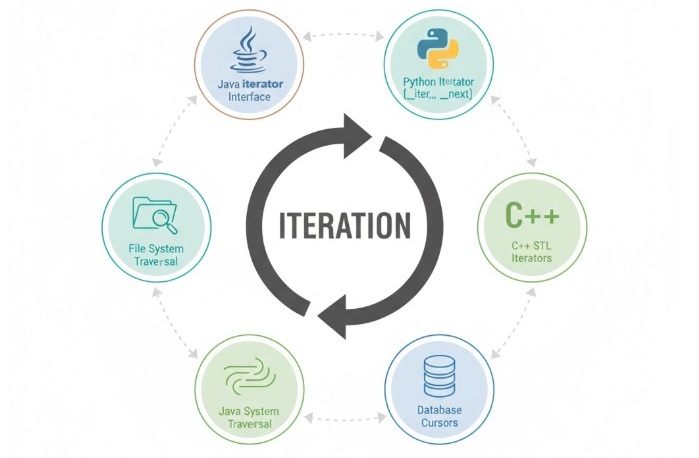
ConclusionThe Iterator Design Pattern is a practical and widely used solution for working with collections of data. By separating the way you access items from the way they are stored, it makes your code more flexible, easier to maintain, and ready for future changes. Whether you're building a playlist app, managing a library of books, or working with any kind of collection, the Iterator pattern helps you keep your code clean and adaptable. 
Advertisements
| ||||||||
| You are visitor 01402503 — GeezerVison does not store the pages you look up. Best viewed with Netscape Navigator 4.7 or Internet Explorer 6 at 800×600. No cookies required. |