GV

GeezerVison

The World Wide Web, restored to 800 pixels of glory.

Home|About|Gaming cabinet|Archives|How it works|Starter sites

On this site

  • About
  • Publications
  • Events
  • Notes and studies
  • Primary sources on the Bajīlah’s ‘fourth’
  • Qādisiyyah in modern Middle Eastern discourse
  • A Brief analysis of ‘Ṣaddām’s Qādisiyyah’

This view

  • Original page
  • New address

GeezerVison is showing bahai.dglnotes.com — Scholarship on Bahāʾī studies by D Gershon Lewental, PhD (DGLnotes)

DGLnotes: Scholarship on Middle Eastern history, culture, and identity by D Gershon Lewental, PhD
  • About
    • Research interests
    • Education
    • Teaching experience
    • Editing and translating experience
    • Biography
    • Current projects
    • Teaching interests and syllabi
    • Fellowships and awards
    • Languages and special skills
    • Professional membership
    • Papers presented at scholarly meetings
    • Public lectures
    • Publications
  • Events
  • Notes and studies
    • Early Islamic civilisation Early Islamic civilisation
      • Primary sources on the Bajīlah’s ‘fourth’
      • Qādisiyyah in modern Middle Eastern discourse
    • Modern Middle East Modern Middle East
      • A Brief analysis of ‘Ṣaddām’s Qādisiyyah’
      • Early Islamic history and memory in radical Islamist discourse
      • Qādisiyyah in modern Middle Eastern discourse
      • Morgan Shuster and the roots of Iran-US relations (forthcoming)
    • Central Asia Central Asia
      • Tajiki identity caught between Iran, Islam, and Russia
    • Language and linguistics Language and linguistics
      • Rasmī or aslī?: Arabic’s impact on modern Israeli Hebrew
      • Ben-Yehūdāh’s ‘Sources to fill the lacunæ in our language’ (forthcoming)
    • Transliteration tables
  • Bahā’ī studies
    • General information General information
    • Notes and studies Notes and studies
      • Genealogy of the central figures of the Bahāʾī faith and their descendants
      • The Bahāʾī community in the Holy Land (forthcoming)
    • Primary sources and texts Primary sources and texts
      • Browne’s List of descendants of Mīrzā ʿAbbās Nūrī
    • Transliteration tables
  • Course syllabi
    • Introductory/survey courses Introductory/survey courses
      • Introduction to the modern Middle East
      • Introduction to Islam
      • History of Iran
      • History of Israel
      • History of the Ottoman Empire
      • Introduction to Islamic civilisation
      • History of the world to 1500
    • Higher-level courses Higher-level courses
      • Religion and society in the Middle East
      • Nineteenth- and Twentieth-Century Iran
      • Early Islamic history, 600–1258
      • Arab-Israeli conflict
      • Political Islam
      • The Making of the modern Middle East
      • History and development of Israeli society
      • Minorities of the Middle East
      • Shīʿī Islam
      • History of Zionism
      • Jews and Christians under Islam
      • Jews of the Ottoman Empire
      • The Middle East through film
      • Israeli society through film
      • Ottomans and Ṣafavids
      • Israeli politics
      • Mediæval Indian history
    • Seminar/graduate courses Seminar/graduate courses
      • Seminar on the Arab-Muslim conquests
      • Nationalism and identity in the Middle East
      • History and memory in the Middle East
      • Constitutional revolutions and movements
      • Identities and tensions in Israeli society
      • Millenarianism and Islam
  • Publications
    • Books
    • Edited volumes
    • Journal articles
    • Chapters in edited collections
    • Encyclopædia contributions
    • Translations
    • Other writing
    • Book reviews
    • Unpublished work
  • News
  • Contact

DGLnotes—Bahāʾī studies section

D Gershon Lewental, DGLnotes
Provide feedback Add to favourites
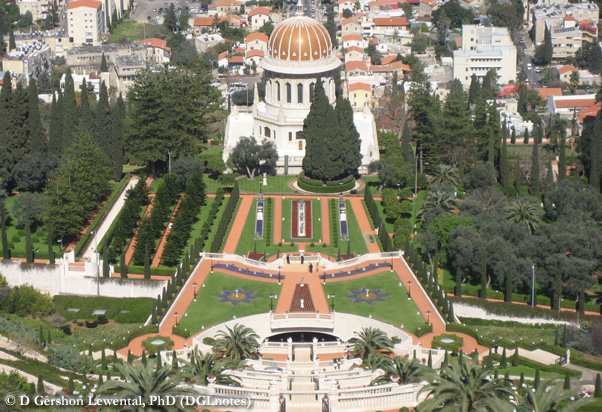
The Bahāʾī terraces and Shrine of the Bāb in Ḥaifa, Israel.
The Bahāʾī terraces and Shrine of the Bāb in Ḥaifa, Israel. [Source: D Gershon Lewental (DGLnotes)]

The Bahāʾī faith emerged in Iran during the mid-Nineteenth Century as a new religion within the Abrahamic monotheistic faith tradition, focusing on human unity and equality. Although the faith and its prophet-founder, Bahāʾ-Ollāh (also Baháʾu’lláh, born Mīrzā Ḥusayn-ʿAlī Nūrī, 1817–1892) came from Iran, persecution brought them to ʿAkko (Acre) and Ḥaifa (Haifa) in Ottoman Palestine, where the leadership of the faith has remained ever since. For nearly a century, the families and descendants of Bahāʾ-Ollāh and many of his early followers continued to live and thrive in the land, as it passed from the Ottomans to the British to the Israelis. I have conducted extensive research on the relations between the Bahāʾī community and British, Jewish, and Israeli authorities at the Israel State Archives and present general information on the Bahāʾī faith, original studies, and primary sources and other resource materials below.

Table of contents

  • General information on the Bahāʾī faith
  • Bahāʾī-related notes and studies
  • Primary sources and texts
  • General information on the Bahāʾī faith

  • Interview: ‘The Bahaʾi: Yet another world religion based in the Holy Land’,
    interview by Gilad Halpern, TLV1, ‘Tel-Aviv Review’ podcast, 07 October 2016.

    The Bahāʾī gardens in Haifa, Israel. (Credit: Miriam Alster/FLASH90.)
    ‘Dr. D Gershon Lewental, an Israel Studies professor at the University of Oklahoma, gives host Gilad Halpern an overview of the Bahaʾi religion—an offshoot of Shiʿa Islam that set up shop in the Holy Land (albeit not in Jerusalem, thankfully). They discuss its relationship with the local ethnic groups under the different regimes.’ (from TLV1.fm)
  • More coming soon.
  • Bahāʾī-related notes and studies

  • Genealogy of the founders of the Bahāʾī faith and their descendants, 24 October 2011.
    Early Bahāʾīs, including several sons of Bahāʾ-Ollāh.
    Genealogy has occupied an important place within Bahāʾī history and theology, serving to support further the faith’s claims to embody and succeed prior religious traditions. This article presents several genealogical charts that detail both the ancestry of the central figures of the Bahāʾī holy family, as well as their descendants down to the present day. Links are also provided to other online genealogical charts relating to Bahāʾī faith.
  • The Bahāʾī community in the Holy Land, forthcoming.
  • Primary sources and texts

  • Browne’s List of descendants of Mīrzā ʿAbbās Nūrī, 01 August 2012.
    Mīrzā Yaḥyā Nūrī (known as Ṣobḥ-e Azal, 1831–1912), with three of his sons.
    In his 1918 work, Materials for the study of the Bábí religion, the noted Orientalist Edward Granville Browne (1862–1926) reproduced a list of descendants of Mīrzā ʿAbbās Nūrī (known as Bozorg-e Vazīr, d. 1839), the father of the founder of the founder of the Bahāʾī faith, which had been compiled in June 1912 by ʿAbbās Nūrī’s grandson Mīrzā Ebrāhīm Khān. This list provides an early account of the genealogy of the Bahāʾī holy family.
  • Upcoming talks and lectures

    Please note that not all of these events are open to the general audience; please check with the organisers to confirm.

      Recent events ► click to expand

        ► full list of events
        You are visitor 01402503 — GeezerVison does not store the pages you look up.
        Best viewed with Netscape Navigator 4.7 or Internet Explorer 6 at 800×600. No cookies required.
