GV

GeezerVison

The World Wide Web, restored to 800 pixels of glory.

Home|About|Gaming cabinet|Archives|How it works|Starter sites

On this site

  • About
  • Publications
  • Events
  • Notes and studies
  • Primary sources on the Bajīlah’s ‘fourth’
  • Qādisiyyah in modern Middle Eastern discourse
  • A Brief analysis of ‘Ṣaddām’s Qādisiyyah’

This view

  • Original page
  • New address

GeezerVison is showing dglnotes.com — Introduction to the modern Middle East syllabus by D Gershon Lewental, PhD (DGLnotes)

DGLnotes: Scholarship on Middle Eastern history, culture, and identity by D Gershon Lewental, PhD
  • About
    • Research interests
    • Education
    • Teaching experience
    • Editing and translating experience
    • Biography
    • Current projects
    • Teaching interests and syllabi
    • Fellowships and awards
    • Languages and special skills
    • Professional membership
    • Papers presented at scholarly meetings
    • Public lectures
    • Publications
  • Events
  • Notes and studies
    • Early Islamic civilisation Early Islamic civilisation
      • Primary sources on the Bajīlah’s ‘fourth’
      • Qādisiyyah in modern Middle Eastern discourse
    • Modern Middle East Modern Middle East
      • A Brief analysis of ‘Ṣaddām’s Qādisiyyah’
      • Early Islamic history and memory in radical Islamist discourse
      • Qādisiyyah in modern Middle Eastern discourse
      • Morgan Shuster and the roots of Iran-US relations (forthcoming)
    • Central Asia Central Asia
      • Tajiki identity caught between Iran, Islam, and Russia
    • Language and linguistics Language and linguistics
      • Rasmī or aslī?: Arabic’s impact on modern Israeli Hebrew
      • Ben-Yehūdāh’s ‘Sources to fill the lacunæ in our language’ (forthcoming)
    • Transliteration tables
  • Bahā’ī studies
    • General information General information
    • Notes and studies Notes and studies
      • Genealogy of the central figures of the Bahāʾī faith and their descendants
      • The Bahāʾī community in the Holy Land (forthcoming)
    • Primary sources and texts Primary sources and texts
      • Browne’s List of descendants of Mīrzā ʿAbbās Nūrī
    • Transliteration tables
  • Course syllabi
    • Introductory/survey courses Introductory/survey courses
      • Introduction to the modern Middle East
      • Introduction to Islam
      • History of Iran
      • History of Israel
      • History of the Ottoman Empire
      • Introduction to Islamic civilisation
      • History of the world to 1500
    • Higher-level courses Higher-level courses
      • Religion and society in the Middle East
      • Nineteenth- and Twentieth-Century Iran
      • Early Islamic history, 600–1258
      • Arab-Israeli conflict
      • Political Islam
      • The Making of the modern Middle East
      • History and development of Israeli society
      • Minorities of the Middle East
      • Shīʿī Islam
      • History of Zionism
      • Jews and Christians under Islam
      • Jews of the Ottoman Empire
      • The Middle East through film
      • Israeli society through film
      • Ottomans and Ṣafavids
      • Israeli politics
      • Mediæval Indian history
    • Seminar/graduate courses Seminar/graduate courses
      • Seminar on the Arab-Muslim conquests
      • Nationalism and identity in the Middle East
      • History and memory in the Middle East
      • Constitutional revolutions and movements
      • Identities and tensions in Israeli society
      • Millenarianism and Islam
  • Publications
    • Books
    • Edited volumes
    • Journal articles
    • Chapters in edited collections
    • Encyclopædia contributions
    • Translations
    • Other writing
    • Book reviews
    • Unpublished work
  • News
  • Contact

Introduction to the modern Middle East

D Gershon Lewental, DGLnotes
Provide feedback Add to favourites
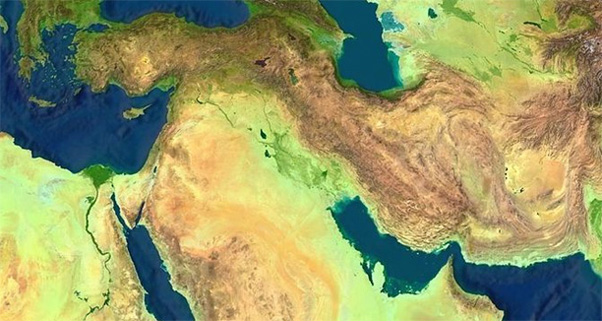
Satellite view of the Middle East.
Satellite view of the Middle East. [Source: Wikipedia]

As the ‘cradle of civilisation’ located at the juncture of three continents, the Middle East is home to a wide range of cultures, religions, and ethnicities that make the region so interesting, yet so complex. This survey course will introduce students to the modern Middle East, beginning with the important changes of the Nineteenth Century and continuing through the period of European dominance into the age of independence and the contemporary Middle East. Throughout the course, we will examine various themes, especially the important and recurring force of religion. Some of the topics that we will cover include the Arab-Israeli conflict, the Iranian Revolution, the Persian Gulf Wars, and radicalism, while placing them within the broader framework of the modern Middle East. We will conclude by addressing recent developments in the region and its outlook for the future. [Introductory/survey-level course]

Course expectation and student evaluation

Regular attendance of this course’s lectures and thorough reading of the assigned texts are critical to success in this class. The readings consist of a selection from the textbook, supplemented by articles and chapters from other books that illuminate various aspects of the topic. Students are expected to have read the assigned readings in advance of each lecture and to be prepared to talk about them in the discussion sections. Students will be evaluated on the basis of four factors: (1) two five-page essays (25% each), (3) final exam (35%), and (4) participation (15%). Sporadic ‘pop’ quizzes delivered at the beginning of class will offer students a chance to earn extra credit. At the end of this course, it is hoped that students will have not only a better understanding of the modern Middle East, but have developed better research skills, practiced critical thinking and reading, and gained experience collecting and presenting information clearly.

Required texts

Cleveland, William L and Martin Bunton. A History of the modern Middle East. 6th ed. Boulder: Westview Press, 2016.

Hourani, Albert Habib, Philip Shukry Khoury, and Mary Christina Wilson, eds. The Modern Middle East: A Reader. 2nd ed. London/New York City: I B Tauris, 2004.

Course outline

I. Historical context

  1. The Geography of the Middle East

  2. Required reading:
    • Examine the class primer (always review relevant materials and bring the primer to each class).
    • Arthur Goldschmidt, Jr and Aomar Boum, A Concise history of the Middle East, 11th ed. (Boulder: Westview Press, 2015), 1–11.
    Recommended reading:
    • Bernard Lewis, The Multiple identities of the Middle East (New York: Schocken Books, 2001), 9–24.
  3. Introduction to the Middle East: Religion, ethnicity, and history

  4. Required reading:
    • Cleveland, History, 1–52.
  5. The Ottoman and Qajar Empires in the Nineteenth Century

  6. Required reading:
    • Cleveland, History, 76–110, 124–138.
    • Ann K S Lambton, ‘Social change in Persia in the Nineteenth Century’, in Hourani, Khoury, and Wilson, eds., Modern Middle East, 145–168.
    Recommended reading:
    • * Uriel Heyd, ‘The Ottoman ʿulemā and Westernization in the time of Selīm III and Maḥmūd II’, in Hourani, Khoury, and Wilson, eds., Modern Middle East, 145–168.
  7. The Destruction of the Ottoman Empire

  8. Required reading:
    • Cleveland, History, 53–55, 139–163.
    • Readings from Walter Z Laqueur and Barry M Rubin, eds., The Israel-Arab Reader: A Documentary history of the Middle East conflict, 7th revised ed. (New York City: Penguin Books, 2008), 11–16. [Primary source]
    Recommended reading:
    • * Roger Owen, ‘Egypt and Europe: From French expedition to British occupation’, in Hourani, Khoury, and Wilson, eds., Modern Middle East, 111–124.
    • * Feroz Ahmad, ‘War and society under the Young Turks, 1908–18’, in Hourani, Khoury, and Wilson, eds., Modern Middle East, 111–124.

II. European power and influence in the Middle East

  1. Turkey: From Muslim empire to secularist republic

  2. Required reading:
    • Cleveland, History, 161–175.
    • Şerif Arif Mardin, ‘Religion and secularism in Turkey’, in Hourani, Khoury, and Wilson, eds., Modern Middle East, 347–374.
  3. Iran: From dynasty to autocracy

  4. Required reading:
    • Cleveland, History, 176–183.
    • Mohammad H Faghfoory, ‘The Ulama-state relations in Iran: 1921–1941’, International Journal of Middle East Studies 19.4 (November 1987), 413–432 (DOI 10.1017/S002074380005649X).
  5. Egypt, Iraq, and Transjordan under British rule

  6. Required reading:
    • Cleveland, History, 184–205.
    • Hanna Batatu, ‘Of the diversity of Iraqis, the incohesiveness of their society, and their progress in the monarchic period toward a consolidated political structure’, in Hourani, Khoury, and Wilson, eds., Modern Middle East, 503–525.
    Recommended reading:
    • Reeva Spector Simon, ‘The Imposition of nationalism on a non-nation state: The Case of Iraq during the interwar period, 1921–1941’, in Rethinking nationalism in the Arab Middle East, ed. James P Jankowski and Israel Gershoni (New York City: Columbia University Press, 1997), 87–104.
  7. Syria and Lebanon under French rule

  8. Required reading:
    • Cleveland, History, 206–225.
    • Ayşe Tekdal Fildiş, ‘The Troubles in Syria: Spawned by French divide and rule’, Middle East Policy 18.4 (Winter 2011), 129–139 (DOI 10.1111/j.1475–4967.2011.00515.x). [online]
    Recommended reading:
    • Gitta Yaffe-Schatzmann, ‘Alawi separatists and unionists: The Events of 25 February 1936’, Middle Eastern Studies 31.1 (January 1995), 28–38 (DOI 10.1080/00263209508701039).
  9. Palestine from British Mandate to State of Israel

  10. Essay #1 due
    Required reading:
    • Cleveland, History, 226–256.
    • Avraham Sela, ‘The “Wailing Wall” riots (1929) as a watershed in the Palestine conflict’, The Muslim World 84.1–2 (January–April 1994), 60–94 (DOI 10.1111/j.1478-1913.1994.tb03589.x).
    • Avi Shlaim, ‘Israel and the Arab coalition in 1948’, in Hourani, Khoury, and Wilson, eds., Modern Middle East, 79–103.
    Recommended reading:
    • Taysir Nashif, ‘Palestinian Arab and Jewish leadership in the Mandate period’, Journal of Palestine Studies 6.4 (Summer 1977), 113–121.
    • Mordechai Bar-On, ‘Remembering 1948: Personal recollections, collective memory, and the search for “what really happened”’, in Making Israel, ed. Benny Morris (Ann Arbor: University of Michigan, 2007), 29–46.

III. Independence and the age of nationalism

  1. Religion, the state, and the army in Turkey and Iran

  2. Required reading:
    • Cleveland, History, 261–285.
    • Hamid Algar, ‘The Oppositional role of the ulama in Twentieth-Century Iran’, in Scholars, saints, and sufis: Muslim religious institutions in the Middle East since 1500, ed. Nikki Ragozin Keddie (Berkeley/Los Angeles/London: University of California Press, 1972), 231–255.
    • Ümit Cizre Sakallioğlu, ‘The Military and politics: A Turkish dilemma’, in Armed forces in the Middle East: Politics and strategy, ed. Barry M Rubin and Thomas A Keaney (London/Portland: Frank Cass, 2002), 189–205.
    Recommended reading:
    • Mark J Gasiorowski, ‘The 1953 coup d’etat in Iran’, International Journal of Middle East Studies 19.3 (August 1987), 261–286.
  3. Nāṣirism in Egypt and the Arab world

  4. Required reading:
    • Cleveland, History, 286–327.
    • Adeed I Dawisha, Arab nationalism in the Twentieth Century: From Triumph to despair (Princeton/Oxford: Princeton University Press, 2003), 160–185.
    Recommended reading:
    • C Ernest Dawn, ‘From Ottomanism to Arabism: The Origin of an ideology’, in Hourani, Khoury, and Wilson, eds., Modern Middle East, 375–393.
  5. The 1967 War and the decline of pan-Arabism

  6. Required reading:
    • Cleveland, History, 328–349.
    • R Stephen Humphreys, ‘The Strange career of pan-Arabism’, in Hourani, Khoury, and Wilson, eds., Modern Middle East, 577–596.
    • Fouad Ajami, ‘The End of pan-Arabism’, Foreign Affairs 57.2 (Winter 1978–1979): 355–373.
  7. Israel, the Palestinians, and the Arabs, 1967–1979

  8. Required reading:
    • Mark Tessler, A History of the Israeli-Palestinian conflict, 2nd ed. (Bloomington/Indianapolis: Indiana University Press, 2009), 422–445.
    • Cleveland, History, 378–389.
    • Readings from Walter Z Laqueur and Barry M Rubin, eds., The Israel-Arab Reader: A Documentary history of the Middle East conflict, 7th revised ed. (New York City: Penguin Books, 2008), 93–96, 117–121, 130–131. [Primary source]
    Recommended reading:
    • W Andrew Terrill, ‘The Political mythology of the Battle of Karameh’, Middle East Journal 55.1 (Winter 2001), 91–111.
    • Moshe Shemesh, ‘The IDF raid on Samuʾ: The Turning-point in Jordan’s relations with Israel and the West Bank Palestinians’, Israel Studies 7.1 (Spring 2002), 139–167.
  9. Iraq and Syria under Baʿth authoritarianism

  10. Required reading:
    • Cleveland, History, 423–446.
    • John F Devlin, ‘The Baath Party: Rise and metamorphosis’, American Historical Review 96.5 (December 1991), 1396–1407 (DOI 10.1086/ahr/96.5.1396).
    • Kanan Makiya, ‘Dark truth in Saddam’s Iraq’, Dissent 45.3 (Summer 1998), 52–60.
    Recommended reading:
    • Hanna Batatu, ‘Some observations on the social roots of Syria’s ruling, military group and the causes for its dominance’, Middle East Journal 35.3 (Summer 1981), 331–344. [online]

V. Revolution and revolt

  1. The Iranian Revolution and the resurgence of Islam

  2. Required reading:
    • Cleveland, History, 355–377.
    • Nikki Ragozin Keddie, ‘Iranian revolutions in comparative perspective’, in Hourani, Khoury, and Wilson, eds., Modern Middle East, 615–637.
    • Mangol Bayat, ‘The Iranian Revolution of 1978–79: Fundamentalist or modern?’, Middle East Journal 37.1 (Winter 1983), 30–42.
    Recommended reading:
    • David Menashri, ‘Iran’s revolutionary politics: Nationalism and Islamic identity’, in Ethnic conflict and international politics in the Middle East, ed. Leonard Binder (Gainesville: University Press of Florida, 1999), 131–154.
  3. Lebanon: From civil war to the ‘Party of God’

  4. Essay #2 due
    Required reading:
    • Cleveland, History, 389–401.
    • Yitzhak Nakash, Reaching for power: The Shiʿa in the modern Arab world (Princeton: Princeton University Press, 2006), 99–128.
  5. The Palestinians: From the Intifāḍah to the Oslo era

  6. Required reading:
    • Cleveland, History, 447–498.
    • Kenneth W Stein, ‘The Intifada and the 1936–39 uprising: A Comparison’, Journal of Palestine Studies 19.4 (Summer 1990), 64–82.
  7. Israel and the Palestinians since the Oslo era

  8. Required reading:
    • Emanuele Ottolenghi, ‘Why Palestinians and Israelis are not ready for peace’, Survival 46.1 (Spring 2004), 41–54 (DOI 10.1080/00396330412331343653).
    • Ronald R Krebs, ‘Israel’s bunker mentality: How the occupation is destroying the nation’, Foreign Affairs 90.6 (November–December 2011), 10–18.
    • Yosef Kuperwasser and Shalom Lipner, ‘The Problem is Palestinian rejectionism: Why the PA must recognize a Jewish state’, Foreign Affairs 90.6 (November–December 2011), 2–9.
    • Mohammed S Dajani Daoudi and Zeina M Barakat, ‘Israelis and Palestinians: Contested narratives’, Israel Studies 18.2 (Summer 2013), 53–69.
    • Ehud Yaʾari, ‘Armistice now: An Interim agreement for Israel and Palestine’, Foreign Affairs 89.2 (March–April 2010), 50–62.
    Recommended reading:
    • Shlomo Ben-Ami, ‘So close and yet so far: Lessons from the Israeli-Palestinian peace process’, Israel Studies 10.2 (Summer 2005), 72–90. [Primary source]
    • Hussein Sirriyeh, ‘Is there a Palestinian civil war? The Concept and the impact’, Israel Affairs 17.2 (April 2011), 247–258 (DOI 10.1080/13537121.2011.547277).

VI. Reform, religion, and radicalism in the contemporary Middle East

  1. Challenges to political ideology in Turkey and Iran

  2. Required reading:
    • Cleveland, History, 499–518.
    • Olivier Roy, ‘The Crisis of religious legitimacy in Iran’, in Hourani, Khoury, and Wilson, eds., Modern Middle East, 639–655.
    • Banu Eligür, ‘Turkey’s declining democracy’, Current Trends in Islamist Ideology 17 (August 2014), 151–175.
    Recommended reading:
    • Burak Bekdil, ‘Erdoğan’s one-man Islamist show’, Middle East Quarterly 23.2 (Spring 2016), 1–8.
    • Yousra Y Fazili, ‘Between mullahs’ robes and absolutism: Conservatism in Iran’, SAIS Review of International Affairs 30.1 (Winter–Spring 2010), 39–55 (DOI 10.1353/sais.0.0066).
  3. The Persian Gulf Wars and the reconstruction of Iraq

  4. Required reading:
    • Cleveland, History, 519–536.
    • Eric M Davis, ‘History matters: Past as prologue in building democracy in Iraq’, Orbis 49.2 (Spring 2005), 229–244.
  5. Oil and Islam in the Persian Gulf states

  6. Required reading:
    • Cleveland, History, 402–422.
    • Mamnoun Fandy, ‘Religion, social structure, and political dissent in Saudi Arabia’, in Hourani, Khoury, and Wilson, eds., Modern Middle East, 657–676.
  7. Tensions and changes in Israeli society

  8. Required reading:
    • Anita Shapira, Israel: A History (Waltham: Brandeis University Press, 2012), 469–475.
    • Uzi Rebhun and Chaim Isaac Waxman, ‘Challenges for the Twenty-First Century’, in Jews in Israel: Contemporary social and cultural patterns, ed. Uzi Rebhun and Chaim Isaac Waxman, 467–479.
    • David McDowall, ‘Dilemmas of the Jewish state’, in Hourani, Khoury, and Wilson, eds., Modern Middle East, 557–576.
    Recommended reading:
    • Ezra Koplewitz, ‘Religious politics and Israel’s ethnic democracy’, Israel Studies 6.3 (Fall 2001), 166–190.
  9. Political & radical Islam: From Muslim Brethren to ISIS

  10. Required reading:
    • Frederick M Denny, An Introduction to Islam, 4th ed. (Upper Saddle River, New Jersey: Prentice Hall, 2011), 341–347.
    • Peter Mandaville, ‘The New transnationalism: Globalising Islamic movements’, in The New Cambridge history of Islam, ed. Robert W Hefner, vol. 6, Muslims and modernity: Culture and society since 1800 (Cambridge: Cambridge University Press, 2010), 198–217.
    • Readings in Barry M Rubin and Judith Rubin, eds., Anti-American terrorism and the Middle East: A Documentary reader (New York City/Oxford: Oxford University Press, 2002), 27–28, 29–32. [Primary source]
    • Michael Scott Doran, ‘Somebody else’s civil war’, Foreign Affairs 81.1 (January–February 2002), 22–42.
    Recommended reading:
    • Beverly Milton-Edwards, ‘The Ascendance of political Islam: Hamas and consolidation in the Gaza Strip’, Third World Quarterly 29.8 (December 2008), 1585–1599 (DOI 10.1080/01436590802528739).
  11. New and future challenges in the Middle East

  12. Required reading:
    • Cleveland, History, 537–556.
    • Simon Bromley, ‘The States-system in the Middle East: Origins, development, and prospects’, in A Companion to the history of the Middle East, ed. Youssef M Choueiri (Malden/Oxford: Blackwell Publishers, 2005), 504–532 (DOI 10.1002/9780470996423.ch27).
    • TBA
    Final exam at end of term.

Upcoming talks and lectures

Please note that not all of these events are open to the general audience; please check with the organisers to confirm.

    Recent events ► click to expand

      ► full list of events
      You are visitor 01402503 — GeezerVison does not store the pages you look up.
      Best viewed with Netscape Navigator 4.7 or Internet Explorer 6 at 800×600. No cookies required.

