GV

GeezerVison

The World Wide Web, restored to 800 pixels of glory.

Home|About|Gaming cabinet|Archives|How it works|Starter sites

On this site

  • About
  • Publications
  • Events
  • Notes and studies
  • Primary sources on the Bajīlah’s ‘fourth’
  • Qādisiyyah in modern Middle Eastern discourse
  • A Brief analysis of ‘Ṣaddām’s Qādisiyyah’

This view

  • Original page
  • New address

GeezerVison is showing dglnotes.com — Transliteration tables by D Gershon Lewental, PhD (DGLnotes)

DGLnotes: Scholarship on Middle Eastern history, culture, and identity by D Gershon Lewental, PhD
  • About
    • Research interests
    • Education
    • Teaching experience
    • Editing and translating experience
    • Biography
    • Current projects
    • Teaching interests and syllabi
    • Fellowships and awards
    • Languages and special skills
    • Professional membership
    • Papers presented at scholarly meetings
    • Public lectures
    • Publications
  • Events
  • Notes and studies
    • Early Islamic civilisation Early Islamic civilisation
      • Primary sources on the Bajīlah’s ‘fourth’
      • Qādisiyyah in modern Middle Eastern discourse
    • Modern Middle East Modern Middle East
      • A Brief analysis of ‘Ṣaddām’s Qādisiyyah’
      • Early Islamic history and memory in radical Islamist discourse
      • Qādisiyyah in modern Middle Eastern discourse
      • Morgan Shuster and the roots of Iran-US relations (forthcoming)
    • Central Asia Central Asia
      • Tajiki identity caught between Iran, Islam, and Russia
    • Language and linguistics Language and linguistics
      • Rasmī or aslī?: Arabic’s impact on modern Israeli Hebrew
      • Ben-Yehūdāh’s ‘Sources to fill the lacunæ in our language’ (forthcoming)
    • Transliteration tables
  • Bahā’ī studies
    • General information General information
    • Notes and studies Notes and studies
      • Genealogy of the central figures of the Bahāʾī faith and their descendants
      • The Bahāʾī community in the Holy Land (forthcoming)
    • Primary sources and texts Primary sources and texts
      • Browne’s List of descendants of Mīrzā ʿAbbās Nūrī
    • Transliteration tables
  • Course syllabi
    • Introductory/survey courses Introductory/survey courses
      • Introduction to the modern Middle East
      • Introduction to Islam
      • History of Iran
      • History of Israel
      • History of the Ottoman Empire
      • Introduction to Islamic civilisation
      • History of the world to 1500
    • Higher-level courses Higher-level courses
      • Religion and society in the Middle East
      • Nineteenth- and Twentieth-Century Iran
      • Early Islamic history, 600–1258
      • Arab-Israeli conflict
      • Political Islam
      • The Making of the modern Middle East
      • History and development of Israeli society
      • Minorities of the Middle East
      • Shīʿī Islam
      • History of Zionism
      • Jews and Christians under Islam
      • Jews of the Ottoman Empire
      • The Middle East through film
      • Israeli society through film
      • Ottomans and Ṣafavids
      • Israeli politics
      • Mediæval Indian history
    • Seminar/graduate courses Seminar/graduate courses
      • Seminar on the Arab-Muslim conquests
      • Nationalism and identity in the Middle East
      • History and memory in the Middle East
      • Constitutional revolutions and movements
      • Identities and tensions in Israeli society
      • Millenarianism and Islam
  • Publications
    • Books
    • Edited volumes
    • Journal articles
    • Chapters in edited collections
    • Encyclopædia contributions
    • Translations
    • Other writing
    • Book reviews
    • Unpublished work
  • News
  • Contact

Transliteration tables

D Gershon Lewental, DGLnotes, 10 December 2011
Provide feedback Add to favourites

The Hebrew and Arabic alphabets along with respective transliterations into the Latin alphabet.
The Hebrew and Arabic alphabets along with respective transliterations into the Latin alphabet. [1]
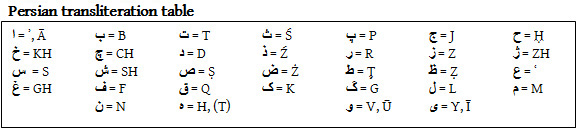
Transliteration is the process whereby the text of one alphabet is converted into that of another. Within the realm of Western scholarship on the Middle East, transliteration is essential in order to represent characters, words, and phrases from Arabic, Hebrew, Persian, and other languages. A uniform transliteration system is necessary to avoid confusion. Non-systematic transliteration results in numerous variants of one word; some examples: the Hebrew חנוכה (Ḥanukkāh, Ḥanukkah, Hanukkah, Chanukah, Chanukkah, Chanuka, Hanuka, etc.); the Arabic محمد (Muḥammad, Muhammad, Mohammed, Mahomet, etc); and the Persian نو روز (Now-Rūz, Now-Ruz, Noruz, Naw-Rúz, Nawruz, etc). Unless otherwise noted, on this website and in my scholarship, I follow a standard academic format, with some minor changes, in transliterating Arabic, Hebrew, and Persian. These systems are used by leading academic and scholarly publications and resources (with slight modifications). The tables below are designed to serve as a reference tool for readers and students. Clicking on the icon [ transliteration scheme ] throughout the text below will bring up images of various other transliteration schemes.

Table of contents

  • 1. Arabic transliteration
  • 2. Persian transliteration
  • 3. Hebrew transliteration
  • 4. Related links
  • 5. Image credits
  • Arabic transliteration

    For transliteration of Arabic (known in Arabic as ʿarabiyyah), I have chosen to conform to the basics of the system used in the International Journal of Middle East Studies (IJMES) [ IJMES transliteration scheme ], the new Encyclopædia of Islam, 3rd ed. (EI3), and the Library of Congress (LOC) [ LOC transliteration scheme ], with two major exceptions: I always mark the tāʾ marbūṭah (ة) with an ‘h’ and I assimilate the definite article (al-/-ال) into the sun letters, both stemming from an effort to make the transliterations approximate both orthography and pronunciation.

    Arabic transliteration table

    Persian transliteration

    Since Modern Persian (known in Persian as fārsī) is written using the Arabic alphabet, transliteration of Persian resembles very closely that of Arabic. Although a number of academic references tend to use an identical transliteration system for Persian and Arabic, I prefer to use a system similar to that of the Encyclopædia Iranica (EIr), with the minor difference of using consonantal digraphs. A major difference between the EIr system and the ‘Arabic-centric’ ones is that the short vowels are marked as they are pronounced in Persian (the Arabic ‘i’ and ‘u’ are the Persian ‘e’ and ‘o’). Hence, rather than write the name of the Iranian leader as ‘Khumaynī’, as an Arabic-reader would read it, I write ‘Khomeynī’; the spelling of Persian individuals bearing Arabic names follows this pattern (e.g., ʿAżod od-Dowleh, not ʿAḍud ad-Dawlah). With a few exceptions, I write Middle Persian words and names as they appear in modern Persian (e.g., Pīrūz, not Pērōz).

    Arabic transliteration table

    Hebrew transliteration

    For transliteration of Hebrew (known in Hebrew as ʿivrīt), I have adopted a method, essentially that of the Society of Biblical Literature (SBL) [ SBL transliteration scheme ] and similar to that of the Jewish Quarterly Review (JQR) [ JQR transliteration scheme ], which highlights its shared elements with other Semitic languages. One difference from the SBL is that I transliterate the final héh (ה-), which marks the vowel ā, in order to represent the orthography. Unlike with Arabic, I do not mark doubled letters caused by the assimilation of the definite article (ha-/-ה) into sun letters; since the assimilation is neither pronounced nor visually apparent in Hebrew, transliterating it as such may prove confusing (thus, ha-kohén and not hak-kohén). The same goes for a number of the fricatives that are no longer in use (e.g., /th/ [תּ/ת], /dh/ [דּ/ד]). Because transliteration of Hebrew vowels is complex and often unnecessary, I do not usually mark them with macrons or other symbols.

    Arabic transliteration table

    When both Arabic and Hebrew transliterations appear frequently within a study, I transliterate slightly differently, in order to highlight the similarities between the two languages.

    Arabic transliteration table

    Related links

  • Transliteration guide (International Journal of Middle East Studies)
  • Arabic (Library of Congress)
  • Romanization of Arabic (Wikipedia)
  • Notes for contributors: Language and transcription (Encyclopædia Iranica)
  • Transliteration scheme (International Society for Iranian Studies)
  • Persian (Library of Congress)
  • Romanization of Persian (Wikipedia)
  • Hebrew and Yiddish (Library of Congress)
  • Romanization of Hebrew (Wikipedia)
  • Transliteration of non-Roman scripts (Thomas T Pedersen)
  • Transliteration (Wikipedia)
  • Image credits

    1. The Hebrew and Arabic alphabets along with respective transliterations into the Latin alphabet. Source: D Gershon Lewental (DGLnotes).

    Upcoming talks and lectures

    Please note that not all of these events are open to the general audience; please check with the organisers to confirm.

      Recent events ► click to expand

        ► full list of events
        You are visitor 01402503 — GeezerVison does not store the pages you look up.
        Best viewed with Netscape Navigator 4.7 or Internet Explorer 6 at 800×600. No cookies required.