GV

GeezerVison

The World Wide Web, restored to 800 pixels of glory.

Home|About|Gaming cabinet|Archives|How it works|Starter sites

On this site

  • About
  • Publications
  • Events
  • Notes and studies
  • Primary sources on the Bajīlah’s ‘fourth’
  • Qādisiyyah in modern Middle Eastern discourse
  • A Brief analysis of ‘Ṣaddām’s Qādisiyyah’

This view

  • Original page
  • New address

GeezerVison is showing dglnotes.com — Notes and studies on Middle Eastern history, culture, and identity by D Gershon Lewental, PhD (DGLnotes)

DGLnotes: Scholarship on Middle Eastern history, culture, and identity by D Gershon Lewental, PhD
  • About
    • Research interests
    • Education
    • Teaching experience
    • Editing and translating experience
    • Biography
    • Current projects
    • Teaching interests and syllabi
    • Fellowships and awards
    • Languages and special skills
    • Professional membership
    • Papers presented at scholarly meetings
    • Public lectures
    • Publications
  • Events
  • Notes and studies
    • Early Islamic civilisation Early Islamic civilisation
      • Primary sources on the Bajīlah’s ‘fourth’
      • Qādisiyyah in modern Middle Eastern discourse
    • Modern Middle East Modern Middle East
      • A Brief analysis of ‘Ṣaddām’s Qādisiyyah’
      • Early Islamic history and memory in radical Islamist discourse
      • Qādisiyyah in modern Middle Eastern discourse
      • Morgan Shuster and the roots of Iran-US relations (forthcoming)
    • Central Asia Central Asia
      • Tajiki identity caught between Iran, Islam, and Russia
    • Language and linguistics Language and linguistics
      • Rasmī or aslī?: Arabic’s impact on modern Israeli Hebrew
      • Ben-Yehūdāh’s ‘Sources to fill the lacunæ in our language’ (forthcoming)
    • Transliteration tables
  • Bahā’ī studies
    • General information General information
    • Notes and studies Notes and studies
      • Genealogy of the central figures of the Bahāʾī faith and their descendants
      • The Bahāʾī community in the Holy Land (forthcoming)
    • Primary sources and texts Primary sources and texts
      • Browne’s List of descendants of Mīrzā ʿAbbās Nūrī
    • Transliteration tables
  • Course syllabi
    • Introductory/survey courses Introductory/survey courses
      • Introduction to the modern Middle East
      • Introduction to Islam
      • History of Iran
      • History of Israel
      • History of the Ottoman Empire
      • Introduction to Islamic civilisation
      • History of the world to 1500
    • Higher-level courses Higher-level courses
      • Religion and society in the Middle East
      • Nineteenth- and Twentieth-Century Iran
      • Early Islamic history, 600–1258
      • Arab-Israeli conflict
      • Political Islam
      • The Making of the modern Middle East
      • History and development of Israeli society
      • Minorities of the Middle East
      • Shīʿī Islam
      • History of Zionism
      • Jews and Christians under Islam
      • Jews of the Ottoman Empire
      • The Middle East through film
      • Israeli society through film
      • Ottomans and Ṣafavids
      • Israeli politics
      • Mediæval Indian history
    • Seminar/graduate courses Seminar/graduate courses
      • Seminar on the Arab-Muslim conquests
      • Nationalism and identity in the Middle East
      • History and memory in the Middle East
      • Constitutional revolutions and movements
      • Identities and tensions in Israeli society
      • Millenarianism and Islam
  • Publications
    • Books
    • Edited volumes
    • Journal articles
    • Chapters in edited collections
    • Encyclopædia contributions
    • Translations
    • Other writing
    • Book reviews
    • Unpublished work
  • News
  • Contact

DGLnotes: Notes and studies

D Gershon Lewental, DGLnotes
Provide feedback Add to favourites
The hoopoe instructing the other birds, in a scene from a Seventeenth-Century manuscript of Farīd od-Dīn ʿAṭṭār’s The Conference of the birds. Source: Wikipedia.
The hoopoe instructing the other birds, in a scene from a Seventeenth-Century manuscript of Farīd od-Dīn ʿAṭṭār’s The Conference of the birds. [Source: Wikipedia]

A list of the notes and studies available on DGLnotes may be found below, sorted by subject and listed in reverse chronological order. Further materials relating to the Bahāʾī faith may be found in the Bahāʾī studies section.

Site contents

  • Early Islamic civilisation
  • Modern Middle East
  • Central Asia
  • Language and linguistics
  • Bahāʾī studies section
  • Other notes
  • Early Islamic civilisation

  • Primary sources on the Bajīlah’s ‘fourth’, 27 November 2011.
    al-Baṭḥā, a contemporary settlement in the Sawād, on the banks of the Euphrates River.
    During the Arab-Muslim conquest, numerous tribesman from Arabia settled the fertile land of central Iraq. A collection of reports regarding the specific case of the tribe of Bajīlah provide an opportunity for studying the narrative development of Islamic historiographical literature. This article presents primary source literature relating to the Bajīlah’s land claims.
  • Qādisiyyah in modern Middle Eastern discourse, 21 November 2005.
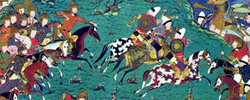
    Depiction of the Battle of al-Qādisiyyah from a manuscript of the Persian epic Shāh-nāmeh.
    The Battle of al-Qādisiyyah during the Arab-Muslim conquest of Iran in the 630s has since taken on a reputation of legendary proportions and its image today highlights the function of history and memory in the modern Middle East. From Ṣaddām Ḥusayn (Saddam Hussein) to al-Qāʿidah, Qādisiyyah is exploited for political uses, and the frequency of its nomenclature throughout the Muslim world exemplifies its continuing emotive power.
  • Modern Middle East

  • Early Islamic history and memory in radical Islamist discourse, 11 June 2013.
    Internet banner created by the Katāʾib Aḥrār ash-Shām (‘Freemen of Syria Battalions’), an Islamist group fighting in the Syrian civil war, depicting their cause as a ‘second’ Qādisiyyah.
    Radical Islamists hearken often to events, figures, and symbols from early Islamic history in their recruitment and mobilisation efforts. This short study examines the radical rhetoric regarding the Battle of al-Qādisiyyah and the imagined heroïne and rôle model al-Khansāʾ as examples of how radicals reinterpret history to further contemporary interests.
  • A Brief analysis of ‘Ṣaddām’s Qādisiyyah’, 19 July 2012.
    A Baghdād mural depicting Ṣaddām Ḥusayn surveying both the Seventh-Century and the ‘modern’ Battles of al-Qādisiyyah.
    The choice by Ṣaddām Ḥusayn (Saddam Hussein) to call his eight-year war with Iran ‘Ṣaddām’s Qādisiyyah’ was a deliberate effort to hearken back to the Seventh-Century Battle of al-Qādisiyyah during the Arab-Muslim conquest of Iran. This short study examines Ṣaddām’s manipulation of the memory of al-Qādisiyyah and how this discourse reflected an ‘Arab-Islamist’ idiom that allowed him and his régime to fuse religious and nationalist sentiment into one ideological discourse.
  • Morgan Shuster and the roots of Iran-US relations, forthcoming.
  • Central Asia

  • Tajiki identity caught between Iran, Islam, and Russia, 11 May 2014.
    Tajiki one-hundred somoni note depicting the Sāmānid ruler Esmāʿīl, emphasising the connexion between modern Tajikistan and the Ninth/Tenth-Century state.
    The Republic of Tajikistan came into being in late 1991 as a state with no historical precedent. Emerging from decades of secular Soviet political and cultural control, cut off from the Tajik heartland of Bukhōrō and Samarqand, and facing a potent challenge from a charismatic Islamist movement, the country faces a great need to construct a cohesive and durable national identity. Several options were and are available to the leaders of the country: an embrace of Iranian ethnic roots, a return to the Islamic tradition that had defined the region in in the pre-Soviet era, or a continuation of the pattern of Soviet society and civil religion. While any one may appear a logical choice, each path brings with it certain hazards. This article discusses these various identities available to the Tajik leadership and how the country has navigated a careful balance between them.
  • Language and linguistics

  • Rasmī or aslī?: Arabic and its impact on modern Israeli Hebrew, 27 January 2012.
    Artistic rendering of the Hebrew and Arabic words for ‘peace’, shālōm and salām, respectively, in a style demonstrating their graphic resemblance, against the backdrop of the Old City of Yāfō (Jaffa).
    The revival of Hebrew in recent times provides an interest case study of one language’s influence upon another. There are many similarities between Israeli Hebrew, on the one hand, and Modern Standard Arabic and Levantine Arabic, on the other. What are these similarities and what conclusions can we draw from them about the extent and manner of Arabic’s impact on Hebrew?
  • Ben-Yehūdāh’s ‘Sources to fill the lacunæ in our language’, forthcoming.
  • Other notes

  • Transliteration tables, 10 December 2011.
    The Hebrew and Arabic alphabets along with respective transliterations into the Latin alphabet.
    Transliteration is the process whereby the text of one alphabet is converted into that of another. Within the realm of Western scholarship on the Middle East, transliteration is essential in order to represent characters, words, and phrases from Arabic, Hebrew, Persian, and other languages. Here are several transliteration tables for these languages as used on DGLnotes and in leading academic and scholarly publicatios and resources, along with links to other transliteration schemes.
  • Upcoming talks and lectures

    Please note that not all of these events are open to the general audience; please check with the organisers to confirm.

      Recent events ► click to expand

        ► full list of events
        You are visitor 01402503 — GeezerVison does not store the pages you look up.
        Best viewed with Netscape Navigator 4.7 or Internet Explorer 6 at 800×600. No cookies required.