Python ord() Function
The ord() function in Python is used when we need to get the Unicode
value from the specified character. For example:
ch = 'A'
print(ord(ch))
ch = 'B'
print(ord(ch))
ch = '4'
print(ord(ch))
ch = '5'
print(ord(ch))
ch = 'c'
print(ord(ch))
The output will be:
Python ord() Function Syntax
The syntax of ord() function in Python, is:
Python ord() Function Example
Here is an example of ord() function in Python. This program receives a character from user at run-time
of the program, and prints the Unicode value of given character:
print("Enter the Character: ", end="")
ch = input()
print("\nUnicode =", ord(ch))
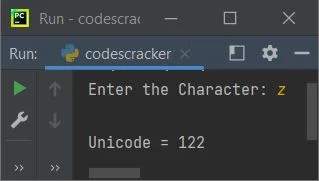
The snapshot given below shows the sample run of above program, with user input z as character to find
and print its Unicode value:
But the problem is, when user enters an invalid input, like codescracker, then the function raises
TypeError exception, because ord() accepts a single character as its parameter. Therefore the
program needs to be modified in this way:
print("Enter the Character: ", end="")
ch = input()

try:
    uc = ord(ch)
    print("\nUnicode =", ord(ch))
except TypeError:
    print("\nInvalid Input!")
You'll get the same output as of previous program's output. Also the program prints Invalid Input! instead
of that exception error, when user enters an input that is not a single character.
Python Online Test
« Previous Function
Next Function »