GeezerVisonThe World Wide Web, restored to 800 pixels of glory. |
| Home|About|Gaming cabinet|Archives|How it works|Starter sites |
GeezerVison is showing codescracker.com — Python str() Function
Python str() FunctionThe str() function in Python is used when we need to convert a value to a string object. For example: a = 1234 x = str(a) print(type(x)) a = 2.43 x = str(a) print(type(x)) a = [12, 32, 43] x = str(a) print(type(x)) The output is: <class 'str'> <class 'str'> <class 'str'> Python str() Function SyntaxThe syntax of str() function in Python, is: str(object, encoding, errors)
where object refers to an object that is going to convert into a str object. The encoding parameter is used to apply the particular encoding method, while converting the object into string. And the errors parameter is used to specify what to do, in case, if decoding fails. Note: The encoding and errors parameters are optional. Note: The default value of encoding is UTF-8. And the default value of errors is strict. Important - If encoding parameter is used to specify the encoding method, then the object must be a bytes object. The errors parameter's value can be any of the following:
Python str() Function ExampleHere is an example of str() function in Python: a = 12 x = str(a) print(x) a = b'Python Programming' x = str(a, 'ascii') print(x) a = b'Python Programming' x = str(a, 'U7', 'replace') print(x) a = [12, 23, 43] x = str(a) print(x) print(x[0]) print(x[1]) print(x[2]) print(x[3]) print(x[-1]) The snapshot given below shows the sample output produced by above program, demonstrating the str() function in Python: 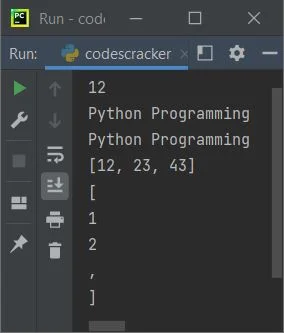
« Previous Function Next Function » Practice Quizzes
Test your programming and computer science knowledge with interactive MCQs and topic-based quizzes. Popular Topics
Explore the most popular programming and computer science tutorials on CodesCracker. |
| You are visitor 01402503 — GeezerVison does not store the pages you look up. Best viewed with Netscape Navigator 4.7 or Internet Explorer 6 at 800×600. No cookies required. |